The interpretive grounds and soteriological purpose of the Trinity are based solely upon the authority and meaning of Scripture revealed by God as transmitted by the biblical authors. From the Old Testament to the New, God revealed Himself as three persons in one essence. And the biblical authors wrote about that under the inspiration and guidance of the Holy Spirit. From creation, through the covenants, redemptive history, and eschatological trajectories, each person of the Trinity was at work as recorded throughout Scripture.
Doctrinal Assertions
There are four ways, among many, to understand the doctrine of the Trinity.
There is One God, Elohim, Plural (Deut 6:4)
There is One God, Eternal, Immutable, Transcendent (Heb 7:3)
There is One God, Exclusive, Distinct (Isa 45:5)
There is One God, Modeless (John 17:5, John 1:1, John 14:26)
Doctrinal Approaches
The Trinity is revealed by divine presence, activity, and instruction; not derived through human attainment of knowledge, reason, or inference.
A. Subjects of Scripture
Structured summarization of Trinitarian functions and assessment of affected topics (i.e., deconstructed doctrines without the Trinity):
God the Father Doctrine of God
Pneumatology Doctrine of the Holy Spirit
Christology Doctrine of Christ
Angelology Doctrine of Creation (bene-elohim)
Anthropology Doctrine of Man
Hamartiology Doctrine of Sin
Soteriology Doctrine of Human Salvation
Eschatology Doctrine of Last Things
Bibliology Doctrine of God’s Word
Ecclesiology Doctrine of the Church
B. Storyline of Scripture
Genesis to Revelation, the Scriptural presence of the Trinity and its productivity (i.e., coherent involvement of the Trinity through biblical events) were prominent for the overall creative and soteriological purpose among both old and new covenants. Specific events communicated through the various literary genres involved all three persons of the Trinity.
Tracing events through scripture narratives across generations to corroborate the existence and work of the Trinity is an interpretive necessity through the formation of comprehensive biblical theology.
C. Statements of Scripture
Explicit attestations concerning the Trinty – Individual truths, promises, and themes are consistent throughout the Bible. The doctrinal implications of the relational nature between the members of the Trinity affect covenants, marriages, parenting, contracts, mediation, communication, and relationships.
The Glory of Triune God
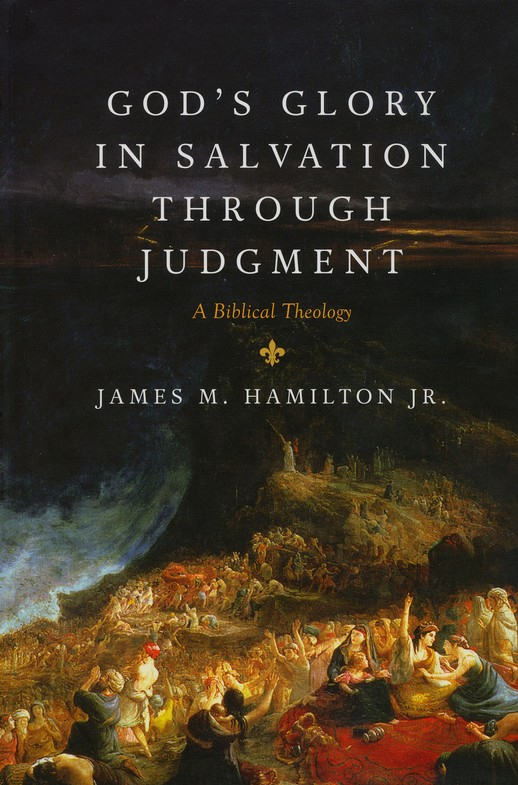
While the soteriological purposes of God are highly evident throughout both the Old and New Testaments, what we recognized about His glory is, I am convinced, a part of a larger meta-narrative. There is much more at work than what we realize. James Hamilton Jr writes an excellent biblical theology around the salvation of people as a central theme throughout Scripture. Hamilton’s work is an exhaustive book-by-book horizontal examination of how triune God attains glory in salvation through the judgment of disobedient people.
He writes from the various events that coalesce into biblical theology, but I happen to think there is a vertical narrative as made evident by revelatory detail. Especially from a first-century New Testament perspective. A solely human-centered theology presents a limited one-dimensional horizontal perspective, but the soteriological value of comprehensive biblical theology speaks to who God is and what He has done for humanity as recorded in the pages of Scripture. I have nothing but heartfelt gratitude for Hamilton’s work. I study a range of his materials.
I’m highly sympathetic to Karl Barth (renowned most influential theologian of the 20th-century). He didn’t like the phrase, “systematic theology” because it suggested to readers a root of human reason to discern spiritual truth to shape harmful ecclesiological outcomes (like socialist liberal tolerance and acceptance of the Jewish holocaust). He got a lot of pushback from that among socialists and liberals within his time (thus his “Church Dogmatics”). It’s also why we see “Reformed Dogmatics” (Bavinck) and other similar titles from Reformed theologians who object to liberalism or socialist thought stemming from Aristotle and Kant (i.e., modernity and the ensuing enlightenment).
Assumptions about the supremacy of human thought and reason outside what specific truths, principles, and imperatives are revealed in Scripture can form categories of doctrine that misguide church polity and social structures contrary to the explicit interests of God as recorded in His Word, the Bible. Modernity and post-modern thought contribute to a low view of Scripture. – For example, a complementary perspective concerns God’s glory in the realm beyond ours (a vertical dimensionality). While Hamilton comprehensively and deeply writes about the redemptive human history (a horizontal dimensionality), Michael Heiser writes of nations reclaimed (salvation) through a process of judgment for God’s glory. Where those judged are not human, but spiritual as Yahweh reclaims humanity for His interests. See video: Heiser’s Biblical Theology (Biblical & ANE Cosmology).
There are distinctions between Eastern and Western doctrines of the Trinity that reveal a separation of thought about its internal relations. The Eastern (Greek) and Western (Latin) formations of Trinitarian theology amount to historically propagative thought from Augustine, Aquinas, and Rahner, among others. Yet the most grounded and meaningful interpretive understanding of the triune God originates from Scripture. Throughout the Old and New Testaments, God was revealed as persons who performed specific work within Creation to interact with humanity as recorded across many centuries. Recognition of God down through time is made clear through distinctions between God the Father, God the Son, and God the Holy Spirit. The way God is in Himself is trinitarian.
From the gospel of John, it is clear that the Son is begotten of God the Father as incarnate (Jn 5:26) God coequal yet in temporal subordination to accomplish a function of outworking love between them toward humanity (Jn 5:19, 8:28, 1 Jn 4:9). Jesus begotten of the Father is also indicative of a derivative subordination function of the Holy Spirit. Just as Jesus was sent for a specific purpose, the Holy Spirit was sent to accomplish another function. However, they together remain present as God through what objectives are achieved throughout history. It is by Eastern Greek thought that the Trinity is a metaphysical procession where the Son and Holy Spirit proceed as persons to cause existence. Whereas the causation of everything is of a hypostasis referring to each concrete and distinct trinitarian persons who share a single diving nature or essence. Hypostasis is a theological concept in contrast to the doctrine of the hypostatic union of Christ to describe the bringing together of Jesus’ divine and human nature.
In the tradition of Latin or Western theology, the approach to understanding the Trinity concerns a principle of personhood to describe the members of God as a single substance. Paul, the apostle, referred to God as God, Lord Jesus Christ, and Holy Spirit to indicate his frame of reference as a worshiper. Within Paul’s thought, the essence of the Trinity is Scripturally evident as individual names as positional or relational to him. In comparison to “Father,” “Son,” and “Holy Spirit,” Paul consistently wrote of the Trinity from the standpoint of a created being in reverence to God as three persons holding office separately as One (i.e., the Father as God, the Son as Lord, and Holy Spirit as Holy Spirit). John and Jesus referred to the persons as Father, Son, and Holy Spirit to exemplify the Eastern approach to suggest a less formal way of identification as compared to the title or function designation through Paul.
While there is explicit scriptural support for persons of the Trinity sent and begotten, there is an interpretative view of the doctrine about how procession occurred. From eternity past, in a temporal sense, a mutual decision was made about Creation involving the redemption of chosen people through belief. There “was” an original decision together made about what was to occur through the entire sinful course of history. Salvation would be made possible through One becoming incarnate and Who would accomplish specific work through mutual submission and eternal symmetry as three persons. Without distinction concerning origination, the three as One God is ever explicitly made as such in Scripture or by revelatory detail. Other than statements and declarations of interpersonal unity and identity, expressed description of triune presence is never revealed as understandable within humanity’s three-dimensional domain. Sent and begotten God acted to produce Creation in the sense that subordinate functional objectives were met without any notion of inferiority in status or nature of aseity, presence, and limitless co-eternal power to accomplish salvation for glory and love.
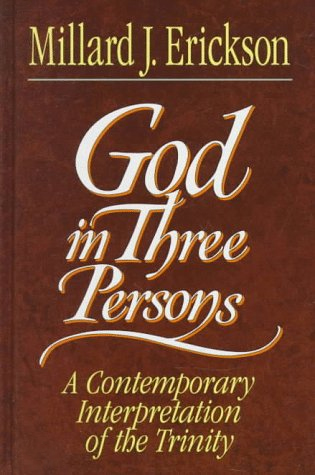
This afternoon I finished reading the entirety of God in Three Persons: A Contemporary Interpretation of the Trinity (342-pages). The whole effort was time well spent because it concerns the doctrine of the Trinity upon which various other doctrines rest. The book was a comprehensive look at the doctrine and the Trinity itself from the author (Millard Erickson, 1995) yet from the perspectives of various 18th, 19th, and 20th-century theologies as well. Moreover, the scope of the book covered the councils of Nicea (325 A.D.) and Constantinople (381 A.D.) to assert the relevance and consequences of the doctrine, including the safety and survival of Rome.1
While the book thoroughly covers the history of the doctrine’s development and its interpretive approaches, it highlights with careful attention the importance of what it is and what it does. The well-known and highly influential German theologian Wolfhart Pannenberg (1923-2014) asserted without hesitation that the doctrine of the Trinity is the most important among all doctrines by comparison. With numerous historical citations involving early church patristics, Erickson traverses the formulaic development of the doctrines from the first through fourth centuries. The apostolic fathers, Irenaeus, Hippolytus, Tertullian, Origen, and Athanasius formed instruction and traditions around the doctrine to counter opposing thoughts and assertions about the triadic form of God. Furthermore, over decades, modalism, tri-theism, Arianism, and other disputes concerned the developing church where the formation of the doctrine of the Trinity had to become a priority to settle.
From the earliest understanding of authoritative and inspired Scripture, the biblical meaning of the doctrine appeared on a scale. A valid and necessary interpretation of the Trinity was at rest on a sort of conceptual fulcrum on a scale. Move too much one way in understanding and interpretation slides to a form of modalism (liberation theology & feminism), move in the opposite direction on the scale, and interpretation moves to tri-theism, or Arianism. While tri-theism tends to be an errant way of thinking about the Trinity today, Arianism purported that Jesus could not have been truly God. The teaching of Arius (335/336 A.D.) was deemed heretical at the council of Nicea in 325 A.D.
Erickson enumerates the numerous passages that biblically reference the doctrine of the Trinity from the Old to New Testaments. Historical and cultural narratives concerning the nature and triadic unity of God across Old Testament covenants involved God’s interaction with individuals, groups, tribes, and nations. To further extend the presence of God as triune in the New Testament, numerous gospel and Pauline references point to the truth of God’s Being as Father, Son, and Holy Spirit as separate yet One. The various triadic passages and references within Pauline writings and the baptismal formula set the doctrine’s foundation to assure interpreted revelation for humanity to recognize God as He is.
To further narrow the meaning of the triadic union of God, the gospel of John makes extensive reference to the relationship between all members of the Trinity. In contrast to the Old Testament, the members of the Trinity are identified explicitly to indicate their function, momentary subordination, incarnation, and the relationship between each other and humanity. Taken together, the compiled meaning of God’s identity as revealed in Scripture is nothing short of astonishing and profound. The testimony of Old and New Testament witnesses to God, His activity, and work through the patriarchs, prophets, and apostles made a punctuated and alarming impression about reality beyond day-to-day recognition that is certain to last until the Parousia.
As Greek and Latin recognition of the revelatory witness began, numerous approaches to the understanding of the Trinity ensued. Philosophical assertions about the metaphysical nature of Trinitarian theology took shape from early Greek thought to more scholastic and postmodern perspectives. Erickson does an exceptional job outlining the substance of various contributors to philosophical and theological engagement. From Aquinas and Kant to Schleiermacher, Barth, Rahner, and more contemporary contributors of Henry, Davis, and Lacugna, different competing perspectives are presented, emphasizing a process of elimination given biblically grounded rationale. Tradition, utilitarian, or social preferences carried no interpretive weight with the author.
To make a case for the understanding and correct interpretation of the doctrine of the Trinity, the author covers various objections to the Trinity in painstaking detail. Moreover, the author effectively argues for the necessity of instruction on the doctrine as a matter of pressing discipleship or catechesis. A proper understanding and interpretation of the doctrine are foundational and practical as it concerns prayer life, worship, apologetical contention, interpersonal relationships, and church governance. The doctrine of the Trinity is such a crucial area of instruction that it affects the future health and development of the Church and Christianity in general.
[1] Erickson cites on page 13: Adolf Harnack, History of Dogma (New York: Dover, 1961), 4:60–67.
Throughout section three of God in Three Persons – A Contemporary Interpretation of the Trinity, Erickson offers comprehensive and compelling scriptural evidence for the Trinity as a way to understand the identity and interwoven roles of each member. Each in a single essence as God, they together and separately work from distant history to first century and contemporary activity through God incarnate as Christ and the work of the Holy Spirit within the new covenant context. Recorded historical accounts of various events and narratives involving God in different forms of persons and pluralities bring a fuller understanding of the nature of God’s unity. Still today, through the work of the Holy Spirit, God’s involvement in a new covenant context from the first century to the present and future fulfillment of promises, there is a reconciliation evident as a continuum of combined effort.
Through a plurality of presence, as God manifests in Spirit and observed corporeal reality from the Old Testament, there is a continuing thread of literary witness accounts of what occurred as a matter of course. The fulfillment of prophecies and historical events factually confirmed assembled in Scripture to involve God at work in the lives of people point to covenant promises kept. During that progression of time, it revealed the essence and nature of God’s unity and plurality to carry meaning formative to what He does to redeem people and build His kingdom. The presence of the Trinity in the Old Testament is communicated as divine truth to offer concrete interpretive recognition of both states of plurality and unity. Story after story involves nature or Being to produce the highest confidence in the doctrine of the Trinity.
It is also trustworthy as accurate the correspondence of Christ’s witness to what and who God is. The New Testament and especially the gospel of John is replete with writings that attest to the same manner of recognition about how to view God as Creator, Spirit, and Incarnate Word. Historical, biblical, and extracanonical writings offer a significant depth and range of rationale concerning triadic references important to developing Christianity down through the centuries. Whether from the synoptic gospels, Pauline texts, or other books and letters of Scripture, numerous triadic passages of interest involved many people firsthand. Corroboration from affected societies, cultures, individuals, synagogues, and churches that were immersed in the time of Jesus, James, Peter, Paul, John, and later others produced a way of recognizing who God was and how He was made evident by what was accomplished.
It was not by happenstance that the gospels were written with a commonality of meaning meant for consistent interpretation of the triadic nature of God’s existence. There is a certain sense of security and relief in recognizing Trinity’s meaning as “persons.” The Father bestows everything upon the Son and Holy Spirit except for being the Father. Likewise, the Son and Holy Spirit everything to each without yielding identity is a form of interrelated communication and mutual communion. The interrelated nature of God as a society of persons is together shared love and not an exclusive one-to-one arrangement; as Erickson wrote love, to be love must have both a subject and an object. The triadic expression of unconditional love and interrelated selflessness further explains the nature of God as love. As presented in Scripture (1 John 4:16), God is love, yet distinct individual beings not separate or isolated from one another.
To the extent that separation is impossible within the Trinity, the Son took on flesh to become incarnate God, fulfill the triadic work on Earth, and return to His position ascendant in a resurrected and glorified body to become the firstborn of the dead. A new Adam to fulfill the Genesis 3:15 covenant where the love of triune God becomes shared with humanity.
In my reading this week, an author at length wrote about God’s metaphysical and logical nature of existence. Specifically, it concerns the intelligibility and coherence of the doctrine of the Trinity when considering the doctrine of God. Relying upon Immanuel Kant and Friedrich Schleiermacher to frame philosophical and theological thought within the framework of human reason, 18th and 19th-century conclusions were prescribed around philosophy and theology from a human-centered rationale. Doctrines of religion were not spiritual but pragmatic and narrow from perspectives constrained by the limited domains in which they exist. To philosophical and humanistic reasons that deny spiritual and metaphysical realities as merely speculative in thought are generally dismissed from secular worldviews arising from Kant. Schleiermacher, a prominent liberal theologian, developed his doctrinal positions from Kant to surmise that religion is subject to feeling and experience as validated by human interaction or engagement.
Kantian epistemology brought further liberal reason that doctrines were subject to religious consciousness. The truth of spiritual realities was contingent upon receptive and permissive human acceptance or interaction. While supported by theological and biblical truth, God as a “Trinitary” Being is necessary in all possible worlds. Creation (humanity) is entirely contingent on the physical, abstract, and metaphysical realities they are set within. These are not theological judgments to which Trinitarian and Christological doctrines are formulated. They are from revelatory truth made from God’s presence within creation. The testimonial witness of the patriarchs, prophets, Christ, and apostles carry far more significant credibility and bearing of truth without our realm of existence than the philosophical and scientific speculations and descriptions concerning our limited 3-dimensional space of reality. Consciousness as emergent within physically contingent beings is a constructed object. The noetic equipment serves as an interface of the mind and spirit to recognize God and truth as expressed.
As a sort of checkmate against liberal notions of God’s existence speculatively within people’s minds (as expressed by the doctrine of the Trinity). Or by a process theology that claims God exists unchanging and infinite as only governed by the laws of the universe (Erickson, 122), there are biblical truths and philosophical reasons to conclude otherwise. For example, see Peter van Inwagen’s views about contingency theory that points to the necessity of God (video (Links to an external site.)) to dismiss dependency upon contingent beings (liberal view of theological pragmatism). Or by the existence of God as Being outside Creation in its entirety (real, physical, abstract, metaphysical, spiritual) as stated by a primitive sense of where in this video (Links to an external site.) (4D space). Or watch the full video (Links to an external site.) here to understand how space constrains perception outside our realm of existence.
Logic as a construct is abstract and not a physical thing to experience. Meaning, God created EVERYTHING perceptive, imagined, or observed by His created beings, sentient or otherwise. I’m not entirely convinced that God is neither logical nor illogical but alogical. To help further, I still have this book, Infinity, Causation, & Paradox (Links to an external site.), on my bookshelf to delve through. The author covers topics such as Satan’s apple and Beam’s paradox (probability and decision theory), divine motivation, knowledge, and action. That is to infer God is to be outside of Creation for Him to create everything (including time, space, and the laws that govern the universe). By comparison, Millard Erickson’s book God in Three Persons: A Contemporary Interpretation of the Trinity often communicates from a process theology framework (at least section two). Moreover, at times, the book presupposes that eternal God exclusively operates within temporality and the presence of time. Eschatologically speaking, for example, where His people will take on resurrected bodies that are no longer subject to the second law of thermodynamics (i.e., entropy or decay and death) present throughout the universe. The states of all three persons of the Trinity within a single essence as Elohim exist as a personal identity, without modal functionality, in Spirit to create and encounter. God as Trinity is transcendent, immutable, and immanent.
So basically, in my view, Kant and Schleiermacher were well-intentioned but often in error. But more than that, counterproductive as speculations presented to others built erroneous systems of thought off the mark from the truth of the Creator as Trinitary Being in perichoresis by “His” aseity. Even our perception of Him as given to us by the pronoun “His” is anthropomorphic (i.e., human-centered) as a divine act of will, grace, and mercy as He is the source of all such attributes, including love.
Getting beyond the what and how (science, philosophy) to the why (philosophy, theology), I often think its futile were it not for God’s Word and His Spirit within us. With all our searching for God as a people who grope in the dark (Isa. 59:10), here is such a poignant point to remember as the doctrine of the Trinity is modeled to us.
“Jesus replied, ‘If anyone loves me, he will obey my teaching. My Father will love him, and we will come to him and make our home with him. He who does not love me will not obey my teaching. These words you hear are not my own; they belong to the Father who sent me.’ ” Not only does obedience to Jesus’ words bring a relationship to both the Father and the Son; the words are not even simply the Son’s words, but belong to the Father. The relationship between the Father and the Son is such that to be related to one is to be related to the other, but they are not simply different names for the same person. They are two closely related persons, whose actions are very much intertwined (Erickson, 201).”
Jesus’ spoken words for you in Scripture are from Creator God who gave His son to take our sins. It just doesn’t seem enough to understand the sacrifice on its face for what it did, but also the gravity of temporary intentional loss of perfect love between all members of the Trinity. When I think about that exchange, it kills me. Makes me think that nothing else matters whatsoever.
As many have observed throughout centuries past, the doctrine of the Trinity isn’t explicitly identified as a term or concept to present to us how we are to identify or interpret God. In his book, God in Three Persons – A Contemporary Interpretation of the Trinity, Millard Erickson presents to readers the biblical basis for the existence of the Trinity.1 In defense of the doctrine of the Trinity, Erickson lists several vulnerabilities concerning some views of Richardson’s work on the subject.2 The work involves process theology which is a philosophical theology concerning the world having two natures. To describe process theology as the “primordial” transcendence of God and the “consequent,’ or imminent nature by which God is part of the cosmic process.3 While Erickson lists many valuable points of refutation or objections against a process theology interpretation of the Trinity, and he also makes sound biblical arguments about the existence of the Trinity implicit from the patriarchs, prophets, Christ, and the apostles. Within this monograph, and from his work Making Sense of the Trinity, 3 Crucial Questions, exact details and references are made about the case for the Trinity as a formative doctrine by which humanity is to recognize God.4 The doctrine of the Trinity assembled from Scripture as the revealed Word of God presents to people across all time the nature of Trinitarian existence.
God the Father, God the Son, and God the Holy Spirit are the same essence who have separate identities and are knowable as God. God, by name YHWH, is a single Being comprised of three together in perfect relationship and essence as one. Readers of Scripture see the interaction between members of the Trinity as God is revealed to people within Creation. He interacts with generations of individuals and nations through various covenants, interventions, and creative efforts to redeem humanity from corruption by the errant free will of persons. Erickson meticulously addressed the biblical problems caused by Richardson’s interpretation of the Trinity. There were eight separate enumerated issues around Richardson’s arguments covered by Erickson. From a range of erroneous thoughts around the authority of Scripture to human-centered logical arguments that arrive at modalism, there were numerous counterpoints of biblical evidence and interpretation. Erickson gives explicit reason for how Richardson works from false premise to conclude flawed outcomes of reason.
The doctrine of the Trinity matters pragmatically as it is a model of the relationship between God and His created beings. Invited into fellowship between Creator and created beings, the redemptive process itself is a part of the creative work to derive creatures with a free will made eligible and acceptable to God. The love of others, marriage covenants, and vows to involve the perfect form of relationship has implications about how people are to live out loyalty and obligations centered upon love and commitment. The doctrine of the Trinity provides a theological grounding for human interaction as imagers of God who will at some point be in fellowship with Him as He intended and promised from His revealed Word.
Contested thoughts around the pragmatic interests of people without concern for the Creator is an exercise in futility. The self-serving philosophical rationale that ingratiates itself with interest to improve the human condition doesn’t go far enough because everyone dies. Worse, everyone dies from a position of corruption and suffering by obvious and continued rebellion against natural order in defiance of its Creator (sin), if not just from creation itself. People unredeemed without purpose from God who live and die with philosophical and metaphysical convictions are still empty, albeit temporarily satisfied by answers to practical problems. That is to say, soothe yourself with pseudo-intellectual reasons to ignore God and His revelatory essence to abide in self with contradictory interests.
Objections to Trinitarian Christianity and its uniqueness have concentrated around feminism and liberation theology, where they together form an alternative to “extremities of patriarchal trinitarianism” (Erickson, 147). A range of feminist cases that argue for feminist theology stems from objections around the male gender identity of the trinitarian doctrines explicitly communicated in Scripture. Concepts of domination, power, and authority as masculine traits to express God as a trinitarian form of Being contradict the interests and preferences of females who conceive God as almighty Creator. Their efforts are then to appeal to a tradition of female social prominence and recast it into feminine consciousness. As gender-Trinity is set aside to reshape worship and objects of worship, idolatrous forms of veneration emerge.
Historical female interests in poetry, myth, legend, ritual, and nature worship were elements of common interest in magic to practice goddess worship (Erickson, 144). By what is sometimes known as witchcraft extending back 35,000 years, objections to patriarchal trinitarianism of the last 5,000 years arrived later on the scene to oppose female power according to developing feminine thought. Universal Trinitarian Christianity, with its heritage and bedrock patriarchal foundation, formed its doctrinal system to arrive at well-formed beliefs altogether Scripturally and objectively anchored. In contrast, feminine interest in goddess religion throughout the centuries (pagan, Greco-Roman, and contemporary) was more subjective without concrete tethering to Truth. In the mind of the historical feminist, male patriarchy was and is ascendant to function as a repressive force to which liberation becomes necessary in common cause with liberation theologians who believe a different gospel contrary to the revealed Word of God in Scripture. To deny Scripture as patriarchal (or toxically masculine) and dismiss its authority is to abandon or forsake complementarian order. It is an intentional effort to exchange female will to power for feminist claims toward the worship of feminine deity in the name of liberation. The erasure of a masculine trinitarian concept contrary to the historical work of God interpreted through Scripture is a less than obvious aspiration of historical female theologians.
The formation and acceptance of generic religion as an objection to the uniqueness of Christianity is yet another effort to bring the Creator and creation into subjection to social interests. It is the removal and dilution of the Trinity as unique to Christianity as it must give way to a homogenous interreligious discussion because exclusive claims are viewed as unacceptable. As it is with feminists who view the masculine trinitarian view of Christianity as objectionable, there are those within Islam, Hinduism, and other religions unable to accept the Trinitarian doctrine and theological traditions. Consequently, to those who object and instead press toward a generic religion or a homogenous spirituality, it is Christianity that must conform to social expectations more palatable to belief in an effort to satisfy its interests. The assimilation of new values to transform human understanding of the Christian faith is a necessary sociological pursuit in the mind of those who object to the doctrine of the Trinity as it is participative of creation having exclusive obligations to YHWH, the only God.
__________________________
Citations
1 Millard J. Erickson, God in Three Persons: A Contemporary Interpretation of the Trinity (Grand Rapids, MI: Baker Books, 1995), 100. 2 Cyril C. Richardson, The Doctrine of the Trinity (Nashville: Abingdon, 1958). 3 Stanley Grenz, David Guretzki, and Cherith Fee Nordling, Pocket Dictionary of Theological Terms (Downers Grove, IL: InterVarsity Press, 1999), 95–96. 4 Millard J. Erickson, Making Sense of the Trinity, 3 Crucial Questions (Grand Rapids, MI: Baker Academic, 2000), 15–16.
Two years ago, when I joined the Evangelical Theological Society (ETS), I was required to affirm the inerrancy of Scripture. While I’m not a literalist or fundamentalist, I still willingly and whole-heartedly embrace the doctrine of inerrancy as essential to faith and practice (as upheld by CSBI). Not expedient for strained acceptance, but essential. I publicly confess that the truth of God’s word is inspired, inerrant, infallible, sufficient, reliable, authoritative, and clear from the intent of the biblical authors. I utterly delight in God’s word. As necessary for truth and reason, epistemic and existential knowledge of God through divine encounter is shaped by being conformed to Christ.
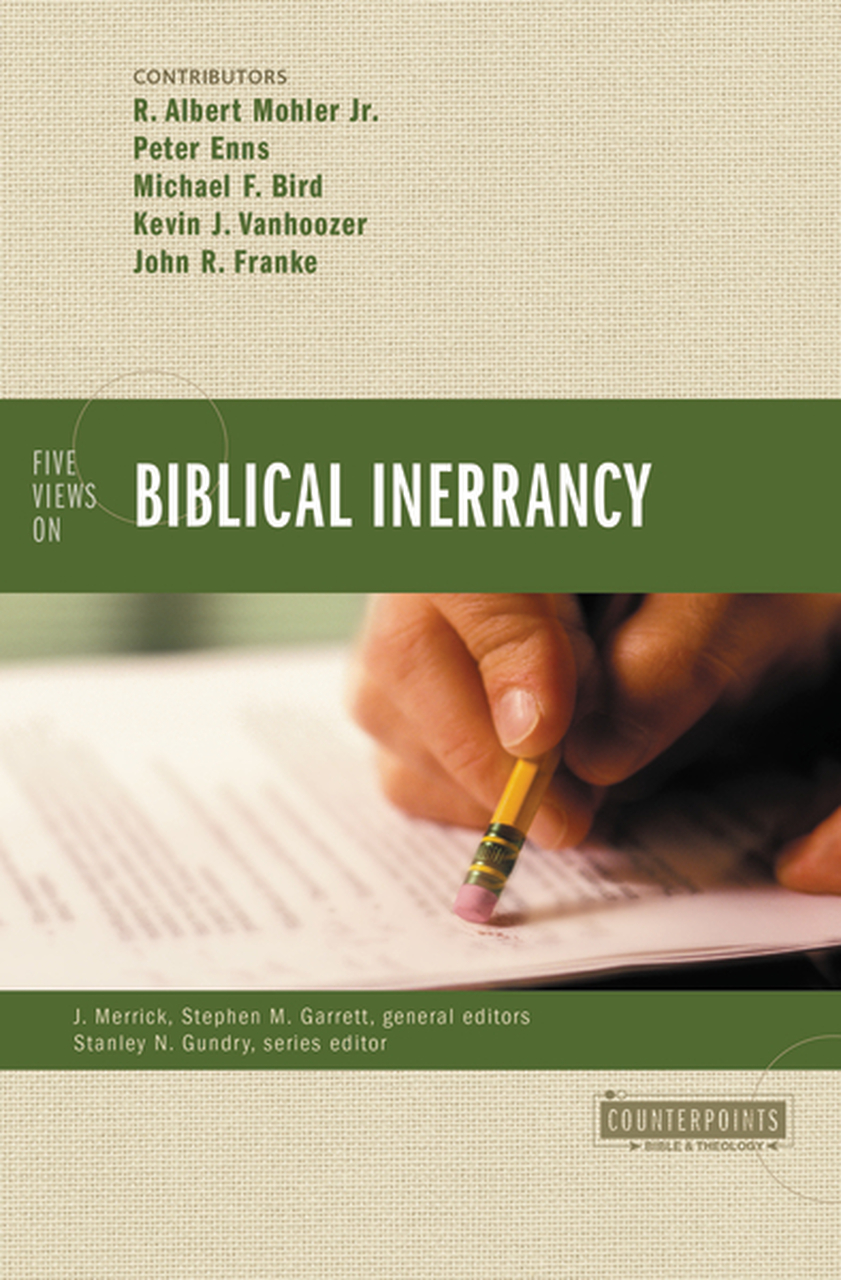
Yesterday I finished carefully and completely reading through Five Views of Biblical Inerrancy (about 325-pages). Sometimes I take notes and highlight areas of the book to fully ingest the meaning of the subject matter, which I did this time. Aside from my written work reviewing the material, I have numerous notes for continuing interest. To get the various perspectives from prominent members of three evangelical and two secular academic institutions, I’ve taken a macro and micro look at the different topics and perspectives it contains. The five participants came from scholars who wrote their essays as respected and influential people from Cambridge (Vanhoozer), Harvard (Enns), Oxford (Franke), Queensland University (Bird), and Southern Baptist Theological Seminary (Mohler). Each participant has a Ph.D., and all of them vary widely about the doctrine of inerrancy. While all five participants are self-identified evangelical, their distinctions are between conservative and liberal worldviews.
Franke and Enns would call evangelicalism to a postconservative society-centered way of faith and practice concerning interpretive and sapiential meaning. Conversely, Vanhoozer and Mohler have a God-centered view of faith and practice with a more objectively truth-based historical-grammatical approach to sapiential interpretation. While Bird appears somewhere in between the two pairs. Vanhoozer and Mohler embrace an authorial intent hermeneutic, while Bird does as well to a limited extent contingent upon validated merits of biblical meaning. While it isn’t apparent if Enns and Franke apply a reader-response form of interpretation, they both seem to advocate an altogether different categorization of interpretation for social utility. Enns and Franke are not hostile to truth. They are deconstructive of Truth in exchange for small t – truth.
The reading readily shows who subscribes to truth in relativistic terms and who wants to define it or redefine it to suit social interests for a plurality of cultural and missional outcomes. To the liberal worldview, Enns and Franke appear to subordinate evangelicalism as an instrument of society to satisfy and affirm a divergence of human interests. The others are more sensitive to the value and necessity of theological doctrines that arise from revelatory truth. Including the doctrine of inerrancy, but even further retroactive to other doctrines of the faith to reshape Christian thought, commitments, and trajectories. By inference, Enns (Harvard) and Franke (Oxford) have hyper-radical ideologies concerning Christianity and therefore do not fully accept the core tenets of the faith. Their departure from evangelicalism appears inevitable. Otherwise, what they profess is in contradiction to their beliefs and worldview.
All participants had much to say about the doctrine of inerrancy and the Chicago Statement of Biblical Inerrancy (CSBI). Those who were not U.S. citizens rejected the CSBI for various reasons, while it seems apparent there’s a not-invented-here (NIH) perspective at work. Some residents outside the U.S. can have a sense of resentment that the CSBI originated from American evangelicalism. If the statement were to become otherwise revised from a global (worldly) perspective, it would become shaped toward infalliblistic interpretation at best, while the doctrine of inerrancy would become surrendered entirely. While “progressive” or postliberal “Christians” decry colonialism or imperialistic export of Western or American foundations of theological doctrines, there is an oppositional posture toward Christ’s commission concerning the gospel and discipleship. Paul the Apostle, an Israelite Hebrew, originated cross-national mission work that spanned languages, cultures, time zones, historical religious commitments, and indigenous (Gentile) people groups to spread the gospel, plant churches, and develop the spiritual well-being of believers in Christ. He took absolute Truth to a harvest field of people for the Kingdom without liberal or “progressive” impediments. Instead, he faced cultural and philosophical opposition, much like we see among academics and scholars today. Particularly against the doctrine of inerrancy.
The following are chapter notes from the book, “Five Views on Biblical Inerrancy.” The book is a compilation of essays from R. Albert Mohler Jr., Peter Enns, Michael F. Bird, Kevin J. Vanhoozer, and John R. Franke. The general editors are J. Merrick and Stephen M. Garrett. The textbook is in the Counterpoints of Bible & Theology Series. It was published in 2013 by Zondervan.
Chapter One: When the Bible Speaks, God Speaks: The Classic Doctrine of Biblical Inerrancy
The editors of the book “Five Views on Biblical Inerrancy” have put together a conversation in written form between academics who discuss the doctrine of inerrancy. The discussion is structured in a counterpoint format where four contributors frame the narrative by an opening statement to challenge thought and debate. Participants of the discussion include four prominent individuals within an academic context who bring together multiple perspectives about what inerrancy is. And if it is a valid way to understand and accept Scripture, its merits or flaws. Participants include Albert Mohler Jr (President of Southern Baptist Theological Seminary), Michael F. Bird (Anglican Priest, Theologian, and NT Scholar), Peter Enns (Author, Biblical Studies Professor), John R. Franke (Theologian, Professor of Religious Studies), and Kevin Vanhoozer (Theologian, Systematic Theology Professor).
As anyone would understand the term inerrancy, a common definition is generally accepted as follows: “The idea that Scripture is completely free from error. It is generally agreed by all theologians who use the term that inerrancy at least refers to the trustworthy and authoritative nature of Scripture as God’s Word, which informs humankind of the need for and the way to salvation. Some theologians, however, affirm that the Bible is also completely accurate in whatever it teaches about other subjects, such as science and history.”1 In comparison, the Second Vatican Council defines it as: “Therefore, since everything asserted by the inspired authors or sacred writers must be held to be asserted by the Holy Spirit, it follows that the books of Scripture must be acknowledged as teaching solidly, faithfully and without error that truth which God wanted put into sacred writings2 for the sake of salvation.” 3 To further recognize Protestant or Evangelical attestation of inerrancy, the Chicago Statement on Biblical Inerrancy (CSBI) is widely understood as informative to clarify what is meant and accepted as Scripture inerrant of facts and truth.
Mohler offered the prescriptive “When the Bible Speaks, God Speaks: The Classic Doctrine of Biblical Inerrancy” to open the first of a five-part series of declarations. He makes a case for inerrancy as Scripture is a testimony to itself while serving the faith and needs of the Church. To anchor the testimony of God’s Word as trustworthy, Mohler makes a further compelling and persuasive point that Scripture corresponds to God’s personal nature as his own self-revelation (44).
According to Mohler, our comprehension and understanding of God’s Word to support formulaic doctrines are not freestanding. A theology stems from God’s Word as it produces a realism to “affirm the irreducible ontological reality of the God of the Bible.” As “God wrote a book” (45), Mohler affirms that human authors were guided into truth and protected from all error by the Holy Spirit. The absence of error, as a result, explains the propositional value of inerrancy. As such, the terms infallible and inerrant reject the claims the Word of God is theologically incorrect or without truthfulness in its intent to bring salvific, theological, and historiological messaging to its readers.
Therefore, it is affirmed by the CSBI that the Word of God constitutes plenary inspiration for faith and practice. It is helpful as it is authoritative for belief and instruction.
Chapter Two: Inerrancy, However Defined, Does Not Describe What the Bible Does
As ideological fencing was placed by Pharisees who set up regulations around the Mosaic law, they did so to provide insulative barriers at some distance to prevent people from breaking the Old Testament covenant after their return from Babylonian exile. By comparison, it intuitively seems like evangelicals set up theological fencing around the doctrine of inerrancy to prevent people from corrupting the closed Biblical canon and the interpretive meaning of Scripture for valid soteriological purposes. As Enns referred to John Frame’s view about inerrancy as a theologically propositional idea, he wrote that he would rather do away with the term but could not do so because of certain corruptions to follow from theologians (scholars).4
Before Enns began to deconstruct each of the three test cases of Biblical inerrancy initiated by Mohler in chapter one, he spent considerable effort on the disharmony of evangelicals over inerrancy (i.e., socially liberal objections to Scriptural authority) and the Chicago Statement on Biblical Inerrancy (CSBI). He grieves over the disconnect between academics and inerrantist evangelicals over the doctrine of inerrancy, and he makes clear that it sells the Bible short. Enns also declares that inerrancy sells God short as it is merely a theory of inferior purpose. In his view, it’s a doctrine that needs to be scrapped as it preempts discussion about scholarly conclusions about Scripture’s accuracy, facts, and truths (or at least evangelical interpretation of it). Through Enns’ perspective, it is clear that some academic scholars are certain inerrantists are intellectually dishonest (84) and a disservice to culture as ineffectual spiritual witnesses.5
To add further detail to Enns’ objections to the CSBI, he walks through each of its four assertions point-by-point. All four assertions pertain to the authority of Scripture, its witness of Christ and the Holy Spirit, its commitments to faith, life, and mission, and discontinuity between lifestyle and faith claims of inerrantists. Stemming from each, as there is his distinction made between authority and inerrancy, this is deconstruction. As God’s testimony of himself is true, His Word is undoubtedly accurate without error by extension. Conversely, Enns supposes that as inerrantists view the inseparable linkage between authority and inerrancy, that is a perspective should require a defense. The type of authority recognized by inerrantists is questioned in a further effort to dilute the purpose and intent of the CSBI as merely an affirmation document. The CSBI carries no creedal weight, but it is simply a point of reference or a marker to ascertain what someone concludes or supposes about the nature of Scripture, its truth claims, self-witness, and testimony. Enns and like-minded evangelicals prefer to eliminate the doctrine to render it subject to open-ended critical interaction.
While Enns wants to see “a valid definition of the word truth” (87), he wants Scripture held up to critical review without immunity to our interpretive cultural assumptions. It appears he wants the plain truth and meaning of Scripture and its message rendered impotent to guide and protect believers. Consider the interchange between Jesus and the religious leaders of John 8:12-58 as it concerns how He defines Truth of Himself and that of the Father. By His verbal expression of meaning, it is absolute and without error.
Finally, in so many words, Enns says he genuinely wants to introduce a way to make Scripture compatible with scholars’ research concerning ANE facts, archeological discoveries, and literary analysis of ancient civilizations. So Enns wrote what he thought about an “incarnation model” as an alternative in opposition to the doctrine of inerrancy. An “incarnation model” was set up as a counterpoint to an “inerrancy model” to frame the discussion with a new category of false or foreign meaning. As if generations of the doctrine of inerrancy had no bearing, it was set up as an objective comparison or alternative to inerrancy overall to include the CSBI statement. Contributors Bird, Franke, and Vanhoozer’s views about what Enns wrote weren’t comprehensive or well developed, but they revealed a tension between the doctrine of inerrancy and the incarnation model as if there was something to explore further according to Enns’ perspective.
To consider what the incarnation model implies, Bird’s restatement of John Webster’s view is an eye-opening refutation: “this incarnational model is, as John Webster calls it, ‘Christologically disastrous.’ It’s disastrous because it threatens the uniqueness of the Christ event, since it assumes that hypostatic union is a general characteristic of divine self-disclosure in, through, or by a creaturely agent. Furthermore, it results in a divinizing of the Bible by claiming that divine ontological equality exists between God’s being and his communicative action.”6 Moreover, Irenaeus of Lyons (130-230 A.D.), a disciple of Polycarp, separated incarnation between the Word and Christ within his work Against Heresies. He wrote of the incarnation of Jesus but not of the Word itself to exclude incarnational participation. To quote Irenaeus, “For they will have it, that the Word and Christ never came into this world; that the Saviour, too, never became incarnate, nor suffered, but that He descended like a dove upon the dispensational Jesus; and that, as soon as He had declared the unknown Father, He did again ascend into the Pleroma.” 7
Chapter Three: Inerrancy Is Not Necessary for Evangelicalism Outside the USA
The book’s third part, Five Views on Biblical Inerrancy, entitled “Inerrancy is Not Necessary for Evangelicalism Outside the USA,” concerns Michael F. Bird’s views on American understanding of inerrancy concerning the CSBI. Without much interaction with inerrancy in general as a contribution to the work of the book about Biblical Inerrancy, there is an absence of the distinction. The work of chapter 3 in the text is primarily a discourse on affirmations, objections, and concerns about the CSBI. As Bird narrows his thoughts around the particulars of the CSBI, he goes well beyond the purpose and intent of the Chicago Statement’s purpose of upholding the doctrine of inerrancy. Bird takes exception to various points of CSBI inerrancy verbiage around the Biblical creation account in Genesis. He would presumably agree that the truth and principles of inerrancy refer to the trustworthiness and authoritative nature of God’s word as authoritative.
From Bird’s various perspectives, he would not entirely affirm what the Bible infers about other subjects such as science and history. In fact, Bird’s views about inerrancy are better stated as a better categorization of veracity. From the inner witness of the Church by the Holy Spirit, Scripture’s “divine truthfulness” (158) is a way to set aside the claims or proclamations of negative statements in defense of “inerrancy.” Whether on its own merits or as an apologetic expression of the CSBI by American evangelicalism concerning the doctrine inerrancy or inspiration of Scripture.
What the Bible says about itself pertains to its use and inspiration (2 Tim 3:16). Among the various genres of Scripture, the Old and New Testaments are attestations of divine truth whether in narrative, poetic, prophetic, apocalyptic, epistolary form. Scripture best interprets Scripture and reservations about exceptions concerning inerrancy as it does so, whether supported by the CSBI or not, isn’t productive on the grounds of harmonization, literary discrepancies, nation of origination, or supposed contradictions without historiographical refutation. Particularly when so much antipathy exists around the meaning and purpose of God’s Word as it is intended by define revelation for God’s glory and for salvific outcomes. The doctrine of inerrancy doesn’t claim for itself authority over matters concerning self-contradictory postmodern assertions (i.e., opposition to absolute truth and authority). The CSBI and the doctrine of inerrancy are assembled to support a high view of Scripture toward confidence for its intended purpose.
Some objections to inerrancy appear to stem from the term itself. As the Word of God is without error and reliable as God is Truth, Bird calls attention to its comparative infallibility and inspiration. Bird doesn’t indicate that the Word of God is with error or without truth, nor does he suggest that it is uninspired. His reservations are around what interpreters understand about the idea of inerrancy and how that pertains to conclusions involving life and practice. Particularly across cultures of different nationalities that do not hold to the doctrine of inerrancy, especially as it is defined and understood in the West or America more narrowly.
The difference between inerrancy and infallibility is essential and necessary to recognize and understand. To put it clearly, inerrancy, at a minimum, refers to the trustworthy and authoritative nature of God’s word for salvific purposes. By comparison, infallibility refers to Scripture’s inability to fail in its ultimate purpose of revealing God and the way to salvation. It is counterproductive to conflate the two terms or to use them interchangeably. The doctrines of infallibility and inerrancy are not for a social utility or to shape social justice initiatives for society or the State. While Catholicism shares the same definition of inerrancy as Protestantism, it differs in defining infallibility. Infallibility within Catholicism includes the church (i.e., the magisterium and its dogma) under the pope’s authority.
Bird’s assessment and criticism about tirades against God’s Word is exactly the correct posture against those who stand in opposition to its truth, authority, reliability, and inspiration of Scripture. However, it isn’t so much secular culture or atheists who so much pose a harmful threat to the doctrines of inerrancy and infallibility as does Christian academics or scholars, well-meaning or not. It is for internal reasons of mishandling God’s Word that it is served by assertive statements of inerrancy to prevent its surrender to a multitude of professing Christians who have a large range of worldviews (including liberalism, or socialism) and would rather see God’s Word rendered insufficient and irrelevant to a postmodern society. Professing Christians, especially progressive Christians, are just as readily inclined to make God’s Word into its own image as secular society.
Unrelated Note: In support of feminist egalitarianism, Bird makes an inflammatory assertion that complementarians enable abuse: Article
Chapter Four: Augustinian Inerrancy: Literary Meaning, Literal Truth, and Literate Interpretation in the Economy of Biblical Discourse
As affirmed by Vanhoozer, the doctrine of inerrancy has an important presupposition. That most important presupposition is: God speaks. Or, more specifically, God the Creator communicates through human language and literature as a means of communicative action to people. Vanhoozer also points out that the works of the Trinity are undivided (opera trinitatis ad extra indivisa sunt) as triune discourse indicative of communicative action involving subjects, objects, and purpose. He makes the case that language is functional and cognitive in nature to support the intent of divine revelation. Therefore, it is recognized that Scripture is a corpus of written communicative work consisting of historical assertions, commands, and explanations. According to Carl Henry (20th-century theologian), Scripture is propositional, but it is also trustworthy as true as it is a correspondence of Christ’s witness to what and who God is.
Inerrancy is a claim that the Bible is true and trustworthy through critical testing and cross-examination. Just as Augustine speaks of the incarnation as humans give tangibility of thoughts as words, Christ is the exact imprint of God’s being (Heb 1:3). Jesus is the image of the invisible God (Col 1:15) and what Christ speaks is Truth because He originates as God from the Father who is Truth and communicates truth. Whether verbally while with us in Creation or in Scripture by the testimonies of eye-witness accounts of his verbal speech acts. Within the old or new covenants, by God’s presence or His Spirit among people, He cannot lie in Scripture as His personal veracity is made clear through the inspiration of the Canon.
As made evident through divine revelation, truth is a correspondence of covenantal and redemptive meaning. The modes of its conveyance have a bearing on the methods of truth messaging by which it is delivered and understood. Allegory, metaphors, poetic expressions, and narrative discourses together establish the means of language utilized to accomplish its desired intent. Therefore, as Vanhoozer proved, it isn’t helpful when critics of inerrancy confuse matters by suggesting that inerrantists believe every word of the Bible as literal truth. Vanhoozer distinguishes between “sentence meaning” and “speaker, or writer meaning” when readers seek to understand what the author is doing or saying within Scriptural messaging. Analogies defy critical assertions about literalist interpretations of meaning.
Literalism, irrespective of context, can produce contradictions in meaning. Or it can confuse the intent of messaging through various linguistic methods, especially as prophecies and parables were verbally uttered and recorded in Scripture to convey imagery or parallel thoughts and ideas to achieve Spiritual understanding among listeners or readers. The communication method and its content are intentional, just as the assembly, formation, and preservation of God’s Word are true, sure, and lasting for those of faith to believe.
Inerrancy doesn’t claim to affirm or validate scientific or philosophical observations and constructs precisely. Observations of physical behaviors and explanations of metaphysical reality originating from beings in natural order don’t have reach to ascertain spiritual truth and meaning as propositioned and asserted from God’s Word. Supposed contradictions in Scripture that serve as proof-text “gotchas” do not subvert the inerrant truth and meaning of intended spiritual messaging, and theological truth held out as spiritually factual from different authorial perspectives. Even with elaborate and effective explanations to reconcile apparent differences, there isn’t much acceptance to recover veracity among many who object to the doctrine of inerrancy.
Whether believers or unbelievers interpret Scripture according to cognitive reason and comprehension for rational thought and conclusion, gathered facts can become assembled incorrectly to arrive at false notions of belief or disbelief. To quote Vanhoozer, “God’s words are wholly reliable; their human interpretation, not so much” (224). To further explain, biblical inerrancy requires biblical literacy. It is a yoke of burden that people of postmodern culture view Scriptural literality by its terms and expectations of meaning. People within modern society expect a reality of the time of the Old and New Covenants to conform to how things are expected today. The claims of inerrancy do not imply there is only one way to map the reality of the world correctly, either then or now. Proper hermeneutical stands separate from inerrancy as necessary to understand and accept Truth from Scripture.
Chapter Five: Recasting Inerrancy: The Bible As Witness to Missional Plurality
John R. Franke’s contribution to the evangelical conversation around inerrancy is driven by his aspirations around what he calls a plurality of truth toward God’s missional objectives. By missional theology in keeping with the mission of God, Franke means humanitarian relief and advancement as chief of concerns. When Franke speaks of missional imperatives that involve the gospel and discipleship, it is always within a social and cultural context to improve the human condition. To Franke, the meaning of Scripture as inerrant is not so much about its salvific relevance as humanity is lost in sin and stands condemned without redemption. The authority of Scripture as a witness to the mission of God comes from the truth claims of Christ and the veracity of His words as He is the incarnate expression of God.
Franke’s sympathy toward postmodern theology explains his objections to static biblicism. The Spirit continues to speak through Scripture as he puts it but doesn’t offer thoughts about the meaning and purpose of Holy Spirit inspired Scripture for the actual gospel purpose of salvation and restoration of people to God. Franke’s contribution rests very much on the here and now for people in terms of missional objectives, not the already but not yet. The concern isn’t so much that people are perishing and headed toward hell, as it is their earthly well-being. The concern should rather be primary-secondary prioritization from a missional perspective. The truth of the Old and New Covenant’s meaning entirely revolves around how humanity would return to God. The confidence believers have about what Christ does to reconcile people to God comes from truth spoken and written without error and infallibly. With authority, believers can meet people’s spiritual and physical needs by missional endeavor rooted in sound theology and a commitment to the truth claims of Christ and God’s Word at work.
As Franke writes, “I believe that inerrancy challenges this notion and serves to deconstruct the idea of a single normative system of theology” (277), he is revealing his thoughts about what postmodern progressives do to reject conformity to the text of Scripture “for the sake of systematic unity.” The assertion illegitimate interpretive assumptions make clear postmodern thought, as there is no acceptance of universal truth. According to Franke, truth must be plural to accomplish contextual missional objectives relative to individual interpretation from Scripture. As conventionally defined by Protestants and Catholics, the doctrine of inerrancy is recast by Franke as an open and flexible tradition for pluralistic perspectives, practices, and experiences. It is unacceptable to Franke that the whole Bible is interpretive as an inerrant description of the gospel and Christ’s commands to love God and neighbor. Essentially, it is his call to redefine inerrancy such that the Bible is what we make of it and not what the authors intended.
Franke’s final thoughts about the cultural relevance of the gospel bring further alarm as he calls on his readers to surrender universal and timeless theology. He attempts to message a desire to redefine inerrancy to accomplish a culturally relativistic notion of God’s Word. That is, to rewrite Scripture to shape truth suitable for cultural conditions toward various human interests aside from salvific reconciliation. Where truth as concrete or abstract meaning carries less utility to accomplish objectives and instructions explicitly set forth by the Creator. Objectives and instructions delivered through human language expressed in truth as God is truth that must be accepted and theologically contextualized without compromise. It is crucial to ensure there is no loss or corruption of meaning. It is necessary to further God’s kingdom and bring people together in redemption toward their salvation and physical well-being without surrendering absolute truth and our acceptance of Scriptural authority.
Citations
__________________________ 1 Stanley Grenz, David Guretzki, and Cherith Fee Nordling, Pocket Dictionary of Theological Terms (Downers Grove, IL: InterVarsity Press, 1999), 66. 2 cf. St. Augustine, “Gen. ad Litt.” 2, 9, 20: PL 34, 270–271; Epistle 82, 3: PL 33, 277: CSEL 34, 2, p. 354. St. Thomas, “On Truth,” Q. 12, A. 2, C.Council of Trent, session IV, Scriptural Canons: Denzinger 783 (1501). Leo XIII, encyclical “Providentissimus Deus:” EB 121, 124, 126–127. Pius XII, encyclical “Divino Afflante Spiritu:” EB 539. 3 Catholic Church, “Dogmatic Constitution on Divine Revelation: Dei Verbum,” in Vatican II Documents (Vatican City: Libreria Editrice Vaticana, 2011). 4 John M. Frame, Systematic Theology: An Introduction to Christian Belief (Phillipsburg, NJ: P&R Publishing, 2013), 598. 5 Cited by Enns: “For a focused critique of the CSBI (and its later sister document the Chicago Statement on Biblical Hermeneutics 1982), see Iain Provan, ” ‘How Can I Understand, Unless Someone Explains It to Me?’ (Acts 8:30–31): Evangelicals and Biblical Hermeneutics,” BBR 17.1 (2007): 1–36. See also Carlos Bovell, Rehabilitating Inerrancy in a Culture of Fear (Eugene, Ore.: Wipf & Stock, 2012), 44–65; Kevin J. Vanhoozer, “Lost in Interpretation? Truth, Scripture, and Hermeneutics,” JETS 48, no. 1 (March 2005): 89–114. For an appeal for a more prominent role the Chicago statements should play in evangelicalism today, see Jason Sexton, “How Far beyond Chicago? Assessing Recent Attempts to Reframe the Inerrancy Debate,” Themelios 34 (2009): 26–49.” 6 Peter Enns, “Inerrancy, However Defined, Does Not Describe What the Bible Does,” in Five Views on Biblical Inerrancy, ed. J. Merrick, Stephen M. Garrett, and Stanley N. Gundry, Zondervan Counterpoints Series (Grand Rapids, MI: Zondervan, 2013), 125. 7 Irenaeus of Lyons, “Irenæus against Heresies,” in The Apostolic Fathers with Justin Martyr and Irenaeus, ed. Alexander Roberts, James Donaldson, and A. Cleveland Coxe, vol. 1, The Ante-Nicene Fathers (Buffalo, NY: Christian Literature Company, 1885), 427.
The caregiver of my sponsored child wrote to me a letter about her interests and a little about what she is like. Destine Hanamaria’s caregiver is her mother. Outline / Letter dated 31 October 20171. Caregiver’s name2. No brothers and sisters3. She can walk, jump,…
Shadow & Shade Sometimes the best place to be is in an open field under the shade of swaying branches. While in a slight breeze and in the warmth of the sun. With just the whispering wind to vanish and reappear again. If you listen…