Archive | Theology RSS feed for this section

Dry & Weary Land

Jericho is among the world’s oldest cities, and the first city conquered as referenced in the Old Testament. [1] As written in the book of Joshua (Joshua 6:1-27), the city was destroyed by fire with the slaughter of all its inhabitants. Jericho is referred to as the city of palm trees [2], and its place name means “moon.” [3] In Genesis 13:10, the plains of Jericho within the south Jordan River valley are characterized as a well-watered garden. [4]

Old Testament Jericho

The site of OT Jericho is largely today subdued by erosion. Through exposure to wind and rain over the years, its location is pitted and marred by abrasion and environmental wear. While the surface area of OT Jericho is worn at its exterior due to stresses, substantial historical records were buried for discovery to reveal details about the city’s construction and layout. Specifically, records pertaining to burn sites, pottery, dwellings, and wall construction.

Two key areas of interest with OT Jericho pertain to its destruction and the account of Joshua’s scouts involving Rahab, a Canaanite prostitute resident of Jericho. With extensive archaeological research, to verify these biblical accounts’ historical validity, Jericho’s historical background is buried beneath modern-day Tel es-Sultan. Whereas the specifics about timing and method of destruction are well documented and made public by John Garstang (1930-1936), Bryant G. Wood (1990), and others.

The biblical account of Jericho’s felled wall is clearly articulated in Joshua 6:20. To validate the biblical record, historical and archaeological evidence was collected and analyzed to recognize the ceramic type in that biblical era along with the erosion and fire damage that ceramic evidence underwent.

Mitzpeh – The Land of Israel

Long after the city was burned in a fire by Joshua’s men, there were jug containers excavated from within the city. Those jugs contained grain with further archaeological evidence of fire damage. With Garstang’s discovery of fallen mud bricks from inside the city and the presence of scorched surfaces throughout the area, the biblical account’s historicity was verified. Decades later, Bryant Wood’s successful refutation of radiocarbon-14 dating of burned grain found within the containers at Jericho resolves questions, doubt, and controversy about the timeline of the attack in the historical record. [5] The inside-outward fallen brick wall of Jericho is not just a legend, but a historical fact proven by archaeological evidence across various research studies. [6]

It appears that the capstone message associated with OT Jericho is the curse that is proclaimed upon it by Joshua. Specifically, that the one who again builds or fortifies Jericho shall experience the loss of his offspring. As thereafter confirmed and fulfilled in scripture (1 Kings 16:34), Hiel of Bethel, in his defiance, loses all his children while building Jericho several hundred years after its destruction. The subsequent curse that fell upon him revealed the oath proclaimed by Joshua and the Israelites before the LORD (Joshua 6:26).

New Testament Jericho

A separate nearby Jericho site sometimes referred to as Herodian Jericho, underwent further development with palaces, complex buildings, swimming pools, a hippodrome, a theater, and possibly a gymnasium. The area supported numerous residential dwellings during the second temple period. [7] Well, after the events of OT Jericho, further biblical narratives are recorded with miracles performed by Jesus while He spent time traveling there during His ministry. [8]

While numerous New Testament Jericho locations remain in place, modern construction and dwellings prevent research or archaeological excavations.

Modern Jericho

From post-biblical Jericho through the Crusader era up to about the 1940s, Jericho was a village of less development and notoriety. Undeveloped through hundreds of years whereas at the turn of the 20th century it was sparsely populated with mud huts. A sort of Holy Land ghetto as described by Dr. Olin who says it was the “meanest and foulest of Palestine.” [9]

In contrast to earlier decades of mud huts, today the city is rich in produce as supported by a powerful spring in the area. Jericho is on the West Bank of the Jordan river within Israel and it is populated with Palestinian peoples and a few Jewish settlements at its outskirts. The area is 80-85% Sunni Muslim [10] occupied while the city is widely irrigated for agricultural purposes. There are significant trade and tourism in the area to support Holy Land visitors from among many nations throughout the globe.

Citations

[1] Collins Thesaurus of the Bible, A. Colin Day, Region, M Place Names Beginning J, M3a Jericho, the Place, 184
[2] Deuteronomy 34:3
[3] Holman Illustrated Bible Dictionary, Jericho
[4] The Holman Christian Standard Bible, Genesis 13:10 annotated
[5] “Digging up Jericho”, Kathleen M., Kenyon (1952-1958) London: Ernest Benn, 1957
[6] Carbon 14 Dating at Jericho, Bryant G. Wood, Ph.D., “Conquest of Canaan”, 08/07/2008
https://biblearchaeology.org/research/conquest-of-canaan/4051-carbon-14-dating-at-jericho
[7] Netzer, Ehud, “Jericho, Tulul Abu El-‘Alayiq, Excavation Until 1951.” New Encyclopedia of Archaeological Excavations in the Holy Land 2 (1993): 682–83
[8] Matthew 20:29, Mark 10:46, Luke 10:30-37, Luke 18:35, Luke 19:1
[9] Smith’s Bible Dictionary, Jericho, https://biblehub.com/topical/j/jericho.htm
[10] CIA World Factbook, West Bank, Jericho.
https://www.cia.gov/library/publications/resources/the-world-factbook/geos/we.html

Continue Reading ·

Burial of a King

Modern and historical rationale about why the Church of the Holy Sepulcher is preferred over the Garden Tomb appears to rest upon the type of tomb Jesus’s body was placed. While the first-century era in which the Jewish dead were traditionally buried differs from those during the first temple period (1200-586 BC), there are clear structural distinctions between the two.

The Garden Tomb is dated within the first temple period as referenced between the 9th and 7th centuries BC. By historical photographic record and visual observation, the interior of this tomb consists of a small collection area reserved for bone collection of the Jewish dead. Whereas it is suggested that the Garden Tomb bed platform is reused by the deceased while the bones of prior corpses in decay become co-mingled in an adjacent container location. Moreover, this tomb is atypical of first-century tombs by the absence of burial niches (kukhin/kokim) or arch-covered burial platforms (arcosolium) hewed into a tomb wall.

The tomb of the Holy Sepulcher is of a first-century burial tradition. That is, it consists of a number of burial niches and platforms within a cave environment. That after a period of one year of corpse decay, the bones of the dead became collected and placed into an ossuary or osteophagi for separation and portability of an individual’s remains.

As a comparison between the tomb descriptions of Lazarus and Joseph of Arimathea, there is a commonality in scripture from the root Greek language of the biblical text. The personal tomb reference of risen Lazarus given in John 11:38 is mnēmeion or mnēmeiou to indicate a memorial chamber sense of meaning. That is, a burial chamber constructed and marked for a person’s remembrance. The tomb of Joseph of Arimathea has given the same term in scripture (Matt 27:60, John 19:41) to indicate the type of a new tomb he constructed in a garden. Matthew 27:60 explicitly reads among various English translations that Joseph made the tomb for himself.

In reference to Luke 23:55, the same account uses the term mnēmeion as ‘tomb’ to describe how Jesus’s body was laid. Two verses prior to that in Luke 23:53, the Greek term for tomb changes to mnēma having a burial chamber sense of meaning. Different than mnēmeion which is a memorial chamber sense of meaning. Where mnēma in scripture appears closer in meaning to a sepulcher in use as a gravesite.

The Babylonian Talmud (Baba Metsia 85b; Baba Batra 58a) references this type of tomb as either ‘rock-hewn’ or a ‘natural cave’ translated to the term ‘Mearta’. Mearta translated to English is grotto. The term grotto in English is defined as a small picturesque cave, especially an artificial one in a park or garden. Furthermore, by the first-century tradition, a kukhin (kokhim), or arcosolium hewed into the wall of a Mearta suggests a more plausible account of where Jesus was interred. It is, therefore, reasoned this type of structure found in the Church of the Holy Sepulcher adds further credibility and confidence about where Jesus was buried and rose from the dead.

To summarize, comparative scriptural references and historical records both point to the tomb of Jesus as a first-century sepulcher. As through the centuries, it is recognized why the Church of the Holy Sepulcher is the preferred burial location of Jesus.

As one may conclude that Joseph of Arimathea constructed the tomb of Jesus according to first-century tradition or practices, the Garden Tomb is a wonderful and meaningful pilgrimage location for fellowship and remembrance of our LORD and King.


Continue Reading ·

Living Waters

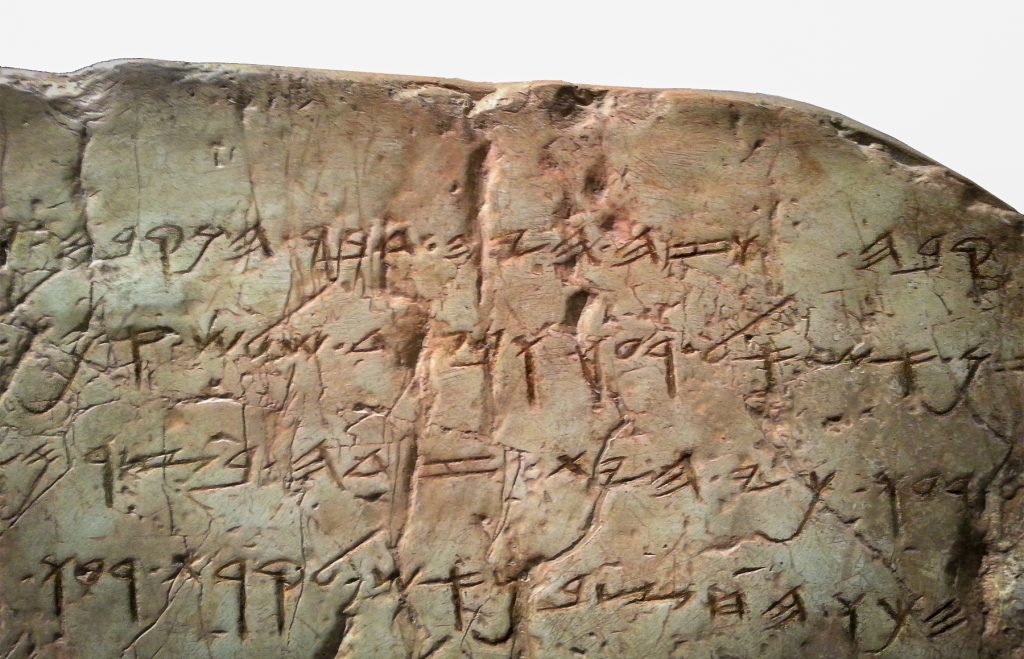
An ancient paleo Hebrew inscription was discovered in Hezekiah’s tunnel that gives a clear historical record about how the underground aqueduct was excavated. The Siloam Inscription, or Shiloah Inscription, was etched into the rock wall of the tunnel to describe the method by which the aqueduct was quarried. That in support of the biblical account of 2 Kings 20:20, workers thousands of years ago dug through each end of the tunnel to meet at about its center. In so doing, they navigated toward one another while digging until their breakthrough in the rock to each other. With pickaxes striking the rock wall and while calling out to one another, workers from each end dug in a coherent direction until they met together to completely open the water channel from Gihon Spring to the Siloam Pool.

With successive approximation, as they dug through the tunnel’s rock walls, there were some false starts that required course correction. This is made evident from a close look at the tunnel wall contour and shallow cut-away sections of the tunnel that appear abandoned. While adjusted and continued digging advanced toward each end with reduced time and effort, workers called to one another as a sort of sounding beacon to remain on course or to return on course as necessary.

The ancient inscription translated to English reads as follows to detail the method of the dig.

The Siloam Inscription

“Behold the tunnel. This is the story of its cutting. While the miners swung their picks, one towards the other, and when there remained only 3 cubits to cut, the voices calling to his fellow were heard – for there was a resonance in the rock coming from both north and south. So the day they broke through the miners struck, one against the other, pick against pick, and the water flowed from the spring towards the pool, 1200 cubits. The height of the rock above the head of the miners was 100 cubits.”  – Translation by E. Puech [1]

With a total excavation distance of 1,750 feet, there are questions that naturally surface about what additional methods Hezekiah applied to accomplish the dig. Such as how they brought light into the tunnel, how rock debris was removed and how their axes were sharpened to drive through the tunnel. However, while their objective was to reroute the spring water from outside the city walls to within the city, Hezekiah’s leadership and support for the LORD’s people was an example of his character and stature before God. He brought living water through the living rock and overcame a seemingly insurmountable obstacle during a time of duress. That with determination and persistence, he laid preparation for a siege by the Assyrians at the time of King Sennacherib. He brought living water through the living rock to help assure the well-being and continued survival of the LORD’s people.

[1] Jerome Murphy-O’Connor, The Holy Land, An Oxford Archaeological Guide 5th Edition (Oxford U.K., Oxford University Press) 128

Continue Reading ·

Front & Center

Four longitudinal zones comprise of the land of Israel. These zones run from North to South, while each has an adjacent neighboring region. All four are distinct and unique from one another laterally and in elevation. Each has its separate attributes in the composition of Israel overall. The climates among these zones range from temperate and fertile to arid, dry, and barren. The topographical contour, environmental severity, and scarcity of water beyond the Hill country are especially pronounced to highlight further differences. Furthermore, Israel consists of forests, plains, valleys, mountains, hills, deserts, canyons, and seacoasts among all zones within a relatively small area. Including a large river running the length of the deep Rift Valley.

The Coastal Plain region is rich in agriculture, and it provides merchants port access to the Mediterranean Sea. The Hill Country to the East of the Coastal zone serves as a watershed as it rises in elevation all the way to the edge of the Rift Valley. Still Eastward, the 10-mile wide Rift Valley below is a very large trench that extends up and down the full length of Israel. Finally, the rough and arid Transjordan Plateau is a desert high above the Rift Valley that runs contiguous with the Arabian Desert for hundreds of miles to the East.

Given the geographical variation within the area, together, these zones represent a synergy of topography and natural resources. Such that their whole is greater than the sum of their parts. Mainly because each together contributes to social suitability, sustenance, commerce, and defense of the country in a way that suggests that the land is intentionally and providentially crafted. Each zone does not operate or exist as a free-standing entity all its own. As it is formed, the country appears assembled and situated this way for a specific purpose (Ezekiel 5:5). The Holy Land is a region where Israel is strategically positioned on the world stage.

Continue Reading ·

Trust & Follow

“One thing thou lackest: go thy way, sell whatsoever thou hast, and give to the poor, and thou shalt have treasure in heaven: and come, take up the cross, and follow me.”

– Mark 10:21 KJV

This is what it means to be justified before God. What it takes to become perfection by God’s standard and to obtain eternal life. Spoken plainly, Jesus has said that there are these specifics in Mark 10:21 above that require attention.

Its context is about when a wealthy man approached Jesus to ask him about how to inherit eternal life. While in his view he kept the commandments and obeyed the Mosaic law on one level, he actually was not perfect. To which Jesus said, “You lack one thing”.

The “ONE thing” the moral and wealthy man heard Jesus say is outlined and parsed here:

(a.) Sell all you have
(b.) Give to the poor
(c.) Take up your cross
(d.) Come to Him
(e.) Follow Him

So we can infer, that as we abide by what God morally requires, these are the specifics about what you must have to inherit eternal life. While on the outside the wealthy man’s behaviors honored God’s moral law, that wasn’t the full condition of his heart. So the answer Jesus gave him was explicit about what is necessary to inherit eternal life. Which is above and beyond moral and righteous conduct. That in this way, Jesus directly and clearly got to the heart of the wealthy man’s question.

On its face, Jesus describes in total more than one thing as required (a, b, c, d, and e above). Where taken together, he must transfer all that he is and all that he has to all that Jesus is. Really, the “One Thing” as compared to his wealth and status. Because of His wealth, Jesus was to reign in his heart over his wealth and anything else.

Even with a high degree of personal righteousness, this is the only way to God’s kingdom. It wasn’t that this outward righteousness isn’t correct and necessary, but it just wasn’t enough because we are not perfect without Christ. It wasn’t possible to achieve perfection on his own, either internally of the heart and externally from behaviors, performance or obedience.

To further see what happens after we trust and follow Christ, there are two historical and scriptural principles to consider. Principles that reinforce Jesus’s words about our transformation as we set aside everything else and follow Him. That over time, and as it is written, we are His workmanship (Eph 2:10 KJV).

A. Trust Him – IMPUTATION | We are given Christ’s Righteousness.
Through Jesus and His life, death, and resurrection, God has accepted His sacrificial atonement for those who would trust and follow Him. Where all our sins are canceled and God doesn’t see us as sinful or imperfect anymore. Jesus himself is the perfection of those who trust and follow Him.

B. Follow Him – SHEMA | Love the LORD and love others as yourself.
The presence and power of Christ and the Holy Spirit within you will transform you. When we trust and follow Him. That love will develop within you toward perfection until fully completed in heaven (Mk 12:37-40).


Continue Reading ·

Logger’s Dilemma

When in further contemplation about what Jesus wants of those who love Him, he requires that we abstain from judging others. From a type of judgmentalism that calls attention to our own personal hypocrisy. Which can become viewed as an outward expression of anger. Just as there is good and bad anger, there is good and bad judgment. From anger, judge not. Where the root of discriminate hypocritical judgment is anger.

From a careful look at Matthew 7:1-5, we read that Jesus requires His listeners to first clear themselves of what condemnation they may bring upon their own heads if they judge others of wrong when they are guilty of a very same matter or offense.

“You hypocrite, first take the log out of your own eye, and then you will see clearly to take the speck out of your brother’s eye.” – Matt 7:5
  • Judge not, that you be not judged.
  • For with the judgment you pronounce you will be judged, and with the measure, you use it will be measured to you.
  • Why do you see the speck that is in your brother’s eye, but do not notice the log that is in your own eye?
  • Or how can you say to your brother, ‘Let me take the speck out of your eye,’ when there is the log in your own eye?
  • You hypocrite, first take the log out of your own eye, and then you will see clearly to take the speck out of your brother’s eye.

The Holy Bible: English Standard Version. (2016). (Mt 7:1–5).

So it is explicit by His own words in context. That after first removing the source of our own wrong or error, we then are eligible and able to engage others with a patient, delicate, and caring attitude toward applying judgment. A judgment that brings about healing or correction and not harm. So then it is with forbearance that advice is offered, while not out of unrighteous anger or unreasonable expectations. Jesus requires that we do not judge hypocritically. Yet he also requires that when we do judge, we do so without the same behavior found within ourselves.

The condition in which you are expected or permitted to judge is by simply keeping yourself free of the same sinful entanglements. Where you’re in a position to offer and share advice, reproof, correction, and training in righteousness (2 Tim 3:16-17).


Continue Reading ·

Debtor’s Prison

The kingdom of heaven is closely compared to the power to forgive. The LORD has made clear that as necessary to keep forgiveness, it is also necessary to in turn forgive others.

“Then Peter came and said to Him, “Lord, how often shall my brother sin against me and I forgive him? Up to seven times?” Jesus said to him, “I do not say to you, up to seven times, but up to seventy times seven.” – Mt 18:21–22

To keep and love mercy and forgiveness is directly tied to your willingness to give the same at any scale and by any frequency. To experience the kingdom of heaven is to receive mercy and forgiveness. To experience the kingdom of heaven is to give mercy and forgiveness.

The absence of a person’s willingness to forgive demonstrates missing acceptance of the Lord’s incalculable forgiveness. Where there is anger from an injustice, offense, or abuse and each continues without mercy, that person has not changed and therefore has not accepted an enormous sin debt forgiven of the Lord. A debt that an individual is personally responsible to pay.

In such circumstances, Jesus presses us to understand and accept that forgiveness and mercy are reversed from the person who was given both but has not returned the same to others. Where there was anger from a continued or repeated offense from a debt that was comparatively minuscule and unpaid.

As it is written (Matt 18:32-35), the person who does not forgive and demonstrate mercy is thrown in prison until the enormity of all debt is paid. Jesus the living God clearly articulates as impossible.

So the kingdom of heaven is closely compared to the power to forgive (Matt 18:23). Where if we claim the forgiveness and mercy of Jesus, but there is no forgiveness in our hearts for other people, God’s mercy and forgiveness are not present (Matt 6:14-15, Mark 11:25). Not that God’s mercy and forgiveness depend upon our willingness or transformation, but that both must come from within us the same if we are to receive salvation and experience heaven.


Continue Reading ·

Expositor’s Treasure


A few days ago, I finished a time again in the Pentateuch. It took over 3-months to again pour myself into the Holy Torah from Genesis to Deuteronomy. Day-by-day, word-by-word, all five sections to see and hear the words spoken within.

I love you, Father God. No matter what.


Continue Reading ·