Tags Archives: inferno

Simony

O Simon Magus, O forlorn disciples,
Ye who the things of God, which ought to be
The brides of holiness, rapaciously

For silver and for gold do prostitute,
Now it behoves for you the trumpet sound,
Because in this third Bolgia ye abide.

We had already on the following tomb
Ascended to that portion of the crag
Which o’er the middle of the moat hangs plumb.

Wisdom supreme, O how great art thou showest
In heaven, in earth, and in the evil world,
And with what justice doth thy power distribute!

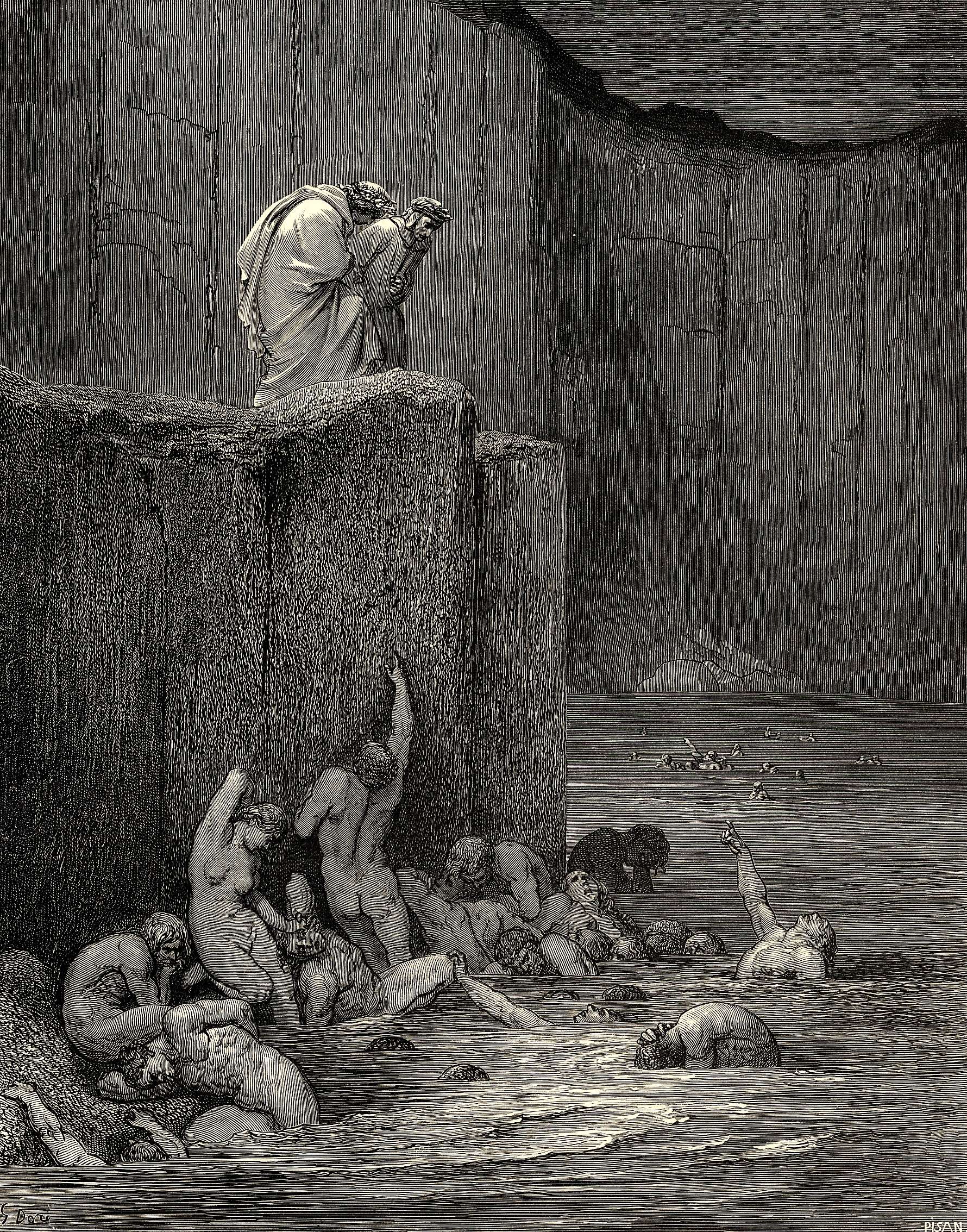
I saw upon the sides and on the bottom
The livid stone with perforations filled,
All of one size, and every one was round.

To me less ample seemed they not, nor greater
Than those that in my beautiful Saint John
Are fashioned for the place of the baptisers,

And one of which, not many years ago,
I broke for some one, who was drowning in it;
Be this a seal all men to undeceive.

Out of the mouth of each one there protruded
The feet of a transgressor, and the legs
Up to the calf, the rest within remained.

In all of them the soles were both on fire;
Wherefore the joints so violently quivered,
They would have snapped asunder withes and bands.

Even as the flame of unctuous things is wont
To move upon the outer surface only,
So likewise was it there from heel to point.

“Master, who is that one who writhes himself,
More than his other comrades quivering,”
I said, “and whom a redder flame is sucking?”

And he to me: “If thou wilt have me bear thee
Down there along that bank which lowest lies,
From him thou’lt know his errors and himself.”

And I: “What pleases thee, to me is pleasing;
Thou art my Lord, and knowest that I depart not
From thy desire, and knowest what is not spoken.”

Straightway upon the fourth dike we arrived;
We turned, and on the left-hand side descended
Down to the bottom full of holes and narrow.

And the good Master yet from off his haunch
Deposed me not, till to the hole he brought me
Of him who so lamented with his shanks.

“Whoe’er thou art, that standest upside down,
O doleful soul, implanted like a stake,”
To say began I, “if thou canst, speak out.”
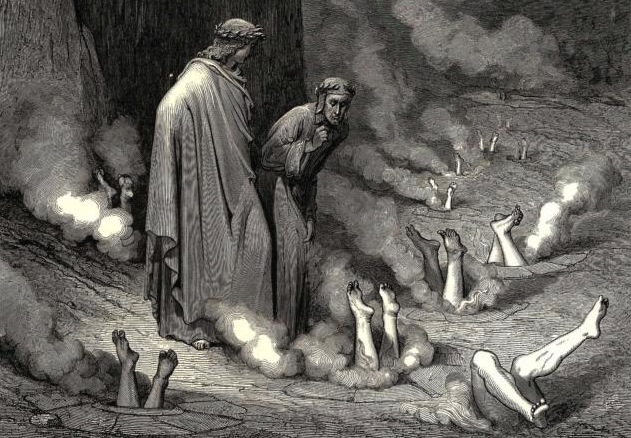
O doleful soul, implanted like a stake,” / To say began I, “if thou canst, speak out.”


I stood even as the friar who is confessing
The false assassin, who, when he is fixed,
Recalls him, so that death may be delayed.

And he cried out: “Dost thou stand there already,
Dost thou stand there already, Boniface?
By many years the record lied to me.

Art thou so early satiate with that wealth,
or which thou didst not fear to take by fraud
The beautiful Lady, and then work her woe?”

Such I became, as people are who stand,
Not comprehending what is answered them,
As if bemocked, and know not how to answer.

Then said Virgilius: “Say to him straightway,
‘I am not he, I am not he thou thinkest.'”
And I replied as was imposed on me.

Whereat the spirit writhed with both his feet,
Then, sighing, with a voice of lamentation
Said to me: “Then what wantest thou of me?

If who I am thou carest so much to know,
That thou on that account hast crossed the bank,
Know that I vested was with the great mantle;

And truly was I son of the She-bear,
So eager to advance the cubs, that wealth
Above, and here myself, I pocketed.

Beneath my head the others are dragged down
Who have preceded me in simony,
Flattened along the fissure of the rock.

Below there I shall likewise fall, whenever
That one shall come who I believed thou wast,
What time the sudden question I proposed.

But longer I my feet already toast,
And here have been in this way upside down,
Than he will planted stay with reddened feet;

For after him shall come of fouler deed
From tow’rds the west a Pastor without law,
Such as befits to cover him and me.

New Jason will he be, of whom we read
In Maccabees; and as his king was pliant,
So he who governs France shall be to this one.”

I do not know if I were here too bold,
That him I answered only in this metre:
“I pray thee tell me now how great a treasure

Our Lord demanded of Saint Peter first,
Before he put the keys into his keeping?
Truly he nothing asked but ‘Follow me.’

Nor Peter nor the rest asked of Matthias
Silver or gold, when he by lot was chosen
Unto the place the guilty soul had lost.

Therefore stay here, for thou art justly punished,
And keep safe guard o’er the ill-gotten money,
Which caused thee to be valiant against Charles.

And were it not that still forbids it me
The reverence for the keys superlative
Thou hadst in keeping in the gladsome life,

I would make use of words more grievous still;
Because your avarice afflicts the world,
Trampling the good and lifting the depraved.

The Evangelist you Pastors had in mind,
When she who sitteth upon many waters
To fornicate with kings by him was seen;

The same who with the seven heads was born,
And power and strength from the ten horns received,
So long as virtue to her spouse was pleasing.

Ye have made yourselves a god of gold and silver;
And from the idolater how differ ye,
Save that he one, and ye a hundred worship?

Ah, Constantine! of how much ill was mother,
Not thy conversion, but that marriage dower
Which the first wealthy Father took from thee!”

And while I sang to him such notes as these,
Either that anger or that conscience stung him,
He struggled violently with both his feet.

I think in sooth that it my Leader pleased,
With such contented lip he listened ever
Unto the sound of the true words expressed.

Therefore with both his arms he took me up,
And when he had me all upon his breast,
Remounted by the way where he descended.

Nor did he tire to have me clasped to him;
But bore me to the summit of the arch
Which from the fourth dike to the fifth is passage.

There tenderly he laid his burden down,
Tenderly on the crag uneven and steep,
That would have been hard passage for the goats:

Thence was unveiled to me another valley.
Continue Reading ·

Seduction

There is a place in Hell called Malebolge,
Wholly of stone and of an iron colour,
As is the circle that around it turns.

Right in the middle of the field malign
There yawns a well exceeding wide and deep,
Of which its place the structure will recount.

Round, then, is that enclosure which remains
Between the well and foot of the high, hard bank,
And has distinct in valleys ten its bottom.

As where for the protection of the walls
Many and many moats surround the castles,
The part in which they are a figure forms,

Just such an image those presented there;
And as about such strongholds from their gates
Unto the outer bank are little bridges,

So from the precipice’s base did crags
Project, which intersected dikes and moats,
Unto the well that truncates and collects them.

Within this place, down shaken from the back
Of Geryon, we found us; and the Poet
Held to the left, and I moved on behind.

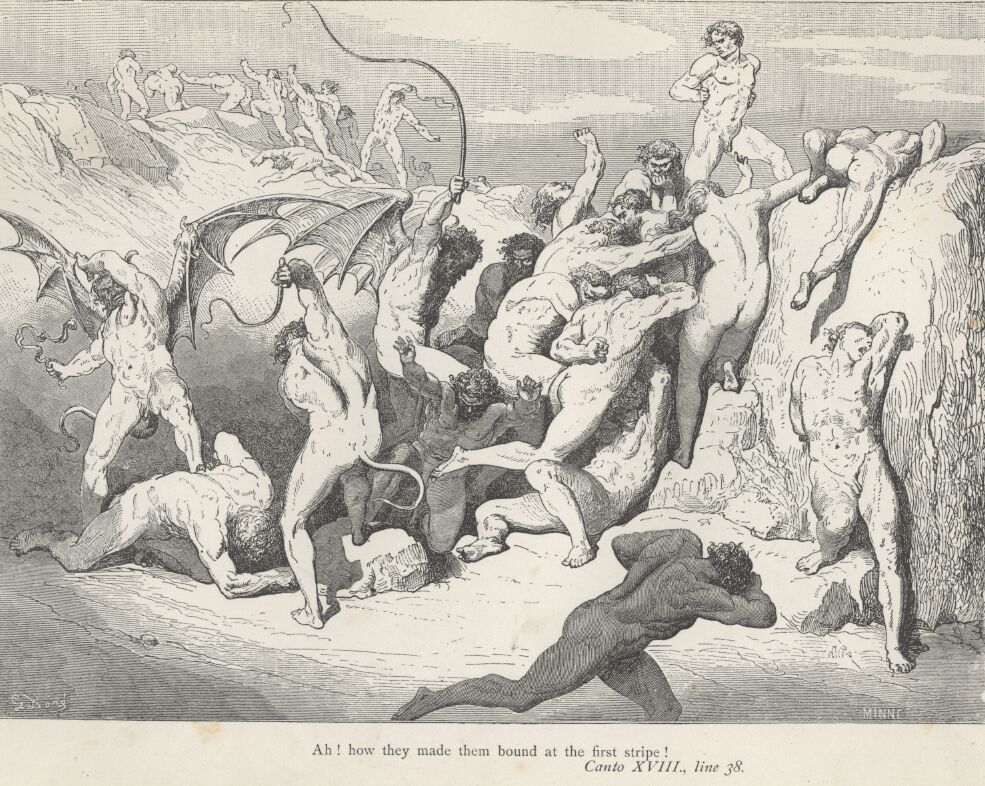
Upon my right hand I beheld new anguish,
New torments, and new wielders of the lash,
Wherewith the foremost Bolgia was replete.

Down at the bottom were the sinners naked;
This side the middle came they facing us,
Beyond it, with us, but with greater steps;

Even as the Romans, for the mighty host,
The year of Jubilee, upon the bridge,
Have chosen a mode to pass the people over;

For all upon one side towards the Castle
Their faces have, and go unto St. Peter’s;
On the other side they go towards the Mountain.

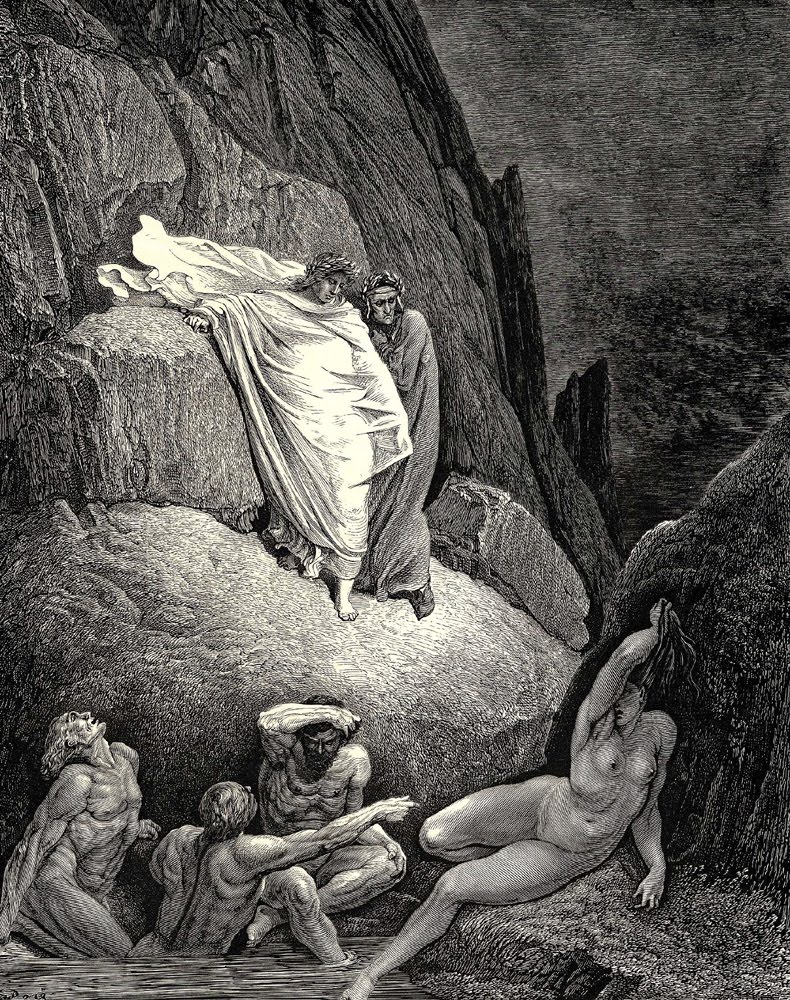
This side and that, along the livid stone
Beheld I horned demons with great scourges,
Who cruelly were beating them behind.

Ah me! how they did make them lift their legs
At the first blows! and sooth not any one
The second waited for, nor for the third.

Ah me! how they did make them lift their legs / At the first blows!


While I was going on, mine eyes by one
Encountered were; and straight I said: “Already
With sight of this one I am not unfed.”

Therefore I stayed my feet to make him out,
And with me the sweet Guide came to a stand,
And to my going somewhat back assented;

And he, the scourged one, thought to hide himself,
Lowering his face, but little it availed him;
For said I: “Thou that castest down thine eyes,

If false are not the features which thou bearest,
Thou art Venedico Caccianimico;
But what doth bring thee to such pungent sauces?”

And he to me: “Unwillingly I tell it;
But forces me thine utterance distinct,
Which makes me recollect the ancient world.

I was the one who the fair Ghisola
Induced to grant the wishes of the Marquis,
Howe’er the shameless story may be told.

Not the sole Bolognese am I who weeps here;
Nay, rather is this place so full of them,
That not so many tongues to-day are taught

‘Twixt Reno and Savena to say ‘sipa;’
And if thereof thou wishest pledge or proof,
Bring to thy mind our avaricious heart.”

While speaking in this manner, with his scourge
A demon smote him, and said: “Get thee gone
Pander, there are no women here for coin.”

I joined myself again unto mine Escort;
Thereafterward with footsteps few we came
To where a crag projected from the bank.

This very easily did we ascend,
And turning to the right along its ridge,
From those eternal circles we departed.

When we were there, where it is hollowed out
Beneath, to give a passage to the scourged,
The Guide said: “Wait, and see that on thee strike

The vision of those others evil-born,
Of whom thou hast not yet beheld the faces,
Because together with us they have gone.”

From the old bridge we looked upon the train
Which tow’rds us came upon the other border,
And which the scourges in like manner smite.

And the good Master, without my inquiring,
Said to me: “See that tall one who is coming,
And for his pain seems not to shed a tear;

Still what a royal aspect he retains!
That Jason is, who by his heart and cunning
The Colchians of the Ram made destitute.

He by the isle of Lemnos passed along
After the daring women pitiless
Had unto death devoted all their males.

There with his tokens and with ornate words
Did he deceive Hypsipyle, the maiden
Who first, herself, had all the rest deceived.

There did he leave her pregnant and forlorn;
Such sin unto such punishment condemns him,
And also for Medea is vengeance done.

With him go those who in such wise deceive;
And this sufficient be of the first valley
To know, and those that in its jaws it holds.”

We were already where the narrow path
Crosses athwart the second dike, and forms
Of that a buttress for another arch.

Thence we heard people, who are making moan
In the next Bolgia, snorting with their muzzles,
And with their palms beating upon themselves

The margins were incrusted with a mould
By exhalation from below, that sticks there,
And with the eyes and nostrils wages war.

The bottom is so deep, no place suffices
To give us sight of it, without ascending
The arch’s back, where most the crag impends.

Thither we came, and thence down in the moat
I saw a people smothered in a filth
That out of human privies seemed to flow;

I saw a people smothered in a filth / That out of human privies seemed to flow;


And whilst below there with mine eye I search,
I saw one with his head so foul with ordure,
It was not clear if he were clerk or layman.

He screamed to me: “Wherefore art thou so eager
To look at me more than the other foul ones?”
And I to him: “Because, if I remember,

I have already seen thee with dry hair,
And thou’rt Alessio Interminei of Lucca;
Therefore I eye thee more than all the others.”

And he thereon, belabouring his pumpkin:
“The flatteries have submerged me here below,
Wherewith my tongue was never surfeited.”

Then said to me the Guide: “See that thou thrust
Thy visage somewhat farther in advance,
That with thine eyes thou well the face attain

Of that uncleanly and dishevelled drab,
Who there doth scratch herself with filthy nails,
And crouches now, and now on foot is standing.

Thais the harlot is it, who replied
Unto her paramour, when he said, ‘Have I
Great gratitude from thee?’–‘Nay, marvellous;’


Thais the harlot is it, who replied /
Unto her paramour, when he said, ‘Have I / Great gratitude from thee?’–‘Nay, marvellous;’


And herewith let our sight be satisfied.

Continue Reading ·

Fraud

“Behold the monster with the pointed tail,
Who cleaves the hills, and breaketh walls and weapons,
Behold him who infecteth all the world.”

Thus unto me my Guide began to say,
And beckoned him that he should come to shore,
Near to the confine of the trodden marble;

And that uncleanly image of deceit
Came up and thrust ashore its head and bust,
But on the border did not drag its tail.

And that uncleanly image of deceit / Came up and thrust ashore its head and bust,


The face was as the face of a just man,
Its semblance outwardly was so benign,
And of a serpent all the trunk beside.

Two paws it had, hairy unto the armpits;
The back, and breast, and both the sides it had
Depicted o’er with nooses and with shields.

With colours more, groundwork or broidery
Never in cloth did Tartars make nor Turks,
Nor were such tissues by Arachne laid.

As sometimes wherries lie upon the shore,
That part are in the water, part on land;
And as among the guzzling Germans there,

The beaver plants himself to wage his war;
So that vile monster lay upon the border,
Which is of stone, and shutteth in the sand.

His tail was wholly quivering in the void,
Contorting upwards the envenomed fork,
That in the guise of scorpion armed its point.

The Guide said: “Now perforce must turn aside
Our way a little, even to that beast
Malevolent, that yonder coucheth him.”

We therefore on the right side descended,
And made ten steps upon the outer verge,
Completely to avoid the sand and flame;

And after we are come to him, I see
A little farther off upon the sand
A people sitting near the hollow place.

Then said to me the Master: “So that full
Experience of this round thou bear away,
Now go and see what their condition is.

There let thy conversation be concise;
Till thou returnest I will speak with him,
That he concede to us his stalwart shoulders.”

Thus farther still upon the outermost
Head of that seventh circle all alone
I went, where sat the melancholy folk.

Out of their eyes was gushing forth their woe;
This way, that way, they helped them with their hands
Now from the flames and now from the hot soil.

Not otherwise in summer do the dogs,
Now with the foot, now with the muzzle, when
By fleas, or flies, or gadflies, they are bitten.

When I had turned mine eyes upon the faces
Of some, on whom the dolorous fire is falling,
Not one of them I knew; but I perceived

That from the neck of each there hung a pouch,
Which certain colour had, and certain blazon;
And thereupon it seems their eyes are feeding.

And as I gazing round me come among them,
Upon a yellow pouch I azure saw
That had the face and posture of a lion.

Proceeding then the current of my sight,
Another of them saw I, red as blood,
Display a goose more white than butter is.

And one, who with an azure sow and gravid
Emblazoned had his little pouch of white,
Said unto me: “What dost thou in this moat?

Now get thee gone; and since thou’rt still alive,
Know that a neighbour of mine, Vitaliano,
Will have his seat here on my left-hand side.

A Paduan am I with these Florentines;
Full many a time they thunder in mine ears,
Exclaiming, ‘Come the sovereign cavalier,

He who shall bring the satchel with three goats;'”
Then twisted he his mouth, and forth he thrust
His tongue, like to an ox that licks its nose.

And fearing lest my longer stay might vex
Him who had warned me not to tarry long,
Backward I turned me from those weary souls.

I found my Guide, who had already mounted
Upon the back of that wild animal,
And said to me: “Now be both strong and bold.

Now we descend by stairways such as these;
Mount thou in front, for I will be midway,
So that the tail may have no power to harm thee.”

Such as he is who has so near the ague
Of quartan that his nails are blue already,
And trembles all, but looking at the shade;

Even such became I at those proffered words;
But shame in me his menaces produced,
Which maketh servant strong before good master.

I seated me upon those monstrous shoulders;
I wished to say, and yet the voice came not
As I believed, “Take heed that thou embrace me.”

But he, who other times had rescued me
In other peril, soon as I had mounted,
Within his arms encircled and sustained me,

And said: “Now, Geryon, bestir thyself;
The circles large, and the descent be little;
Think of the novel burden which thou hast.”

Even as the little vessel shoves from shore,
Backward, still backward, so he thence withdrew;
And when he wholly felt himself afloat,

There where his breast had been he turned his tail,
And that extended like an eel he moved,
And with his paws drew to himself the air.

A greater fear I do not think there was
What time abandoned Phaeton the reins,
Whereby the heavens, as still appears, were scorched;

Nor when the wretched Icarus his flanks
Felt stripped of feathers by the melting wax,
His father crying, “An ill way thou takest!”

Than was my own, when I perceived myself
On all sides in the air, and saw extinguished
The sight of everything but of the monster.

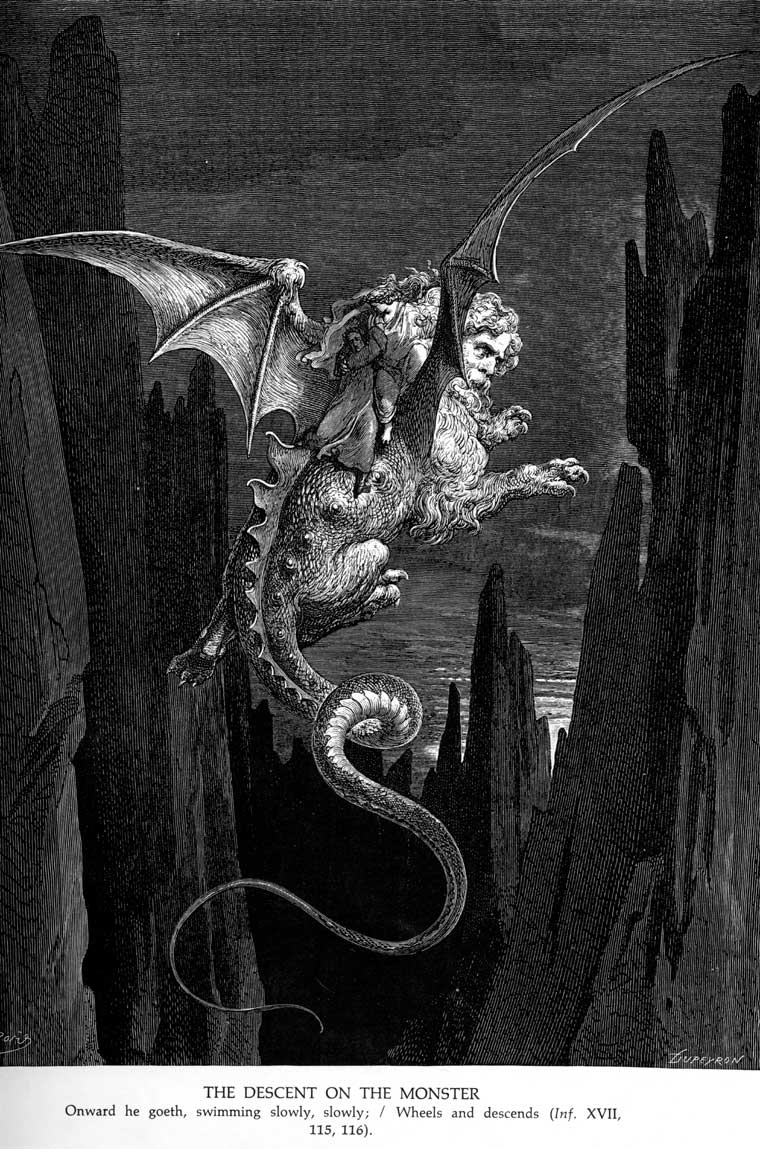
Onward he goeth, swimming slowly, slowly;
Wheels and descends, but I perceive it only
By wind upon my face and from below.

Onward he goeth, swimming slowly, slowly; / Wheels and descends, but I perceive it only / By wind upon my face and from below.


I heard already on the right the whirlpool
Making a horrible crashing under us;
Whence I thrust out my head with eyes cast downward.

Then was I still more fearful of the abyss;
Because I fires beheld, and heard laments,
Whereat I, trembling, all the closer cling.

I saw then, for before I had not seen it,
The turning and descending, by great horrors
That were approaching upon divers sides.

As falcon who has long been on the wing,
Who, without seeing either lure or bird,
Maketh the falconer say, “Ah me, thou stoopest,”

Descendeth weary, whence he started swiftly,
Thorough a hundred circles, and alights
Far from his master, sullen and disdainful;

Even thus did Geryon place us on the bottom,
Close to the bases of the rough-hewn rock,
And being disencumbered of our persons,

He sped away as arrow from the string.

Continue Reading ·

Sodomy

Now was I where was heard the reverberation
Of water falling into the next round,
Like to that humming which the beehives make,

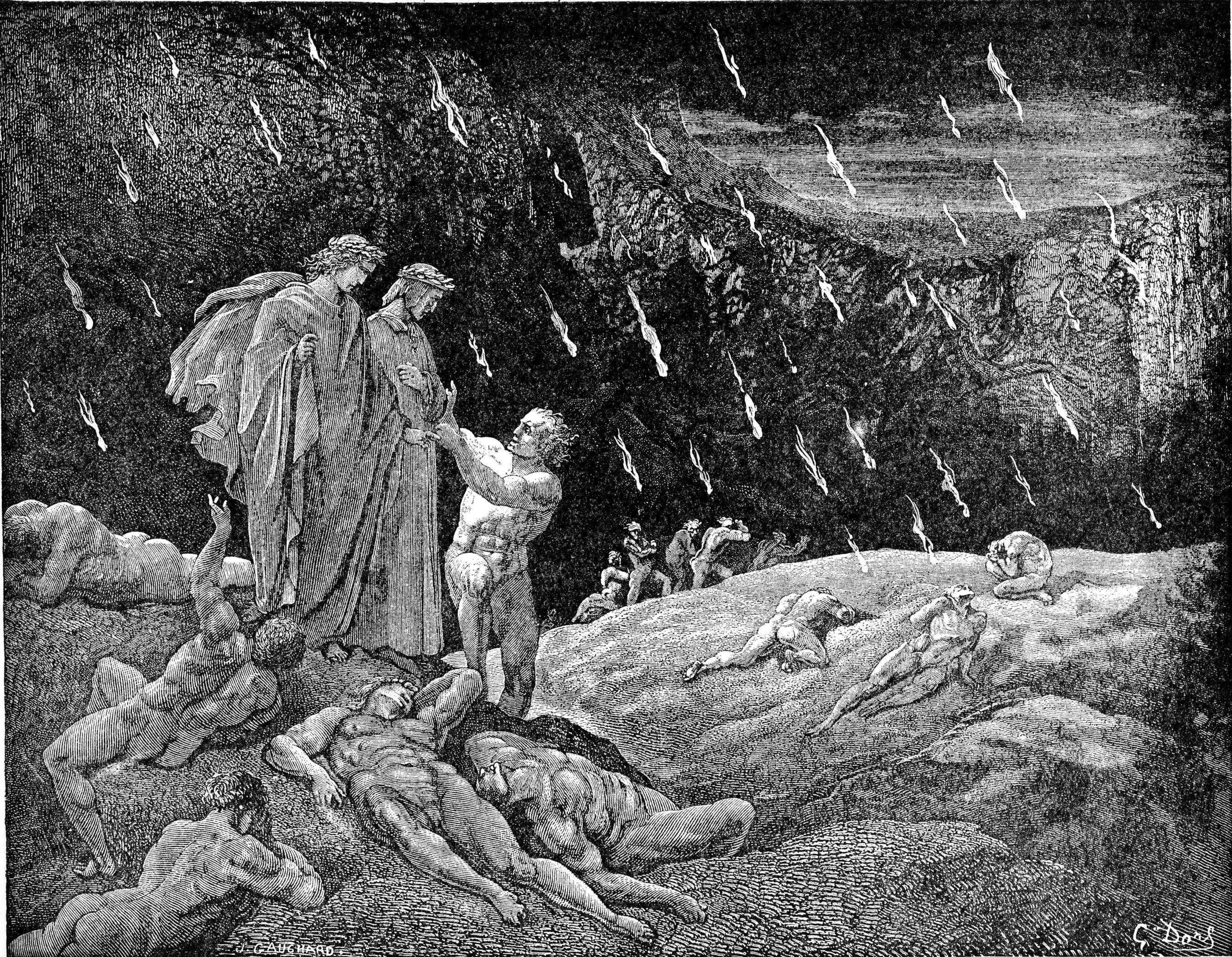
When shadows three together started forth,
Running, from out a company that passed
Beneath the rain of the sharp martyrdom.

Towards us came they, and each one cried out:
“Stop, thou; for by thy garb to us thou seemest
To be some one of our depraved city.”

Ah me! what wounds I saw upon their limbs,
Recent and ancient by the flames burnt in!
It pains me still but to remember it.

Unto their cries my Teacher paused attentive;
He turned his face towards me, and “Now wait,”
He said; “to these we should be courteous.

And if it were not for the fire that darts
The nature of this region, I should say
That haste were more becoming thee than them.”

As soon as we stood still, they recommenced
The old refrain, and when they overtook us,
Formed of themselves a wheel, all three of them.

As champions stripped and oiled are wont to do,
Watching for their advantage and their hold,
Before they come to blows and thrusts between them,

Thus, wheeling round, did every one his visage
Direct to me, so that in opposite wise
His neck and feet continual journey made.

And, “If the misery of this soft place
Bring in disdain ourselves and our entreaties,”
Began one, “and our aspect black and blistered,

Let the renown of us thy mind incline
To tell us who thou art, who thus securely
Thy living feet dost move along through Hell.

He in whose footprints thou dost see me treading,
Naked and skinless though he now may go,
Was of a greater rank than thou dost think;

He was the grandson of the good Gualdrada;
His name was Guidoguerra, and in life
Much did he with his wisdom and his sword.

The other, who close by me treads the sand,
Tegghiaio Aldobrandi is, whose fame
Above there in the world should welcome be.

And I, who with them on the cross am placed,
Jacopo Rusticucci was; and truly
My savage wife, more than aught else, doth harm me.”

Could I have been protected from the fire,
Below I should have thrown myself among them,
And think the Teacher would have suffered it;

But as I should have burned and baked myself,
My terror overmastered my good will,
Which made me greedy of embracing them.

Then I began: “Sorrow and not disdain
Did your condition fix within me so,
That tardily it wholly is stripped off,

As soon as this my Lord said unto me
Words, on account of which I thought within me
That people such as you are were approaching.

I of your city am; and evermore
Your labours and your honourable names
I with affection have retraced and heard.

I leave the gall, and go for the sweet fruits
Promised to me by the veracious Leader;
But to the centre first I needs must plunge.”

“So may the soul for a long while conduct
Those limbs of thine,” did he make answer then,
“And so may thy renown shine after thee,

Valour and courtesy, say if they dwell
Within our city, as they used to do,
Or if they wholly have gone out of it;

For Guglielmo Borsier, who is in torment
With us of late, and goes there with his comrades,
Doth greatly mortify us with his words.”

“The new inhabitants and the sudden gains,
Pride and extravagance have in thee engendered,
Florence, so that thou weep’st thereat already!”

In this wise I exclaimed with face uplifted;
And the three, taking that for my reply,
Looked at each other, as one looks at truth.

“If other times so little it doth cost thee,”
Replied they all, “to satisfy another,
Happy art thou, thus speaking at thy will!

Therefore, if thou escape from these dark places,
And come to rebehold the beauteous stars,
When it shall pleasure thee to say, ‘I was,’

See that thou speak of us unto the people.”
Then they broke up the wheel, and in their flight
It seemed as if their agile legs were wings.

Not an Amen could possibly be said
So rapidly as they had disappeared;
Wherefore the Master deemed best to depart.

I followed him, and little had we gone,
Before the sound of water was so near us,
That speaking we should hardly have been heard.

Even as that stream which holdeth its own course
The first from Monte Veso tow’rds the East,
Upon the left-hand slope of Apennine,

Which is above called Acquacheta, ere
It down descendeth into its low bed,
And at Forli is vacant of that name,

Reverberates there above San Benedetto
From Alps, by falling at a single leap,
Where for a thousand there were room enough;

Thus downward from a bank precipitate,
We found resounding that dark-tinted water,
So that it soon the ear would have offended.

I had a cord around about me girt,
And therewithal I whilom had designed
To take the panther with the painted skin.

After I this had all from me unloosed,
As my Conductor had commanded me,
I reached it to him, gathered up and coiled,

Whereat he turned himself to the right side,
And at a little distance from the verge,
He cast it down into that deep abyss.

“It must needs be some novelty respond,”
I said within myself, “to the new signal
The Master with his eye is following so.”

Ah me! how very cautious men should be
With those who not alone behold the act,
But with their wisdom look into the thoughts!

He said to me: “Soon there will upward come
What I await; and what thy thought is dreaming
Must soon reveal itself unto thy sight.”

Aye to that truth which has the face of falsehood,
A man should close his lips as far as may be,
Because without his fault it causes shame;

But here I cannot; and, Reader, by the notes
Of this my Comedy to thee I swear,
So may they not be void of lasting favour,

Athwart that dense and darksome atmosphere
I saw a figure swimming upward come,
Marvellous unto every steadfast heart,

Even as he returns who goeth down
Sometimes to clear an anchor, which has grappled
Reef, or aught else that in the sea is hidden,

Who upward stretches, and draws in his feet.

Continue Reading ·

Sodomy

Now bears us onward one of the hard margins,
And so the brooklet’s mist o’ershadows it,
From fire it saves the water and the dikes.

Even as the Flemings, ‘twixt Cadsand and Bruges,
Fearing the flood that tow’rds them hurls itself,
Their bulwarks build to put the sea to flight;

And as the Paduans along the Brenta,
To guard their villas and their villages,
Or ever Chiarentana feel the heat;

In such similitude had those been made,
Albeit not so lofty nor so thick,
Whoever he might be, the master made them.

Now were we from the forest so remote,
I could not have discovered where it was,
Even if backward I had turned myself,

When we a company of souls encountered,
Who came beside the dike, and every one
Gazed at us, as at evening we are wont

To eye each other under a new moon,
And so towards us sharpened they their brows
As an old tailor at the needle’s eye.

Thus scrutinised by such a family,
By some one I was recognised, who seized
My garment’s hem, and cried out, “What a marvel!”

And I, when he stretched forth his arm to me,
On his baked aspect fastened so mine eyes,
That the scorched countenance prevented not

His recognition by my intellect;
And bowing down my face unto his own,
I made reply, “Are you here, Ser Brunetto?”

“Are you here, Ser Brunetto?”

And he: “May’t not displease thee, O my son,
If a brief space with thee Brunetto Latini
Backward return and let the trail go on.”

I said to him: “With all my power I ask it;
And if you wish me to sit down with you,
I will, if he please, for I go with him.”

“O son,” he said, “whoever of this herd
A moment stops, lies then a hundred years,
Nor fans himself when smiteth him the fire.

Therefore go on; I at thy skirts will come,
And afterward will I rejoin my band,
Which goes lamenting its eternal doom.”

I did not dare to go down from the road
Level to walk with him; but my head bowed
I held as one who goeth reverently.

And he began: “What fortune or what fate
Before the last day leadeth thee down here?
And who is this that showeth thee the way?”

“Up there above us in the life serene,”
I answered him, “I lost me in a valley,
Or ever yet my age had been completed.

But yestermorn I turned my back upon it;
This one appeared to me, returning thither,
And homeward leadeth me along this road.”

And he to me: “If thou thy star do follow,
Thou canst not fail thee of a glorious port,
If well I judged in the life beautiful.

And if I had not died so prematurely,
Seeing Heaven thus benignant unto thee,
I would have given thee comfort in the work.

But that ungrateful and malignant people,
Which of old time from Fesole descended,
And smacks still of the mountain and the granite,

Will make itself, for thy good deeds, thy foe;
And it is right; for among crabbed sorbs
It ill befits the sweet fig to bear fruit.

Old rumour in the world proclaims them blind;
A people avaricious, envious, proud;
Take heed that of their customs thou do cleanse thee.

Thy fortune so much honour doth reserve thee,
One party and the other shall be hungry
For thee; but far from goat shall be the grass.

Their litter let the beasts of Fesole
Make of themselves, nor let them touch the plant,
If any still upon their dunghill rise,

In which may yet revive the consecrated
Seed of those Romans, who remained there when
The nest of such great malice it became.”

“If my entreaty wholly were fulfilled,”
Replied I to him, “not yet would you be
In banishment from human nature placed;

For in my mind is fixed, and touches now
My heart the dear and good paternal image
Of you, when in the world from hour to hour

You taught me how a man becomes eternal;
And how much I am grateful, while I live
Behoves that in my language be discerned.

What you narrate of my career I write,
And keep it to be glossed with other text
By a Lady who can do it, if I reach her.

This much will I have manifest to you;
Provided that my conscience do not chide me,
For whatsoever Fortune I am ready.

Such handsel is not new unto mine ears;
Therefore let Fortune turn her wheel around
As it may please her, and the churl his mattock.”

My Master thereupon on his right cheek
Did backward turn himself, and looked at me;
Then said: “He listeneth well who noteth it.”

Nor speaking less on that account, I go
With Ser Brunetto, and I ask who are
His most known and most eminent companions.

And he to me: “To know of some is well;
Of others it were laudable to be silent,
For short would be the time for so much speech.

Know them in sum, that all of them were clerks,
And men of letters great and of great fame,
In the world tainted with the selfsame sin.

Priscian goes yonder with that wretched crowd,
And Francis of Accorso; and thou hadst seen there
If thou hadst had a hankering for such scurf,

That one, who by the Servant of the Servants
From Arno was transferred to Bacchiglione,
Where he has left his sin-excited nerves.

More would I say, but coming and discoursing
Can be no longer; for that I behold
New smoke uprising yonder from the sand.

A people comes with whom I may not be;
Commended unto thee be my Tesoro,
In which I still live, and no more I ask.”

Then he turned round, and seemed to be of those
Who at Verona run for the Green Mantle
Across the plain; and seemed to be among them

The one who wins, and not the one who loses.

Continue Reading ·

Anger

I say, continuing, that long before
We to the foot of that high tower had come,
Our eyes went upward to the summit of it,

By reason of two flamelets we saw placed there,
And from afar another answer them,
So far, that hardly could the eye attain it.

And, to the sea of all discernment turned,
I said: “What sayeth this, and what respondeth
That other fire? and who are they that made it?”

And he to me: “Across the turbid waves
What is expected thou canst now discern,
If reek of the morass conceal it not.”

Cord never shot an arrow from itself
That sped away athwart the air so swift,
As I beheld a very little boat

Come o’er the water tow’rds us at that moment,
Under the guidance of a single pilot,
Who shouted, “Now art thou arrived, fell soul?”

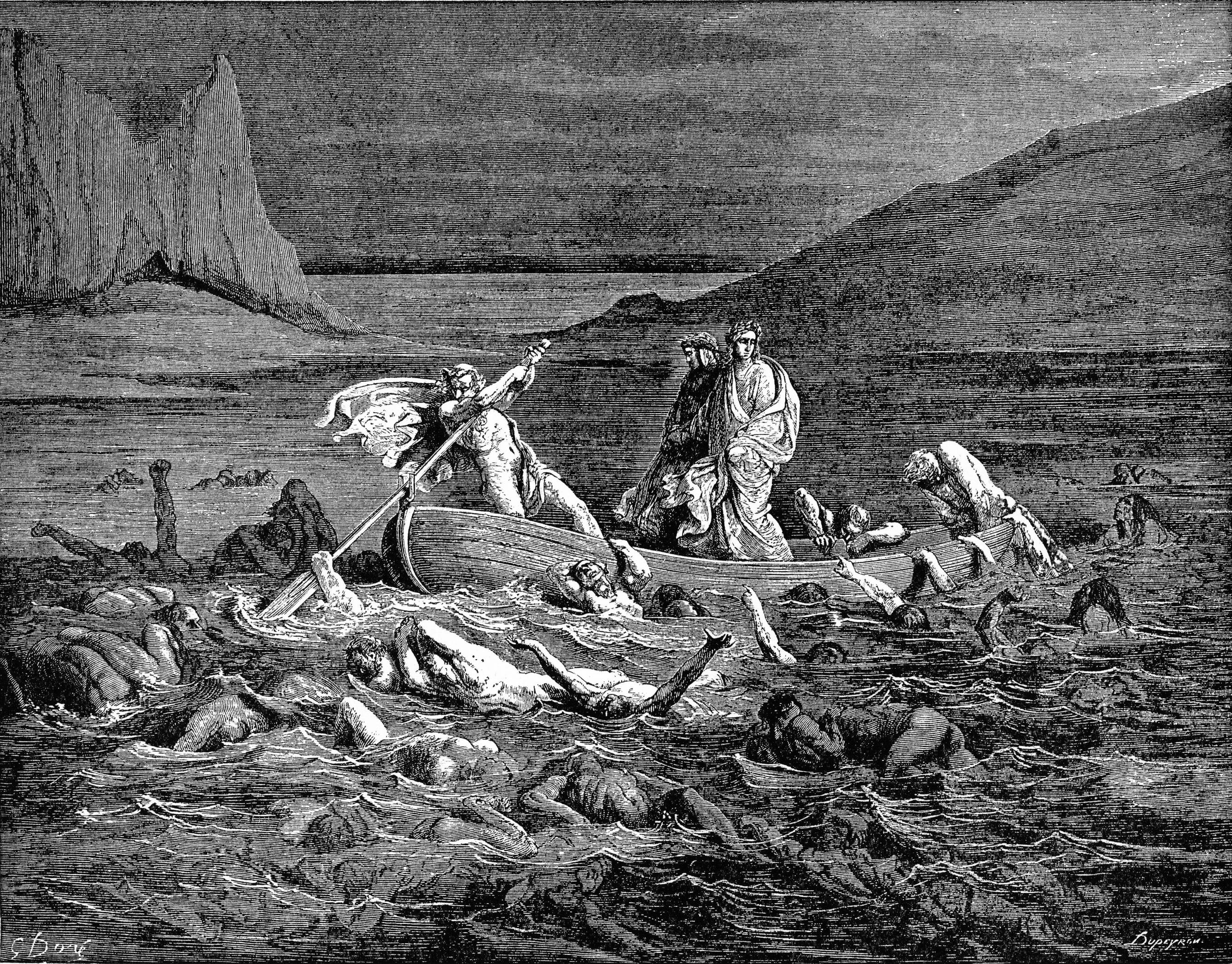
Phlegyas, Phlegyas, thou criest out in vain
For this once,” said my Lord; “thou shalt not have us
Longer than in the passing of the slough.”

As he who listens to some great deceit
That has been done to him, and then resents it,
Such became Phlegyas, in his gathered wrath.

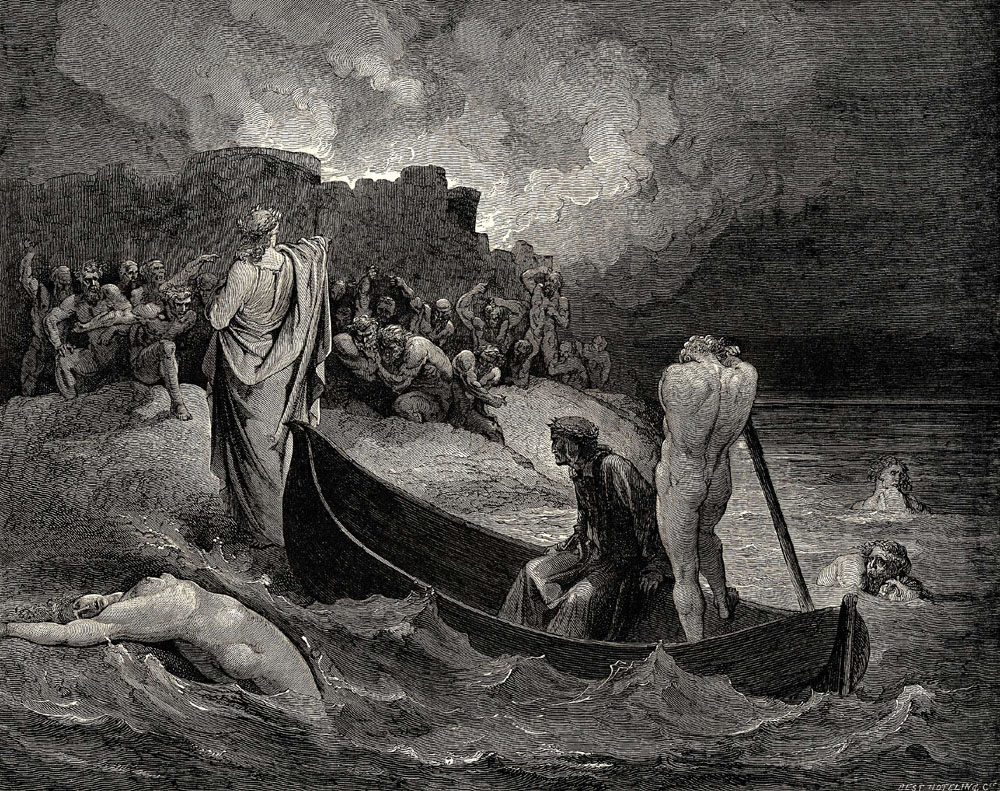
My Guide descended down into the boat,
And then he made me enter after him,
And only when I entered seemed it laden.

Soon as the Guide and I were in the boat,
The antique prow goes on its way, dividing
More of the water than ’tis wont with others.

The antique prow goes on its way, dividing / More of the water than ’tis wont with others.


While we were running through the dead canal,
Uprose in front of me one full of mire,
And said, “Who ‘rt thou that comest ere the hour?”

And I to him: “Although I come, I stay not;
But who art thou that hast become so squalid?”
“Thou seest that I am one who weeps,” he answered.

And I to him: “With weeping and with wailing,
Thou spirit maledict, do thou remain;
For thee I know, though thou art all defiled.”

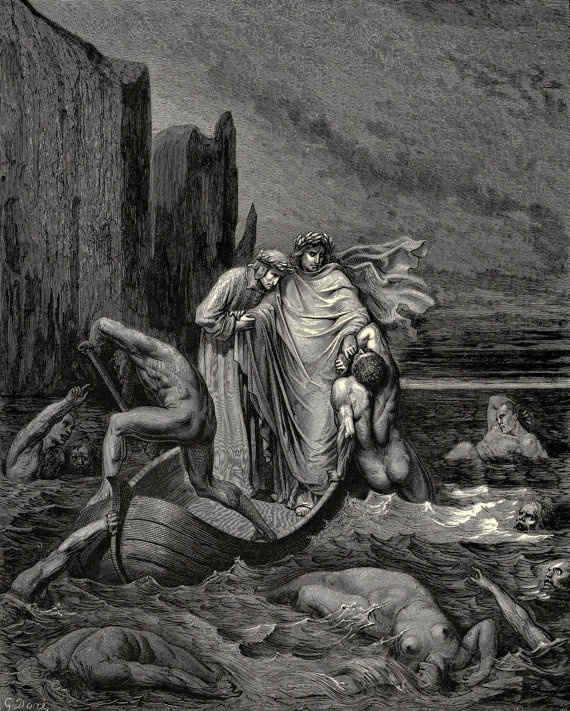
Then stretched he both his hands unto the boat;
Whereat my wary Master thrust him back,
Saying, “Away there with the other dogs!”

Then stretched he both his hands unto the boat; / Whereat my wary Master thrust him back,


Thereafter with his arms he clasped my neck;
He kissed my face, and said: “Disdainful soul,
Blessed be she who bore thee in her bosom.

That was an arrogant person in the world;
Goodness is none, that decks his memory;
So likewise here his shade is furious.

How many are esteemed great kings up there,
Who here shall be like unto swine in mire,
Leaving behind them horrible dispraises!”

And I: “My Master, much should I be pleased,
If I could see him soused into this broth,
Before we issue forth out of the lake.”

And he to me: “Ere unto thee the shore
Reveal itself, thou shalt be satisfied;
Such a desire ’tis meet thou shouldst enjoy.”

A little after that, I saw such havoc
Made of him by the people of the mire,
That still I praise and thank my God for it.

They all were shouting, “At Philippo Argenti!”
And that exasperate spirit Florentine
Turned round upon himself with his own teeth.

We left him there, and more of him I tell not;
But on mine ears there smote a lamentation,
Whence forward I intent unbar mine eyes.

And the good Master said: “Even now, my Son,
The city draweth near whose name is Dis,
With the grave citizens, with the great throng.”

And I: “Its mosques already, Master, clearly
Within there in the valley I discern
Vermilion, as if issuing from the fire

They were.” And he to me: “The fire eternal
That kindles them within makes them look red,
As thou beholdest in this nether Hell.”

Then we arrived within the moats profound,
That circumvallate that disconsolate city;
The walls appeared to me to be of iron.

Not without making first a circuit wide,
We came unto a place where loud the pilot
Cried out to us, “Debark, here is the entrance.”

More than a thousand at the gates I saw
Out of the Heavens rained down, who angrily
Were saying, “Who is this that without death

Goes through the kingdom of the people dead?”
And my sagacious Master made a sign
Of wishing secretly to speak with them.

A little then they quelled their great disdain,
And said: “Come thou alone, and he begone
Who has so boldly entered these dominions.

Let him return alone by his mad road;
Try, if he can; for thou shalt here remain,
Who hast escorted him through such dark regions.”

Think, Reader, if I was discomforted
At utterance of the accursed words;
For never to return here I believed.

“O my dear Guide, who more than seven times
Hast rendered me security, and drawn me
From imminent peril that before me stood,

Do not desert me,” said I, “thus undone;
And if the going farther be denied us,
Let us retrace our steps together swiftly.”

And that Lord, who had led me thitherward,
Said unto me: “Fear not; because our passage
None can take from us, it by Such is given.

But here await me, and thy weary spirit
Comfort and nourish with a better hope;
For in this nether world I will not leave thee.”

So onward goes and there abandons me
My Father sweet, and I remain in doubt,
For No and Yes within my head contend.

I could not hear what he proposed to them;
But with them there he did not linger long,
Ere each within in rivalry ran back.

I could not hear what he proposed to them; / But with them there he did not linger long, / Ere each within in rivalry ran back.


They closed the portals, those our adversaries,
On my Lord’s breast, who had remained without
And turned to me with footsteps far between.

His eyes cast down, his forehead shorn had he
Of all its boldness, and he said, with sighs,
“Who has denied to me the dolesome houses?”

And unto me: “Thou, because I am angry,
Fear not, for I will conquer in the trial,
Whatever for defence within be planned.

This arrogance of theirs is nothing new;
For once they used it at less secret gate,
Which finds itself without a fastening still.

O’er it didst thou behold the dead inscription;
And now this side of it descends the steep,
Passing across the circles without escort,

One by whose means the city shall be opened.”

Continue Reading ·

Greed

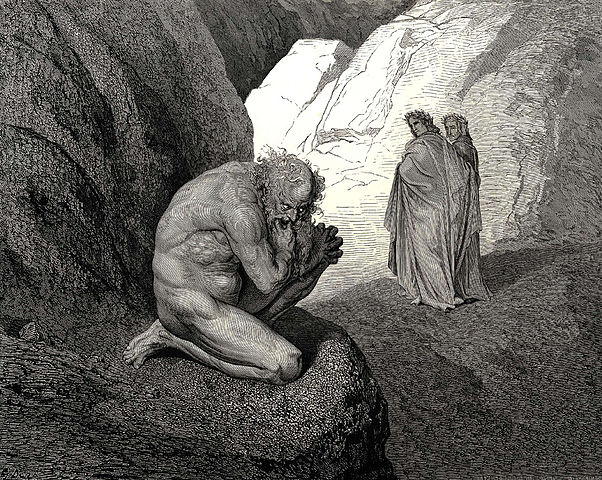
“Pape Satan, Pape Satan, Aleppe!”
Thus Plutus with his clucking voice began;
And that benignant Sage, who all things knew,

Said, to encourage me: “Let not thy fear
Harm thee; for any power that he may have
Shall not prevent thy going down this crag.”

Then he turned round unto that bloated lip,
And said: “Be silent, thou accursed wolf;
Consume within thyself with thine own rage.

“Be silent, thou accursed wolf; / Consume within thyself with thine own rage.


Not causeless is this journey to the abyss;
Thus is it willed on high, where Michael wrought
Vengeance upon the proud adultery.”

Even as the sails inflated by the wind
Involved together fall when snaps the mast,
So fell the cruel monster to the earth.

Thus we descended into the fourth chasm,
Gaining still farther on the dolesome shore
Which all the woe of the universe insacks.

Justice of God, ah! who heaps up so many
New toils and sufferings as I beheld?
And why doth our transgression waste us so?

As doth the billow there upon Charybdis,
That breaks itself on that which it encounters,
So here the folk must dance their roundelay.

Here saw I people, more than elsewhere, many,
On one side and the other, with great howls,
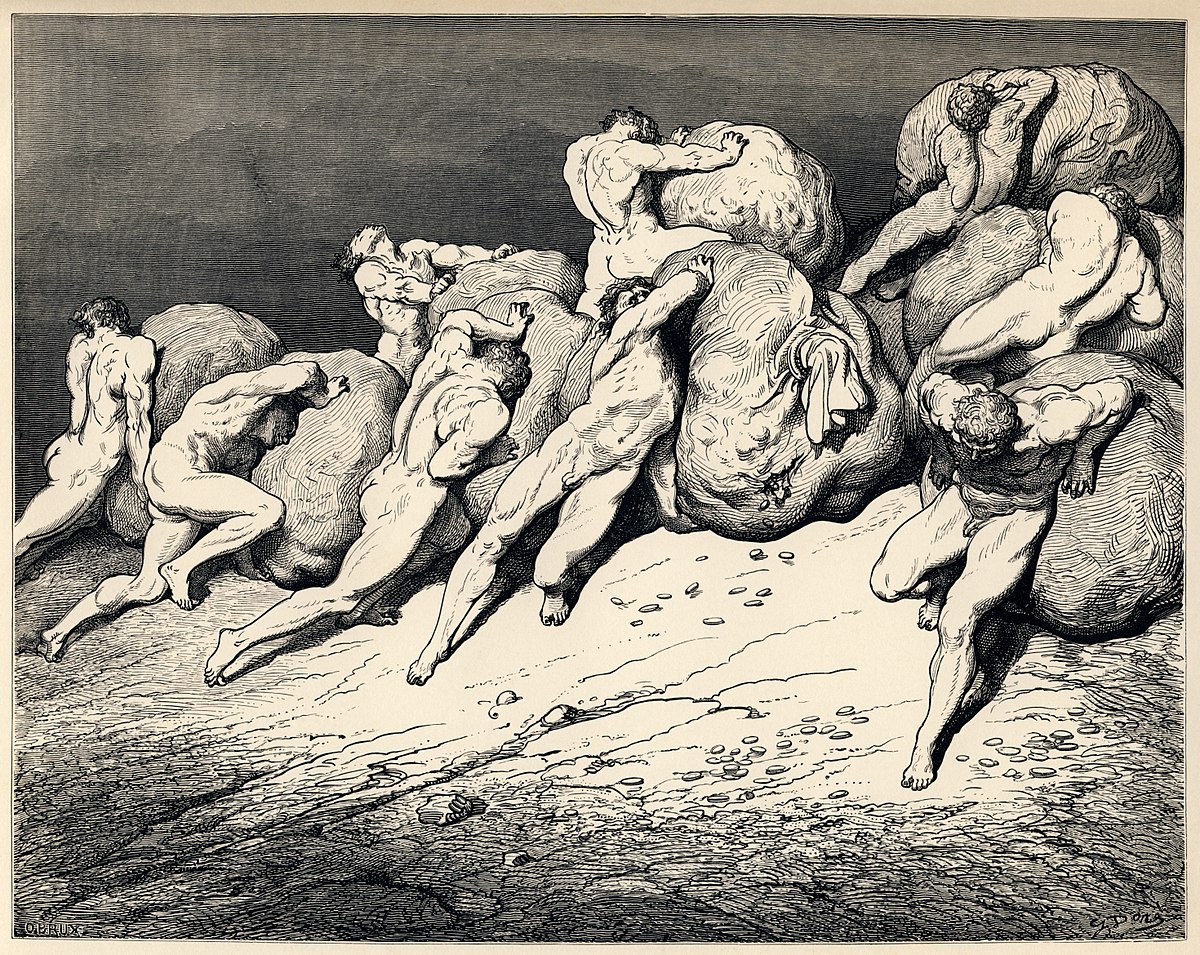
Rolling weights forward by main force of chest.

They clashed together, and then at that point
Each one turned backward, rolling retrograde,
Crying, “Why keepest?” and, “Why squanderest thou?”

Thus they returned along the lurid circle
On either hand unto the opposite point,
Shouting their shameful metre evermore.

Then each, when he arrived there, wheeled about
Through his half-circle to another joust;
And I, who had my heart pierced as it were,

Exclaimed: “My Master, now declare to me
What people these are, and if all were clerks,
These shaven crowns upon the left of us.”

And he to me: “All of them were asquint
In intellect in the first life, so much
That there with measure they no spending made.

Clearly enough their voices bark it forth,
Whene’er they reach the two points of the circle,
Where sunders them the opposite defect.

Clerks those were who no hairy covering
Have on the head, and Popes and Cardinals,
In whom doth Avarice practise its excess.”

And I: “My Master, among such as these
I ought forsooth to recognise some few,
Who were infected with these maladies.”

And he to me: “Vain thought thou entertainest;
The undiscerning life which made them sordid
Now makes them unto all discernment dim.

Forever shall they come to these two buttings;
These from the sepulchre shall rise again
With the fist closed, and these with tresses shorn.

Ill giving and ill keeping the fair world
Have ta’en from them, and placed them in this scuffle;
Whate’er it be, no words adorn I for it.

Now canst thou, Son, behold the transient farce
Of goods that are committed unto Fortune,
For which the human race each other buffet;

For all the gold that is beneath the moon,
Or ever has been, of these weary souls
Could never make a single one repose.”

For all the gold that is beneath the moon, / Or ever has been, of these weary souls / Could never make a single one repose.”


“Master,” I said to him, “now tell me also
What is this Fortune which thou speakest of,
That has the world’s goods so within its clutches?”

And he to me: “O creatures imbecile,
What ignorance is this which doth beset you?
Now will I have thee learn my judgment of her.

He whose omniscience everything transcends
The heavens created, and gave who should guide them,
That every part to every part may shine,

Distributing the light in equal measure;
He in like manner to the mundane splendours
Ordained a general ministress and guide,

That she might change at times the empty treasures
From race to race, from one blood to another,
Beyond resistance of all human wisdom.

Therefore one people triumphs, and another
Languishes, in pursuance of her judgment,
Which hidden is, as in the grass a serpent.

Your knowledge has no counterstand against her;
She makes provision, judges, and pursues
Her governance, as theirs the other gods.

Her permutations have not any truce;
Necessity makes her precipitate,
So often cometh who his turn obtains.

And this is she who is so crucified
Even by those who ought to give her praise,
Giving her blame amiss, and bad repute.

But she is blissful, and she hears it not;
Among the other primal creatures gladsome
She turns her sphere, and blissful she rejoices.

Let us descend now unto greater woe;
Already sinks each star that was ascending
When I set out, and loitering is forbidden.”

We crossed the circle to the other bank,
Near to a fount that boils, and pours itself
Along a gully that runs out of it.

The water was more sombre far than perse;
And we, in company with the dusky waves,
Made entrance downward by a path uncouth.

A marsh it makes, which has the name of Styx,
This tristful brooklet, when it has descended
Down to the foot of the malign gray shores.

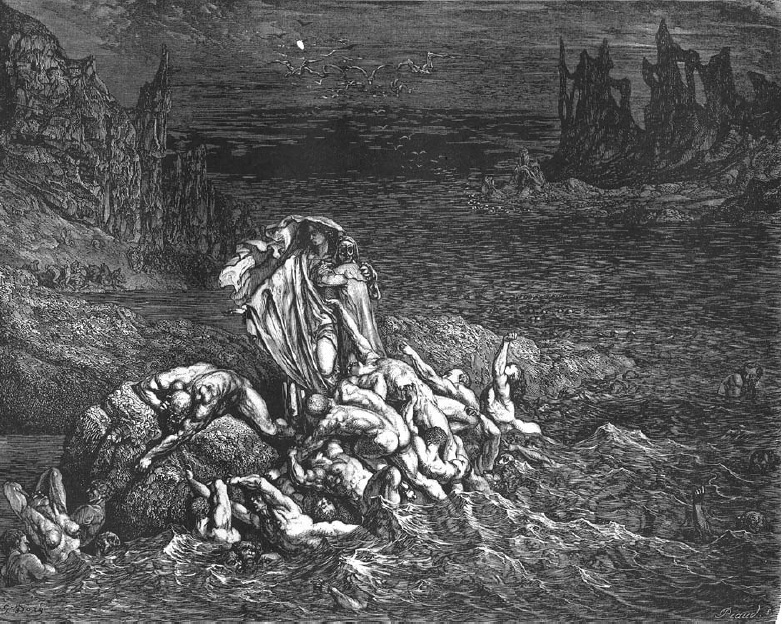
And I, who stood intent upon beholding,
Saw people mud-besprent in that lagoon,
All of them naked and with angry look.

They smote each other not alone with hands,
But with the head and with the breast and feet,
Tearing each other piecemeal with their teeth.

Said the good Master: “Son, thou now beholdest
The souls of those whom anger overcame;
And likewise I would have thee know for certain

“Son, thou now beholdest / The souls of those whom anger overcame;


Beneath the water people are who sigh
And make this water bubble at the surface,
As the eye tells thee wheresoe’er it turns.

Fixed in the mire they say, ‘We sullen were
In the sweet air, which by the sun is gladdened,
Bearing within ourselves the sluggish reek;

Now we are sullen in this sable mire.’
This hymn do they keep gurgling in their throats,
For with unbroken words they cannot say it.”

Thus we went circling round the filthy fen
A great arc ‘twixt the dry bank and the swamp,
With eyes turned unto those who gorge the mire;

Unto the foot of a tower we came at last.

Continue Reading ·

Dante & Virgil

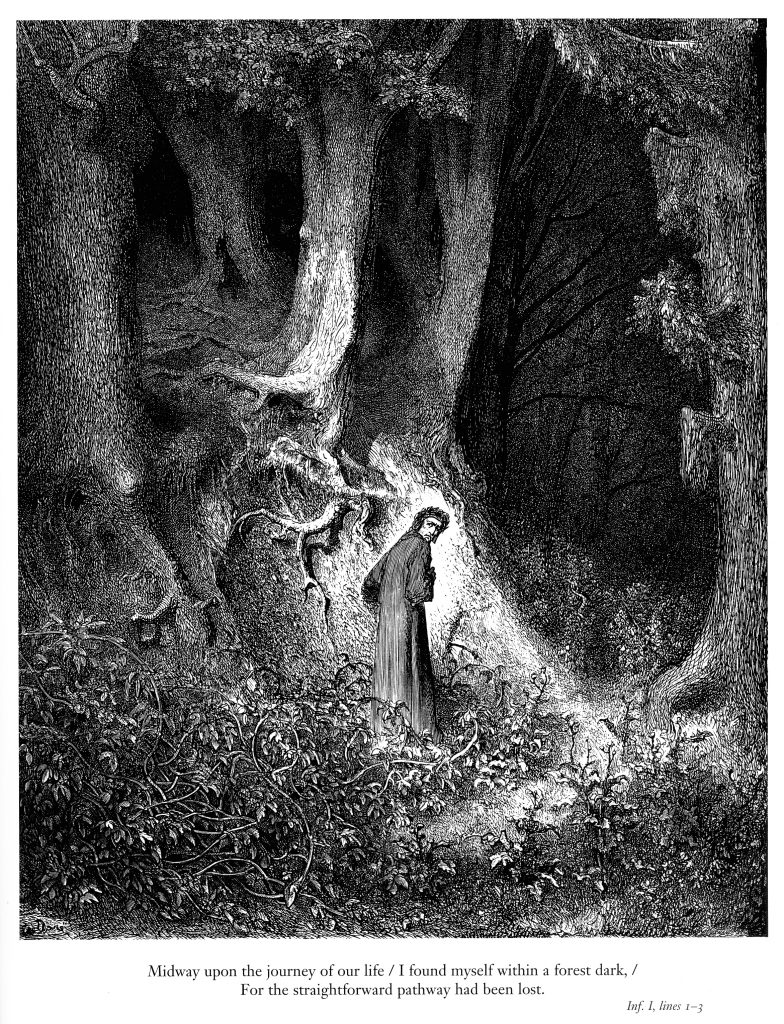
Midway upon the journey of our life
I found myself within a forest dark,
For the straightforward pathway had been lost. 


Ah me! how hard a thing it is to say
What was this forest savage, rough, and stern,
Which in the very thought renews the fear.

So bitter is it, death is little more;
But of the good to treat, which there I found,
Speak will I of the other things I saw there.

I cannot well repeat how there I entered,
So full was I of slumber at the moment
In which I had abandoned the true way.

But after I had reached a mountain’s foot,
At that point where the valley terminated,
Which had with consternation pierced my heart,

Upward I looked, and I beheld its shoulders,
Vested already with that planet’s rays
Which leadeth others right by every road.

Then was the fear a little quieted
That in my heart’s lake had endured throughout
The night, which I had passed so piteously.

And even as he, who, with distressful breath,
Forth issued from the sea upon the shore,
Turns to the water perilous and gazes;

So did my soul, that still was fleeing onward,
Turn itself back to re-behold the pass
Which never yet a living person left.

After my weary body I had rested,
The way resumed I on the desert slope,
So that the firm foot ever was the lower.

And lo! almost where the ascent began,
A panther light and swift exceedingly,
Which with a spotted skin was covered o’er!

And lo! almost where the ascent began, A panther light and swift exceedingly, Which with a spotted skin was covered o’er!

And never moved she from before my face,
Nay, rather did impede so much my way,
That many times I to return had turned.

The time was the beginning of the morning,
And up the sun was mounting with those stars
That with him were, what time the Love Divine

At first in motion set those beauteous things;
So were to me occasion of good hope,
The variegated skin of that wild beast,

The hour of time, and the delicious season;
But not so much, that did not give me fear
A lion’s aspect which appeared to me.

He seemed as if against me he were coming
With head uplifted, and with ravenous hunger,

He seemed as if against me he were coming With head uplifted, and with ravenous hunger,

So that it seemed the air was afraid of him;

And a she-wolf, that with all hungerings
Seemed to be laden in her meagreness,
And many folk has caused to live forlorn!

She brought upon me so much heaviness,
With the affright that from her aspect came,
That I the hope relinquished of the height.

And as he is who willingly acquires,
And the time comes that causes him to lose,
Who weeps in all his thoughts and is despondent,

E’en such made me that beast withouten peace,
Which, coming on against me by degrees
Thrust me back thither where the sun is silent.

While I was rushing downward to the lowland,
Before mine eyes did one present himself,
Who seemed from long-continued silence hoarse.

When I beheld him in the desert vast,
“Have pity on me,” unto him I cried,
“Whiche’er thou art, or shade or real man!”

He answered me: “Not man; man once I was,
And both my parents were of Lombardy,
And Mantuans by country both of them.

‘Sub Julio’ was I born, though it was late,
And lived at Rome under the good Augustus,
During the time of false and lying gods.

A poet was I, and I sang that just
Son of Anchises, who came forth from Troy,
After that Ilion the superb was burned.

But thou, why goest thou back to such annoyance?
Why climb’st thou not the Mount Delectable,
Which is the source and cause of every joy?”

“Now, art thou that Virgilius and that fountain
Which spreads abroad so wide a river of speech?”
I made response to him with bashful forehead.

“O, of the other poets honour and light,
Avail me the long study and great love
That have impelled me to explore thy volume!

Thou art my master, and my author thou,
Thou art alone the one from whom I took

Behold the beast, for which I have turned back; Do thou protect me from her, famous Sage,”

The beautiful style that has done honour to me.

Behold the beast, for which I have turned back;
Do thou protect me from her, famous Sage,
For she doth make my veins and pulses tremble.”

“Thee it behoves to take another road,”
Responded he, when he beheld me weeping,
“If from this savage place thou wouldst escape;

Because this beast, at which thou criest out,
Suffers not any one to pass her way,
But so doth harass him, that she destroys him;

And has a nature so malign and ruthless,
That never doth she glut her greedy will,
And after food is hungrier than before.

Many the animals with whom she weds,
And more they shall be still, until the Greyhound
Comes, who shall make her perish in her pain.

He shall not feed on either earth or pelf,
But upon wisdom, and on love and virtue;
‘Twixt Feltro and Feltro shall his nation be;

Of that low Italy shall he be the saviour,
On whose account the maid Camilla died,
Euryalus, Turnus, Nisus, of their wounds;

Through every city shall he hunt her down,
Until he shall have driven her back to Hell,
There from whence envy first did let her loose.

Therefore I think and judge it for thy best
Thou follow me, and I will be thy guide,
And lead thee hence through the eternal place,

Where thou shalt hear the desperate lamentations,
Shalt see the ancient spirits disconsolate,
Who cry out each one for the second death;

And thou shalt see those who contented are
Within the fire, because they hope to come,
Whene’er it may be, to the blessed people;

To whom, then, if thou wishest to ascend,
A soul shall be for that than I more worthy;
With her at my departure I will leave thee;

Because that Emperor, who reigns above,
In that I was rebellious to his law,
Wills that through me none come into his city.

He governs everywhere, and there he reigns;
There is his city and his lofty throne;
O happy he whom thereto he elects!”

And I to him: “Poet, I thee entreat,
By that same God whom thou didst never know,
So that I may escape this woe and worse,

Thou wouldst conduct me there where thou hast said,
That I may see the portal of Saint Peter,
And those thou makest so disconsolate.”

Then he moved on, and I behind him followed.

Continue Reading ·