Tag Archives | doctrine

Five Views on Biblical Inerrancy

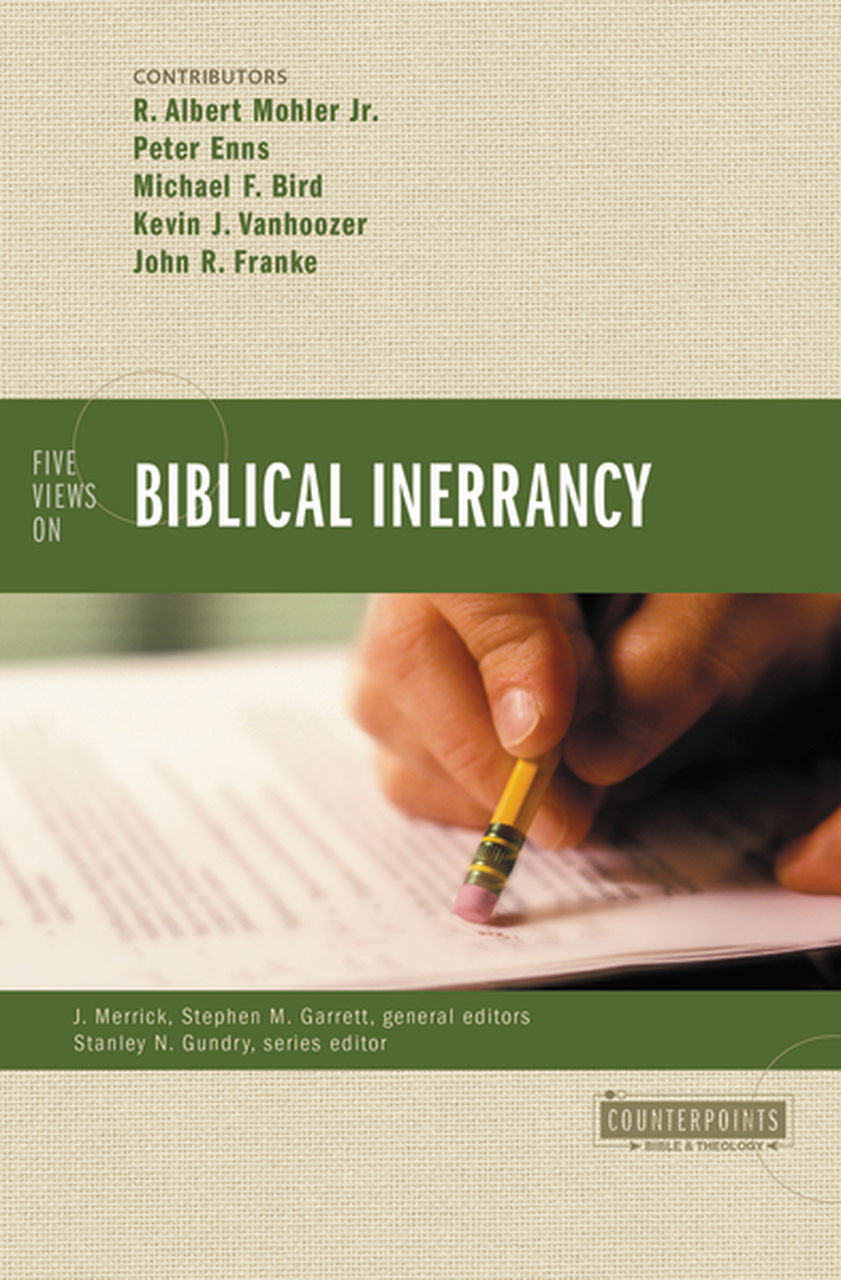
The following are chapter notes from the book, “Five Views on Biblical Inerrancy.” The book is a compilation of essays from R. Albert Mohler Jr., Peter Enns, Michael F. Bird, Kevin J. Vanhoozer, and John R. Franke. The general editors are J. Merrick and Stephen M. Garrett. The textbook is in the Counterpoints of Bible & Theology Series. It was published in 2013 by Zondervan.

Chapter One:    When the Bible Speaks, God Speaks: The Classic Doctrine of Biblical Inerrancy

The editors of the book “Five Views on Biblical Inerrancy” have put together a conversation in written form between academics who discuss the doctrine of inerrancy. The discussion is structured in a counterpoint format where four contributors frame the narrative by an opening statement to challenge thought and debate. Participants of the discussion include four prominent individuals within an academic context who bring together multiple perspectives about what inerrancy is. And if it is a valid way to understand and accept Scripture, its merits or flaws. Participants include Albert Mohler Jr (President of Southern Baptist Theological Seminary), Michael F. Bird (Anglican Priest, Theologian, and NT Scholar), Peter Enns (Author, Biblical Studies Professor), John R. Franke (Theologian, Professor of Religious Studies), and Kevin Vanhoozer (Theologian, Systematic Theology Professor).
As anyone would understand the term inerrancy, a common definition is generally accepted as follows: “The idea that Scripture is completely free from error. It is generally agreed by all theologians who use the term that inerrancy at least refers to the trustworthy and authoritative nature of Scripture as God’s Word, which informs humankind of the need for and the way to salvation. Some theologians, however, affirm that the Bible is also completely accurate in whatever it teaches about other subjects, such as science and history.”1 In comparison, the Second Vatican Council defines it as: “Therefore, since everything asserted by the inspired authors or sacred writers must be held to be asserted by the Holy Spirit, it follows that the books of Scripture must be acknowledged as teaching solidly, faithfully and without error that truth which God wanted put into sacred writings2 for the sake of salvation.” 3 To further recognize Protestant or Evangelical attestation of inerrancy, the Chicago Statement on Biblical Inerrancy (CSBI) is widely understood as informative to clarify what is meant and accepted as Scripture inerrant of facts and truth.

Mohler offered the prescriptive “When the Bible Speaks, God Speaks: The Classic Doctrine of Biblical Inerrancy” to open the first of a five-part series of declarations. He makes a case for inerrancy as Scripture is a testimony to itself while serving the faith and needs of the Church. To anchor the testimony of God’s Word as trustworthy, Mohler makes a further compelling and persuasive point that Scripture corresponds to God’s personal nature as his own self-revelation (44).

According to Mohler, our comprehension and understanding of God’s Word to support formulaic doctrines are not freestanding. A theology stems from God’s Word as it produces a realism to “affirm the irreducible ontological reality of the God of the Bible.” As “God wrote a book” (45), Mohler affirms that human authors were guided into truth and protected from all error by the Holy Spirit. The absence of error, as a result, explains the propositional value of inerrancy. As such, the terms infallible and inerrant reject the claims the Word of God is theologically incorrect or without truthfulness in its intent to bring salvific, theological, and historiological messaging to its readers.

Therefore, it is affirmed by the CSBI that the Word of God constitutes plenary inspiration for faith and practice. It is helpful as it is authoritative for belief and instruction.

Chapter Two:    Inerrancy, However Defined, Does Not Describe What the Bible Does

As ideological fencing was placed by Pharisees who set up regulations around the Mosaic law, they did so to provide insulative barriers at some distance to prevent people from breaking the Old Testament covenant after their return from Babylonian exile. By comparison, it intuitively seems like evangelicals set up theological fencing around the doctrine of inerrancy to prevent people from corrupting the closed Biblical canon and the interpretive meaning of Scripture for valid soteriological purposes. As Enns referred to John Frame’s view about inerrancy as a theologically propositional idea, he wrote that he would rather do away with the term but could not do so because of certain corruptions to follow from theologians (scholars).4

Before Enns began to deconstruct each of the three test cases of Biblical inerrancy initiated by Mohler in chapter one, he spent considerable effort on the disharmony of evangelicals over inerrancy (i.e., socially liberal objections to Scriptural authority) and the Chicago Statement on Biblical Inerrancy (CSBI). He grieves over the disconnect between academics and inerrantist evangelicals over the doctrine of inerrancy, and he makes clear that it sells the Bible short. Enns also declares that inerrancy sells God short as it is merely a theory of inferior purpose. In his view, it’s a doctrine that needs to be scrapped as it preempts discussion about scholarly conclusions about Scripture’s accuracy, facts, and truths (or at least evangelical interpretation of it). Through Enns’ perspective, it is clear that some academic scholars are certain inerrantists are intellectually dishonest (84) and a disservice to culture as ineffectual spiritual witnesses.5

To add further detail to Enns’ objections to the CSBI, he walks through each of its four assertions point-by-point. All four assertions pertain to the authority of Scripture, its witness of Christ and the Holy Spirit, its commitments to faith, life, and mission, and discontinuity between lifestyle and faith claims of inerrantists. Stemming from each, as there is his distinction made between authority and inerrancy, this is deconstruction. As God’s testimony of himself is true, His Word is undoubtedly accurate without error by extension. Conversely, Enns supposes that as inerrantists view the inseparable linkage between authority and inerrancy, that is a perspective should require a defense. The type of authority recognized by inerrantists is questioned in a further effort to dilute the purpose and intent of the CSBI as merely an affirmation document. The CSBI carries no creedal weight, but it is simply a point of reference or a marker to ascertain what someone concludes or supposes about the nature of Scripture, its truth claims, self-witness, and testimony. Enns and like-minded evangelicals prefer to eliminate the doctrine to render it subject to open-ended critical interaction.

While Enns wants to see “a valid definition of the word truth” (87), he wants Scripture held up to critical review without immunity to our interpretive cultural assumptions. It appears he wants the plain truth and meaning of Scripture and its message rendered impotent to guide and protect believers. Consider the interchange between Jesus and the religious leaders of John 8:12-58 as it concerns how He defines Truth of Himself and that of the Father. By His verbal expression of meaning, it is absolute and without error.

Finally, in so many words, Enns says he genuinely wants to introduce a way to make Scripture compatible with scholars’ research concerning ANE facts, archeological discoveries, and literary analysis of ancient civilizations. So Enns wrote what he thought about an “incarnation model” as an alternative in opposition to the doctrine of inerrancy. An “incarnation model” was set up as a counterpoint to an “inerrancy model” to frame the discussion with a new category of false or foreign meaning. As if generations of the doctrine of inerrancy had no bearing, it was set up as an objective comparison or alternative to inerrancy overall to include the CSBI statement. Contributors Bird, Franke, and Vanhoozer’s views about what Enns wrote weren’t comprehensive or well developed, but they revealed a tension between the doctrine of inerrancy and the incarnation model as if there was something to explore further according to Enns’ perspective.

To consider what the incarnation model implies, Bird’s restatement of John Webster’s view is an eye-opening refutation: “this incarnational model is, as John Webster calls it, ‘Christologically disastrous.’ It’s disastrous because it threatens the uniqueness of the Christ event, since it assumes that hypostatic union is a general characteristic of divine self-disclosure in, through, or by a creaturely agent. Furthermore, it results in a divinizing of the Bible by claiming that divine ontological equality exists between God’s being and his communicative action.”6 Moreover, Irenaeus of Lyons (130-230 A.D.), a disciple of Polycarp, separated incarnation between the Word and Christ within his work Against Heresies. He wrote of the incarnation of Jesus but not of the Word itself to exclude incarnational participation. To quote Irenaeus, “For they will have it, that the Word and Christ never came into this world; that the Saviour, too, never became incarnate, nor suffered, but that He descended like a dove upon the dispensational Jesus; and that, as soon as He had declared the unknown Father, He did again ascend into the Pleroma.” 7

Chapter Three:    Inerrancy Is Not Necessary for Evangelicalism Outside the USA

The book’s third part, Five Views on Biblical Inerrancy, entitled “Inerrancy is Not Necessary for Evangelicalism Outside the USA,” concerns Michael F. Bird’s views on American understanding of inerrancy concerning the CSBI. Without much interaction with inerrancy in general as a contribution to the work of the book about Biblical Inerrancy, there is an absence of the distinction. The work of chapter 3 in the text is primarily a discourse on affirmations, objections, and concerns about the CSBI. As Bird narrows his thoughts around the particulars of the CSBI, he goes well beyond the purpose and intent of the Chicago Statement’s purpose of upholding the doctrine of inerrancy. Bird takes exception to various points of CSBI inerrancy verbiage around the Biblical creation account in Genesis. He would presumably agree that the truth and principles of inerrancy refer to the trustworthiness and authoritative nature of God’s word as authoritative.

From Bird’s various perspectives, he would not entirely affirm what the Bible infers about other subjects such as science and history. In fact, Bird’s views about inerrancy are better stated as a better categorization of veracity. From the inner witness of the Church by the Holy Spirit, Scripture’s “divine truthfulness” (158) is a way to set aside the claims or proclamations of  negative statements in defense of “inerrancy.” Whether on its own merits or as an apologetic expression of the CSBI by American evangelicalism concerning the doctrine inerrancy or inspiration of Scripture.

What the Bible says about itself pertains to its use and inspiration (2 Tim 3:16). Among the various genres of Scripture, the Old and New Testaments are attestations of divine truth whether in narrative, poetic, prophetic, apocalyptic, epistolary form. Scripture best interprets Scripture and reservations about exceptions concerning inerrancy as it does so, whether supported by the CSBI or not, isn’t productive on the grounds of harmonization, literary discrepancies, nation of origination, or supposed contradictions without historiographical refutation. Particularly when so much antipathy exists around the meaning and purpose of God’s Word as it is intended by define revelation for God’s glory and for salvific outcomes. The doctrine of inerrancy doesn’t claim for itself authority over matters concerning self-contradictory postmodern assertions (i.e., opposition to absolute truth and authority). The CSBI and the doctrine of inerrancy are assembled to support a high view of Scripture toward confidence for its intended purpose.

Some objections to inerrancy appear to stem from the term itself. As the Word of God is without error and reliable as God is Truth, Bird calls attention to its comparative infallibility and inspiration. Bird doesn’t indicate that the Word of God is with error or without truth, nor does he suggest that it is uninspired. His reservations are around what interpreters understand about the idea of inerrancy and how that pertains to conclusions involving life and practice. Particularly across cultures of different nationalities that do not hold to the doctrine of inerrancy, especially as it is defined and understood in the West or America more narrowly.

The difference between inerrancy and infallibility is essential and necessary to recognize and understand. To put it clearly, inerrancy, at a minimum, refers to the trustworthy and authoritative nature of God’s word for salvific purposes. By comparison, infallibility refers to Scripture’s inability to fail in its ultimate purpose of revealing God and the way to salvation. It is counterproductive to conflate the two terms or to use them interchangeably. The doctrines of infallibility and inerrancy are not for a social utility or to shape social justice initiatives for society or the State. While Catholicism shares the same definition of inerrancy as Protestantism, it differs in defining infallibility. Infallibility within Catholicism includes the church (i.e., the magisterium and its dogma) under the pope’s authority.

Bird’s assessment and criticism about tirades against God’s Word is exactly the correct posture against those who stand in opposition to its truth, authority, reliability, and inspiration of Scripture. However, it isn’t so much secular culture or atheists who so much pose a harmful threat to the doctrines of inerrancy and infallibility as does Christian academics or scholars, well-meaning or not. It is for internal reasons of mishandling God’s Word that it is served by assertive statements of inerrancy to prevent its surrender to a multitude of professing Christians who have a large range of worldviews (including liberalism, or socialism) and would rather see God’s Word rendered insufficient and irrelevant to a postmodern society. Professing Christians, especially progressive Christians, are just as readily inclined to make God’s Word into its own image as secular society.

Unrelated Note: In support of feminist egalitarianism, Bird makes an inflammatory assertion that complementarians enable abuse: Article

Chapter Four:    Augustinian Inerrancy: Literary Meaning, Literal Truth, and Literate Interpretation in the Economy of Biblical Discourse

As affirmed by Vanhoozer, the doctrine of inerrancy has an important presupposition. That most important presupposition is: God speaks. Or, more specifically, God the Creator communicates through human language and literature as a means of communicative action to people. Vanhoozer also points out that the works of the Trinity are undivided (opera trinitatis ad extra indivisa sunt) as triune discourse indicative of communicative action involving subjects, objects, and purpose. He makes the case that language is functional and cognitive in nature to support the intent of divine revelation. Therefore, it is recognized that Scripture is a corpus of written communicative work consisting of historical assertions, commands, and explanations. According to Carl Henry (20th-century theologian), Scripture is propositional, but it is also trustworthy as true as it is a correspondence of Christ’s witness to what and who God is.

Inerrancy is a claim that the Bible is true and trustworthy through critical testing and cross-examination. Just as Augustine speaks of the incarnation as humans give tangibility of thoughts as words, Christ is the exact imprint of God’s being (Heb 1:3). Jesus is the image of the invisible God (Col 1:15) and what Christ speaks is Truth because He originates as God from the Father who is Truth and communicates truth. Whether verbally while with us in Creation or in Scripture by the testimonies of eye-witness accounts of his verbal speech acts. Within the old or new covenants, by God’s presence or His Spirit among people, He cannot lie in Scripture as His personal veracity is made clear through the inspiration of the Canon.

As made evident through divine revelation, truth is a correspondence of covenantal and redemptive meaning. The modes of its conveyance have a bearing on the methods of truth messaging by which it is delivered and understood. Allegory, metaphors, poetic expressions, and narrative discourses together establish the means of language utilized to accomplish its desired intent. Therefore, as Vanhoozer proved, it isn’t helpful when critics of inerrancy confuse matters by suggesting that inerrantists believe every word of the Bible as literal truth. Vanhoozer distinguishes between “sentence meaning” and “speaker, or writer meaning” when readers seek to understand what the author is doing or saying within Scriptural messaging. Analogies defy critical assertions about literalist interpretations of meaning.

Literalism, irrespective of context, can produce contradictions in meaning. Or it can confuse the intent of messaging through various linguistic methods, especially as prophecies and parables were verbally uttered and recorded in Scripture to convey imagery or parallel thoughts and ideas to achieve Spiritual understanding among listeners or readers. The communication method and its content are intentional, just as the assembly, formation, and preservation of God’s Word are true, sure, and lasting for those of faith to believe.

Inerrancy doesn’t claim to affirm or validate scientific or philosophical observations and constructs precisely. Observations of physical behaviors and explanations of metaphysical reality originating from beings in natural order don’t have reach to ascertain spiritual truth and meaning as propositioned and asserted from God’s Word. Supposed contradictions in Scripture that serve as proof-text “gotchas” do not subvert the inerrant truth and meaning of intended spiritual messaging, and theological truth held out as spiritually factual from different authorial perspectives. Even with elaborate and effective explanations to reconcile apparent differences, there isn’t much acceptance to recover veracity among many who object to the doctrine of inerrancy.

Whether believers or unbelievers interpret Scripture according to cognitive reason and comprehension for rational thought and conclusion, gathered facts can become assembled incorrectly to arrive at false notions of belief or disbelief. To quote Vanhoozer, “God’s words are wholly reliable; their human interpretation, not so much” (224). To further explain, biblical inerrancy requires biblical literacy. It is a yoke of burden that people of postmodern culture view Scriptural literality by its terms and expectations of meaning. People within modern society expect a reality of the time of the Old and New Covenants to conform to how things are expected today. The claims of inerrancy do not imply there is only one way to map the reality of the world correctly, either then or now. Proper hermeneutical stands separate from inerrancy as necessary to understand and accept Truth from Scripture.

Chapter Five:    Recasting Inerrancy: The Bible As Witness to Missional Plurality

John R. Franke’s contribution to the evangelical conversation around inerrancy is driven by his aspirations around what he calls a plurality of truth toward God’s missional objectives. By missional theology in keeping with the mission of God, Franke means humanitarian relief and advancement as chief of concerns. When Franke speaks of missional imperatives that involve the gospel and discipleship, it is always within a social and cultural context to improve the human condition. To Franke, the meaning of Scripture as inerrant is not so much about its salvific relevance as humanity is lost in sin and stands condemned without redemption. The authority of Scripture as a witness to the mission of God comes from the truth claims of Christ and the veracity of His words as He is the incarnate expression of God.

Franke’s sympathy toward postmodern theology explains his objections to static biblicism. The Spirit continues to speak through Scripture as he puts it but doesn’t offer thoughts about the meaning and purpose of Holy Spirit inspired Scripture for the actual gospel purpose of salvation and restoration of people to God. Franke’s contribution rests very much on the here and now for people in terms of missional objectives, not the already but not yet. The concern isn’t so much that people are perishing and headed toward hell, as it is their earthly well-being. The concern should rather be primary-secondary prioritization from a missional perspective. The truth of the Old and New Covenant’s meaning entirely revolves around how humanity would return to God. The confidence believers have about what Christ does to reconcile people to God comes from truth spoken and written without error and infallibly. With authority, believers can meet people’s spiritual and physical needs by missional endeavor rooted in sound theology and a commitment to the truth claims of Christ and God’s Word at work.

As Franke writes, “I believe that inerrancy challenges this notion and serves to deconstruct the idea of a single normative system of theology” (277), he is revealing his thoughts about what postmodern progressives do to reject conformity to the text of Scripture “for the sake of systematic unity.” The assertion illegitimate interpretive assumptions make clear postmodern thought, as there is no acceptance of universal truth. According to Franke, truth must be plural to accomplish contextual missional objectives relative to individual interpretation from Scripture. As conventionally defined by Protestants and Catholics, the doctrine of inerrancy is recast by Franke as an open and flexible tradition for pluralistic perspectives, practices, and experiences. It is unacceptable to Franke that the whole Bible is interpretive as an inerrant description of the gospel and Christ’s commands to love God and neighbor. Essentially, it is his call to redefine inerrancy such that the Bible is what we make of it and not what the authors intended.

Franke’s final thoughts about the cultural relevance of the gospel bring further alarm as he calls on his readers to surrender universal and timeless theology. He attempts to message a desire to redefine inerrancy to accomplish a culturally relativistic notion of God’s Word. That is, to rewrite Scripture to shape truth suitable for cultural conditions toward various human interests aside from salvific reconciliation. Where truth as concrete or abstract meaning carries less utility to accomplish objectives and instructions explicitly set forth by the Creator. Objectives and instructions delivered through human language expressed in truth as God is truth that must be accepted and theologically contextualized without compromise. It is crucial to ensure there is no loss or corruption of meaning. It is necessary to further God’s kingdom and bring people together in redemption toward their salvation and physical well-being without surrendering absolute truth and our acceptance of Scriptural authority.

Citations

__________________________
1 Stanley Grenz, David Guretzki, and Cherith Fee Nordling, Pocket Dictionary of Theological Terms (Downers Grove, IL: InterVarsity Press, 1999), 66.
2 cf. St. Augustine, “Gen. ad Litt.” 2, 9, 20: PL 34, 270–271; Epistle 82, 3: PL 33, 277: CSEL 34, 2, p. 354. St. Thomas, “On Truth,” Q. 12, A. 2, C.Council of Trent, session IV, Scriptural Canons: Denzinger 783 (1501). Leo XIII, encyclical “Providentissimus Deus:” EB 121, 124, 126–127. Pius XII, encyclical “Divino Afflante Spiritu:” EB 539.
3 Catholic Church, “Dogmatic Constitution on Divine Revelation: Dei Verbum,” in Vatican II Documents (Vatican City: Libreria Editrice Vaticana, 2011).
4 John M. Frame, Systematic Theology: An Introduction to Christian Belief (Phillipsburg, NJ: P&R Publishing, 2013), 598.
5 Cited by Enns: “For a focused critique of the CSBI (and its later sister document the Chicago Statement on Biblical Hermeneutics 1982), see Iain Provan, ” ‘How Can I Understand, Unless Someone Explains It to Me?’ (Acts 8:30–31): Evangelicals and Biblical Hermeneutics,” BBR 17.1 (2007): 1–36. See also Carlos Bovell, Rehabilitating Inerrancy in a Culture of Fear (Eugene, Ore.: Wipf & Stock, 2012), 44–65; Kevin J. Vanhoozer, “Lost in Interpretation? Truth, Scripture, and Hermeneutics,” JETS 48, no. 1 (March 2005): 89–114. For an appeal for a more prominent role the Chicago statements should play in evangelicalism today, see Jason Sexton, “How Far beyond Chicago? Assessing Recent Attempts to Reframe the Inerrancy Debate,” Themelios 34 (2009): 26–49.”
6 Peter Enns, “Inerrancy, However Defined, Does Not Describe What the Bible Does,” in Five Views on Biblical Inerrancy, ed. J. Merrick, Stephen M. Garrett, and Stanley N. Gundry, Zondervan Counterpoints Series (Grand Rapids, MI: Zondervan, 2013), 125.
7 Irenaeus of Lyons, “Irenæus against Heresies,” in The Apostolic Fathers with Justin Martyr and Irenaeus, ed. Alexander Roberts, James Donaldson, and A. Cleveland Coxe, vol. 1, The Ante-Nicene Fathers (Buffalo, NY: Christian Literature Company, 1885), 427.


Continue Reading ·

The Glory of Rome

This post is to bring into view the work of the apostle Paul as he brought the gospel to Jews and Gentiles in the first-century world of Asia Minor and Eastern Europe. More specially, Paul was appointed by Christ Jesus as an apostle to the Gentiles (1 Tim 2:7), and he fulfilled his mission with passion and strenuous attention.

Purpose and Background

With every bit of his mind, body, soul, and strength, Paul brought the message of reconciliation to God through Christ among people who were culturally alien to the messianic prophecies and the old covenants that extended back for generations. This post surveys the subject matter of Paul’s letters to the Romans. In his writing, he engages a people steeped in Greco-Roman culture with all of its pagan influences and Gentile customs of early gnostic and epicurean thought. The purpose of Paul’s letter itself cannot be narrowed to a single topic (i.e., systematic reasoning of God’s salvific power to the Gentiles). Paul wrote numerous additional matters of concern to the formative Gentile Church. Issues about the Church, humanity’s sin problem, God’s method of redemption, personal and shared holiness, sovereignty, ethnic cohabitation, and ministry work together inform the readers of Romans what principles to understand and abide in a life of hope and godliness.

Earlier in life, Apostle Paul was a Jew known as Saul of Tarsus (Acts 21:39), a province in Cilicia, southeast Asia Minor (modern-day Turkey). He was a tentmaker by trade who became a Pharisee and relocated to Jerusalem to live by the old covenant faith of Judaism. He was an educated man and a Jewish rabbi ardent in observing the Torah and tradition. The Torah of Moses was a focal point of his life, and he was devoted to the traditions of Israel. Paul was a rigorous student of the Torah as a Hebrew legal scholar under Gamaliel, a Jewish leader of his time (Acts 22:3). Paul’s achievements and status within his circles of Judaism earned him respect and admiration. His intellectual accomplishments and influence produced an authority recognized and accepted by Jewish religious leaders as necessary for his development and continuing work in Jerusalem and synagogues throughout Judea and various Mediterranean locales.

Paul was a Roman citizen by birth. A Jewish Roman citizen with status and privileges befitting a family of means. While his accomplishments were impressive and carried a significant weight of influence, he was of the tribe of Benjamin sealed as a Jew by circumcision (Phil 3:5). Moreover, as an official Roman citizen, he was recognized by the Roman and Israeli governments as a prominent social figure having cultural stature and notoriety. Paul was resourceful, driven, intelligent, strong-willed, persistent, and zealous. His convictions concerning the Torah and Jewish traditions were so fierce that he captured and prosecuted Christians of the emergent church in Jerusalem and Judea. While Paul did not accept Jesus’s status as the Jewish Messiah, he would come to know Him as the Christ of humanity to include Jews and Gentiles. Specifically, while Paul was on a journey from Jerusalem to Damascus toward Syria, Jesus appeared before him to confront his persecution (Acts 9:1-22). After His resurrection and ascension, Jesus revealed His identity to Paul as the risen Christ foretold. Paul’s direct encounter with Jesus confronted his understanding of Scripture, as he was very attuned to the experience of Jesus’ appearance as Messiah yet not to Pharisaic expectations. From within the Torah and across the various covenants down through the centuries, through divine encounter, Paul was granted mercy and a mission concerning what he must suffer and accomplish (Acts 9:15-16). Paul was converted from Judaism to Christianity in a flash of divine revelation while on the Damascus road.

Structure

As Paul was chosen to bear the name of Christ Jesus to the Gentiles, kings, and the children of Israel, his actions were guided and propelled by the Spirit to suffer hardships, form churches, shepherd God’s people, and write letters (2 Pet 3:16) to testify to the truth of the gospel, answer questions, and provide teaching. Accordingly, as Paul undertook his travels, he likely wrote to the Church of Rome by an amanuensis while in Corinth.1 The apostolic era of the early Church were recipients of direct verbal and written communication to shape their form of assembly and practice of faith according to principles and instruction concerning their development. Namely, the substance and body of Paul’s letter to the Romans were written in 56 A.D., while on his third missionary journey. His letter centers around doctrinal and practical concerns2 for the unification of the Church and furtherance of the gospel.

Doctrinal Concerns

Before delving further into the various sections of Paul’s letter, it is helpful to understand the circumstances around the hope of the gospel for both Jews and Gentiles. These were expressed as doctrines of depravity, sin, judgment, and the solution through a redemptive path. Involving justification, sanctification, and glorification of believers in Christ, God provides a way of reconciliation for eternal life and salvation. Those who accept and receive Christ Jesus by faith to include both Jews and Gentiles unified in the gospel. By one gospel as a reliable means of return to God through Christ Jesus, the Church of Rome was informed of what it meant to live by hope and grace to place individual and corporate confidence in Christ for reconciliation and escape from judgment due to the consequences of sin. Through the first eleven chapters of Romans, Paul precisely describes what this entails in thorough detail.

Practical Concerns

As Paul writes in contiguous form from the first eleven chapters, he informs the Roman Church about the day-to-day implications of fruitful godly living. Notably, in light of the redemptive work of Christ as a practical matter to any ethnicity. Together in the hope of the gospel, Jews and Gentiles transitioned to new lives as they set aside traditions, preferences, fears, and concerns about the requirements of the law, culture, and matters of conscience. In the face of religious and cultural baggage, interpersonal tensions and obstacles had to be overcome through peace and renewal of perspectives and attitudes applicable to each individual. Routine matters of fellowship, sharing meals, and work habits had to be resolved in light of the unity in the gospel and well-being of the Church.

Synthesis

Bringing together both doctrinal and practical concerns is rooted in the teaching of Paul as stipulations of the new covenant were formed as standards to live by. It just was not enough to become informed of principles concerning justification, righteous living, and their obligations to God and one another. The Church of Rome needed to know what was different and new and what was expected of them as they lived lives pleasing to God, befitting their faith and fruitful lives in the Spirit. It was necessary to practice what they learned and were taught as one people.

Introduction (Romans 1:1-17)

Paul’s credibility was necessary to establish before beginning his instructions to the Church. In doing so, he specifies his authoritative position as an apostle of God and servant of Christ set apart and appointed to inform others of the gospel and obedience of faith among all nations. In the opening comments to the Romans, he was explicit in greeting by way of encouragement and a longing to visit them from Corinth. As he intended to visit Rome, he was under obligation to Jesus Christ that he must preach the gospel to Gentiles elsewhere as well. Paul was committed to satisfying the expectations placed upon him. It was necessary to include the Greeks and Barbarians, and he informed the Church of Rome of such obligations while prevented from an earlier visit. Paul’s greeting followed an epistolary format of salutation that explicitly informs the reader of the gospel, Christ the Son, Scriptures, Paul’s gospel, the obedience of faith, and the name and glory of God.3

The Problem of Depravity & Judgment (Rom 1:18–3:20)

As Paul wrote that “the righteous shall live by faith” (Rom 1:17), he contrasts that state of being with God’s wrath upon the unrighteous. Paul articulated the infamous Romans 1 passage about everyone lost in sin with observations concerning the culture at the time. Both Jews and Gentiles of first-century Rome were indicative of unrighteous people and ungodliness in suppression of the truth. Contrary to the evidence of God’s existence through creation and His divine attributes, people exchanged the truth about God for a lie and worshiped creatures instead of God the Creator. The consequences of self-delusion, error, and degrading passions led people into depravity to remove them from a desire for the Creator and truth. Instead, people become filled with evil and thoroughly opposed to natural order and righteousness.

As given over to unrighteousness, covetousness, and malice, the sin itself involves envy, murder, strife, deceit, gossip, slander, hatred, insolence, arrogance, conceit, disobedience, dishonor, foolishness, faithlessness, heartlessness, and cruelty. As indicative of Greco-Roman culture, people who deny Truth and God their Creator were and are desperately lost while subject to God’s righteous judgment. Without recourse, the problem was a staggering loss of peace, order, and a common harmony with one another and God to fill a purpose of contentment and life to glorify God and love Him and each other as designed and intended.

The judgment of God involves a “giving over” people to their sinful and erroneous interests (cf. Rom 1:24, Acts 7:42).4 The suffering and misery of people that ensues as an outcome of depravity and evil conduct is a manifestation of hardships and distress in physical life that was certain and against the created order of humanity. The passive and foreboding wrath of God actively against humanity engaged in the error and depravity constitute the sinfully lost disposition. Enmity with God involved depraved people who were subject to judgment as anyone without Christ is lost in sin.

Paul further elaborates on the truth that sinful people cannot mitigate the judgment of God by their efforts. Following and abiding by the law in an attempt to satisfy God’s requirement for righteousness was a futile undertaking (Rom 3:19) because if anyone offends in one point of the law, then there is the guilt of the whole law (Jas 2:10). Paul makes it clear to the Church that God’s righteousness solves the problem of sin as no one is righteous and fit to stand before God in judgment. While there is condemnation upon those separated from Him due to sin, there is no way for an individual to make up for offenses. The deep corruption of all humanity laid bare before God was a debt paid through Christ regardless of individual merit, ethnic status, or nationality (Rom 3:1-4). It was God’s righteousness as the intervening solution to humanity’s sin problem that required judgment and wrath. No person can be justified before God by works of the law as the corrupt nature of everyone involves an inevitable rejection of God by knowledge of sin. An absence of the fear of God reveals to those who violate His law all unmet obligations to cement their condemnation before Him without Christ.

Righteousness from God’s Justification (Rom 3:21–5:21)

While everyone is conscious of sin, whether later suppressed or not, everyone has sinned and fallen short of the glory of God (Rom 3:23). The law makes the need for faith evident, and it is a witness to our fallen condition apart from Christ. Therefore, the law in Paul’s mind performed a positive function in this way as it pointed to Christ.5 More explicitly, the imputation of faith to believers for righteousness through God’s forbearance. Faith is imputed for righteousness, counted for righteousness, and reckoned for righteousness by God’s righteousness (Rom 4:3, 5, 9, 22, 24).6 Paul brings attention to the authority of Scripture to make clear Abraham’s Justification before God by faith. “Abraham believed God, and it was counted to him as righteousness” is declared in Scripture to highlight the principle of faith to become made righteous.

Abrahams’s righteousness was counted to him without considering what he accomplished through performance or circumcision in an effort to earn God’s favor. As circumcision was a seal for all those who believed, he was made the father of faith for all without being circumcised. The seal of circumcision itself was a covenant indicator of distinction for righteousness by faith to count for others. While there was the presence of sin and guilt upon Abraham and those of the seal of circumcision, faith in God was the means of their justification for right standing with God and salvific righteousness. Justification by faith as righteousness is a claim for all believers validated by Paul from the authority of Scripture. Paul makes vividly clear that believers who are the spiritual offspring of Abraham (Gal 3:29) are people in Christ as heirs according to the guaranteed promise of God (Rom 4:16). Those who share in Abraham’s faith and believe God participates in justification by faith about God’s promise, “so shall your offspring be” (Gen 15:5).

Paul further elaborates to the Roman Church that faith’s intended effect of justification is peace with God. Achieved by the Lord Jesus Christ, access to God is obtained as He died for the ungodly. The death of Christ to redeem people of faith made righteous was to bring to God heirs of inheritance according to His promise. As the blood of Christ (Rom 5:9) justifies the redeemed, His people are saved from the wrath of God. As the cost of this work of redemption is far beyond human wisdom and comprehension, God gave up His Son for reconciliation.

Furthermore, Paul stressed that once believers are reconciled, they are saved through the life of Christ (Rom 5:10). This free gift of reconciliation to escape condemnation is the gospel hope for all only in Christ. To live in Christ by grace made possible through His sacrificial death, burial, and resurrection, where believers are made righteous by faith.

Holiness and Sanctification (Rom 6:1–8:39)

Paul’s letter to the Romans transitions from justification to sanctification as he instructs believers about holy and righteous living. Where people of faith were formally slaves to righteousness, he urges them to present their bodies as slaves to righteousness leading to sanctification (Rom 6:19). While people were set free from the slavery of sin through the gospel, the righteousness lived leads to sanctification, ending in eternal life.7 Grace as an active ingredient appears as a functional impetus at work in the life of a believer. To affect a drive toward individual sanctification as people transition from slaves to sin to slaves of righteousness. Grace, in this sense, is not a passive activity that allows for God’s favor or merit to override the presence of sin. It is an active ingredient in the catalyst of sanctification.

Free from condemnation, believers in Christ are no longer under the law but under grace. As promised, any person given eternal life is righteous by faith and free from the law. More specifically, freedom from the law correlates to freedom from condemnation as believers under grace are united in Christ to bear fruit and live by the Spirit. Those in Christ are cut off from the law and bound to grace as a husband’s death releases a woman from one covenant to render her bound to another in marriage.8

While those in Christ are free from sin, the struggle against sin continues because while a person belongs to God, that person still lives in the body where sin dwells. The law is righteous and holy, but sin itself within produces death. As the law is spiritual, that law of sin in the flesh holds us captive. The struggle with sin is the person’s bodily flesh waging war with the inner being or spirit of those in Christ. Aurelius Augustin further expressed this condition as the carnality of the mortal body “sold under sin” (Rom 7:14) until the spiritual body is clothed in immortality.9 Until physical death, therefore, as it is of those in Christ, Paul served the law of God with his mind to bear fruit, yet in his flesh, he served the law of sin.

As those in Christ by the spirit inhabit the flesh subject to death, believers walk by the Spirit. That is, to set the mind on the Spirit where there is life and peace. Living and walking by the flesh is enmity with God, and it cannot submit to God’s law. Conversely, righteousness that abides in the believer is made alive to the Spirit as the body is dead because of sin. As by the Spirit, the deeds of the flesh are put to death, then by the Spirit, those in Christ will live. This hope was made possible by the love of Christ to bring us into union and fellowship with him.

The Sovereignty of God (Rom 9:1–11:36)

Paul distinguishes the children of the flesh and children of the promise. There are children of Israel according to the flesh, and there are the children of Abraham according to the promise (Gal 4:23). He elaborates on the difference between the flesh and the promise to bring into view the wisdom and sovereignty of God through “vessels of wrath” (Rom 9:22) and “vessels of mercy” (Rom 9:23). The declared “sons of the living God” (Rom 9:26) is in contextual reference to the adoption as sons (Rom 8:23) as heirs of the promise. As those in Christ justified by faith walk in the Spirit, they are reckoned righteous and heirs to eternal life. The sovereign difference between the children of the flesh and the children of the promise is between those in Christ and those who are not.

The believers within the first-century Roman Church were informed of these doctrinal concerns to contrast between the belief and unbelief of Jews and Gentiles. To the Gentiles, righteousness is pursued by grace through faith that produces fruit. With the Jews, righteousness is pursued by works of the old covenant law. Within the new covenant context, by the sovereignty of God, the children of promise and children of the flesh are regarded intentionally separate through the “rock of offense” of Christ, who God placed upon His old covenant people.

Israel’s unbelief does not preclude their ultimate justification and reconciliation to God. It is through their trespass salvation has come to the Gentiles (Rom 11:11). God does as He wills between the elect and the justified (Rom 9:11-24) in His redemptive plan to bring people to Him through Christ. It is along a span of time that people become reconciled either as Jews or Gentiles through faith in Christ as made present for purposes of justification and righteousness. Salvation unachievable by the law, Israel was hardened by a rejection of the gospel as God’s sovereign means of their corresponding redemption across covenantal periods. Israel will eventually be restored and reconciled, but until that time, the sovereign work of God prevails.

Renewed Life & Mind (Rom 12:1-2)

Paul again transitions to an appeal to the Church. Predicated upon his discourse concerning the sin problem of Jews and Gentiles, he makes clear the mercies of God through the gospel. For all in Christ who believe, His people are called to faith for justification and righteousness, whether Jew or Gentile, to become reconciled to God. While there is life in the body of flesh, sanctification is the spiritual course of life in the Spirit. The work of God between unbelief and belief among Jews and Gentiles is a sovereign work alongside the redemptive accomplishments of Christ. The inclusion of Israel will be saved and restored (Rom 11:1-32), but until then, Gentiles are ushered into belief and justification for God’s good pleasure and for those who would believe.

It stands to reason that those in Christ should present their bodies of flesh as a sacrifice to God. Spiritual service as a form of worship is a rational endeavor in the life of the Spirit. Romans 12:1-2 is a prelude and theme to the remainder of what Paul’s letter concerns.10 The life of a believer should be devoted to the service of others as a means of living by the Spirit. Made evident in the believer’s life by the Spirit are the fruits of the Spirit. As Paul wrote to the believers in Galatia (Gal 5:1-26), the fruits of the Spirit yield positive and meaningful character and work toward individual conduct and the life of a body of believers.

In contrast to the works of the flesh that come into opposition to the life of the Spirit, Paul charges believers to renew their minds. Where it becomes necessary to recognize and follow the will of God, this involves a transformation of priorities and values in keeping with a change of heart and mind holy, acceptable, and pleasing. The freedom that belongs to those in Christ renders to them the capacity to serve God and people by the Spirit from a renewed life.

Life of Peace, Unity, & Love (Rom 12:3-13:14)

As Paul’s discourse transitions from doctrinal concerns to practical concerns, he sets course to write specifics about what believers are to do by faith through grace. With a renewal of mind and life by the Spirit that gives way to service and worship, behavioral principles for Godly living become a daily practice. Numerous examples of such performative outcomes result from gifts “assigned” by God (Rom 12:3). Functions within the church that metaphorically compare to the body of a person represent the necessity and purpose of its various members. Suppose a concern or dispute should surface about one church member being more important than others. In that case, Paul communicates the unity of the body as its diverse members achieve a given purpose. As Paul addressed in 1 Cor 12, a diversity of gifts must be honored. Otherwise, members could become tempted to compare each other with false pride.11

Further practical instructions were written to the Romans and for believers today. The marks of a Christian include living at peace with one another. Furthermore, Paul instructs those in Christ to live in peace with society and authorities. There is no ambiguity about what positive attitudes and inner motivations must become externally evident toward others. Living in submission, harmony, cooperation, and gratitude are necessary Christian dispositions. It is contradictory to the life of peace, unity, and love to live contentiously with people. Christians are called to live by faith and walk by the Spirit both inwardly and outwardly.

As love is a fruit of the Spirit, Paul makes it evident that the love of one another fulfills the law (Rom 13:8). Accordingly, those in Christ are urged to cast off “works of darkness” that bring harm to others through the gratification of the flesh. Such behavior is incompatible, whether by immoral conduct, undue abrasive attitudes, or verbal animosity and abuse.

Conscience, Discernment & Deference (Rom 14:1-15:13)

Paul further narrows his instructions to the church in Rome concerning the presence and diversity of new believers and Jews among them. Explicit guidance is given to believers in Christ about unity within the church, and Paul was precise concerning the conscience of people who object to acceptable yet divergent faith practices. The opinions of some people who were weak in faith were not to be disputed or accused of stringent rules around meals or the abstention from valued traditions. Paul’s concern amounted to the spiritual preservation of believers and Jews who were in the presence of Christians that appeared to violate people’s conscience and not just their preferences or tastes. More seasoned and mature believers were warned about causing others to sin by violation of conscience. And Paul’s tone is severe in the matter as he verbally brought to mind the inevitable judgment of God by which everyone must stand (Rom 14:10). It is abundantly clear that each person must give an account of themselves to God.

To sin against Christ was to cause a brother or sister in the Lord to violate their conscience (1 Cor 8:13). It was Paul’s exhortation that Christian’s strong in the faith must not destroy the work of God in the lives of fellow believers. Inconsiderate exercise of freedom in eating anything at-will could distress the ‘weak’ and lead them to act against their consciences, thus causing shipwreck of their faith.12 The ‘strong’ who would destroy the work of God in the lives of the ‘weak’ merely for the sake of food were not living according to the principle of love Paul earlier wrote about (Rom 13:10). To pass judgment on fellow believers or grieve them by what others do in their freedom of conscience by faith is unacceptable and counterproductive.

Method & Ministry (Rom 15:14-33)

Paul wrote to the church in Rome to express his satisfaction with them. He acknowledged their advanced development in the gospel. Their goodness and knowledge had matured where they could instruct one another without undue burden or strife. It is apparent that Paul delighted in their growth as believers in Christ as he shared his confidence in them by what he accomplished and valued. Inclusive to their place in the Kingdom of God, Paul had fulfilled his ministry. From Jerusalem all the way to Illyricum (modern Yugoslavia) to the North of the Adriatic Sea, Paul reached yet further people beyond the rim of the Mediterranean. Paul’s recorded missionary journeys extended farther and farther in duration to ensure the fulfillment of Christ’s commission. Namely, to bring the Gentiles the gospel and obedience by word and deed (Rom 15:18). Location after location, Paul planted churches and formed them with believers in Christ to involve fellow ministry workers. Paul’s work of the gospel of Christ was an epic undertaking to which God obtains the fullest measure of glory.

Paul’s affection for the church in Rome was a pleasing experience. Their spiritual blessings translated to material blessings of welcomed support for furtherance of the gospel and Paul’s ministry work in Jerusalem and later toward Spain if he were to reach that far. As Paul began to conclude his written discourse, his appeal for prayer was on his mind as safety from the Church was concerned.13 He knew that he would encounter conflict once he arrived in Jerusalem, and he desired deliverance from people opposed to his work further West toward Spain. As his work in the region ended, Paul sought to further the gospel. He hoped to gain the favor of the saints in Jerusalem for continued support and encouragement.

Final Commendations & Farewell (Rom 16:1-27)

The closure of the letter to the church at Rome is a roster of greeting to acknowledge numerous people active in the faith. Its length is unique and comprehensive as the people that Paul personally greeted were a listing of notable figures involved in the work of ministry and the church’s growth. While the identities of each person were explicit by name, various contributions and associations among the saints were made clear. The roster also somewhat served as a listing of risks undertaken by first-century prisoners and missionaries of the Church alongside Paul. Behind each of the names made apparent in the letter is a notable person responsible for the advancement of the Kingdom.

Paul’s final appeal was written in the form of instructions. He warned the church in Rome to guard against people who would stir up divisions and obstacles that contradict the doctrines they were taught. Paul’s doctrinal concerns through the first eleven chapters of his letter were not up for contravening opinions or perspectives. The teachings of Paul to the Romans and the churches throughout Asia-Minor were a work of collaboration from among additional apostles and their disciples to assure a lasting and coherent belief. The strengthening of the saints according to the gospel and the preaching of Jesus Christ was in bloom for the world to witness. Paul’s heartfelt interest was toward the obedience of faith to the Gentiles. It was and is for the glory of God through Christ Jesus for all eternity.

Conclusion

The apostle Paul’s ministry and his passionate written letter to the church in Rome is an incredibly beautiful expression of spiritual significance. The direct inspiration and active involvement of the Holy Spirit is the only viable explanation for its meaning and purpose. As the letter to the Romans is intended for mature believers in Christ, it is a tenderhearted work of profound importance. While it is intellectually rich, a reader of the letter cannot escape the plain content of the text. The surface of the letter as constituted by words assembled without further depth is in itself unspeakably heartwarming. As the letter speaks to the inner being about truth and the work of God through Christ Jesus, it is impossible to miss the joy and peace that comes with its message. The gospel of Christ is a treasure, and the love of God through the Lord Jesus is of incomparable worth.

The comprehensive nature of the letter as a guide for doctrinally sound theology and Christian living is undeniable. While the text of the letter is specific to the church in Rome, it has immeasurable value to those in Christ. Those who wish to probe the depths of justification, sanctification, righteousness, faith, grace, unity, and many other topics of crucial necessity, will never fully exhaust the wonder of God’s love, wisdom, and sovereignty.

Citations

1 F. F. Bruce, Paul: Apostle of the Free Spirit (Milton Keynes, UK: Paternoster, 1977), 16.
2 M. Scott Bashoor, Visual Outline Charts of the New Testament (B&H Academic, 2016), 44.
3 Crossway Bibles, The ESV Study Bible (Wheaton, IL: Crossway Bibles, 2008), 2157.
4 William Arndt et al., A Greek-English Lexicon of the New Testament and Other Early Christian Literature (Chicago: University of Chicago Press, 2000), 762.
5 Scott Hafemann, “Review of Paul, the Law, and the Covenant by A. Andrew Das,” Trinity Journal 25, no. 2 (2004): 265.
6 John Miley, Systematic Theology, Volume 2 (New York: Hunt & Eaton, 1893), 319.
7 Mark A. Seifrid, “Romans,” in Commentary on the New Testament Use of the Old Testament (Grand Rapids, MI;  Nottingham, UK: Baker Academic;  Apollos, 2007), 631.
8 C. E. B. Cranfield, A Critical and Exegetical Commentary on the Epistle to the Romans, International Critical Commentary (London; New York: T&T Clark International, 2004), 333.
9 Augustine of Hippo, “A Treatise against Two Letters of the Pelagians,” in Saint Augustin: Anti-Pelagian Writings, ed. Philip Schaff, trans. Robert Ernest Wallis, vol. 5, A Select Library of the Nicene and Post-Nicene Fathers of the Christian Church, First Series (New York: Christian Literature Company, 1887), 383.
10 Thomas R. Schreiner, Romans, vol. 6, Baker Exegetical Commentary on the New Testament (Grand Rapids, MI: Baker Books, 1998), 649.
11 Douglas J. Moo, The Epistle to the Romans, The New International Commentary on the New Testament (Grand Rapids, MI: Wm. B. Eerdmans Publishing Co., 1996), 763.
12 Colin G. Kruse, Paul’s Letter to the Romans, ed. D. A. Carson, The Pillar New Testament Commentary (Cambridge, U.K.; Nottingham, England; Grand Rapids, MI: William B. Eerdmans Publishing Company; Apollos, 2012), 524.
13 John Chrysostom, “Homilies of St. John Chrysostom, Archbishop of Constantinople, on the Epistle of St. Paul to the Romans,” in Saint Chrysostom: Homilies on the Acts of the Apostles and the Epistle to the Romans, ed. Philip Schaff, trans. J. B. Morris, W. H. Simcox, and George B. Stevens, vol. 11, A Select Library of the Nicene and Post-Nicene Fathers of the Christian Church, First Series (New York: Christian Literature Company, 1889), 549.

Bibliography

  • Bashoor, M. Scott. Visual Outline Charts of the New Testament. Nashville, TN: B&H Academic, 2016.
  • Bruce, F.F. Paul: Apostle of the Free Spirit. Milton Keynes, UK: Paternoster, 1977.
  • Chrysostom, John. “Homilies of St. John Chrysostom, Archbishop of Constantinople, on the Epistle of St. Paul to the Romans.” In A Select Library of the Nicene and Post-Nicene Fathers of the Christian Church, First Series, vol. 11, by trans. J. B. Morris, W. H. Simcox, and George B. Stevens ed. Philip Schaff, 549. New York: Christian Literature Company, 1889.
  • Cranfield, C.E.B. A Critical and Exegetical Commentary on the Epistle to the Romans, International Critical Commentary. London: T&T Clark International, 2004.
  • Crossway Bibles. The ESV Study Bible. Wheaton: Crossway Bibles, 2008.
  • Hafemann, Scott. “Review of Paul, the Law, and the Covenant by A. Andrew Das.” Trinity Journal 25, no.2, 2004: 265.
  • Hippo, Augustine of. “A Treatise against Two Letters of the Pelagians.” In A Select Library of the Nicene and Post-Nicene Fathers of the Christian Church, Saint Augustin: Anti-Pelagian Writings Vol. 5, by trans. Robert Ernest Wallis ed. Philip Schaff, 383. New York: Christian Literature Company, 1887.
  • Miley, John. Systematic Theology. New York: Hunt & Eaton, 1893.
  • Moo, Douglas J. The Epistle to the Romans, The New International Commentary on the New Testament. Grand Rapids: Wm. B. Eerdmans Publishing Co., 1996.
  • Schreiner, Thomas R. Romans, vol. 6, Baker Exegetical Commentary on the New Testament. Grand Rapids: Baker Books, 1998.
  • Seifrid, Mark A. “Romans.” In Commentary on the New Testament Use of the Old Testament, by G.K. Beale and D.A. Carson, 607-694. Grand Rapids: Baker Academic, 2007.
  • William Arndt, et al. A Greek-English Lexicon of the New Testament and Other Early Christian Literature. Chicago: University of Chicago Press, 2000.

Continue Reading ·