Tag Archives | scripture

Sea of Confusion

When a biblical author writes about a specific matter or topic and conveys meaning in a real or strict sense as given by terminology, background, grammar, and context, it is that literal hermeneutic or meaning which a reader comes to accept and understand. It becomes recognized as an appropriate and necessary contribution to context and the direct course of work provided in Scripture.

As a reader sets sail toward spiritualizing Scripture, true and accurate interpretation of God’s word can become adrift in a sea of confusion. While human intellect and imagination can never prevail over what the Spirit of God has revealed in His word, an arbitrary retrojection must become rejected as it is dangerous and harmful.

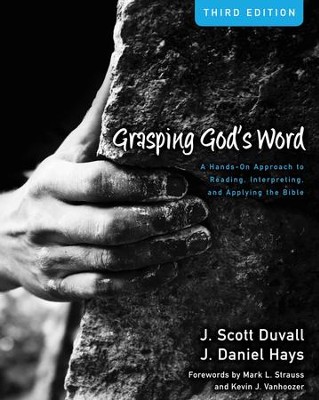
The authors of Grasping God’s Word prefer the term literary meaning as a comparison to the literal meaning.[1] I especially appreciate this rationale because the term incorporates a real and valid spiritual meaning as well. It is a refreshing perspective rather than a purely clinical, sterile, or academic view of God’s word. When the Spirit of God’s authority, influence, and inspiration upon biblical authors is neglected or dismissed, that imposes a hostile vacuum of significance, which can become alarming.

As recently presented within the Truth Matters conference about the Sufficiency of Scripture, personal revelation in the absence of Scriptural truth was rightfully assailed. The hyper-spiritualization of personal and emotional experience must never override the truth of our LORD as the way of Balaam shall never prevail. The canon is closed. Our God is a consuming fire and He must be worshiped in spirit and truth.

Concerning typology, the New Testament serves as a general and necessary guide about what is permitted or acceptable for proper and correct Old Testament interpretation. While we desperately want to find Jesus anywhere and everywhere we can find Him, typologies of Christ are available to us through God’s word in the New Testament. Let the New Testament point to the foreshadowing of Christ in the Old Testament.

[1] J. Scott Duvall and J. Daniel Hays, Grasping God’s Word, 3rd ed. (Grand Rapids, Mich.: Zondervan, 2012), 207.


Continue Reading ·

Theological Criteria of Meaning

Seeker-sensitive individuals can, at times, accept what is imagined among people when reading the biblical text. If imaginations, both creative and wild, reach too far to form false ideas of theological relevance, the outcome can at best result in confusion or contradiction to Scriptural truths. The truths of Scripture that are made clear are often simple, in keeping with the author’s biblical genre and the Spirit of the LORD. A practice that is colloquially known as “twisting scripture” is a distortion of meaning without contemplation, careful thought, or proper biblical exegesis. It can become that which accompanies the absence of critical thought for questionable gain.

Honor Intended Meaning

To find Christ in every single area of the biblical text is to betray the intended meaning given by the authors of Scripture. The word of YHWH is precious and the source of life. It is written to save the souls of those who are His (James 1:21). It should be revered, loved, and honored with such a high view that interpretation never becomes a source of confusion to shape misguided conclusions. It is possible to go too far in seeing Christ in the Bible.

Consider the context of Proverbs 6:6-8, where it is written, “Go to the ant, O sluggard, Observe her ways and be wise, which having no chief, officer or ruler, prepares her food in the summer and gathers her provision in the harvest.” Where is Christ in that segment of text?

We do have helpful guidelines to walk through and keep our conclusions coherent and on point. Specifically, with the intended meaning of Scripture. [1]

  • The principle should be reflected in the biblical text.
  • The principle should be timeless and not tied to a specific situation.
  • The principle should not be culturally bound.
  • The principle should be consistent with the teaching of the rest of Scripture.
  • The principle should be relevant to both the biblical and the contemporary audience.

Theological Criteria of Meaning

This outline serves as a criterion to identify a valid theological principle. If we seek to find correlations with Christ and foreshadowings of Him in Scripture, we can apply this outline to ensure we are on the mark in forming reliable conclusions about what the LORD wants us to understand and accept.

It is especially useful to reference the Biblical Map of written text across genres. A principle we come upon using this guideline must fit or correlate with the rest of the Bible, as indicated in our outline above. This criterion helps to qualify theological principles eligible for acceptable use. An overall effort to include relevant passages about the person and deity of Christ, His mission, and permanent status as our LORD and King.

[1] J. Scott Duvall and J. Daniel Hays, Grasping God’s Word, 3rd ed. (Grand Rapids, Mich.: Zondervan, 2012), 45, 262.

Continue Reading ·

Circles of Context

This post is about how to gather, sort, filter, and orchestrate words from root Scripture languages to get at a New or Old Testament author’s intended word meaning. It’s about how to do Bible word analysis and avoid false interpretation or erroneous meaning from Scripture.

Method of Biblical Word Study

For purposes of consistency and as a repeatable exegetical methodology, it is an efficient use of time and effort to do Bible word studies with a proven and well-developed process. This post outlines a process where the analysis guidelines are given by the “Grasping God’s Word” [1] text is adapted to this Bible word analysis method with Logos software.

This walk-through is a highly useful method for carrying out Bible word studies, and it is now central to a personal workflow. The same process is suitable for both the Old and New Testaments and can be done both manually or automatically to a limited extent.

Select Word for Study

  • Words that are crucial to a Scripture passage.
  • Repeated words.
  • Figures of speech.
  • Words that are unclear, puzzling, or difficult.

The outline given below makes trial use of the chosen word “confidence” in Hebrews 4:16 NASB and ESV.

“Therefore let us draw near with confidence to the throne of grace, so that we may receive mercy and find grace to help in time of need. ” – Hebrews 4:16

Determine Semantic Range

Gather a listed range of all possible word definitions using a standard English dictionary.

Do Concordance Work

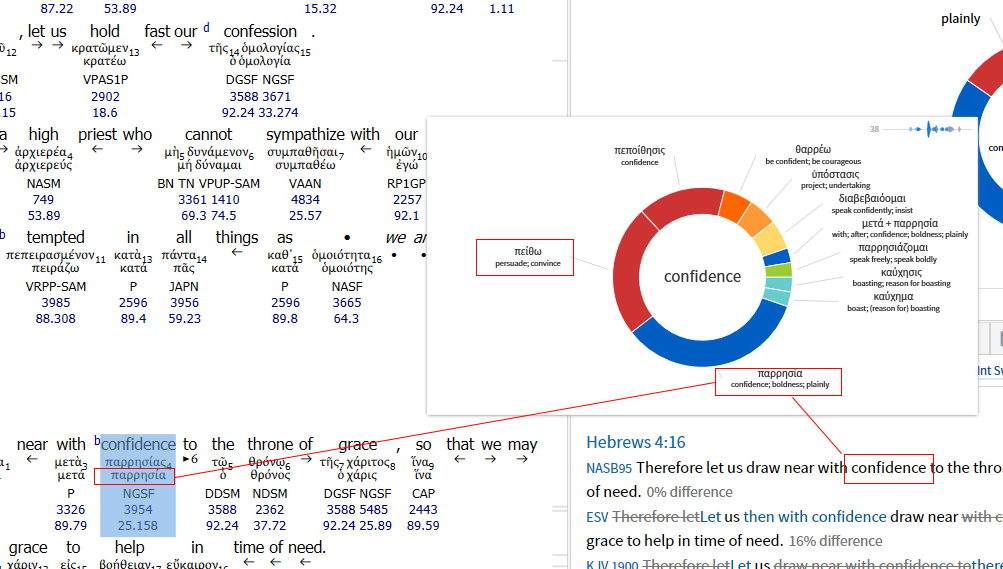
Determine what the word could mean from the original Hebrew or Greek language. This is a further narrowing of the semantic range as it becomes recognized what the words mean in that language. From the original manuscript word, isolate the other word terms to identify their meaning from the reading of the text. In this example, the Greek word for “παρρησία” (parrēsia) could mean “confidence,” “plainly,” “boldness,” “public, publicity,” or “openly, openness.”

Several modern Bible translations can now align with one another as the word chosen for analysis become compared between text translators. All translations taken together in the concurrently listed form should translate from the same original word.

Drill down into the circular word definition segment to separate the term given in Greek. By extracting this term for greater precision, it then becomes possible to see the differences among all variability. By process of elimination, we can from there conclude the word has a “confidence, boldness, plainly” meaning. As compared, for example, to “persuade” or “convince,” which isn’t the rendered word used by the author. We can, therefore, understand from the word choice that a person isn’t to approach the throne of grace of the LORD Most High to “persuade” or “convince”.This method can sometimes reconcile rendered word differences between various formal or informal Bible translations.

Examine the Context of Word Analysis

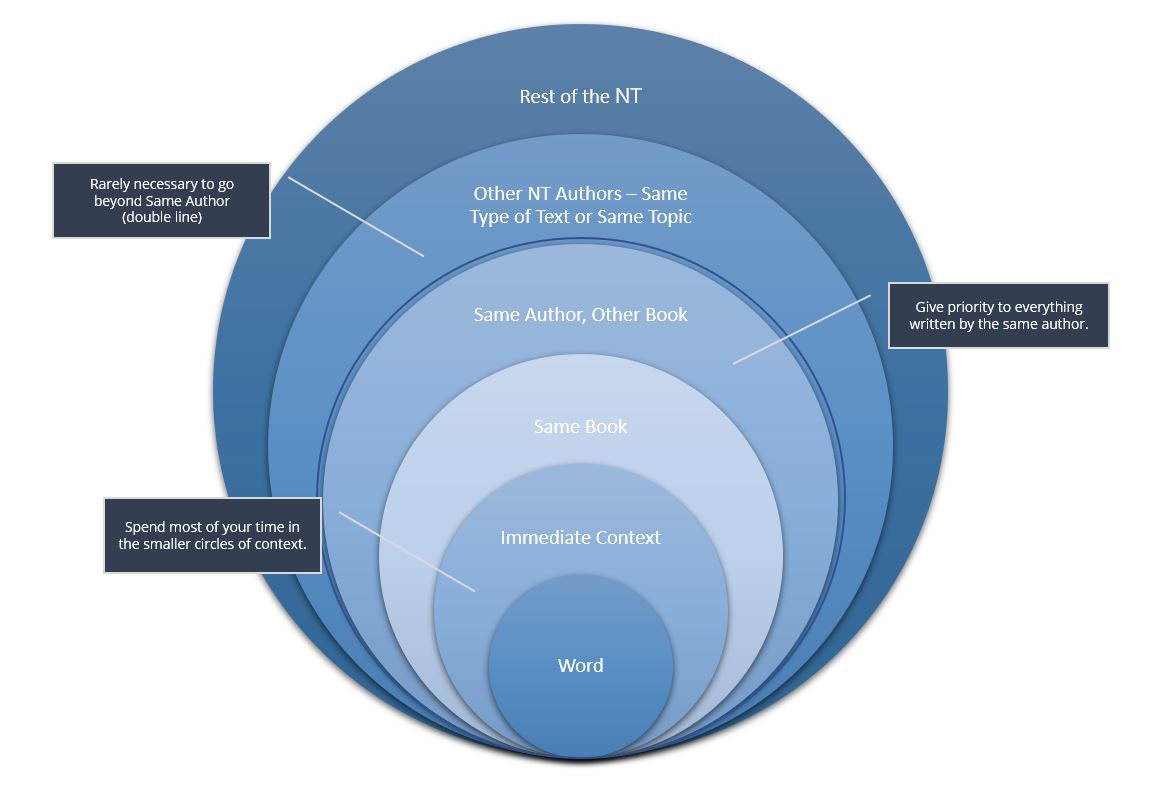
This is a crucial step to determine what the word could mean. From the chosen word for study, examine other sources of context located among biblical passages, as indicated in this diagram below. Imagine this diagram as a 3D Venn-type illustration. With the chosen word study at the top and its surrounding concentric circles of context beneath, examine progressive levels of context while extending outward. Each circle supports or reinforces its suitable meaning.

Look up all verses associated with the separated word to identify commonalities in meaning elsewhere. With the same author and then all verses together that make use of the specific word through the same covenant (OT or NT).

To assure faulty logic is not applied to word analysis and arrive at a false conclusion, test, or screen the rationale for a prospective and interpreted meaning. Specifically, this is to check tentative findings against any potential pitfalls. If the word-analysis fails any of these tests, the process must begin again. The process must remain iterative until there is a high degree of certainty about a word’s interpreted meaning.

Watch for Fallacies of Interpretation

English-Only Fallacy

This occurs when you base your word study on the English word rather than the underlying Greek or Hebrew word.

Root Fallacy

Falsely concludes that the real meaning of a word always comes from the original root or etymology of the word. For example, a butterfly is not a fly soaked, or coated in butter.

Time-Frame Fallacy

This occurs when the definition or meaning of a term in modern use is read back into Scripture, or applied to biblical times.

Overload Fallacy

An acceptance that a word means every definition within its semantic range.

Word-Count Fallacy

To conclude that a word has the same meaning every time it occurs.

Word-Concept Fallacy

A false assumption that the full meaning of a concept is the same as the meaning of a single word. The meaning of a concept is bigger than a single word.

Selective-Evidence Fallacy

Choosing an interpreted word that matches our preference while we dismiss evidence that contradicts our view.

Conclude the Author’s Intended Definition and Use of the Word

Specifically, for the verse interpreted inside the passage and within context, it is safe to conclude and accept the intended meaning of the word.

[1] J Scott Duvall and J. Daniel Hays, Grasping God’s Word, 3rd ed. (Grand Rapids, MI: Zondervan, 2012), 163 – 184.
[2] Ibid. 177.
[3] Ibid. 164 -166.

Continue Reading ·

Method & Meaning

An inquiry into scriptural interpretation is such a crucial question to answer and get correct. It goes right to the heart of not only what we understand about who Jesus is and what His interests are, but how we understand what God is saying to us in our local and time-specific context. All of Scripture calls attention to Jesus from the earliest of Old Testament times right up to what Scripture communicates today and beyond.

The practice of reading and searching the truth of Scripture comes with an obligation to understand it in its unique context. Specifically, to interpret and get relevant and accurate meaning from the text. While reading through a message of specific interest, it is necessary to view and understand the surrounding circumstances of a story or discourse.

While the Holy Spirit helps to bring awareness to presuppositions that affect understanding of His Word, we are to recognize linguistic use, social reconstruction, culture, traditions, preconceived assumptions, political realities, and historical facts conveyed to us. So our hermeneutical methodology during study or even devotional time must attend to the breadth and depth of the Word revealed by the LORD.

How we come to understand and apply the Word of the LORD is hypercritical. We must believe the LORD provided and preserved His Word for us to get to the messages and principles He intended. In practice, by attending to events, occurrences, or writings from biblical authors among various genres. We seek to grasp the who, what, where, when, and why of meaning in the original context. It is a conscious effort to sustain a viable understanding of His eternal Word and apply it.


Continue Reading ·

Perspective & Meaning

To effectively contextualize meaning from Yahweh through the authors of Scripture, the biblical reader eventually comes to recognize that God inspires all Scripture (2 Tim 3:16). Where along with an indwelling Spirit, a reader gets at intended meaning that takes into account a biblical context. Specifically to appropriate original meaning in a powerful, relevant, and truthful way.

Across time, worldviews, and cultures, a reader takes a position from authorial intent to recognize scriptural specifics and principles. To appropriate and contextualize meaning for his or her circumstances over a lifetime.

An absent or disconnected author from textual communication with multiple potential language conflicts can allow for numerous possibilities in meaning from nonsense to that which goes well beyond linguistic intent. Furthermore, communicative intentionality can become lost along a spectrum between what is transmissive or expressive. Such as a range of biblical Epistles, and Poetry to a narrative storyline somewhere in the middle.

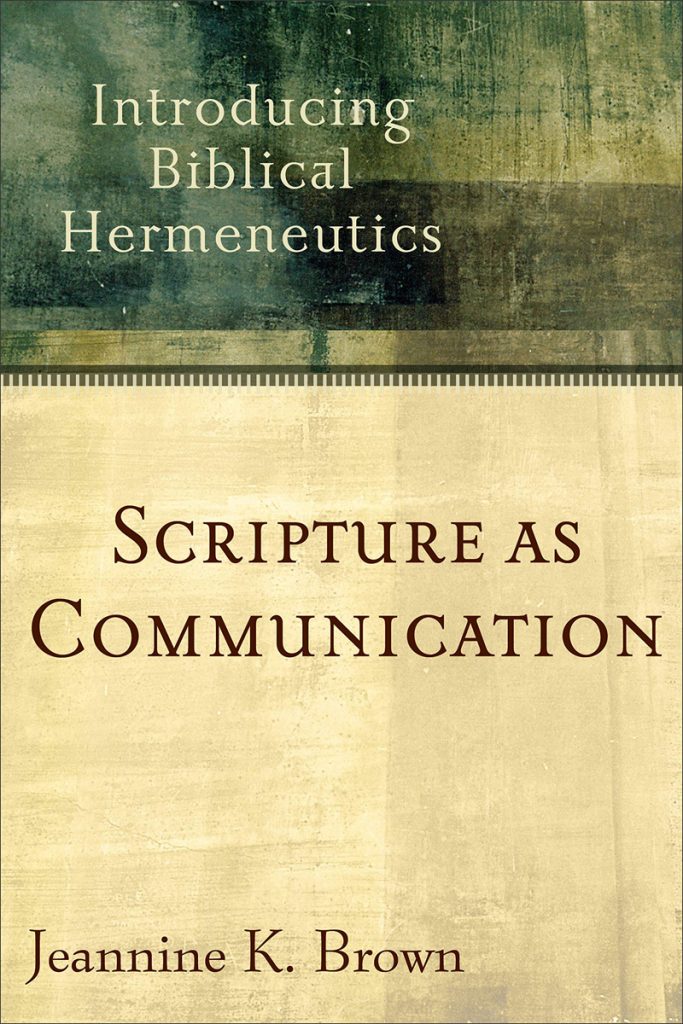
While poetry and some forms of narrative communication are relatively safer to accurately interpret and get at relevant meaning without authorial intent and control, an author’s objective and transmissive intent are not. Transmissive meaning that is instructional or objective at its surface is independent of an author, as illustrated on Brown’s communication spectrum of intent.

While there are often presuppositions between an author and reader that affect textual meaning. With those, there are risks of misinterpretation from a reader to suit intended or unintended personal interest. A misreading can, in turn, result in unfavorable or harmful outcomes. Whereas, eventually, readers of text become the authors and assert all-powerful ownership of meaning. “The reader becomes the god of the text whether through assimilation or mastery.”


Continue Reading ·

Words to Live By

In the past week or so, I have still had this lasting appetite to pour daily into Ezekiel. Not in a visceral sense, but as a sheep that nurses to get its energy. Something happens to lighten the heart and spirit by bringing those words into view by holding the pages close and dwelling upon their meaning. Honestly, when Jesus said that we would live on more than bread, but on the word of God, I didn’t take it in the literal sense. I was wrong. It is, in fact, in the literal sense. Once you have a taste, there isn’t a way to live without having those words as a source of wisdom, guidance, comfort, and faith.

“And he humbled you and let you hunger and fed you with manna, which you did not know, nor did your fathers know, that he might make you know that man does not live by bread alone, but man lives by every word that comes from the mouth of the LORD.”

But he answered, “It is written, “ ‘Man shall not live by bread alone, but by every word that comes from the mouth of God.’ ” – Matt. 4:4


Continue Reading ·

Powers That Be

“Therefore write the things which you have seen, and the things which are, and the things which will take place after these things. As for the mystery of the seven stars which you saw in My right hand, and the seven golden lampstands: the seven stars are the angels of the seven churches, and the seven lampstands are the seven churches.” – Rev 1:19-20

Several weeks ago, I began the gradual re-introduction to the KJV. Not to abandon the NASB, but to run concurrently with the archaic and beautiful language in the KJV.

My spirit is still deep into daily reading and study of my NASB, but along with that, I am tracing back all of the same/common written words in this earlier KJV version. Usually a few chapters a day for months now, plus random sections here and there.

There is something deeper and meaningful about repeating the same material with written notes and illustrations side by side. My eyes see the words differently in full absorption of this early translation.


Continue Reading ·

Coram Deo

Last night was a full immersion in page after page of those Holy words again. Written to say what it does and not to appear as ink on pages and pixels in view. I went very late and lost track of time, but it didn’t matter—principles upon principles and definitions. Phrases in Greek read, spoken, and enunciated. These were parallel meanings and close antonyms.

“Tua Da Gloriam Non Nobis Domine Non Nobis Sed Nomini”

Saints and who they were and what they believed. What they did and did not do. Apostle Paul’s relationships and hardships, his offenses, and what he was committed to. His passion for the kingdom for the sake of the elect. By happenstance came upon the words ‘reign’ and ‘rebuke’ again and again—no idea why.

And today, while out and about it dawned on me that the reason I felt so alive and renewed was because of what came from that time spent—fully delved in meaning for the renewal. There were words I saw and felt that served as nourishment.

So I was reminded that what Jesus said is that the reborn shall not live by bread alone but by his Words. So very literally true, but that wasn’t what was so incredibly awakening. That evidence of the reborn is by what sustains it. It’s those words and meanings that were needed. They were craved then, and I don’t think that will ever go away. It was a promise made clear in an unexpected way.

So today was a different kind of energy. A gift of strength inside that comes for just long enough in the moment. Just long enough for the day. Long enough for eternity.

Continue Reading ·