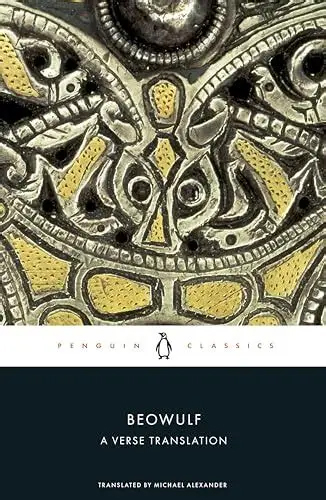
Today I finished Beowulf (202 pages, ISBN: 978-0140449310), translated with an introduction and notes by Michael Alexander. It is an anonymous Old English poem preserved in the Nowell Codex, with the surviving manuscript usually dated around AD 975–1025, though the poem itself is probably older. It is one of the great works near the beginning of English literature, set in a world of Danes, Geats, kings, halls, warriors, feuds, treasure, loyalty, exile, and death.
Introduction
Michael Alexander’s edition is a helpful way into the poem. His introduction gives the reader enough background to understand the older heroic world behind the story: the audience, the ancestors, the poem’s reception, its style, its verse, and the difficulty of translating Old English into modern English. The genealogical tables are also useful, because Beowulf is full of names that can feel distant at first. Those names are not random. They belong to families, kingdoms, old debts, acts of loyalty, and long memories of violence.
That background matters because Beowulf is easy to misread as a simple monster story. The poem is much older and sterner than that. A hall is where a people gather under their lord. A gift carries obligation. A warrior’s courage is remembered after death. A king is judged by how he protects and gives. The poem’s world is harsh, but it is not empty. It has order, honor, grief, and memory.
Book Review
The story begins in Denmark, where Hrothgar, king of the Danes, builds Heorot, a great hall for feasting, song, and fellowship. Then Grendel comes from the darkness and attacks the hall night after night. He is tied to the line of Cain, and his hatred falls on the joy of the hall itself. What should have been a place of music and order becomes a place of fear.
Beowulf, a warrior of the Geats, crosses the sea to help Hrothgar. He comes with a name, a lineage, and a reputation to uphold. He faces challenge before he faces combat, and that is part of the poem’s strength. This is a world where words, vows, and public honor have force. When Grendel enters Heorot expecting helpless men, Beowulf seizes him and tears away his arm. The hall is freed.
Then Grendel’s mother comes for revenge. She kills Aeschere, one of Hrothgar’s trusted men, and retreats to the mere. Beowulf follows her below the water, where the fight becomes stranger and more dangerous than the first. His ordinary weapon fails, and he survives by taking up a giant sword found in that dreadful place. The episode feels darker because it is not only about attack, but about vengeance, grief, and old violence.
After Denmark is delivered, Beowulf returns home to Geatland. He gives treasure to Hygelac, his lord, which shows the order of his world. Glory is not kept as private property. It is returned into loyalty and service. Years pass, and Beowulf becomes king of the Geats.
The last part of the poem belongs to the dragon. A buried hoard is disturbed, the dragon burns Beowulf’s land, and the old king goes out to face it. Most of his men run. Wiglaf remains. That moment gives the ending much of its force. The old bond between lord and retainer is tested, and nearly everyone fails it.
Beowulf kills the dragon, but he receives his death wound. The treasure is won, but the king who won it cannot stay to guard his people. His funeral by the sea is a fitting end to the poem: solemn, beautiful, and heavy with loss.
What stays with me is the poem’s honesty. Beowulf gives honor to courage, kingship, loyalty, and fame, but it never lets them escape death. Halls burn. Treasure is buried. Kingdoms weaken. The hero dies. Still, the poem does not treat courage as wasted. It leaves the reader with the sense that brave and faithful deeds are worth remembering, even in a world where every earthly glory passes away.
Reflections
What stayed with me after finishing Beowulf is the poem’s treatment of glory. It honors courage, kingship, loyalty, and fame, but it leaves all of them under the shadow of death. Beowulf is brave, generous, and worthy of remembrance, yet his strength cannot finally secure his people. His last victory ends beside his own grave. The treasure is won, but it cannot save. That is where the poem becomes especially searching for a Christian reader. Human glory is not false simply because it is human; courage, faithfulness, and noble rule are real goods. But when human glory is treated as final, it becomes theft. “Not unto us, O LORD, not unto us, but unto thy name give glory” came to mind, as did the warning that the Lord will not give His glory to another. The poem does not preach those verses, but it makes their truth felt. All flesh is grass. Treasure fails. The name of even a great man must stand beneath the name of God.
That also helped me place Beowulf beside the great ancient epics. The Iliad gives the grief of wrath, honor, and death on a vast battlefield. The Odyssey gives the long hunger for home. The Aeneid carries the burden of founding a people under destiny and loss. Beowulf is smaller in outward scale, but it is not slight. Its world is colder and sparer: the hall, the mere, the hoard, the dragon, the funeral mound by the sea. After reading The Divine Comedy, the difference is even sharper. Dante carries the soul through judgment toward the vision of God. Beowulf remains in the twilight of heroic memory. It can honor the good king, the faithful retainer, and the brave deed, but it cannot raise the dead. It makes the reader feel the need for a glory beyond fame, a kingdom beyond the hall, and a victory beyond the dragon.
That is what inspired me most: not mere strength, but faithfulness under mortal conditions. Beowulf crosses the sea to help Hrothgar. He descends into the mere when grief returns to the hall. In old age, he goes out against the dragon because his land is burning. Wiglaf remains when the others flee, and that single act of loyalty may be the most piercing human moment in the poem. That is why the poem still inspires: it does not deny death, yet it refuses to make courage meaningless. The final pages left me with admiration and warning together. The hero dies. The people mourn. The mound rises by the sea. The poem gives Beowulf honor, but it does not give him salvation. It leaves his greatness where all earthly greatness must finally stand: remembered by men, judged by God, and finally answered only by the greater victory that Christ gives over death.


Comments are closed.