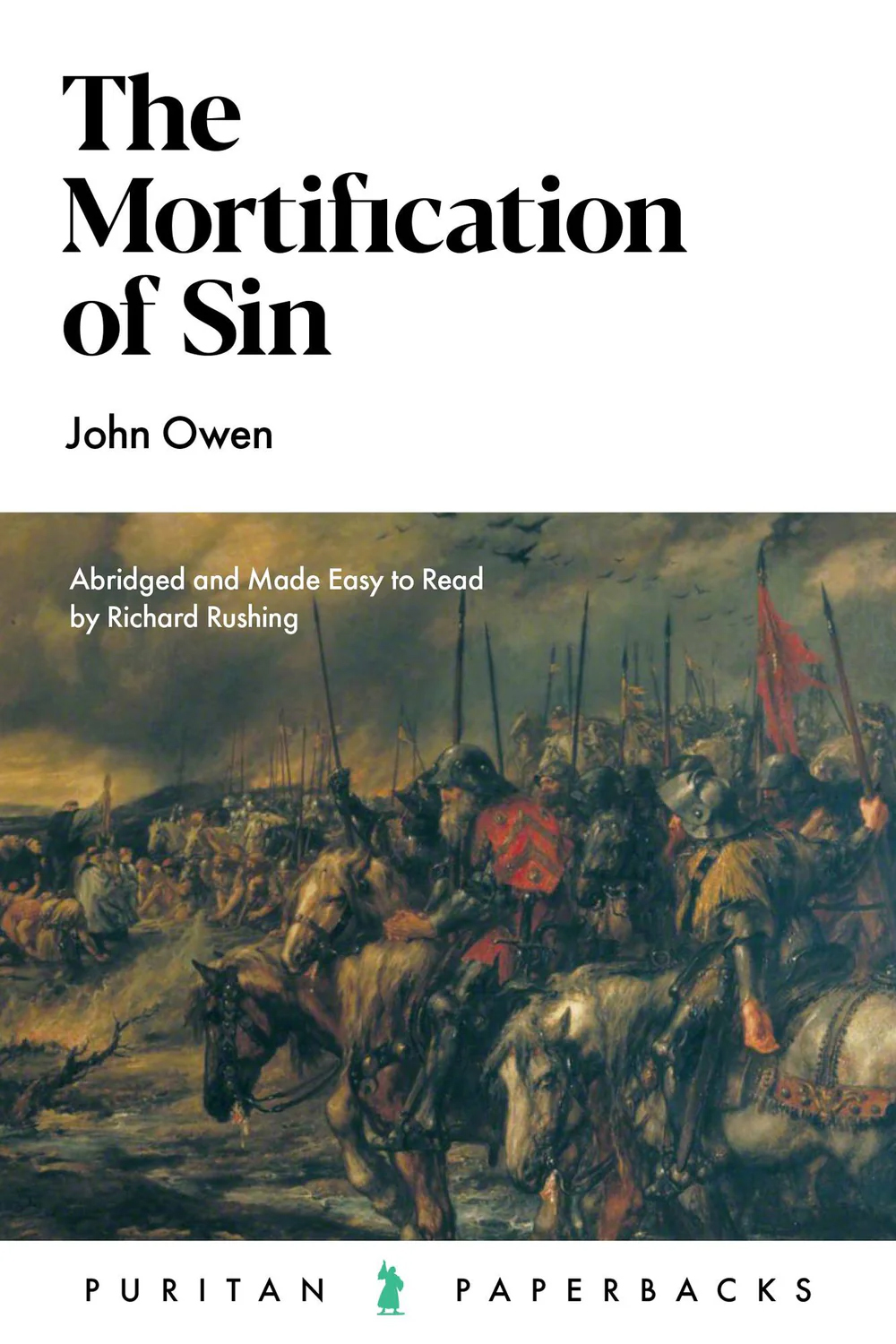
For quite a long time, I’ve had an abridged version of John Owen’s The Mortification of Sin published by Banner of Truth. It’s about 130 pages long and spans 14 short chapters, just like the unabridged version. However, it was written in significantly different prose to retain the thoughts throughout the book’s structure and format. As it was so different and written in an “easy to read” style (as indicated by its cover), the editor (Richard Rushing) updated John Owen’s old English to modern terms and phrases. The text changes went far beyond that compared to Owen’s written work. So, I turned my attention to the unabridged version and went through that until completion. The written copy I have is from The Works of John Owen, Volume 6 of 16, part 1 (“The Mortification of Sin in Believers”).1 John Owen wrote this treatise on killing sin many years before this publication date of 1862, but the subject matter was carried forward differently and directly for a more thorough understanding.
While this book section, The Mortification of Sin in Believers, is short, it is highly dense in meaning and urgency. This first pass was an effort to clear through the book (section 1 of volume 6) without analyzing or dwelling on anything. The overall effort was to convey the message and meaning through a read-through of a Puritan’s perspective on what the Apostle Paul wrote to the churches in Rome and Colossae. Specifically, the 17th-century Puritan was deeply concerned about sin in the lives of believers, and he wrote a widely read examination of what it means to put sin to death. While the mortification of sin was John Owen’s pressing concern, he offered encouragement, exhortation, clarity, and guidance on what sin is and what it does. He had specific thoughts about what it is to eradicate its root by the Spirit and the involvement of the believer’s intentional will.
“For if ye live after the flesh, ye shall die: but if ye through the Spirit do mortify the deeds of the body, ye shall live.” – Romans 8:13 KJV.
“Mortify therefore your members which are upon the earth; fornication, uncleanness, inordinate affection, evil concupiscence, and covetousness, which is idolatry: For which things’ sake the wrath of God cometh on the children of disobedience.” – Colossians 3:5-6 KJV.
This is not a book that can be read once and passed through without much contemplation or self-reflection. Sin is so grave that it eternally damns people, according to scripture. Owen, just as Paul did, wrote of “mortifying” it. As mortification is an old English translation, it corresponds to “putting to death” in modern translations (ESV, NIV, NKJV, HCSB, and more). The term “mortify” is translated identically in both references in Romans 8:13 and Colossians 3:5, even though their Greek roots are different.
Furthermore, mortification, or mortify, is understood from multiple perspectives, all of which are consistent in meaning. “The act of self-denial or the ‘putting to death’ of sinful instincts or cravings to have freedom from sin and to live in the power of the Holy Spirit. The NT stresses that this act of humiliation comes about through the grace of God. It is the result of, not the condition for, conversion.” The key passages Paul wrote correspond to numerous principles Owen stressed, and together they support the Reformed tradition.
Mortification: The process of “putting to death” one’s sinful nature as the old self, which continually struggles because of the reality of indwelling sin. This process takes place in the lives of believers who, while they have been set free from sin’s dominion by the indwelling Holy Spirit who unites them to Christ, are called to live in light of God’s grace as they actively work out their salvation. …. if it is truly part of sanctification, it must be accomplished through the Spirit of Christ in dynamic interplay with a believer’s response of repentance; mere human effort does not result in increased freedom from sin, even if it changes outward behavior.2
To Owen’s point in his book, while a person can successfully overcome sinful behaviors, that doesn’t necessarily mean that the instincts and cravings have been put to death. Compared to Reformed theology, Catholicism also emphasizes Galatians 5:24, where it is necessary to “crucify the flesh.”3 As some English translations render “consider as dead” (NASB, LSB) in a passive sense, many other translations (including various Catholic translations) are active with the “put to death” language. For example, the “Little Rock Catholic Study Bible,” “New American Bible: Revised Edition” (NABRE), “The Revised Standard Version, Catholic Edition” (RSVCE), “Douay-Rheims Bible” as mortify (D-R), and the “Ignatius Bible: Revised Standard Version, Second Catholic Edition” (RSV2CE) all express the same meaning. When delving further into the definition of the terms nekroō (νεκρόω) in Colossians 3:5 and thanatoō (θανατόω) in Romans 8:13, they both correlate to the “put to death” sense of meaning. The Louw-Nida Greek-English Lexicon of the New Testament treats both terms as figurative, with suggestive meanings, where intended readers understood the original root manuscripts as conventional figures of speech to convey the same idea.4
Owen is clear in his book that mortification is not a passive posture of sin in the flesh, nor is it mere recognition or consideration from a believer. He stresses that it is an active, conscious effort on the part of someone who has become a believer by faith and repentance. However, he also recognizes that the process of mortification is lifelong, and it depends solely upon the Spirit of Christ to definitively accomplish the continued crucifixion of sin in the life of a believer. The believer is participative by necessity, but is not the practical and final means of mortification. The Spirit of Christ is who does the work. As sin was put to death in the sacrifice and resurrection of Christ Jesus, the law of death is applied to sin itself in the lives of believers. Where the Spirit lives within believers, there is the law of life by the Spirit as long as there is no yield to sin. That sin is persistently, iteratively, and ruthlessly killed actively against particular offenses. Mortification is “the slaying of the disease of the soul, and by slaying this disease, it restores and invigorates the soul’s true life.” 5
To further give careful thought about directions, general rules, assertions, means, and the heart, it is of salvific concern to camp on Owen’s written views as supported by scripture. He doesn’t attempt to assign weight to tradition or works of the law. Still, that mortification of the flesh is an intentional effort of faith, necessary to sanctify believers who work out their salvation with fear and trembling (Phil 2:12-13). As it is impossible to earn salvation through works or efforts that yield positive outcomes and the removal of sins, if efforts of mortification are not by faith, they are of no spiritual value. Owen asserts that such progress involves replacing sins with others in the absence of the necessary faith, through the heart of a believer, concerning the treacherous and destructive nature of sin. Under the authority of God’s Word as written by the Holy Spirit through the Apostle Paul, those who live by the flesh will die. In contrast, those who live by the Spirit shall live. To be more explicit, regarding the term “flesh” (Rom 8:13 KJV), John Chrysostom (347 – 407 A.D., Archbishop of Constantinople) refers to it as follows: “what Paul means by the flesh in this passage is not the essence of the body but a life which is carnal and worldly, serving self-indulgence and extravagance to the full.” 6
Owen’s readers might also remember Jesus’s parable of the rich man and Lazarus (Luke 16:19-31). And specifically, verse 25: “But Abraham said, ‘Child, remember that you in your lifetime received your good things, and Lazarus in like manner bad things; but now he is comforted here, and you are in anguish (see Luke 6:24; Job 21:13; Ps. 17:14). The comparative man who fared “sumptuously” (Luke 16:19) was condemned. Where the rich man in the parable was delighted, glad, and enjoying himself in celebration and rejoicing by dining and merriment, there was apparent opulence that highlighted the disparity between him and Lazarus.
While this is a short book review on the unabridged version of The Mortification of Sin, it is about the abridged version from Banner of Truth Trust and the more comprehensive version in volume 6 from T&T Clark as part of the sixteen-volume set published in 1862 (MDCCCLXII). The first pass through the book is insufficient for a reader to grasp the necessary points of study and understand the subject matter. A surface reading to get a topical understanding of what Owen wrote doesn’t support the best in terms of retention and application. To more fully grasp what Owen wrote here concerning the killing of sin is a weighty subject. Whether a reader’s immersion in the text is through the abridged or unabridged version, this is a book to iterate upon. My first time through this book thoroughly informed me about why John Owen is so widely read and studied. Nevertheless, his pressing concern about the lifelong urgency of killing sin within is not a daily call to repentance but a persistent and ruthless inward campaign to find and destroy anything innate that raises itself against God and the Spirit of Christ.
Citations
___________________________________________ 1 John Owen, The Works of John Owen, ed. William H. Goold, vol. 6 (Edinburgh: T&T Clark, n.d., 1862). 2 Kelly M. Kapic and Wesley Vander Lugt, Pocket Dictionary of the Reformed Tradition, The IVP Pocket Reference Series (Downers Grove, IL: IVP Academic, 2013), 76. 3 Charles G. Herbermann, Edward A. Pace, et al., eds., “Mortification,” The Catholic Encyclopedia: An International Work of Reference on the Constitution, Doctrine, Discipline, and History of the Catholic Church (New York: The Encyclopedia Press; The Universal Knowledge Foundation, 1907–1913). 4 Johannes P. Louw and Eugene Albert Nida, Greek-English Lexicon of the New Testament: Based on Semantic Domains (New York: United Bible Societies, 1996), 660. 5 Ibid. Herbermann. 6 John Chrysostom, “Homilies of St. John Chrysostom, Archbishop of Constantinople, on the Epistle of St. Paul to the Romans,” in Saint Chrysostom: Homilies on the Acts of the Apostles and the Epistle to the Romans, ed. Philip Schaff, trans. J. B. Morris, W. H. Simcox, and George B. Stevens, vol. 11, A Select Library of the Nicene and Post-Nicene Fathers of the Christian Church, First Series (New York: Christian Literature Company, 1889), 434–435.
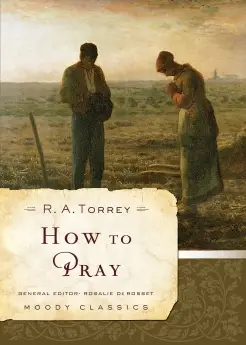
In recent months, I’ve had a growing interest in prayer, and I’ve been gathering subject matter about the reasons for it and how its continued use is critical within the believer’s life of faith and practice. Prayer is how people communicate with God, and there are many biblical examples within the Old and New Testaments concerning what that means and involves. Jesus spoke of prayer to teach His followers how to pray properly in spirit, sincerity, and truth according to individual and group needs according to God’s will and interests (Matt 6:5-15). With some further interest, I’ve brought together additional relevant titles that shall be read to understand prayer at a greater depth, but this written work is from R.A. Torrey’s short book, How to Pray.
Background
From a Protestant perspective, they are from Reformed and Wesleyan traditions to get a narrowly diverse view about what prayer is, how it functions, and its purposes by examples from within Scripture. Catholic & Orthodox perspectives are considered for further understanding and review in forthcoming separate reviews. These titles are read and closely tracked with notes to clarify what prayer is from various traditions and confessional commitments. The book, How to Pray is a public-domain classic historically read widely among evangelicals. The author has written numerous books and comes from a faith tradition relevant to early perspectives from 20th-century Western Christianity to today. The book review and summary presented here are from the unabridged text within the Moody Classics series from Moody Publishers (ISBN-13 978-0-8024-5652-6).
R.A. Torrey’s “Little Book on Prayer” is 121 pages in a 5” x 7” format, and it covers vital concerns about life in “conversation” with God. While his writing comes from the worldview of Torrey as an early 20th-century Protestant minister, it is clear that the terms and principles come from language inherent in Western civilization at the time. The book has a wild-west tone as Torrey’s spiritual development is from the late 1800s. The book was written and in circulation just after the U.S. Civil War (1861–1865) but before World war I (1914–1918) and II (1939–1945). While How to Pray was written after the industrial revolution between about 1820 through 1840, Western civilization slid into decades of moral descent while humanity underwent the historical “development” of modernity beginning about 1910. After modernism peaked in the 1960s, U.S. cultural and sexual revolutions gave a further pretext for postmodern worldviews to shape societies, governments, academia, economies, and liberalism.
Before some evangelical denominations from liberal traditions sank into moral relativism and decay through their participation in postmodern society’s interests, it surrendered biblical imperatives concerning racial, social, and economic justice with warnings about moral and sexual ethics contrary to centuries of Scriptural interpretation according to the intent of Old and New Testament writers. As R.A. Torrey’s written views come from this era, he objected to the pressures of modernity upon seminaries and the church. And while he didn’t ascribe to a single denomination,1 he was a proponent of Keswick theology,2 which was a partition of theological persuasion aside from the “Arminian strain of Wesleyan thought” and unlike Methodist leaders who dominated the Holiness Movement. As Keswick theology was more within the Calvinist tradition,3 Torrey was a congregationalist in alignment with presbyterian polity. Torrey routinely informed his audiences that he was ‘Episcopresbygationalaptist!‘
From the 19th century to today, the historical presence of Wesleyan thought, and feminist ideology among Methodist traditions of evangelicalism had a significant bearing on the development of Western Protestantism. In contrast to the social and ecclesial priorities of Methodist interests concerning capitulations to modernity, R.A. Torrey was a revivalist and anti-modernist. He was one of the founders of the fundamentalist movement4 before broader evangelicalism superseded it to import various denominations with hidden egalitarian leanings to assert progressive “unity” and soften the edge of biblical adherence of believers to Scriptural faith and practice within modern society. “Fundamentalism” had become a pariah and a pejorative within Western Christianity, just as “Protestantism” was to Catholicism for different reasons. Today, the readership of R.A. Torrey’s How to Pray is situated within evangelicalism that is largely spiritually weak, biblically illiterate to a significant extent, and either in denial or uninformed concerning what Christ expects of His church.
As indicated before, this title, How to Pray, is accompanied by further reading among other faith traditions. Namely, these additional titles shall be reviewed and cited among various others to balance how I begin with Torrey’s work. Eastern Orthodox and Puritan writings on prayer shall also get due attention, but these are well-known with favorably earned reputations.
The Complete Works of E.M. Bounds by E.M. Bounds – The Essentials of Prayer, The Necessity of Prayer, The Possibilities of Prayer, Power through Prayer, Prayer and Praying Men, Purpose in Prayer, The Reality of Prayer, The Weapon of Prayer
An Exposition on Prayer in the Bible by Dr. James Rosscup – Volumes 1 through 4, Expositions from Genesis to Revelation
Fire Within by Dr. Thomas Dubay – St. Teresa of Avila, St. John of the Cross, and the Gospel – on Prayer
R.A. Torrey’s book on prayer spans 12 chapters concerning methods of communication with God involving preparation, state of being, and intentionality. As Christ Jesus taught His disciples how to pray (Luke 11:2-4), He provides a model to follow (Matt 6:5-15). Moreover, he gave guidelines about what not to do during prayer. It is His prayer that sets the New Covenant baseline model for prayer, but there are numerous prayers throughout Scripture that serve as examples. Prayers offered to YHWH originate from the patriarchs and extend to kings, priests, prophets, poets, saints, and puritans throughout the centuries. God heard the prayers we read in Scripture, and believing readers are inspired and motivated to understand their meaning to pray familiarly as models for us to aspire. The prayer of God incarnate to God the Father is the pedagogical model we witness in Scripture, but we also have Jesus’ prayer within the gospels to learn much from. For example, the prayer through John 17 is for all people to marvel at its substance and beauty as the LORD’s relationship to the Father is of enormous spiritual significance.
Yet during the course of daily life, as a disciple asked Jesus how to pray, these were His words for us today.
The Lord’s Prayer
And he said unto them, When ye pray, say, Our Father which art in heaven, Hallowed be thy name. Thy kingdom come. Thy will be done, as in heaven, so in earth. Give us day by day our daily bread. And forgive us our sins; for we also forgive every one that is indebted to us. And lead us not into temptation; but deliver us from evil.
– Luke 11:2-3 KJV
In The Dark Hallway of Prayerlessness
The editor of this book, Dr. Rosalie de Rosset, wrote an utterly delightful introduction to Torrey’s little book on prayer, How to Pray. Dr. Rosset is a retired Literature, English, and Homiletics professor at Moody Bible Institute. She earned an M.A. in English from Northeastern Illinois University, M.Div. from Trinity Evangelical Divinity School and a Ph.D. in Language, Literacy, and Rhetoric from The University of Illinois at Chicago. Her summary of Dr. Torrey’s life work was also recounted with her own experiences and affections about prayer that draw the reader into the book with a fresh and open perspective. As prayer is a blessing and privilege, she reminds us that the discipline of it is a source of reward that suggests peace, joy, rest, and contentment. She read numerous books on prayer, both old and new, and she served as a wonderful and fitting editor of this book by R.A. Torrey. Her passing through the dark hallway of prayerlessness was written touchingly by her reading and heartful presentation of this little prayer book. A book that should inspire anyone who may want to draw close to God and speak.
The Importance of Prayer
As Torrey begins his book, he answers the questions about why prayer is essential. He specifically wrote that prayer must be constant, persistent, sleepless, overcoming, and necessary. There were eleven reasons Torrey listed to explain why prayer carries such an urgency to remain disciplined and continuously about it.
There is a devil -An evil influence that seeks to ensnare believers who relax in prayer.
Prayer is God’s appointed way of obtaining things, and the great secret of all lack in our experience, in our life and in our work is neglect of prayer.
Men whom God set forth as a pattern of what He expected Christians to be—the apostles —regarded prayer as the most important business of their lives (Rom 1:9, Eph 1:15-16, Col 1:9, 1 Thess 3:10, 2 Tim 1:3).
Prayer occupied a very prominent place and played a very important part in the earthly life of our Lord (Mark 1:35 Luke 6:12).
A startling quote from this section of the book: “a man or woman who does not spend much time in prayer cannot properly be called a follower of Jesus Christ.”5
Prayer that seems if possible even more forcible than this, namely, praying is the most important part of the present ministry of our risen Lord (Rom. 8:34, Heb. 7:25).
Prayer is the means that God has appointed for our receiving mercy, and obtaining grace to help in time of need (Luke 11:8, Heb. 4:14-16).
Prayer in the name of Jesus Christ is the way Jesus Christ Himself has appointed for His disciples to obtain fullness of joy (Ps. 16:11, John 16:24).
With thanksgiving, every care, anxiety, and need of life is the means that God has appointed for our obtaining freedom from all anxiety, and the peace of God which passes all understanding (Phil 4:6-7).
Prayer is the method that God Himself has appointed for our obtaining the Holy Spirit (Luke 11:13).
Prayer is the means that Christ has appointed whereby our hearts shall not become overcharged with surfeiting and drunkenness and cares of this life, and so the day of Christ’s return come upon us suddenly as a snare (Luke 21:34-36, Acts 4:31, Acts 8:15, Eph. 6:18).
Prayer accomplishes the following: a. Prayer promotes our spiritual growth as almost nothing else, indeed as nothing else but Bible study; and true prayer and true Bible study go hand in hand. b. Prayer brings power into our work. c. Prayer avails for the conversion of others. d. Prayer brings blessings to the church.
Torrey doesn’t offer scriptural support on this last point (11).
Praying to God
Torrey makes the point that the recipient of prayer is God and that it is necessary to offer prayer to Him constantly. However, he begins by noting that this continuous prayer is also about how to pray with power. To at least infer that the length and intensity by which prayer is offered have a bearing on the recipient when two or more believers gather together in prayer. He elaborates further on three areas of interest.
In the twelfth chapter of the Acts of the Apostles, we have the record of a prayer that prevailed with God and brought to pass great results (Acts 12:5).
The second secret of effective praying is found in the same verse, in the words without ceasing. Rendered as “earnest” in other translations, it carries the tone of a serious, persevering, eager, fervent, and constant heart and intent.
A third secret of right praying is also found in this same verse, Acts 12:5. It appears in the three words “of the church”; there is a special blessing as Torrey interprets Matthew 18:19. Translated quote of Christ Jesus: “If two of you shall agree on earth as touching anything that they shall ask, it shall be done for them of my Father which is in heaven.”
Note: The word “touching” (προσψαύω) rendered by the KJV, ASV, or ERV doesn’t appear in early manuscripts [4th-century Alexandria (Sinaiticus majuscule)].
The duration and intensity of group prayer appear to have a bearing on how effective prayer is in terms of power. Still, it must be said that God is not beholden to group pressure or the substance of a group’s prayer (and its persistence or intensity) to get what’s requested, even if motives are pure. God’s promises are true, and He fulfills them as recorded within Scripture; however, as He does fulfill His promises, it is by His will and sovereign intent about how He does that.
Obeying and Praying
The book comes to a critical point regarding the relationship between prayer and obedience. Torrey brings the reader’s attention to 1 John 3:22, where the biblical author makes clear a correlation between what we ask and receive to doing what He instructs and what pleases him. In this context, the term “because” is set as a conjunction, not to indicate a cause-and-effect relationship between an antecedent and result but a correlation between obedience, loyalty, and love with answered prayer.
“Beloved, if our heart does not condemn us, we have confidence before God; and whatever we ask we receive from him, because we keep his commandments and do what pleases him.” – 1 John 3:22
Torrey stresses the point that it is necessary to do what pleases God, not only that which constitutes simple obedience according to His Word through Scripture. The spirit of what pleases God in a believer’s faith and practice is a matter of principle according to what the Spirit produces as fruit (Galatians 5:22). Moreover, an internal conviction of the Holy Spirit that serves as a source of discernment shall be sought and honored to please God as well.
Praying in the Name of Christ and According to the Will of God
Consistent with each chapter of this book on prayer, Torrey structures his points in an ordered and numbered fashion. Previous chapters pertain to the reasons for prayer, prayer directed to God individually or in the corporate gathering of believers, and the necessity of obedience with a right heart of love for God. In this way, the believer is advised to pray in the name of Christ Jesus, as the name of Christ has power with God. God the Father is well pleased with Jesus Christ. Christ Jesus, the Great Advocate of believers, is heard by God the Father.
It was a wonderful word about prayer that Jesus spoke to His disciples on the night before His crucifixion, “Whatsoever ye shall ask in My name, that will I do, that the Father may be glorified in the Son. If ye shall ask anything in My name, I will do it.”
Great light is thrown upon the subject “How to Pray” by 1 John 5:14-15: “And this is the boldness which we have toward Him, that if we ask anything according to His Will, He heareth us: and if we know that He heareth us whatsoever we ask, we know that we have the petitions which we have asked of Him.”
To further understand the will of God either by general or special revelation from Him, Torrey draws the reader’s attention to Scripture as the Word of God (Luke 11:13, James 1:5) and by the help of the Holy Spirit. To quote Torrey’s emphasis on God’s word to discern the Lord’s will, he wrote the following:
“To study the Word to find what God’s will is as revealed there in the promises, and then simply take these promises and spread them out before God in prayer with the absolutely unwavering expectation that He will do what He has promised in His Word.”6
Apostle Paul wrote to the church at Rome (Rom. 8:26-27) concerning the help from the Holy Spirit as He intercedes for us. He prays for the saints according to the will of God. As the Holy Spirit intercedes for us, Torrey also draws our attention to the confidence we have in Christ, as made clear in 1 John 5:14-15. Furthermore, this love banishes self-condemnation, resulting in confidence in every believer’s relationship with God.7
Praying in the Spirit
Torrey references two passages that call attention to prayer in the Spirit. Ephesians 6:18 and Jude 20 explicitly refer to “praying in the Spirit” to indicate a person’s state of being while communicating before God. The Holy Spirit helps believers in Christ before the Father (John 14:16-17) through personal weakness (i.e., “the Spirit helpeth our infirmity” according to Romans 8:26). Torrey says explicitly that the Holy Spirit teaches us how to pray.8 And that “true prayer is prayer in the Spirit; that is, the prayer the Spirit inspires and directs.” Torrey makes this point about the authenticity of prayer because of a concern over praying for the right things in the right way. Where to accompany joy and power, prayer in the Spirit is a necessity. However, his accurate observations from authoritative Scripture appear to be about requests, supplications, or petitions and not explicitly about confession, thanksgiving, or adoration. These further categories of prayer involve praying in the Spirit yet are unaddressed in this chapter.
Over and over again in what has already been said, we have seen our dependence upon the Holy Spirit in prayer.
If we are to pray with power we must pray with faith.
As Torrey makes Scripturally sound points about praying in the Spirit, he also covers the point about praying with faith. Jesus informs His followers that belief is necessary for effective prayer (Mark 11:24), and Torrey includes faith or belief as a component of prayer that requires due attention. Together, prayer in the Spirit and prayer in faith work as a methodology or condition about communication with God that bears undeniable merit as the points are grounded in Scripture, and the teachings of Christ are clear and unambiguous in this area. However, it is essential to recognize that the wider context of Christ’s teachings extends to the scope and the state of the heart of prayer. Carefully observing the gospel witness accounts of prayer serve as a model for prayer, yet what Jesus further said about prayer in the context of faith and reconciliation carries enormous weight.
And Jesus answered them, “Have faith in God. Truly, I say to you, whoever says to this mountain, ‘Be taken up and thrown into the sea,’ and does not doubt in his heart, but believes that what he says will come to pass, it will be done for him. Therefore I tell you, whatever you ask in prayer, believe that you have received it, and it will be yours. And whenever you stand praying, forgive, if you have anything against anyone, so that your Father also who is in heaven may forgive you your trespasses.” – Mark 11:22-25
Later in the book (chapter 9), Torrey lists various hindrances to prayer. Reconciliation is one of them (Mark 11:25). However, this prayer in faith is spiritually affected by the interpersonal status of relationships we have among believers and people in general, where resentments, grudges, and attitudes of unforgiveness remain held against those who have offended. Faith, as a required state of mental and spiritual belief in the absence of doubt, represents a stable mind confident of who God is and what He can do (James 1:5-6).
It is reasonable to ask where faith comes from where there is no faith and faith is expected for prayer. Torrey points to Scripture as the origination and development of faith as supported by Romans 10:17. More specifically, the “word of Christ” produces faith where it becomes further possible to pray in the Spirit in a growing way among the spiritual lives of believers. As people read or intake the words of Christ, faith is developed to support prayer for various purposes, as outlined in chapter one of this book. It is yet unwise to let it go unrecognized that faith is a gift (Ephesians 2:8). At the same time, faithfulness is a fruit of the Spirit (Galatians 5:22). This faith is “a confident trust and reliance upon Christ Jesus and is the only means by which one can obtain salvation.”9 The passage in Ephesians 2:8, “For by grace you have been saved through faith. And this is not your own doing; it is the gift of God,” captures the gift’s essence to include grace and faith as one gift together. There is providence and sovereignty at work in the lives of believers in this area of confidence and belief involving faith given to those who would decide to trust Christ Jesus.
In contrast to prayer in the Spirit and by faith, recited prayers and benedictions stand alongside the examples given in Scripture and what Torrey wrote about in this book. Torrey doesn’t touch upon this form of devotion expressed as prayer, but the presence of it in the lives of believers is undeniable. Psalms and prayers are sung and read from prepared materials from Scripture, the Church, Spirit-indwelt individuals, institutions, and the magisterium, where there are true and important spiritual facts and principles that contribute to the development of personal and public faith. Furthermore, fellowship and outreach have an additional effect on the development of faith as believers acknowledge every good thing they have in Christ Jesus (Philemon 1:6). A growing, effective and powerful prayer life rests upon faith as it is formed through the Holy Spirit, Scripture, fellowship among believers, and outreach toward society as belief and spiritual truth is proclaimed. There are benedictions, both written and spoken in person and written in the Word, that have significant biblical and theological meanings. More specifically, the Aaronic and apostolic benedictions commonly appear in ceremonial, worship, and instructional settings directed to YHWH God for His glory and the edification of the saints (Num 6:24-26, Rom 15:13, 2 Cor 13:14, Heb 13:20-21).10
Prayers among believers from structured writings offer a consistent and formatted use of terms, phrases, and recited truths directed inward, just as they are in prayers of sincere reflection and outward expression of petitions. Aside from confessional documents that summarize doctrines, prayer books serve as acknowledgments, devotional, and liturgical aids that help frame spiritual thought and practice. Prayer books appear among theological traditions and denominations that are recited by millions of people and across generations. The Common Book of Prayer is an example of verbiage prescribed and applied by faithful followers of Christ who follow methods of spoken words uttered and thoughts formed to communicate to God about events, instruction, devotion, and worship as a matter of recited effort. Either as empty words outward or to the inward life of the mind. Also, they are as heartfelt words claimed and recited, just as benedictions are to convey meaning and personal or corporate interest within the Church.
Prayer in the Spirit and by faith as an attitude of the softened heart given by God to commune with Him and others is an authentic mode of prayer that substantiates how prayer is formed. Prayers both as free-form thoughts to speak and as read and recited with a warmth of conviction to yield a personal heart of faith and fellowship in the Spirit. Prayers in the Spirit and by faith are not auto-repeated (vain repetitions) empty words that Christ taught against (Matt 6:7) but appropriated words that speak through us and for us by the Spirit as an expression of faith. Singing the Psalms, reciting the Lord’s prayer, and repeating the Aaronic and apostolic benedictions are just a few examples.
Always Praying and Not Fainting
In this section (chapter 6), Torrey wrote about persistence and stamina in prayer. Torrey draws upon the parables of Christ directly from passages within the gospel of Luke. Among two parables, Jesus spoke to His followers about the necessity of continuous prayer as a matter of persistence and great faith. As God is pleased by the faith of His people, it can take continued attention from a believer to press in prayer what is desired to please Him, worship Him, serve Him, and love others through service. Beginning with Luke 11:5-13, Jesus invited understanding about what it meant to ask, seek, and knock, as necessary to receive in faith what was sought. People who appear before God in prayer have, at times, a need to remain persistent as an expression of faith where their importunity demonstrates the sincerity and urgency of petitions. This importunity (Luke 11:8) is a lack of sensitivity about what is proper, and it is a carelessness about the opinion of others. It is a shameless immodesty without concern for propriety or one’s own dignity, and it ignores convention.11 In a manner of speaking, it is shameless persistence.
The example given to us about this importunity is from the Syro-Phœnician (Canaanite) woman who appeared before Jesus in desperation concerning her daughter, who was oppressed by a demon (Matt 15:21-28). While Jesus was initially unresponsive to her and then declined her request for help, she remained persistent with Him in her pleas for help. As Jesus’s disciples were disturbed about her manner of approach and wanted her sent away, her request was heard even after Jesus reasoned that she was not entitled to “the children’s bread.” Jesus’ made the point that His ministry wasn’t for the Gentiles, who were foreign to the work of the Messiah at the time. Jesus’ use of the term “dogs” was correlated to Gentile peoples (Matt 1:26), while the lost people of Israel were “sheep” (Matt 1:24). The sheep were lost, and the dogs were not entitled or eligible as they were not of the house of Israel. While she knew she was an outsider, her persistence prevailed as she confessed and proclaimed Him as Lord and Master. Jesus granted her prayer, and He acknowledged her dignity as a woman who would see her daughter delivered while her faith was made evident before God and the lost sheep of Israel.
An important takeaway in this parable of the Canaanite woman is the recognition that persistence in prayer shows “great faith” that pleases God immensely. We are reminded that without faith, it is impossible to please God (Heb 11:6), and persistence in prayer is a way to exercise faith to gain what is sought, but more importantly, to please God by seeking Him continually and, when necessary, with importunity.
Abiding in Christ
When considering what it means to abide in Christ, it is easy to miss how this imperative relates to prayer. Apostle wrote to the church what he witnessed of Christ’s teaching, “If ye abide in Me, and My words abide in you, ye shall ask what ye will, and it shall be done unto you” (John 15:7). What Jesus spoke is a conditional proposition. That is, specifically, “if you abide in Me” and “My words abide in you” results in an outcome involving prayer that pleases God (by inference from the point above). Abiding in Christ is inseparable from abiding in His words. It is impossible to abide in Christ without dwelling upon what He said. And by what was recorded in Scripture to state what He said. What Christ spoke and what the biblical writers convey to generations and all nationalities reach individuals who would appear before God in prayer with the grace and mercy to be heard. Torrey further parses the verse between phrases for readers to understand the conditions for answered prayer.
The first condition is, “If ye abide in Me.”
But there is another condition stated in this verse, though it is really involved in the first: “And My words abide in you.”
The words of Christ settled within and richly observed afresh in the hearts and minds of believers yield a disposition of “abiding in Christ.” It isn’t enough to become familiar with God’s Word and the words of Christ by reading the Bible once or less than infrequently and expect to be heard in prayer. It is necessary to feed upon the word. Dwelling in the Word, living in the Word, and spiritually washing oneself in the word bring sanctification (John 17:17) as a means of worship in spirit and truth. Prayers thought and spoken are in the absence of neglect of the Word for petitions to be heard, accepted, and answered insofar as God chooses.
Torrey makes a further point that is quite astonishing. He asserted, “The Holy Spirit works His prayers in us through the Word, and neglect of the Word makes praying in the Holy Spirit an impossibility” (Rom 8:26-27). In contrast to empty ritualistic words uttered by a person in dry prayer and worship, the Spirit works with believers’ meditations upon God’s Word. And by this assertion of Christ, “if you abide in Me, and My words abide in you,” we understand and sit upon the ground of faith for the Spirit to intercede before God the Father on our behalf. God answers the prayers He inspires by His Word indwelt within believers who live by faith.
Of significant interest as a counter-weight to Torrey’s assertion here, consider the parable of the Pharisee and the Tax Collector (Luke 18:12-14). Notice the contrast between the religious leader immersed in the Torah as Old Covenant Scripture as compared to the tax collector, an adversary of the Jewish people, who lifted his eyes and pleaded in desperation, “God, have mercy on me, a sinner!” That man in Christ’s parable was heard and went away justified, even as an illustration of spiritual truth, the LORD hears those who reach out to Him in faith. To further reinforce this point, consider the thief on the cross executed alongside Jesus, “Lord, remember me when you enter into your Kingdom” (Luke 23:42). God incarnate heard the man’s petition and, by His mercy, gave him the grace to die in peace assured of God’s presence to come. There isn’t a contradiction here about what Jesus teaches us about prayers heard and answered. Torrey highlights that those in a relationship with Jesus are expected to abide in His words as necessary for His people to be heard.
Praying with Thanksgiving
In addition to what apostle Paul wrote about thanksgiving during the course of prayer (Phil 4:6-7), Jesus spoke of gratitude beforehand during His ministry. Torrey points out, “God is deeply grieved by the thanklessness and ingratitude of which many of us are guilty.” He telegraphs Jesus’ experience to people today according to the healing of the ten lepers (Luke 17:11-19) at a village between Samaria and Galilee. As the gospel record makes clear, Jesus sent them on their way to present themselves to priests, and as they went, they were healed. As glorious as this miraculous event was, one Samaritan returned to praise God in gratitude to Jesus. Ten percent of the people who were obedient to present themselves to the priests returned to thank Jesus for the cleansing. They asked for help, “Jesus, Master, have mercy on us” (Luke 17:13), and their request was answered with a miracle Jesus performed. One out of ten returned in gratitude. All could have returned to praise God and glorify Him with thanksgiving to Christ and then go to the priests as instructed. One might surmise that the Samaritan did return to Christ Jesus as the high priest in a spiritual sense because He gave the cleansed leper freedom to “Rise and go your way; your faith has made you well” (c.f. Mark 10:52). In any case, the Samaritan’s attitude was of praise to express authentic, heartfelt gratitude by faith that pleased God.
While Apostle Paul stressed the necessity of thanksgiving during prayer to the church at Philippi (Phil 4:6-7), he also wrote to the church as Thessalonica, “in everything give thanks” (1 Thess 5:18). It is in these passages that we recognize that relevant, valid, and necessary methods of prayer extend beyond supplication, intercession, and petition. And even with the Lord’s model, prayer is recorded in Matthew 6:5-15 where there isn’t a specific meaning of terms to indicate a heart or words spoken of gratitude. Prayer with meaning from believers by faith includes thanksgiving as fitting the occasion for prayer. However, thanksgiving is never neglected.
Hindrances to Prayer
There are several hindrances to prayer that Torrey wrote about over 120 years ago. Taken together, they constitute selfish motives [(1) James 4:3], personal sin [(2) Isa 59:1-2], idolatry [(3) Ezek 14:3], neglect of the poor [(4) Prov 21:13], unforgiveness [(5) Mark 11:25], spousal dishonor [(6) 1 Pet 3:7], and doubt or disbelief [(7) James 1:5-7]. The following list is what Torrey offers as hindrances. While Torrey cites scripture from the English Revised Version (ERV), the English Standard Version (ESV) translation is substituted here for improved readability.
The first hindrance to prayer we will find in James 4:3 (ESV): “You ask and do not receive, because you ask wrongly, to spend it on your passions.”
The second hindrance to prayer we find in Is. 59:1-2 (ESV): “Behold, the LORD’s hand is not shortened, that it cannot save, or his ear dull, that it cannot hear; but your iniquities have made a separation between you and your God, and your sins have hidden his face from you so that he does not hear.”
The third hindrance to prayer is found in Ezek. 14:3 (ESV): “Son of man, these men have taken their idols into their hearts, and set the stumbling block of their iniquity before their faces. Should I indeed let myself be consulted by them?” Idols in the heart cause God to refuse to listen to our prayers.
The fourth hindrance to prayer is found in Prov. 21:13 (ESV): “Whoever closes his ear to the cry of the poor will himself call out and not be answered.”
The fifth hindrance to prayer is found in Mark 11:25 (ESV): “And whenever you stand praying, forgive, if you have anything against anyone, so that your Father also who is in heaven may forgive you your trespasses.”
The sixth hindrance to prayer is found in 1 Peter 3:7 (ESV): “Likewise, husbands, live with your wives in an understanding way, showing honor to the woman as the weaker vessel, since they are heirs with you1 of the grace of life, so that your prayers may not be hindered.” Here we are plainly told that a wrong relation between husband and wife is a hindrance to prayer.
The seventh hindrance to prayer is found in James 1:5–7 (ESV): “If any of you lacks wisdom, let him ask God, who gives generously to all without reproach, and it will be given him. But let him ask in faith, with no doubting, for the one who doubts is like a wave of the sea that is driven and tossed by the wind. For that person must not suppose that he will receive anything from the Lord;” Prayers are hindered by unbelief.
Torrey titles chapter nine, “Hindrances to Prayer.” However, when reading the verse references carefully, Torrey accurately proves from Scripture what conditions negatively affect prayer in believers’ lives. However, there doesn’t appear to be room for reading some of these verses as impediments per se as compared to prayers outright obstructed for various reasons. Apostle Peter applied the term “hindered” (ἐγκόπτεσθαι) in 1 Peter 3:7 concerning prayer impediments due to spousal dishonor, whereas that same term doesn’t appear among the other verses where Torrey makes his points about prayers going unheard or unanswered. However, there isn’t another term among these concerns that indicates “hindrance” with a wider semantic range of understanding. The term “hindrance” Torrey uses here indicates the presence of something that interferes, delays, or damages prayers accepted and heard. Compared to the loosely applied word “hindrance,” which infers a strained reach in prayer as opposed to a sense of obstruction or obstacle that altogether prevents the hearing and answering of prayers as an apparent interpretation according to the intent of the biblical authors. There is a big difference between hindered and blocked prayers, and both situations appear as biblical truths from the translations we read.
When to Pray
While not explicitly made evident, the “when” question is answered in terms of chronology, durations, intervals, and events. In this sense, Torrey indicates the circumstances in which it is appropriate and necessary to pray. He rightfully draws upon Christ’s life and ministry examples to answer questions about “when to pray.” As this classic book is entitled “How to Pray,” this chapter offers thoughts about “When to Pray.” In a limited way, Torrey’s various chapters answer questions about when, where, how, why, and what to pray. The verse passages Torrey quoted here are kept in the ERV.
In the 1st chapter of Mark, the 35th verse, we read, “And in the morning, rising up a great while before day, He went out, and departed into a solitary place, and there prayed.” See Mark 1:35 ESV as a comparison.
In the 6th chapter of Luke in the 12th verse, we get further light upon the right time to pray. We read, “And it came to pass in those days, that He went out into a mountain to pray, and continued all night in prayer to God.” See Luke 6:12 ESV as a comparison.
Jesus Christ prayed before all the great crises in His earthly life. (Luke 6:12, 13; Luke 9:18, 21, 22; Luke 3:21, 22; Mark 1:35–38; Luke 22:39–46)
Christ prayed not only before the great events and victories of His life, but He also prayed after its great achievements and important crises. (Matt 14:23, John 6:15).
Jesus Christ gave a special time to prayer when life was unusually busy. He would withdraw at such a time from the multitudes that thronged about Him, and go into the wilderness and pray. For example, we read in Luke 5:15-16 (ERV), “But so much the more went abroad the report concerning Him: and great multitudes came together to hear, and to be healed of their infirmities. But He withdrew Himself in the deserts and prayed.” (Mark 3:20, 6:31, 33, 46)
Jesus Christ prayed before the great temptations of His life. (Mark 26:36)
In 1 Thess. 5:17 we read, “Pray without ceasing,” and in Eph. 6:18 (ERV), “praying at all seasons.” In the life of the mind, prayers thought and offered should accompany spoken prayers out loud. As a constant walk in communication with God, prayer should be an ever-present state or presence before God with thanksgiving, adoration, confession, and supplication.
General Revival and Its Preparatory Prayer
The final two chapters of Torrey’s book are about his views concerning a pressing need for spiritual revivals during a historical period where such events were more culturally recognized than the old-time thought of revival to modern sensibilities today. From a biblical perspective, spiritual renewal is a theologically relevant matter of interest. The sapiential value of renewal, where people become spiritually restored and reoriented toward a rightful life of faith and practice, there is repentance and a prevailing heart’s desire to return to God and remain with Him.
Torrey was an independent congregationalist educator committed to revival events with a reputation for bringing spiritual renewal to thousands of people. Known for his organizational capabilities, Torrey was an influential Christian leader in the late 1800s and early 1900s who wrote over 40 books and reminded Protestants about the fundamentals of the faith. His contributions to the Kingdom in this little book about prayer now also comes at a time today when his message and guidance are urgently needed.
Citations
___________________ 1 John Calvin, Institutes of the Christian Religion & 2, ed. John T. McNeill, trans. Ford Lewis Battles, vol. 1, The Library of Christian Classics (Louisville, KY: Westminster John Knox Press, 2011), 926. 2 Jack W. Hayford and S. David Moore, The Charismatic Century: The Enduring Impact of the Azusa Street Revival (New York City, NY: FaithWords, 2009). 3 Daniel G. Reid et al., Dictionary of Christianity in America (Downers Grove, IL: InterVarsity Press, 1990). 4 W. V. Trollinger, Jr, “Torrey, Reuben Archer,” ed. Timothy Larsen et al., Biographical Dictionary of Evangelicals (Leicester, England; Downers Grove, IL: InterVarsity Press, 2003), 675. 5 St Augustine et al., Moody Classics Complete Set: Includes 18 Classics of the Faith in a Single Volume (Chicago, IL: Moody Publishers, 2010). 6 Reuben Archer Torrey, How to Pray (Chicago; New York: Fleming H. Revell company, 1900), 55. 7 John F. MacArthur Jr., The MacArthur Study Bible: New American Standard Bible. (Nashville, TN: Thomas Nelson Publishers, 2006), 1 Jn 3:21. 8 Ibid. Torrey, 58. 9 Crossway Bibles, The ESV Study Bible (Wheaton, IL: Crossway Bibles, 2008), 2265. 10 Leland Ryken et al., Dictionary of Biblical Imagery (Downers Grove, IL: InterVarsity Press, 2000), 87. 11 William Arndt et al., A Greek-English Lexicon of the New Testament and Other Early Christian Literature (Chicago: University of Chicago Press, 2000), 63.
This post aims to develop an understanding of the Holy Spirit in the life of the believer in Christ today. The scope of this project is concentrated mainly upon New Testament facts, instruction, details, and principles concerning the Spirit, but there are related areas of interest within the Old Testament this post shall draw upon for a broader old and new covenant perspective. The activity of the Holy Spirit among people serves various purposes throughout Scripture, yet there is His continuous personal work throughout the course of historical events.
Introduction
From creation, the formation and development of humanity, to the upheaval and strife among the nations across centuries, the Holy Spirit is actively at work in building the Kingdom of God. The disinherited nations at Babel, who were dispersed, set the canvas of peoples who would form a Kingdom where Christ Jesus would reign as its King. Incubated and grown to large populations that fill the earth, the harvest of souls brought into the Kingdom by the work of the Spirit is God’s divine means of redemption. Millions of people who form the Kingdom of God on earth, regardless of era, language, culture, nation, time zone, or generation, would enter before God’s presence as redeemed people who glorify and worship God while in eternal fellowship with Him and one another.
As this post is developed, it will more closely explore the Spirit’s work among people as souls are harvested out from a corrupt and evil world alienated from God. As the nations of old were given over to spiritual rulers who are both then and now involved in the affairs of humanity, the Spirit of God thoroughly works among them to reclaim humanity. Through covenants and longstanding persistent mercies, grace, judgments, prophetic utterances, and messianic promises, the Holy Spirit provides a way for people to return to God, their Creator.
Background
The doctrine of the Holy Spirit is an area of study that interacts with the person and work of the Spirit of God. The term that identifies the study of the Holy Spirit is pneumatology. It is derived from the Greek terms pneuma and logos as they describe the topic’s meaning together. With a particular interest in the salvation of people redeemed, the Holy Spirit performs numerous functions while having characteristics unique to Him as the third person of the Trinity. The Holy Spirit is God and a person who exists in triadic union with God the Father and God the Son. Having cognitive intellect, a will, and emotions, the Holy Spirit is self-aware. The identity of the Holy Spirit is established by His role from divine revelation concerning Creation, historical events, and transcendent supernatural activity. While comprehensive, the whole of the Holy Spirit’s presence and work goes well beyond a ministry to people. He, in various ways, ministered to Christ while retaining His functional purposes as transcendent and immutable God of the Universe.
The Holy Spirit in the Old Testament is identified by the Hebrew term ruakh, while in the New Testament, He is identified by the Greek term pneuma. As these are not names but descriptions of the Holy Spirit’s identity, His name is Yahweh (יהוה, yhwh), often referred to as the Tetragrammaton: YHWH. The divine name of the Holy Spirit originates from the encounter Moses had before God in Exodus 3:14. The Holy Spirit, as the I AM, is the existing One who causes to be. That is to say, while the Holy Spirit is the Creator of the physical Universe, He is the cause of all that exists Spiritually. His presence throughout all existence as omnipresent God also inhabits people as sacred space within believers. The Spirit is among His people and within them. From the time of Pentecost (Acts 2), the active presence of the Spirit among believers today is a prominent witness to His existential reality.
Formulated Doctrine
The Trinitarian persons of the Godhead are God the Father, God the Son, and God the Holy Spirit. As formulated from intertextual narrative and testimonies from Scripture, the Holy Spirit is the Most High God. Old and New Testament surveys of His person and work are abundantly evident as people perceive Him as permitted through special revelation. To further compose an understanding of the Holy Spirit as the Spirit of God, the Westminster Confession of Faith articulates some specific biblical references to substantiate this doctrinal assertion (WCF 2.3) that the Holy Spirit is God.1
“In the unity of the Godhead there be three persons, of one substance, power, and eternity: God the Father, God the Son, and God the Holy Ghost: (1 John 5:7. Matt 3:16–17, Matt. 28:19, 2 Cor. 13:14) the Father is of none, neither begotten, not proceeding; the Son is eternally begotten of the Father; (John 1:14, 18) the Holy Ghost eternally proceeding from the Father and the Son. (John 15:26, Gal. 4:6).”
As the identity and deity of the Holy Spirit are established from divine revelation through Scripture, it becomes further possible to understand His work from the beginning of human existence to the eschatological outcomes expected from further events prophetically foretold. Tracing His work and activity in the lives of believers begins from the Old Testament, but as the events of the new covenant are revealed, His presence is far more understood in a redemptive context in light of Christ’s accomplishments.2 As the work of Yahweh is understood from God the Father and God the Son, the Spirit of God is there together to apply what both have been decreed according to an eternal and sovereign plan.
The Holy Spirit is not a passive and impersonal force applied to people as if God somehow works from a distance. The specifics of His work are detailed here in major categorical areas with various attributive characteristics made evident by who He is and what He does. Functions, activities, and outworkings of the Spirit are interspersed as a historical matter of interest as experienced by people and recorded in Scripture. Even as literary encounters with the Spirit are observed, what He does is not a corporeal embodiment of human or anthropomorphic expression or production. Innumerable intangible acts of the Holy Spirit have a bearing on people, events, and circumstances to orchestrate what divine intentions are sought and fulfilled.
The Presence of the Spirit
Before the prophetic promises of the New Covenant in Jeremiah 31:33 and Ezekiel 36:26 were cast into the distant future, it was a common understanding of ancient Judaism that Yahweh dwelled among His people, whether in the wilderness, in the tabernacle, or the temple. The Spirit of God was exterior to the lives of His people but with them nonetheless. Compared to the Spirit interior to people under the new covenant, a different spiritual reality corresponded to old covenant Jews and their status before Yahweh. The work of the Holy Spirit was largely external as an abiding presence yet sometimes limited presence among the inhabitants of Israel. The Spirit of God’s presence upon specific individuals appears among prophets and political figures but not among ordinary people.3 The governing presence of the Holy Spirit was a ministry of protection, social order, guidance, inspiration, and the development of individual capabilities.4
From the time of creation (Genesis 1:2), through the ancient formative years of humanity, to the patriarchs, the Davidic and Solomonic kingdoms, the Assyrian and Babylonian captivity to second-temple Judaism, the Spirit of God remained thoroughly active within and among His chosen people. Yet His activity was within the context of the Old Testament covenants and what was necessary to fulfill divine intentions for the inevitable arrival of the Messianic prophet, priest, and king. The Spirit of God, who shaped the history of His people, guided the sovereign and intended redemptive outcomes with an incorporeal power5 that explains what He did in time differently than what He does under the new covenant. The essence of God as Spirit as He is transcendent over matter, space, and time. God doesn’t consist of material and spirit as humans do. The essence of God, the Holy Spirit, is a single “substance” as spirit yet further considered within the doctrine of divine simplicity.
By general means of human sensory perception, the presence of the Holy Spirit is detectable by processing and interpreting His actions, messages, and influence, through available matter, whether it is physical (air, gas, matter, plasma, fluid) or spiritual (metaphysical, supernatural, transcendent). The overlap of both in which His presence is observable or perceived renders an awareness of who the Holy Spirit is (God) and what He is doing. The sensory perceptions of sight, sound, taste, touch, or smell don’t yield a tangible or physical awareness of the Spirit within space occupied by matter or its properties unless it is somehow made evident by the Spirit. The Spirit otherwise perceived is Spirit to spirit today, where there is a transcendent and intangible reality that becomes manifest (for example, an internal heaviness, a softening, a washing, a filling, a conviction, or some other extra physical and non-cognitive origination without the use of physical or sensory faculties).
The Anointing Spirit
Historically attributed to the kingly accession of rulers, appointed prophets of the Old and New Testaments (e.g., Samuel, John the Baptist) anointed men as King over Israel. As a cultural and religious consecration ritual, the practice usually involved pouring or smearing oil on a person’s head or forehead as a symbolic way of bestowing divine favor upon a person for an appointment to a place or function.6 While the valid application of oil upon a person carried with it divine authority, it also came to represent the outpouring of the Spirit upon the recipient to attain a holy status or position to impart a charter or mandate. Before Christ Jesus went into the wilderness to be tempted by the devil, his baptism was an anointing by John the Baptist where the Holy Spirit would come upon Him for Jesus’ ministry that was just beginning. To accede as King of the Jews, it was necessary for Christ to overcome an adversary and do so by the anointing of a prophet.7
The anointing of the Holy Spirit was placed upon Jesus, where His public ministry would begin. After Christ’s anointing with the power of the Holy Spirit, He overcame Satan’s temptation and entered Jerusalem for His kingly procession (Isaiah 40:3, John 1:23, John 12:12-13). The anointing of the Holy Spirit accompanied Jesus during His wilderness trial and His ascent as King as necessary to fulfill Isaiah’s prophecy. While the prophetic anointing that occurred at baptism was for Christ’s royal accession, it was a baptism to anoint Him for the work of ministry nonetheless. The messianic events that unfolded after Jesus’ anointing (baptism), the defeat of a supernatural foe, and His triumphant arrival into Jerusalem all together signified what believers to as a matter of Christlike accession from death to life.
Baptism in the Spirit
The baptism in the Spirit is an event that occurs among all believers who are regenerated and undergo new spiritual birth. United in the baptism of the Holy Spirit, all believers are together made a new creation (2 Cor 5:17). The baptism of the Holy Spirit unites all believers who were born again, as made clear by Apostle Paul’s letter to the Corinthians (1 Cor 12:13). Further references to the new birth as baptism in the Spirit makes a distinction about the baptism of water for repentance (Mark 1:8, John 1:33, Acts 1:5, 11:16). It is this baptism in the Spirit as regeneration that precedes belief, saving faith by grace, and baptism by water for repentance. As John baptized the body of individual believers by immersion with literal water, the Spirit baptizes believers spiritually by “fire” (Matt 3:11, Luke 3:16).
The historical and biblical precedent for the Spirit of Baptism comes from Moses’s encounter with Yahweh from Numbers 11:15-17. Moses asked the Lord to kill him as the burden was too great for him alone to lead His people. As the Lord heard the petition of Moses, He instructed Him to choose 70 elders to lead the people. Yahweh, speaking to Moses, said he would “take some of the Spirit that is on you and put it on them, and they shall bear the burden of the people with you, so that you may not bear it yourself alone.” The anointing of the Lord upon the 70 elders endowed them to help Moses to lead and support His people. It was ultimately Moses’ wish that Yahweh would put His Spirit upon all people (Numbers 11:29).
The prophet Joel later appropriated Moses’ desire and applied it to all of God’s people as he spoke of coming judgment and redemption. “It shall come to pass afterward, that I will pour out my Spirit on all flesh; your sons and daughters shall prophesy, your old men shall dream dreams, and your young men shall see visions. Even on the male and female servants in those days I will pour out my Spirit” (Joel 2:28-29). The pouring of the Spirit of God upon the 70 elders by divine decree was an indication that later this bestowment would become the means by which people would become baptized by the Holy Spirit, beginning with the Pentecost event in Acts 2:2-4.8
The Scriptural passages concerning baptism in the Spirit accompany baptism by water. The baptism in the Spirit is for salvific purposes as regeneration occurs among believers. Baptism by water immersion is a loyalty oath as it symbolically represents the believer’s death, burial, and resurrection in Christ. The practice of baptism in this was to take a side and affirm by a pledge that the supernatural authority of spiritual rulers over the gentiles was displaced or removed.9 To further assert the difference between baptism by fire and water, Colossians 2:8-15 informs readers that burial with Christ is by baptism to infer immersion as believers are submerged in water to represent spiritual allegiance within the Kingdom of God. As a believer is saved by fire, or baptism in the Spirit, it is in due course that person proclaims a loyalty oath by water baptism to impart an anointing for the Kingdom that involves surrender (repentance) and dedication to the Lordship of Christ.
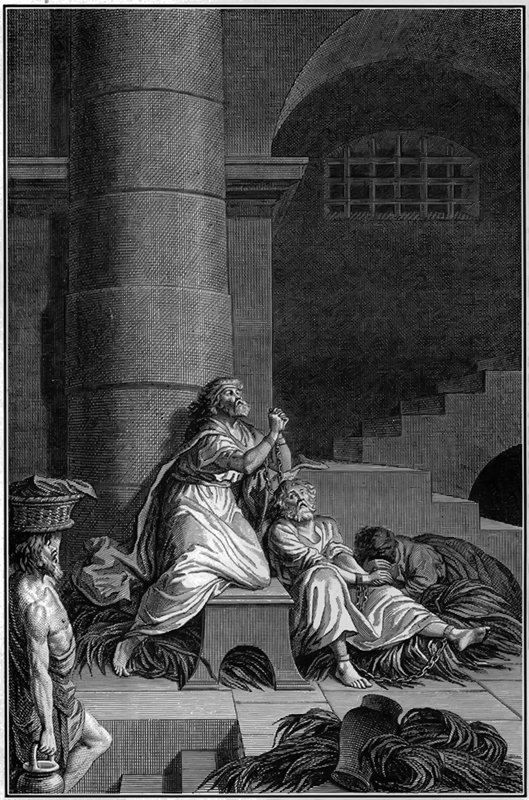
The 1 Peter 3:14-22 passage further deepens the significance of the crucifixion, burial, and resurrection and the reasons it correlates to the Colossians 2:8-15 reference. As the crucifixion meant victory over every demonic force,10 Jesus’ declaration to the “spirits in prison” was about his triumph over sin and death to inform them that they were still condemned. His ascension to authority at the right hand of God was set over all angels, authorities, and powers. Baptism is a personal and spiritual loyalty declaration of unity by Christ’s death and resurrection.
To further develop baptism as a loyalty pledge that corresponds to an anointing of the Holy Spirit, observe verse 21 of 1 Peter 3:14-22 (ESV).
“Baptism, which corresponds to this, now saves you, not as a removal of dirt from the body but as an appeal to God for a good conscience, through the resurrection of Jesus Christ, who has gone into heaven and is at the right hand of God, with angels, authorities, and powers having been subjected to him.”
The terms “appeal” and “conscience” in this passage have a wider semantic range that broadens the interpretive meaning rendered from numerous English translations.
② a formal request,appeal (ἐπερωτάω 2) συνειδήσεως ἀγαθῆς ἐ. εἰς θεόν an appeal to God for a clear conscience1 Pt 3:21. • But cp. a pledge (s. L-S-J-M s.v. 3 with pap ref.; also the vb. in PYadin 17, 38) to God proceeding from a clear conscience; 11
② the inward faculty of distinguishing right and wrong,moral consciousness, conscience • σ. ἀγαθή a good conscience (cp. Herodian 6, 3, 4; PRein s.v. καλός 2b) Ac23:1; 1 Ti 1:5; 1 Pt 3:21 (on the topic cp. FSokolowski, Lois sacrées des cités grecques, Supplément ’62 no. 108, 4–7 ‘one who enters the temple … must be pure, not through bathing but in mind’); 12
Furthermore, the term appeal as rendered pledge appears to produce a reading as a pledge to God for a good conscience. Whether as a pledge or appeal, the effect of baptism with a good conscience is one of repentance to where Jesus is accepted by oath as Lord. The Spirit at work in the believer at baptism is a corresponding spiritual form of anointing similar to Christ at His baptism (Mark 1:9-11). As Christ was anointed at baptism, believers are. As Christ died, was buried, and resurrected, believers are, too, by the process of baptism of water.
The Indwelling Spirit
Regeneration by the Holy Spirit as baptism in the Spirit does not constitute the indwelling of the Spirit. Regeneration of a person simply means that a person is given divine enablement to believe. From belief (i.e., grace through faith), a person is converted as faith and repentance together constitute saving faith in Christ for salvation. When this occurs in the life of a believer, Scripture informs us that Christ will take up residence in the believer (John 7:39, 14:17, 20:22). In contrast to the statements of regeneration (John 3:3-8, 6:63), where God gives people the willingness to believe, there are specific conditions that exist within a believer as the Holy Spirit is to inhabit him. This habitation of the Holy Spirit is more inward evidence of spiritual rebirth because, without the Spirit, it is impossible to be born again.
Apostle Paul also informed the early church that believers are individually the temple of God’s Spirit (1 Cor 3:16, 6:19, 2 Cor 6:16). It is well-understood that this divisible indwelling is not exclusive to corporate fellowship (Matt 18:2) but within each separate life of the believer (1 Cor 3: 17). The presence of the Spirit within the church as a corporate body, and within the body of an individual believer is not mutually exclusive theological principles supported by Scripture.13 The Spirit of God, as promised among the composite body of believers, as the Spirit of God inhabits each of them, includes those who are repentant and full of faith who, by grace, worship in spirit and truth. The Spirit is both with believers and in believers, as the Holy Spirit is their eternal Paraclete (John 14:15).14 The Holy Spirit as Paraclete is an advocate or counselor (John 14:16, 26), and this is significant as it pertains to the ministry of the Spirit among believers who have come to saving faith in Christ Jesus. Paraclete is an old Greek term, “called in aid.”
The Filling of the Spirit
The work of the Spirit in the lives of believers continues through their sanctification as they grow in Christ (Ephesians 2:10). Furthermore, the spiritual maturity developed among believers is toward ongoing personal holiness. After regeneration and the indwelling of the Holy Spirit at spiritual rebirth, believers undergo a lifelong sanctification process. To become sanctified is to be made more holy.15 While regeneration is a one-time event or occurrence, and the indwelling of the Spirit (Romans 8:9) either happens instantaneously at the same time or at a later point in life, the filling of the Spirit is yet another Scriptural distinction to recognize.
Paul wrote to the church in first-century Ephesus (Eph 5:18), “Be filled with the Holy Spirit.” And Luke’s record of Acts explicitly informs its readers:
“And when they (the disciples) had prayed, the place in which they were gathered together was shaken, and they were all filled with the Holy Spirit and continued to speak the word of God with boldness.” – Acts 4:31
The continuity of the Spirit’s presence among believers regenerated, anointed, and indwelt also involves an outpouring for specific missional purposes. Namely, the outpouring is generally expressed in Scripture as having a Kingdom intent. That is, to extend the Kingdom as Paul urges the church to be filled with the Spirit. Receiving the Spirit in this way is not just a passive endeavor, as believers indwelt by the Spirit today are active through the means by which they obtain this outpouring (James 4:8) through Scripture, prayer, and worship.17
The Fruit of the Spirit
Consistent with the doctrine of Sanctification, the Holy Spirit continuously transforms us into the image of Christ. While the fillings of the Spirit are individual and recurring events, the Spirit, who indwells us, shapes us into ever-increasing levels of holiness that please God. Necessary for our access to God, Scripture informs us that without holiness, no one will see the Father (Hebrews 12:14). Both the continuous indwelling of the Spirit and the filling of the Spirit produces fruit in the lives of believers. To more clearly understand what the filling of the Spirit is and does, Apostle Paul informs us about the specifics in his letter to the Galatians (Gal 5:16-22). While Galatians 5:22-23 specifically informs readers what the fruits are, it is necessary to recognize the historical and prophetic allusions to the fruitfulness of a new age. The prophet Isaiah points Old Testament and New Testament believers to a time when there will be the qualities of the Spirit written about by Paul (Isa. 32 and 57).18
Paul wrote of the “first fruits of the Spirit” (Romans 8:23) that point to believers among the whole creation effort of the Holy Spirit. As G.K. Beale eloquently informs us, the Spirit first raises the saints from the dead spiritually and then creates these fruits in them.19 Authentic believers who were regenerated and indwelt by the Holy Spirit will participate in the eschatological course of history by producing fruits of the Spirit to become what God sovereignly intends for His Kingdom. As believers keep in step with the Spirit, they glorify God as they reflect back to Him the holiness developed among His people. With the mutual indwelling of Christ (Gal 2:20) and the Spirit within believers (1 Cor 6:19), they produce fruit.20
The presence of fruit in believers’ lives is evidence of the Spirit within. The absence of the fruit of the Spirit indicates an absence of the Spirit. The pericope lesson of Mark 11:12-14, 20-21, in a sense, informs readers about the displeasing nature of people as believers who do not bear fruit. Not merely that they produce works of the flesh (Gal 5:19-21), as Paul warns the churches in Galatia, but that there are no fruits as described in Galatians 5:22-23 is an unacceptable condition that implies consequences. The Holy Spirit who indwells His people will cause them to bear fruit as they strive to produce fruit of their efforts. As the Holy Spirit has a direct bearing on the sanctification of believers, He also works through human agency to yield the qualities described as the traits of Christ.21
As a further up-close look at the fruit of the Spirit within the lives of believers, Apostle Paul wrote specific details about what they are (Gal 5:22-23). They are described in three triad groupings of Christ lived out in a Christian. The “fruit” of the Spirit (singular ), as compared to the “fruits” of the Spirit (plural) in this passage, renders an intended understanding of the unity of attributes within believers who are yielded to the Spirit.22 They are all present within believers, who are indwelt and, at times, filled by the Holy Spirit. As a matter of faith and practice, Paul tells the church, “walk in the Spirit” (v.16), be “led by the Spirit” (v.18), and “live by the Spirit” (v.25). This is life by the Spirit in contrast to a believer being gratified by the flesh. As trees produce literal fruit, so do believers who first walk by the Spirit, become led by the Spirit, and ultimately live by the Spirit throughout life. The only way to overcome the desires of the flesh is to live according to what Paul counsels in this passage. Being yielded to the Spirit is the way in which a believer escapes the deadly desires of the flesh that works against the Spirit (v.17).
It is, therefore, crucial to understand the fruits of the Spirit to walk by them. Living out the fruit of the Spirit by faith while yielding in surrender to Him is the way to abide in union with Christ against the desires and appetites of the flesh. To understand more specifically, the triad groupings of this fruit consist of love, joy, peace, patience, kindness, goodness, faithfulness, gentleness, and self-control. The first three, love, joy, and peace, are habits of mind. The second three, patience, kindness, and goodness, reach out to others. The final three, faithfulness, gentleness, and self-control, guide the general conduct of the believer.23
The Gifts of the Spirit
The work of the Spirit doesn’t end with His internal presence among believers for personal sanctification. God’s grace is extended to believers through the Holy Spirit for the church’s benefit, edification, and growth. The spiritual gifts as “pneumatika” are translated to “spiritual gifts” from the Greek (1 Cor 14:1, 12, 2:13; 12:1) to render a sense of inspiration from the Holy Spirit toward a functional purpose and conversely translated, “charismata” or “gifts of grace,” derived from the Greek term charis,24 (Latin, gratia). Charisma, as a gift of grace, is distributed among believers as God’s people are restored to harmony and wholeness to fulfill the restorative purposes of people within the church. Spiritual gifts are given to people of the church who are regenerated, indwelt, anointed, and filled to produce the fruit of the Spirit. Alongside the sanctification process, the Holy Spirit places upon people gifts of supernatural and natural origin and effect. Either one or the other corresponds to the measure of faith within a believer. Gifts imparted to believers are apportioned to them as a “manifestation of the Spirit” (1 Cor 12:7).25
As the gifts are meant to build up the church, they serve as examples of what it is to become enabled by the Spirit to fill specific functions that the church needs. When paying close attention to the specific gifts outlined in Scripture, they represent natural and supernatural capabilities characterized by the benefit of people as recipients. In Apostle Paul’s letters to Rome and Asia-Minor, he describes specifics to the early church as relevant for us today. The various gifts in the New Testament are not all-inclusive but represent what they are for the edification of the church. In the table below, Thomas Schreiner organizes the gifts Paul wrote about in the following way. While fitting to the early church, they’re, in principle, what the Holy Spirit does to produce or apply capabilities to people for the church and not for individual self-interest.
Romans 12:6-8
1 Corinthians 12:8-10
1 Corinthians 12:28
Ephesians 4:11
Having gifts that differ according to the grace given to us
To each is given the manifestation of the Spirit for the common good
And God has appointed in the church
And he gave
Apostles
Apostles
Prophecy
Prophecy
Prophets
Prophets
Distinguishing of spirits
Evangelists
Teaching
Word of wisdom and word of knowledge
Teachers
Pastors and teachers
Exhortation
Miracles
Miracles
Healing
Healings
Serving
Helps
Leading
Administration
Various kinds of tongues
Various kinds of tongues
Interpretation of tongues
Giving
Faith
Mercy
Table 1. – Biblical Gifts of the Spirit 26
The gifts are tangible exterior outworkings applied to people distinct from the internal fruit of the Spirit. The fruit of the Spirit originates as a grace for personal sanctification and blessing, while the gifts of the Spirit are for fellow believers who comprise the missional church for discipleship and sanctification of its members. The examples of gifts of the Spirit illustrate what underlying Scripturally supported development methods pertain to the church for eschatological Kingdom objectives, to honor Christ as head of the church, and to glorify God. The gifts of the Spirit according to Catholic tradition (i.e., Summa Theologiae) do not correspond to the biblical definition of the “gifts of the Spirit” as narrated by the example above. Still, they could include them as gifts as a matter of practice without claiming biblical authority and explicit meaning. None of these gifts are included in Paul’s description of gifts to highlight what types of natural skills and talents, or supernatural capabilities could be given to persons. As with the virtues defined by Aquinas,27 these are not counterfeit gifts, but they originate from the Summa Theologica to derive the theological tradition and catechism of the Catholic church.28
The Seven Gifts of the Spirit
The Seven Virtues
The Seven Deadly Sins
Wisdom
Chastity
Lust
Understanding
Temperance
Gluttony
Counsel
Charity
Greed
Fortitude
Diligence
Sloth
Knowledge
Kindness
Wrath
Piety
Patience
Envy
Fear of God
Humility
Pride
Table 2. – Catholic Gifts of the Spirit
Further interest concerning the gifts of the Spirit includes the Charismatic traditions often viewed as controversial and fraught with theological and biblical error. In many cases, to the charismatic believer, the gifts of the Spirit are about the uninformed personal experience with God as a filling and gifting of the Spirit as an admixture of an often faked encounter. The imaginations of often well-meaning people leave less room for the sober, intentional, and self-controlled manner of faith and practice in exchange for frequent healings, prophetic words of knowledge, miracles, and other transactional means of personal experience with others.
The subjective and personal experiences of Charismatic traditions outside instructions about church conduct can often contradict the biblical imperatives of being rational and sober-minded in fulfilling ministry and not carnal desires (1 Pet 4:7, 5:8, Titus 2:2, 6, 1 Cor 15:34).29 Self-control is a fruit of the Spirit. If a gift of the Spirit, according to Charismatic doctrine, contradicts the intended interpretation of Scriptural meaning about gifts of the Spirit, there is a difference that the authority of God’s Word must resolve. The heart, mind, and spirit are informed by Scripture what it means to worship in spirit and truth. However, gifts of the Spirit are defined in God’s Word and not by subjective experiences and imaginations of spiritual predators or well-meaning people in a spirit of error.
Often, Charismatic and Pentecostal traditions are closely joined to prosperity preaching and social gospel activists who find their subjective roots in theological liberalism. Schleiermacher, the father of protestant liberalism, denied his faith in a letter to his father and adopted Romanticism early in his faith. While Ritschl, who believed that Christianity ought to be defined by social justice imperatives and ethics, insisted upon a theologically liberated society.30
Opposing Views
There is a wide array of counterpoint perspectives concerning much of the historically orthodox views of the Church. The presence of the Holy Spirit in the life of believers today is Scripturally described and presented as authoritative by the biblical writers as intended. A common thread among the various opposing views appears centered around special interest concerning tradition, appeal to historical instruction and conditions, and spiritually interfering predilections that bring confusion, error, contradictions, and uncertainty. False or unorthodox beliefs and practices contrary to the clear teaching of Scripture would seemingly run counter to the human conscience of regenerated people indwelt by the Holy Spirit. Yet, there is a multitude of subjective perspectives. This post presented two examples of alternative views around the gifts of the Spirit between confessional Christian belief, Catholicism, and Charismatics. The range of differences is pronounced, but they all, to some extent, diverge from what Scripture specifically reveals about the Holy Spirit, who He is, and what He does in the life of believers.
Wesleyans, Pentecostals, Roman Catholics, and others have differing views about justification, what constitutes saving faith, and the role or function of the Holy Spirit to regenerate people, indwell them and shape their spiritual development during the course of personal sanctification (i.e., whether salvific and consecrated status is immediate, earned, and synergistic, etc.). Additional alternative interpretations in the church also range much further than liberal and neo-orthodox perspectives.31 However, while all these perspectives affect faith and practice, theological conclusions formed from biblical and objective truth carry the lasting weight of God’s specific revelation about what He does through His Spirit.
Historical Positions
In addition to matters of interpretation to suit personal, congregation, institutional, or state interests aside from biblical instruction, there are also matters of control that people want to retain. From the governing perspectives of the Church, the State, and cultures throughout civilization, social and economic interests have a bearing upon what people come to believe and understand with respect to faith and practice. Historical traditions of people among nations that are not in alignment with God’s intentions concerning His Kingdom and its eschatological trajectory are entirely, thoroughly, and utterly spiritual. People believe what they are given to believe. From Yahweh as Creator God, or the spiritual rulers of nations that govern access and the substance of belief, through God’s sovereignty, the historical development and acceptance of orthodox doctrines are under the subjection of what He has already decreed.
Under the care and persistent work of the Holy Spirit, the church will grow as Christendom increases in size to a geometric scale. While the various historical positions of theologians, philosophers, and politicians run in and out of alignment with Scripture, God’s purposes shall prevail. He will have His Kingdom. Humanity will be restored to Him and there will be nothing humanistic culture or secularism can do about it. If fact, by design, the hand of people as free-will human agents will be instruments of God’s intended purpose for Creative intent as it belongs to Him.
Conclusion
In numerous ways, this post resolved open questions about what the Holy Spirit does in the lives of believers today. Within our limited line of sight, there is what we know by what is revealed in His Word. Accordingly, believers also experience what the work of the Holy Spirit corresponds to what readers observe in both the Old and New Testaments. Among the covenants, to the redemptive work of Christ and the ongoing sanctification of regenerated believers indwelt, anointed, and filled, they are given spiritual gifts to build the church for its edification and development. The church exists for God’s purposes, His glory, and His good pleasure. Our place is to abide in Christ and live by the Spirit so as to fulfill His interests about the Kingdom as we love Him, each other, and His plan for our lives together.
Citations
1 Westminster Assembly, The Westminster Confession of Faith: Edinburgh Edition (Philadelphia: William S. Young, 1851), 21–25. 2 John MacArthur and Richard Mayhue, eds., Biblical Doctrine: A Systematic Summary of Bible Truth (Wheaton, IL: Crossway, 2017), 334. 3 James M. Hamilton Jr., God’s Indwelling Presence: The Holy Spirit in the Old & New Testaments (Nashville, TN: B&H Academic, 2006), 27. 4 Sinclair B. Ferguson, The Holy Spirit, ed. Gerald Bray, Contours of Christian Theology (Downers Grove, IL: InterVarsity Press, 1996), 21–22. 5 Basil of Caesarea, “The Book of Saint Basil on the Spirit,” in St. Basil: Letters and Select Works, ed. Philip Schaff and Henry Wace, trans. Blomfield Jackson, vol. 8, A Select Library of the Nicene and Post-Nicene Fathers of the Christian Church, Second Series (New York: Christian Literature Company, 1895), 15. 6 J. A. Motyer, “Anointing, Anointed,” ed. D. R. W. Wood et al., New Bible Dictionary (Leicester, England; Downers Grove, IL: InterVarsity Press, 1996), 49. 7 W. Brian Shelton, “An Ancient Israelite Pattern of Kingly Accession in the Life of Christ,” Trinity Journal 25, no. 1 (2004): 72. 8 R. C. Sproul, What Is Baptism? First edition., vol. 11, The Crucial Questions Series (Orlando, FL: Reformation Trust, 2011), 44. 9 Michael S. Heiser, Demons: What the Bible Really Says about the Powers of Darkness (Bellingham, WA: Lexham Press, 2020), 229. 10 Michael S. Heiser, The Unseen Realm: Recovering the Supernatural Worldview of the Bible, First Edition. (Bellingham, WA: Lexham Press, 2015), 338. 11 William Arndt et al., A Greek-English Lexicon of the New Testament and Other Early Christian Literature (Chicago: University of Chicago Press, 2000), 362. 12 Ibid. 967-968. 13 Thomas R. Schreiner, New Testament Theology: Magnifying God in Christ (Grand Rapids, MI: Baker Academic, 2008), 718–719. 14 James M. Hamilton Jr., God’s Indwelling Presence: The Holy Spirit in the Old & New Testaments (Nashville, TN: B&H Academic, 2006), 181. 15 Joel R. Beeke, Living for God’s Glory: An Introduction to Calvinism (Lake Mary, FL: Reformation Trust Publishing, 2008), 216. 16 Thomas R. Schreiner, The King in His Beauty: A Biblical Theology of the Old and New Testaments (Grand Rapids, MI: Baker Academic, 2013), 490. 17 John M. Frame, Systematic Theology: An Introduction to Christian Belief (Phillipsburg, NJ: P&R Publishing, 2013), 927. 18 G. K. Beale, A New Testament Biblical Theology: The Unfolding of the Old Testament in the New (Grand Rapids, MI: Baker Academic, 2011), 588. 19 Ibid. 20 Leon Morris, The Epistle to the Romans, The Pillar New Testament Commentary (Grand Rapids, MI; Leicester, England: W.B. Eerdmans; Inter-Varsity Press, 1988), 307–308. 21 Guy P. Duffield and Nathaniel M. Van Cleave, Foundations of Pentecostal Theology (Los Angeles, CA: L.I.F.E. Bible College, 1983), 291–292. 22 Donald K. Campbell, “Galatians,” in The Bible Knowledge Commentary: An Exposition of the Scriptures, ed. J. F. Walvoord and R. B. Zuck, vol. 2 (Wheaton, IL: Victor Books, 1985), 608. 23 Ibid. 24 Ralph P. Martin, “Gifts, Spiritual,” ed. David Noel Freedman, The Anchor Yale Bible Dictionary (New York: Doubleday, 1992), 1016. 25 Herman Bavinck, John Bolt, and John Vriend, Reformed Dogmatics: Holy Spirit, Church, and New Creation, vol. 4 (Grand Rapids, MI: Baker Academic, 2008), 299. 26 Thomas R. Schreiner, New Testament Theology: Magnifying God in Christ (Grand Rapids, MI: Baker Academic, 2008), 719–720. 27 Thomas Aquinas, Summa Theologica, trans. Fathers of the English Dominican Province (London: Burns Oates & Washbourne, n.d.), STh., I-II q.61-62 a.1-5. 28 Catholic Church, Catechism of the Catholic Church, 2nd Ed. (Vatican City: Libreria Editrice Vaticana, 1997), 450. 29 John F. MacArthur, Strange Fire: The Danger of Offending the Holy Spirit with Counterfeit Worship (Nashville: Thomas Nelson, 2013). 30 Ibid. 31 Gordon R. Lewis and Bruce A. Demarest, Integrative Theology: Spirit-Given Life: God’s People, Present and Future, vol. 3, Integrative Theology (Grand Rapids, MI: Zondervan, 1994), 174-184.
Bibliography
Aquinas, Thomas. “Question LXI Of the Cardinal Virtues.” In Summa Theologica, 44 Volumes, by Thomas Aquinas, STh., I-II q.62 a.3. London: Burns Oates & Washbourne, 1265 – 1274. Arndt, William et al. A Greek-English Lexicon of the New Testament and Other Early Christian Literature. Chicago: University of Chicago Press, 2000. Assembly, Westminster. The Westminster Confession of Faith: Edinburgh Edition. Philadelphia, 1851. Bavinck, Herman, Bolt John, Vriend, John. Reformed Dogmatics: Holy Spirit, Church, and New Creation, vol. 4. Grand Rapids: Baker Academic, 2008. Beale, G.K. A New Testament Biblical Theology: The Unfolding of the Old Testament in the New. Grand Rapids: Baker Academic, 2011. Beale, G.K., and D.A. Carson. Commentary on the New Testament Use of the Old Testament. Grand Rapids: Baker Academic, 2007. Beeke, Joel R. Living for God’s Glory: An Introduction to Calvinism. Lake Mary: Reformation Trust Publishing, 2008. Caesarea, Basil of. “The Book of Saint Basil on the Spirit.” In St. Basil: Letters and Select Works, by Philip Schaff and Henry Wace, 15. New York: Christian Literature Company, 1895. Church, Catholic. Catechism of the Catholic Church. Vatican City: Libreria Editrice Vaticana, 1997. Demarest, Gordon R. Lewis and Bruce A. Integrative Theology: Spirit-Given Life: God’s People, Present and Future, vol. 3. Grand Rapids: Zondervan, 1994. Ferguson, Sinclair B. “The Holy Spirit.” In Contours of Christian Theology, by Gerald Bray, 21-22. Downers Grove: Intervarsity Press, 1996. Frame, John M. Systematic Theology: An Introduction to Christian Belief. Phillipsburg: P&R Publishing, 2013. Guy P. Duffielld, Nathaniel M Van Cleave. Foundations of Pentecostal Theology. Los Angeles: LIFE Bible College, 1983. Hamilton Jr., James M. God’s Indwelling Presence: The Holy Spirit in the Old & New Testaments. Nashville: B&H Academic, 2006. Heiser, Michael S. Demons. Bellingham: Lexham Press, 2020. Heiser, Michael. The Unseen Realm. Bellingham: Lexham Press, 2015. Liddell, Henry George et al. A Greek-English Lexicon. Oxford: Clarendon Press, 1996. Martin, Ralph P. “Gifts, Spiritual.” In The Anchor Yale Bible Dictionary, by David Noel Freedman, 1016. New York: Doubleday, 1992. Mendenhall, George E, Gary A Herion, and David Noel ed. Freedman. The Anchor Yale Bible Dictionary. New York: Doubleday, 1992. Motyer, J.A. “Anointing, Anointed.” In New Bible Dictionary, by D.R.W Wood et al, 49. Downers Grove: Intervarsity Press, 1996. Schreiner, Thomas R. New Testament Theology: Magnifying God in Christ. Grand Rapids: Baker Academic, 2008. —. The King in His Beauty: A Biblical Theology of the Old and New Testaments. Grand Rapids: Baker Academic, 2013. Shelton, Brian W. “An Ancient Israelite Pattern of Kingly Accession in the Life of Christ.” Trinity Journal 25, no. 1, 2004: 59-72. Sproul, R.C. What is Baptism? Orlando: Reformation Trust, 2011.
John Frame is a well-known seminary professor and theologian in the Reformed tradition. John Frame is an author, lecturer, and teacher of far-reaching significance. Frame’s magnum opus is his Systematic Theology which covers a wide range of doctrines of conventional orthodox Christianity. This paper covers a limited review of selected parts eight and nine—namely, the doctrines of Christ and the Holy Spirit. A review of this subject matter traverses across biblically anchored truths that originate as divine revelation to conclude the necessary understanding of Christ Jesus and the Holy Spirit as two persons of three within the triadic union.
The Doctrine of Christ
In part eight, through chapters 37 and 38, Frame extensively writes about Christ across two categorical areas of crucial interest. The Person and Work of Christ as separate and distinct areas of interest help the reader understand the deity, humanity, incarnation, attributes, and His two natures in hypostatic union. Moreover, Christ Jesus’ offices as King, Priest, and Prophet get significant attention as the intended interpretation is derived from the biblical text. As the work of Christ is more closely understood from Scripture, it becomes clear that Jesus was a prophet who foretold all the Old Testament and eschatological eventualities. He was and is a king who led and ruled His people. He was and is a high priest who interceded for His followers as He atoned for the sins of His people.
Frame describes Jesus as King of Kings and Lord of Lords and extols His status as Creator and Ruler over all existence. As Yahweh the Lord, Jesus is over the covenants with humanity throughout redemptive history. Within His kingship, as God incarnate, He does what God the Father does. Everything made was made through Him, and all things are held together by Him. He is the radiant glory of God the Father. While the royalty of Christ originates through the lineage of David, His power and authority are far more prominently recognized by His resurrection from the dead. By the work of Christ as King, He triumphed over sin and death to make atonement as the high priest over we who died with Him. Severed from sin, having died to it, we are united with Him in resurrection while He is Priest and King over all His people.
While Frame doesn’t extensively cite numerous primary or secondary footnoted sources during his systematic theology’s development, he provides various endnote resources for further study at the end of each chapter. These are helpful resources within the Reformed tradition for further study, including numerous materials from Puritans, influential faith leaders, institutional scholars, and seminary academics. While Frame uses journal articles to support his conclusions and propositional content, he far makes far more use of Scripture references throughout the body of his written work. While he sometimes references scholars who would dispute his Scripturally sound conclusions, assertions, and propositions, he always returns to Scripture with corresponding intertextual weight to reinforce his points and arrive at biblical certainty before moving on.
While Frame further develops the doctrine of Christ, he does so in concert with the larger Westminster Larger Catechism (WLC). The two states of Christ’s stations involve His exaltation and humiliation. And questions 46 through 56 are posed by the WLC and answered in due course within the same. Namely, the Scriptural specifics about Christ’s exaltation by his resurrection, ascension, and coronation together situate Him above all as revered throughout the Kingdom of God and the Kingdom of Heaven. With Christ exalted at the right hand of God’s seat of power, Christ Jesus has power over all things in heaven and earth. As head of His church, Christ reigns over all humanity, all kingdoms past, present, and future, and all nations in an eschatological sense through redemptive history.
After Christ’s humiliation by crucifixion and death on the cross was followed by his “descent into hell,” according to the Apostolic Creed, He rendered to God redeemed people of the Old Testament and New Covenant believers fellowship as those who were adopted among the elect before eternity past. I agree with Frame that, contrary to some Baptist and King James Bible literalist perspectives, Christ’s descent wasn’t to hell because He was brought to a place of punishment. He “descended” to Hades, where those in Abraham’s Bosom were gathered and spiritually resurrected to dwell in heaven. Moreover, while in Hades, he appeared to the rebellious, disembodied, and fallen angelic creatures imprisoned in “chains of gloomy darkness” to proclaim victory over sin and death before His resurrection. After Jesus’ sacrificial death and descent into Hades, Christ’s physical and spiritual enemies were overcome by His triumphal resurrection, ascension, and coronation.
Christ’s presence before the Father as intercessor was now made possible for the elect in Christ. The latter were adopted as sons and daughters before the Priest-King, given to the Father in fellowship as intended before eternity past. According to Frame, as articulated within the WCF, the path to reconciliation was set for believers as the elect, adopted, and redeemed. As further believers are gathered before the Father through and “in Christ,” the eschatological already but not yet trajectory was set toward the final redemptive conclusion. Through passion, blood, story, drama, and apocalyptic intent, historically prophetic realization was assured from the proto-Evangelium to the Parousia.
Frame concludes His exposition on the doctrine of Christ by closely examining what it is to be in union with Him. Through an entire sequence of Christ’s work, there are blessings that must continually be heralded as God is to be worshiped and glorified. Frame threads Christ’s accomplishments with the following blessings toward believers. Our lives are blessed through election, calling, regeneration, faith, justification, adoption, sanctification, perseverance, and glorification. Through all this work, as believing recipients, this is what it is to be “in Christ.” This range of meaning substantiates union with Jesus Christ as people redeemed through the gospel. As born-again believers who inhabit His kingdom, we are sons and daughters in Christ who inherit a state of union while belonging to Him.
The Doctrine of the Holy Spirit
In part nine, through chapters 39 and 45, Frame’s systematic theology thoroughly examines the identity, events, and work of the Holy Spirit. As a more general understanding of the redemptive functionality of the triune God, the Father plans, the Son accomplishes, and the Spirit applies (as Frame puts it). In addition to Frame’s comprehensive approach to the doctrine of the Holy Spirit, various triad illustrations correspond to the subject matter concerning His identity and work. Each triad corresponds to the doctrine’s normative, situational, and existential view, where together they comprise of coherent epistemological and theological perspectives about a given subject.
These triperspectival illustrations appear in key locations through the reading on the doctrine of the Holy Spirit. This model presents a way of understanding matters of interest coherently without missing important details about corresponding points of relevant meaning.
The doctrine of the Holy Spirit begins with understanding God as a personal Spirit, not an impersonal force. To further provide context about the Holy Spirit within the triadic union of God, Frame makes the following general distinctions: The Father plans, the Son accomplishes, and the Spirit applies. Understanding the person of the Holy Spirit must precede cognitive recognition of His work, as abundantly evident throughout Scripture. Like the Father, and the Son, as God, the Holy Spirit is interpersonally situated within the Trinity. He is recognized by His attributes and worthy of worship, just as the Father and Son are. The Spirit is equal to the Father and the Son. The Spirit has a personality and a mind. He communicates in the first person.
Throughout the pages of Frame’s systematic theology about the Holy Spirit, extensive biblical passages are called upon to substantiate what the Holy Spirit does. Chapters of section nine are dedicated to doctrinal areas about the work of the Spirit in the lives of believers. More specifically, the Ordo Salutis is used as a pedagogical instrument to walk a reader through the overlapping, sequential, and biblically supported components of the Holy Spirit’s work. While Frame makes it clear that the linear orientation of the Ordo Salutis is not biblically supported, he does use its meaning to structure an understanding of what happens in the life of a believer where the Holy Spirit dwells.
The breadth and depth of the Spirit’s work in the lives of believers are astonishing. In elaborate detail, Frame effectively captures the biblical references in support of Baptism, the filling of the Spirit, the fruit of the Spirit, the gifts of the Spirit, miracles, prophecy, tongues, and healings exhibited among Old and New Testament believers. With careful attention to the work of the Spirit among believers today, Frame asserts the potentiality of God concerning miracles and supernatural gifts of the Spirit while calling attention to the effects of the indwelt Spirit among believers. In further and growing detail, this work is more understood as developed among numerous biblical passages. Frame does not at length rely upon scholars to form his views or arguments. Still, he occasionally cites orthodox confessions and the Heidelberg catechism to draw conclusions and illuminate further paths of understanding. Where there are exceptions, controversies, or counterpoint arguments to particular views, Frame will identify the source and corresponding specifics by name.
The clarity with which Frame organizes his thoughts and topics complements his substantively biblical views about the work of the Holy Spirit. The order of topics is summarized as follows.
Calling
Regeneration and Conversion
Justification and Adoption
Sanctification
Perseverance and Assurance
Glorification
Taking each area of work as a free-standing point of interest is a thoroughly helpful way to understand each category within the doctrine of the Holy Spirit. Beginning from who the Spirit is as a divine person to what He does, there is specific intentionality about Him ordered among believers and, to a limited extent, unbelievers. While there is a specific and separate focus on the work of the Spirit, it is clear that this work is cooperative and participative among all persons of the Holy Trinity. The work of the Spirit in these areas of doctrine is not the isolated endeavors of this person as God.
Calling
A distinction is made between two types of calling by the Holy Spirit. Frame separates them as a gospel call that can be resisted by individuals and an effectual call that cannot. The gospel call is the message of God’s redemptive invitation to everyone who can comprehend the meaning of Christ’s redemptive work, our guilt from sinful, and each person’s need for reconciliation with God in the form of salvation. Individuals can hear or perceive this message and respond either favorably or disfavorably, with lasting outcomes made sure by belief or disbelief. As many are called, but few are chosen (Matthew 22:14), the many will reject the gospel call and remain within their condemned state.
In contrast to the gospel call of individuals, the effectual calling is Scripturally sound, as it is declared in Paul’s letter to the Romans as it is sometimes referred to as the Ordo Salutis (Romans 8:29-30):
“For those whom he foreknew he also predestined to be conformed to the image of his Son, in order that he might be the firstborn among many brothers. And those whom he predestined he also called, and those whom he called he also justified, and those whom he justified he also glorified.”
The calling in this reference is preceded by the predestination declaration, which includes the status believers will attain as brothers to Christ. People predestined and called are brought into regeneration and faith with justification, adoption, and sanctification to follow. While this arrangement doesn’t necessarily hold in sequential order, the effectual calling in this passage does adhere to the meaning of a predestined status of believers. Effectual calling predicated upon predestined selection renders the will of God preeminent over the active or passive will of people left to their autonomous capacity to choose God while “dead in their sins” (Eph 2:1).
The Holy Spirit’s work in the effectual calling of each person is definitive and final as unbelievers who are chosen before the beginning of the world are brought into the Kingdom of God (Ephesians 1:4). Frame artfully collates the Scripture references that inform his readers about the Holy Spirit’s summoning of chosen people to the following outcomes.
The blessings of effectual calling: “the kingdom (1 Thess. 2:12), holiness (Rom. 1:7; 1 Cor. 1:2; 1 Thess. 4:7; 5:23–24), peace (1 Cor. 7:15), freedom (Gal. 5:13), hope (Eph. 1:18; 4:4), light (1 Peter 2:9), patient endurance (1 Peter 2:20–21), God’s kingdom of glory (1 Thess. 2:12), eternal life (2 Thess. 2:14; 1 Tim. 6:12; Heb. 9:15; 1 Peter 5:10; Rev. 19:9). So this calling is “high” (Phil. 3:14 KJV), “holy” (2 Tim. 1:9), and “heavenly” (Heb. 3:1). Ultimately it calls us into fellowship with Christ (1 Cor. 1:9).”
The Ordo Salutis, as the “Order of Salvation” in Latin, also pedagogically describes the work of the Holy Spirit as having additional effectual purpose. Specifically, Frame collectively orders the following formative efforts of the Holy Spirit to involve the spiritual development of people.
Regeneration and Conversion
The application of redemption by the Holy Spirit, made possible from the plan of the Father and what Christ accomplished includes the regeneration of unbelievers to people who are made holy and righteous before Him. From the effectual calling of a person, unbelievers undergo regeneration toward further spiritual formation. As faith is necessary for salvation, spiritual life is formed by the Holy Spirit through regeneration as a sovereign act of God. Regeneration precedes saving faith as good works and belief are the products of it. As Ephesians 2:8-9 specifically informs readers that grace and saving faith are a gift of God, the Holy Spirit renders power upon and within people to make them believe.
While Frame makes it clear that effectual calling is from the Father, the regeneration of an unbeliever is an act of the Holy Spirit. In both acts, the new birth of regeneration involves the passive acceptance of people to new life. To become born again is to become regenerated; the new believer has nothing to do with that process. To believe and live by faith through grace requires preceding regeneration, as indicated in John 3. However, as 1 Peter 1:23 and James 1:18 indicates that regeneration follows faith, the order of salvation is not necessarily a linear path as both meanings are rendered ambiguous in their sovereign relationship to one another.
As regeneration initiates a reorientation of the mind, will, and affections toward God, faith and repentance together constitute conversion. While it is explicit in Scripture that faith is a gift (Ephesians 2:8) and repentance is a gift (2 Tim 2:25), they are both something we practice as believers. Both belief and repentance are personal choices made by the cooperative intention of the Holy Spirit. Frame further develops the meaning of conversion as the work of the Holy Spirit. He draws attention to faith and repentance as components of conversion. Salvation is by grace through faith, but it also involves repentance. To Frame, faith and repentance are two sides of the same coin. Faith is the positive expression of belief, while repentance is the negative form of it. Both faith and repentance are necessary for salvation.
Justification and Adoption
Returning to the triperspectival view of epistemic knowledge concerning the work of God, Scripture informs us that justification is associated with regeneration and conversion. As believers are justified before God through Christ and His sacrificial atonement, we are adopted as sons and daughters of God. To attain justification is to be both declared righteous and made righteous.
To make adoption as children of God possible by the Holy Spirit, we must not only be brought to new life but made righteous, good, and holy. Justification as works of God through His forensic declaration upon believers and the imputed righteousness of Christ placed within them changes people’s legal and familial status. As Christ is Lord and brother in the sense we are adopted as sons and daughters, that requires more than a baseline status of declared justification. We must be made righteous and be righteous. We must be made holy and be holy.
Furthermore, the sins of justified believers are placed onto Christ as they are no longer attributed to those renewed for adoption. The constitutive declaration of believers as justified involves all persons of the Trinity necessary to attain union with Christ. God declares the regenerated converted as justified through Christ. Christ’s righteousness is imputed to believers, while the sins of believers are imputed to Him. A double imputation to establish the effective ground of justification is necessary for the spiritual growth and sanctification of the Spirit and adoption of believers. While there is punishment for unbelievers due to the wrath of God for sin, there is no punishment for believers adopted as sons and daughters. There is chastisement and correction through the Holy Spirit as He is involved in sanctification to render believers righteous and holy. Believers are the workmanship of God the Father, the Son, and the Holy Spirit.
Sanctification
The work of God to sanctify believers is to make them holy. It is an intentional work of God through grace to bring us into conformance with Christ. According to Frame’s biblical analysis, two types of sanctification are relevant to our interests. First, definitive sanctification is an instantaneous act of God upon a believer at a point in time concurrent with regeneration. More specifically, according to Frame, “Definitive sanctification is a once-for-all event, simultaneous with effectual calling and regeneration, that transfers us from the sphere of sin to the sphere of God’s holiness, from the kingdom of Satan to the kingdom of God” (Heb. 9:13–14; 10:10; 13:12). Through this type of sanctification, there is a separation of believers as holy from unbelievers in the world. It is an event by which there is a severing from sin (Rom. 6:11; Gal. 2:20; Col. 3:3) as believers are joined with Christ as it is said that it overlaps regeneration.
Progressive sanctification is a process of continued spiritual development. Made more holy, believers gradually increase through good works and maturity to bear the fruits of the Spirit. While the work of the Spirit present with believers increases their sanctification, He does so through their human effort. Progressive sanctification is a continuous intentional effort among believers to actively yield to God’s instructions for moral living, good works, and obedience.
Perseverance and Assurance
In the most simple terms, Frame calls attention to the Westminster Confession of Faith (WCF 17.1) to highlight what perseverance is: “They, whom God hath accepted in his Beloved, effectually called, and sanctified by his Spirit, can neither totally nor finally fall away from the state of grace, but shall certainly persevere therein to the end, and be eternally saved.” More concisely, the regenerate in a saving union with Christ cannot lose their salvation. In a more startling passage, John 10:27-29 informs believers that if anyone believes in Jesus now, they cannot lose their salvation. This salvation is in reference to eternal life once any person passes away at death. This is to escape God’s wrath and come into eternal fellowship with Christ. There is no condemnation to those in Christ Jesus (Romans 8:1). So when believers place their trust in Jesus, their past, present, and future sins are immediately and permanently forgiven. Believers are guarded until the end.
Glorification
The final area of Frame’s doctrine of the Holy Spirit concerns the glorification of believers. Along the path of the Ordo Solutis, of glorification of God includes his presence in the lives of believers. Where people who bear the image of God reflect back to Him the work of the Spirit, there is an effect of God’s glory made apparent on us. The work of the Spirit through regeneration, conversion, justification, sanctification, and adoption returns as a shekinah glory within yet reflected back to God for His cumulative and ongoing glory. The glory of God involves and includes His presence as it is unique and utterly foreign to a person’s natural sense. We can see and experience His glory with and through His presence and throughout creation, but our state from the Holy Spirit’s indwelling is a derivative glorification that abides.
To explain why integrative thinking is needed in a diversified world, it is necessary to recognize underlying assumptions about reality and how we know reality in the social issues of life. It develops an awareness of the metaphysical nature of existence. Integrative thinking assembles a correct epistemology concerning physical and spiritual reality that weighs upon the consciousness of contingent beings.
Knowing Ultimate Reality
It is necessary to consider a collection of experiences, sources, philosophies, and present or historical conditions that encompass all knowledge. To explain coherently and exhaustively what truthful worldview contexts exist for living Coram Deo and among people who live together in civility and reasonable harmony.
Theology’s Challenging Task
Even with all of the experiences we live through, and the availability of divinely revealed truth, there are charges brought against the discipline of systematic theology as a manner of response and criticism concerning methodologies and the arrival of decisions about theological conclusions and truth. They are verbatim as follows: 1
Systematic theology organized a system of Christian thought around one central theme (sovereignty, freedom, covenant, dispensation, or kingdom) chosen a priori and imposed on the rest of revelation in a contrived interrelatedness.
Systematic theology failed to do justice to the multiplicity of relevant lines of biblical information seen in their cultural and historical contexts.
Systematic theology paid insufficient attention to the history of doctrine in the church.
Systematic theology tended to regard a system of theology as closed rather than open to new discoveries from God’s Word or God’s world.
Systematic theology passed its teachings on to the next generation by sheer indoctrination—an unworthy approach to education.
Finally, systematic theology failed to display the relevance of its content to the burning personal and social issues of its day.
Theologians unaffected by these criticisms retained “presuppositional and axiomatic methodologies.” Consequently, their effectiveness and limited reach concerning the theological subject matter were explained by faulty priori assumptions, the importation of biblical meaning into current cultural contexts, indifference to historical doctrines, and closed-mindedness.
To advance the course of study adjacent to systematic theologies (with its limitations and impediments), integrative theology is introduced as an embodied approach to the discipline of theology. Integrative theology is the art and science of developing a comprehensive set of convictions from special and general revelation about topics pertinent to Christian life and service. Integrative theology is a discipline of the student who investigates various interrelated criteria of truth, logic, philosophy, and reason. It bears upon evidence from the world as cast into existence from God. It is responsible for evaluating the empirical sciences and internal experiences as interpreted through psychology, axiology, ethics, epistemology, and ontology.
Integrative theology requires testable hypotheses in discovery:
Noncontradiction
Support from adequate evidence
Affirmability without hypocrisy
It does not accept out-of-hand presuppositions imposed upon Scripture but instead adopts a chosen research methodology. Collecting data and facts involves illumination by the Holy Spirit, proper hermeneutics, personal study, teaching, preaching, and other qualified and reliable primary sources that converge into personal convictions that are shareable to the faith community at large.
Integrative theology incorporates the strengths and values of systematics and avoids its weaknesses. There are several specific areas by which that is accomplished.
Rather than presuppositions that feed into systematics that form historical doctrines of immense value from eisegesis, integrative theology produces a coherent end to exegetical interpretation that involves Scriptural data and experience.
Personal revelation by interpretation and thinking God’s thoughts after Him without claim to complete comprehension.
Tested and validated hypothesis formed by beginning from historical and contemporary options before arriving at conclusions – as compared to conclusions of systematics formed from presuppositions.
Systematic theology is a product of indoctrination, while integrative theology is not. Doing theology is an endeavor of recurrence that will withstand reexamination. It is always open to discoveries from the closed canon of Scripture, literary materials, historiographical subject matter, ancient cultures, languages, and discoveries throughout creation, whether through revelation or empirical scientific method.
Systematic theology is a product of indoctrination while integrative theology is not. Doing theology is an endeavor of recurrence that will withstand reexamination. It is always open to discoveries from the closed canon of Scripture, literary materials, historiographical subject matter, ancient cultures, languages, and discoveries throughout creation whether through revelation or empirical scientific method.
Integrative theology is an approach to the practical significance of faith and practice. As an outcome of formulated and established doctrines, it showcases the relevance of theological truth for spiritual value and service.
To explain integrative theology’s relationship to other disciplines of interest, these disciplines must be understood individually as each has functional involvement with other fields.
Apologetics As this is the defense of theological presuppositions, there are reliable and testable assertions that God has acted in creation, Christ, and Scripture. As such, worldview formation that has a bearing upon lived lives affirms God’s existence, His creation, the historical Jesus, and the subject matter of Scripture.
Biblical Studies Theological information originates from biblical studies and primary sources. To study, live, teach, and preach divinely inspired truth, the theology student must reach for the root meaning of written materials, plus how they were formed, translated, conveyed, and transmitted.
Hermeneutics Theological subjectivism is conclusively refuted by sound hermeneutics. Cognitive assertions according to the biblical writers’ intended meaning require readers to change readers assumptions to fit the given facts within Scripture.
Logic As logic is a metaphysical construct that accompanies material creation, it didn’t exist in the Universe before ex nihilo. While philosophical categories of reason within creation are not exclusive to the spiritual realm, the metaspiritual domain of elohim is assumed, or at least it isn’t confined by the properties of three-dimensional creation (abstract or otherwise). – Human logic is merely a tool to form methods, draw reliable conclusions and follow principles of coherent reasoning to make sense of reality. A realm of an eternal now would involve ways and means of rationale beyond the sensory perception of cause-and-effect by sight, sound, smell, touch, and taste that transcends the physical Universe. To say that logic is the root of God’s mind is presumptuous. While divine revelation involves the presence of it throughout creation, are we to conclude that it exists in the same manner in His domain? To assert as much requires Scriptural support. Jesus fed 5000 people from five loaves and two fish.
Previous Theologies (historical theologies) These are secondary sources with provisional authority, yet it is to our loss if we ignore the insights, syntheses, and applications of theological principles from Scripture. Many contributors over the centuries offer meaningfully inspired material about the truth of divine revelation and surrounding truths as made evident within God’s creation. The traditions, creeds, and doctrines of faith produce valuable and helpful sources of subject matter that contribute to investigative efforts. The work of the Patristics, Puritans and Reformed theologians are of especially significant value as historical insights are among people imbued by the Spirit to share their learning and convictions. The conclusions they draw are made our own even if there are sparse areas of misunderstanding and disagreement.
Research Methodology As a key to responsible theological decision-making, how research is conducted has a bearing on how we grasp Truth.
a. Define the problem b. Survey relevant literature and gather many perspectives c. Test all hypotheses d. Formulate preliminary conclusions from among alternatives while open to inquiry e. Determine concrete ways to implement conclusions
Coherent truth must not be rejected in the search for theological truth grounded in Scripture. Existential, pragmatic, and mystical experiences can be significant as a work of the Spirit that cannot be dismissed or discounted. Humanistic philosophies shall not go unchecked and shall be countered with coherent reason and theistic philosophies that defend the faith through engagement while speaking from truth and love.
All Scripture must be the primary source of truthful information for integrative, systematic, and biblical theologies. Whether chronologically or logically, these theologies use Scripture as a matter of principled application toward research. However, defined by purpose or scope, integrative theology invites further sources into chronologically or logically situated biblical truth.
Just as comparative abstractions offer propositional meaning between biblical and systematic theologies, integrative theology holds up just as well in terms of Scriptural principles to derive truth consistent with divine revelation.
As the development of alternative theologies advanced through history, further sources and materials anchored by divine truth arrived by exegetical understanding and historiographical relevance. Integrative theology intentionally uses aggregated sources and materials that cumulate, such as manuscripts, geographical and cultural discoveries, historical pressures among empires, conquests, literary formation and diversity, and scientific discoveries about nature and the Universe itself.
To inspire people as a conduit of God’s revealed truth is a deep joy as a way to glorify Him and worship Him. Because of who He is and what He has done, what He does, and by His promises. To serve as a vessel, not only to host and serve Him but to be the container of His truth which carries His message as an outpouring of His message and His interests.
Even if to both the goats and the sheep together of a small flock, or one-by-one, it is a joy and privilege to be His servant to speak of Him, His Word, and compelling theological truths that reach people where the Holy Spirit might turn them to God (Matt 13:14b-17).
Divine Revelation to All People of All Times
The classical problem the authors make explicit is the question of whether or not every rational person can comprehend something of God. A genuine inquiry into this question is essential for developing a person’s worldview, including personal and social survival. Specific interest around general revelation involves the recognition of God as Creator by observing what is observed throughout Creation. Moreover, Creation and the conscience of people involving moral obligations and duties present evidence of a Being at the source of their existence. Absent self-inflicted severing of conscience or God’s hardening of a person’s heart (Rom 9:18), all people internally recognize and intuitively understand the existence of a Creator as the source of all reality. While people internally understand God’s existence, acknowledging and accepting that is another matter.
Contrary to Barth’s perspective2 and consistent with Romans 1:20, people recognize God in nature, providential history, and moral law. All existentially made possible from among free agents who develop a basic understanding of God through His general revelation in this way. Denial of this as Scripturally factual is a betrayal of God’s Word and, ultimately, of Him as Creator.
There are various hypotheses to be tested to summarize influential answers to this problem objectively.
Aquinas and the Thomistic Tradition Thomas Aquinas favored rational induction to explain that people would eventually recognize the existence of God on their own. He propositioned two realms (nature and grace) and two kinds of knowledge (natural and revealed) with two methods of knowing (reason and faith). As it was his rationale that people are made in the image of God with a rational mind, he also concluded that the intellect was “not seriously affected” by the Fall. Aquinas’ perspectives about the “analogy of being” showed that persons are derivative of God, and their existence is analogous to God’s existence. The Reformers, in contrast, understand the human condition as totally depraved and unable to arrive at God’s existence insofar as their need for Him.
Empirically Orientated Liberalism Liberals who want empirical data to evaluate the merits of God’s existence seek to rely on natural and social sciences. On their terms or methods, the emphasis is upon the power of the rational mind to conclude God’s existence. By observation, knowledge of God is attained through modern learning. In comparison to scholars and theologians who have a high view of Scripture as infallible and inerrant, empirically orientated liberals believe that the Bible is fallible and requires the corrective discipline of human knowledge (i.e., Scripture is not inspired by the Holy Spirit).
Existentially Orientated Liberalism Unlike empirically orientated liberals who want data to determine if God exists or that He can be found and understood, existentially orientated liberals rely upon human experience. God is not found or understood as Creator by external means of observation (contrary to Scripture) but by intuition and a personal mystical experience. In this way, revelation imparts no new knowledge but a new consciousness, according to the author.
The Neoorthodox Tradition Those of the neoorthodox tradition insist that revelation does not exist outside of what God has communicated to humanity through His Word. To the neoorthodox, God is utterly unique as Creator, while humanity is far removed from God by its sinfulness and ability to recognize Him, much less comprehend His existence by general revelation. The author of this text characterizes Karl Barth as the locus of neoorthodoxy as general revelation unknowable from nature (contrary to Rom 1:18-20). The author cites Barth as writing a denial about the meaning of Romans 1:18-20 as it pertains to humanity’s ability to acknowledge God’s existence by general revelation. The author does not indicate whether or not Barth’s position concerns special or secondary revelation.
Dutch Reformed Theology The author writes that just as the neoorthodox deny general revelation has a bearing upon a person’s recognition and understanding of God, the Dutch Reformed concur. They together view the effects of sin upon people as rendering them incapable of drawing correct conclusions about God from nature or anywhere else. According to the author, Dutch reformers claim that only the regenerate can see Creation and nature as it is and recognize God through His work.
Many Fathers, Reformers, and Evangelicals From long ago to more contemporary figures, numerous people of faith hold to both general non-salvific knowledge of God and particular knowledge from revelation through the incarnate Christ. Augustin, Luther, Calvin, and others wrote of general revelation recognizable in nature by humanity. It is ascertained that people can also discern God as Creator who instilled moral values and duties through general revelation by the human conscience. Where general revelation only serves to condemn and does not save, God’s Word through the Holy Spirit witness of Christ and His redemptive work for the elect who believe the gospel.
All literary genres of Scripture account for the evidence between general and particular revelation, the Old Testament and the New. Reformers and early Church fathers were more in line with the covenant distinctions and the substance of the redemptive work to include the authority of God’s Word through instruction and Scripture, plus the inner work of the Holy Spirit from Pentecost onward.
The observable Universe and its laws of nature reveal God as the cause of physical, metaphysical, and material reality. The self-aware nature of humanity and its inherent cognition of right and wrong is also evidence of a causal Creator who originated people as His image bearers. As made clear in Romans 1:18-20, general revelation is explicitly understood that God has made His attributes and power known to all people. Special revelation through the life and teachings of Christ Jesus informs people about God’s redemptive work. Throughout Creation, people are called to eternal life with God through the Messiah for reconciliation as a means to escape sin, judgment, and eternal condemnation. The life and ministry of Christ are God incarnate upon the Earth to inform believers and unbelievers alike who He is and what He set out to do through covenants with people. The witness of the Holy Spirit as God and the whole counsel of His Word specifically reveals His intentions and interests.
God’s view matters most. Human experience, in general, doesn’t reliably describe with logical consistency who God is beyond what was specified and implied in Scripture as intended. Through the consciences of people and observable Creation by what was made (Rom 1:20, 2:14, 15; Acts 14:17; 17:24–27), God and his attributes are revealed to the extent His Word specifies through the Holy Spirit. None of the alternative views among the various perspectives self-derive a knowability about God beyond what He has set in place throughout created order. The ability to reason and conclude comes from God. The presence, behaviors, and properties of Creation are made to glorify Him, and people witness the unspoken praise of Creation for this purpose.
Given the scale and scope of the Universe and the mysterious and hidden nature of the sub-molecular activity of space, matter, and time, people can barely comprehend what is physically before them in an opaque way. Much less the spiritual realities that exist. It is a pronounced understatement to say that each and every individual for all time throughout humanity has a very myopic and narrow view of the world around them. As it is written by the prophet Isaiah, “We grope for the wall like the blind; we grope like those who have no eyes; we stumble at noon as in the twilight, among those in full vigor we are like dead men” (Isa. 59:10).
The categorical groups the authors set out to describe are helpful for understanding perspectives. However, every one of them is limited in its own unique way. I have trouble with the whole perspective that they are fully set against one another (Mark 9:39, Luke 9:50). Or in opposition where the cause of Christ is proclaimed even amid an abundance of error. The empirically orientated liberal who places the highest confidence upon the power of the intellect has little room for the assurance of truth by experience and metaphysical awareness among the existentially orientated liberals. Those of the faith who view neoorthodox believers as dry and vacant of the expressive presence of the Holy Spirit are somewhat upstaged by the reformers and evangelicals who “make room” for the Holy Spirit within to give voice to reason and experience. After a while, the contentious differences become wearisome. Yes, it is necessary to remain on guard, and believers are warned of false teachers as we must avoid them. Still, the following quote occasionally comes to mind as a look at the exercise of compare and contrast weighs heavily. Quote: Caesar Augustus openly professed the worship of the gods, which he had practiced secretly, and set the bishops of the Christians at odds:
“[4] On this, [Caesar] took a firm stand, to the end that, as this freedom increased their dissension, he might afterward have no fear of a united populace, knowing as he did from experience that no wild beasts are such enemies to mankind as are most of the Christians in their deadly hatred of one another.”3 – Ammianus Marcellinus (330 – 400AD), Roman Soldier, Rerum Gestarum, (of the achievements, of history; for achievements), Book XXII, Chapter 5
I’m just doing my best to follow Christ by His invitation,
“Come to me, all who labor and are heavy laden, and I will give you rest. Take my yoke upon you, and learn from me, for I am gentle and lowly in heart, and you will find rest for your souls. For my yoke is easy, and my burden is light.” – Matt 11:28-30
Biblical and doctrinal convictions that develop from immersion in the Word through prayer, worship, fellowship, and reliable academic instruction help to yield me to God’s grace as I am utterly dependent upon Him for understanding, faith, and practice. The viability of my convictions comes from what I’ve accepted as the authoritative Word of God. I am committed to what it says and what it means because the messaging in all its forms originates from God. And how can I not live and abide by them even when, at times, I’m inconsistent in words, thoughts, or deeds (as are the authors of this textbook)?
I do not betray personal convictions of biblical truth as they’re developed within, nor do I live in persistent contradiction to them as they more closely align with this text’s “Many Fathers, Reformers, and Evangelicals” (pg. 65). Far less so am I guided or informed by convictions formed through instruction, the church, and views of people (including believers unless God has placed specific individuals into my life). A verse I memorized is my most pertinent answer to this question:
“I have been crucified with Christ. It is no longer I who live, but Christ who lives in me. And the life I now live in the flesh I live by faith in the Son of God, who loved me and gave himself for me. – Gal 2:20
It is not my intent to be contrarian to the instructional value of this text. I am only writing what comes to mind and heart as I’ve read and studied the material at length. I get what the authors as a whole articulate, and I’m persuaded and better educated by the awakening subject matter in this text, but in my very limited view, some questions are hit-and-miss relevant. God is love and we are to love.
Divine Revelation Through Christ, Prophets, and Apostles
Volumes 1 and 2 of the Integrative Theology texts have the same review questions among nearly all chapters. These are template questions where the authors try to map the questions to readers’ expected or suitable responses about the subject matter. The author intends to have readers relate to and apply each section of the chapter read. Volume 3 of the set includes questions for discussion where they change for each chapter as they are more closely relevant to the subject matter. The chapter questions in volume three do not repeat as they do for volumes one and two.
Under the chapter title, “Divine Revelation through Christ, Prophets, and Apostles,” the authors wrote the question: How does a man, woman, or child, created and loved by God, come to know the Lord of the Universe in a personal, saving relation?
Given that question as a problem, a reader is better served by understanding the gospel with an invitation to seek Christ Jesus through His Word in Scripture. After that, if that person wants to develop a relationship with God further, there are biblically sound churches or fellowships where new believers are directed to help with spiritual formation. Believers attain spiritual formation from the Bible (Divine revelation), which consists of the words of God through the Prophets, Christ, and the Apostles.
The answer to the question as a problem to resolve best comes from Scripture itself (as it is, in fact, a historical reference):
28 But Paul cried with a loud voice, “Do not harm yourself, for we are all here.” 29 And the jailer called for lights and rushed in, and trembling with fear he fell down before Paul and Silas. 30 Then he brought them out and said, “Sirs, what must I do to be saved?” 31 And they said, “Believe in the Lord Jesus, and you will be saved, you and your household.” – Acts 16:28–31 (ESV)
For context, reference the account of the Philippian jailer converted in verses 25 through 40.
Among all the alternatives listed between Roman Catholic Scholasticism to Most Church Fathers, Reformers, and Evangelicals, the views of the latter group are closest to the primary biblical evidence (as answered by Acts 16:28-31).
When the jailer asked what he must do to be saved, he asked what he must do to enter into a salvific relationship with God. Paul’s response serves as the source of authoritative doctrine regarding the matter. The jailer was to believe in the Lord Jesus for salvation, and he was given specific instructions about how to do that by Apostle Paul. There is no grounding to dispute what is necessary to attain salvation. It is belief in the Lord Jesus Christ. From the Greek meaning of the term (, this belief is not a manner of mental assent. It is to entrust oneself to God through Christ Jesus in complete confidence. Furthermore, “God and Christ are objects of this type of faith that relies on their power and nearness to help, in addition to being convinced that their revelations or disclosures are true.”4
Roman Catholic Scholasticism From assertions made at the Council of Trent, Catholics believe that all saving truth is contained in written and unwritten traditions. The “unwritten traditions” from the succession within the Catholic church claim authority of equal weight and relevance to Scripture. God’s Word, as either the Protestant or Catholic canon, never validates that claim.
Enlightenment Skepticism The assertions of Enlightenment theologians who develop perspectives in denial of divine activity deny general or special revelation. This class of “theologians” dismiss all accounts of Scriptural witness and historical testimony. Accordingly, their insistence that salvific value is necessary for understanding through self-derived means judged sufficient through human reason, science, and experience is futile as flesh counts for nothing (John 6:63).
As Enlightenment Theologians and skeptics reject the prospect of a spiritual reality that helps explain what transpired through revelation in all its forms within redemptive history, by inference they have already concluded there is no sin or wrath to be saved from. No need for reconciliation on God’s terms as He is their creator. Accordingly, there is no problem or question to answer as such from this text.
61 But Jesus, knowing in himself that his disciples were grumbling about this, said to them, “Do you take offense at this? 62 Then what if you were to see the Son of Man ascending to where he was before? 63 It is the Spirit who gives life; the flesh is no help at all. The words that I have spoken to you are spirit and life. – John 6:61–63 (ESV)
Kierkegaard and Neoorthodoxy Kierkegaard and Barth have firm convictions about the weight of authority concerning Scripture. As evident by Christ Jesus through His incarnate presence, His words, and His actions, they view revelation as a qualitative difference among people where the Bible becomes the Word of God when believers respond in faith. While I resonate with their views about the authoritative nature of God’s Word and their dismissal of liberal thought as self-serving for social interests, I must withhold agreement about what the authors of this text wrote about when God’s Word becomes a special revelation. The Word of God has the spiritual substance of revelation for salvific merit, as validated by Paul, the apostle. Whether it was accepted or not. The Word is not an instrument to wield as if it were possible to get oneself saved. The Spirit works through His Words in Scripture to produce salvific faith among those appointed to believe.
I understand that the Word of God is His revelation, whether it is perceived that way or not. Conversely, we read Paul’s letter to the Thessalonians as follows:
13And we also thank God constantly for this, that when you received the word of God, which you heard from us, you accepted it not as the word of men but as what it really is, the word of God, which is at work in you believers. – 1 Thess 2:13 (ESV)
Pannenberg’s Revelation as History Revelation as identical to the totality of history is Pannenberg’s view about how revelation is permissible. Divine revelation includes all humanity as recipients across time to involve redemptive and secular history. Contrary to what God has accomplished throughout extensive OT and NT biblical teaching, salvation is up in the air, so to speak, about what is necessary to redeem people and the individual to God.
Theistic Existentialism To existentialist theologians, divine revelation is a progression of experiences or events upon a person where transformation occurs without reference to the communication of gospel information from God. In contradiction to Romans 10:14-15, theistic existentialists also deny the authority of Scripture in this area. And they would likely do the same regarding the message of salvation where the point is moot about their acceptance of the gospel and Christ Jesus’s claims as redeemer Messiah.
In contrast to this question I answered previously, is the question asking if my convictions are viable, valid, or authentic by whether or not I can live by them? Where the underlying rationale is that if I can’t live by them, then my convictions are not valid? The premise to which the question is posed in response to the subject matter in this chapter is puzzling. Because no one fully lives by their convictions in thoughts, words, or actions. Believers are not sinners upon rebirth; they’re saints who sometimes sin (by betraying their convictions). This looks like an unregenerate question, but I’m sure I’m not getting the meaning somehow. We live by faith. Is the question concerning conviction about the subject matter of this chapter?
Our views and actions follow what we believe with consistency. My views are better formed by what I’ve learned in this chapter, yet I tentatively know what is off, false, or unbiblical. I want to be careful about the outliers compared to my convictions because I know there are times I’m a walking-talking contradiction as I seek to learn more about God, experience Him by His Word and Spirit, and rely on Him for life, faith, and those areas where I’m oblivious that my convictions don’t match what I do. If I’m in biblical or theological error, it is my plea for God to reveal that to me from His Word, by His Spirit, through this chapter and the others to follow. If there’s some area of correction about my convictions, I hope for God’s mercy. I assume my views are viable concerning God’s revelation to us because they’re biblical best I can tell.
I wouldn’t frame my agreements or disagreements with what the authors in this text wrote as convictions. This subject matter is informative, and it helps to gather various perspectives and sources about what theological thinking develops, but my level of maturity in this area is pretty low, I suspect. With a one-time read-through of this chapter, the Biblical Teaching and Systematic Formulation sections around the areas of divine revelation are highly stimulating and merge into a personal understanding that wasn’t previously there. It’s not obvious how I would test my understanding of the subject matter on divine revelation other than by what I study within Scripture and what the Spirit allows me to comprehend.
The Bible as Given by Inspiration and Received by Illumination
Under the chapter title, “The Bible as Given by Inspiration and Received by Illumination,” the authors wrote the question: In what way is the Bible Inspired and Authoritative?
Questions about inspiration and the authority of the Bible are relevant and critical to understanding whether or not divine revelation actually exists. Without the inspiration and authority of the written texts as Scripture, its truth claims, propositions, and messages are questioned. As flawed and corrupted human authors attentive to self-interest or their assertions about spiritual matters, what they write is simply a mix of fictional and nonfictional work.
Illumination and authority require the infallibility, inerrancy, and sufficiency of God’s Words made evident as divine revelation through human authors. The supernatural work of God to form messages of historical and salvific importance span the pages of the Bible to inform readers about Christ Jesus. The method in which the Bible is authoritative and inspired comes from Scripture itself. The Holy Spirit carried along men as God spoke through them to convey His messages (2 Pet 1:20-21).
As made evident through all genres of Scripture, there were various means by which God’s revelation is transmitted to people. Whether through people or directly, verbal or written, the source of inspiration originates from God as the Father, Son, and Holy Spirit. The authority of the Word originates from the Creator as God, who has the power to save, engage, withdraw, or destroy.
Jesus himself endorsed the Old Testament as objective truth, both inerrant and authoritative, as he brought to the attention their power against temptation while in the wilderness and tempted by Satan. He also drew attention to the law, the prophets, and the writings to teach and confront people about matters of moral value and conduct. Jesus viewed the teachings of the law, prophets, and writings as valid truth (inerrant) and authoritative. And there are numerous ways that from Him and his apostles, the Word of God as Scripture is demonstrated as both authoritative and inspired by what they spoke, wrote, and historically accomplished.
As structured and answered in prior chapters of this text, alternative proposals from the Church are considered at length about the topic centered upon the doctrine of God’s Word. In contrast to what Scripture informs its readers, those perspectives range from Catholics and Protestants to orthodox and heterodox (liberal) thought. The author of this text also groups “Most Fathers, Reformers, and Evangelicals” as its separate category to include the patristics of the early church, reformed theologians, and modern leaders of Christian traditions.
The Catholics dispute the canon and supremacy of God’s Word and situate it adjacent to the interpretive authority of the Catholic Magisterium. That is, assertions about the Magisterium’s authority are claimed alongside the authority and inerrancy of Scripture through its exclusive ability to interpret the Word of God. Consequently, the authority and inspiration of Scripture as the supremacy of revelation becomes substituted for the primacy of Scripture as if special revelation is derived and participative between God and the church. While historical Catholicism supplants the exclusive and complete inerrancy and authority of God’s Word as special revelation, Protestant Liberalism and Liberal Evangelicals outright deny it. Between them, the question of the inspiration of Scripture is a toss-up. Catholicism, liberal protestants, and liberal evangelicals commonly question the self-attestation of Scripture’s inspiration, inerrancy, and authority. On April 8th, 1546, at the Council of Trent, a Catholic leadership gathering identified its canon of Scripture (to include apocryphal books) in contrast to what Jesus spoke about concerning the Old Testament canon as the law, the prophets, and the writings. Those opposed to the Catholic canon were threatened by penalty of anathema (i.e., accursed as an absolute and irrevocable ex-communication from communion and fellowship).5
Reformed theologian and pioneer Martin Luther objected to the books of Hebrews, Jude, James, and Revelation, the Apocalypse of John. For numerous reasons, I strongly suspect that Jude, a brother of Jesus, was the author of Hebrews in addition to his self-titled letter. James, another brother of Jesus, wrote the book of James. Where these three together are isolated with the Book of Revelation by Luther undermines his credibility in light of his further objections to the Catholic church. Luther was fully persuaded about the soteriological emphasis on grace and held less regard for the tension between grace and living faith by evidence within believers’ lives. So, while the Catholic canon adds material to the Protestant canon (the canon of Athanasius at the Third Synod of Carthage), the protestant reformer Luther sought to deduct material.
Further chafing comes from Both Barth and Brunner. They held that Scripture is errant or has the capacity of error stemming from human words about the divine Word among neo-orthodox perspectives. Brunner rejected verbal inspiration.
Finally, most Patristics, Reformers, and Evangelicals are grouped in a separate category to bring attention to more favorable perspectives about more familiar doctrines about the Word of God according to traditions and confessional standards. A thread of coherent development concerning the inspiration and authority of Scripture is weaved from influential fathers of the early church to the Reformers and evangelicals today, as stated by the CSBI.
There isn’t primary biblical evidence about the inspiration and authority of Scripture concentrated in one area or grouping. There is a wide distribution of demonstrable self-attestation from the Pentateuch to Johannine literature. It is possible to assign weights to the placement and definitive proof of inspiration and authority of Scripture and cast a distribution to show where and how much the doctrine is supported. Such as a histogram or Pareto rule of concentration that objectively quantifies the matter. However, intuitively, the four gospels’ accounts of Jesus’ use of Scripture bear the most interest concerning the Old Testament.
As I deeply distrust the theoretical and spiritually consequential perspectives of people who form conclusions outside Scripture, I have a high degree of skepticism from all traditions, confessions, and denominations. Thinking biblically about matters of doctrine, faith, practice, and matters of conviction, involves a commitment to God and His interests as revealed through His Word. With limited acceptance, I support only the perspectives of historical figures, scholars, academics, pastors, and teachers who align with Scripture and all its substance as truth.
Truthful systematic formulations, doctrines, traditions, confessions, philosophies, teachings, and the ocean of historical documents of enormous weight are far subordinate to Scripture primarily because they speak of truth while God’s Word itself is truth and so much more.
The defense of my views wouldn’t only rest upon what logic and facts I derive. My defense would originate from the Bible, and I would rely on the Spirit to bring to mind what to think and say. If principles of reason or philosophical perspectives are spoken, I wouldn’t likely offer that sort of defense without some references to Scripture or principles derived from the Word without an explicit chapter-and-verse approach.
I would also probably call attention to widespread contradictions among historical authors, academics, and scholars to go on offense about what counter-assertions are made about points unsupported by Scripture (Col 2:8). When it comes to the inspiration, inerrancy, and authority of God’s Word, I won’t engage with individuals who have perspectives that run contradictory to the plain meaning of Scripture simply for argument’s sake. Liberals and Catholics with activist perspectives about inspiration and authority come from a position of relativism and particular interests out of conformance with God’s Word as it has been rendered for centuries. Only from authentic interest and inquiry would I offer thoughts and a defense (offense) to influence or persuade according to what I’ve learned and accepted.
After a while, going from conscious decisions of acceptance in what is written to faith and belief in what God said through His Word became a type of muscle memory. So it isn’t by becoming informed that convictions about the Word are formed most deeply. It is by doing them. Doing them by discipline, worship, giving, and serving brings out spiritual understanding that doesn’t otherwise seem available. It’s not learning by doing but spiritual formation and sanctification by acting out the biblical text. With that and availability to the Spirit comes deeper convictions about the truth, inspiration, authority, and inerrancy of God’s Word.
The Living God
God: An Active Personal, Spirit
Under the chapter titled “God: An Active, Personal Spirit,” the authors wrote the question: How shall we view the reality of God ontologically? Accordingly, there are alternative perspectives in answer to the question in contrast with biblical teaching (according to the authors of the text).
It is thoroughly necessary to understand and live out the reality of God as His existence pertains to each individual’s state of being and eschatological trajectory. As every person is created in the image of God, there is a purpose for which people are created and meant to live coram Deo. As people are individual and social beings, living before God in awareness and faithful obedience to the truth of God is an existential necessity. As various conceptions of God get compared across theological commitments and worldviews, substantive attributes are presented in Scripture that reveals Him as Spirit and personally involved within His Creation.
There are numerous perspectives concerning the being of God and His metaphysical attributes. The spectrum of traditions ranges from Scholastic Thomism, deeply embedded in Catholic theology, to unorthodox, liberal, and protestant proposals. The differences among the perspectives are so broad and distinct that it seems impossible to reconcile them to arrive at an accurate or approximate conclusion about God in terms of His being, essence, identity, and attributes. Perspectives that stem from philosophical thought or premises that do not comport with the Old and New Testament revelation are generally narrowed to individual theories unanchored to Scripture. Perspectives listed and covered also range far and wide depending upon traditions and doctrines that loosely derive from Scripture and early church writings. The text doesn’t offer specifics about the rationale beneath these perspectives (e.g., why Schleiermacher denies the immutability of God), so there is a less meaningful effort to contrast and compare toward objective conclusions (1 Tim 1:4).
While wild speculations are apparent among the various perspectives, Process theology appears to be the farthest afield compared to traditions, doctrines, and Scripture. Contrary to Scripture, adherents of Process theology deny that Yahweh God is a person. Process theology possesses a thoroughly unbiblical notion of God. There is some overlap in truth claims among various perspectives, but there are specifics that are unreconcilable and false compared to a biblical standard. The error between them as groups, whether liberal or orthodox, appears to originate from a “God-centered” or “man-centered” approach to understanding.
Subjective understanding that doesn’t rely on the authority of divine revelation is held by liberalism, idealism, and Process theology perspectives that are errant concerning biblical instruction and teaching that have spanned thousands of years. Protestant and Catholic perspectives that align with Scripture overlap among various beliefs aside from dogmas that have grown out of the Roman Catholic church before and after the Protestant Reformation and Puritan eras. Liberalism, whether Protestant or Catholic, is gravely errant and unmoored from the authority of Scripture, including the gospels and the early church.
The question posed as biblical evidence from the biblical teaching that the authors of this text wrote infers there is single or primary evidence of the most significant weight. How God expresses Himself, His character, attributes, and intentions come through various genres according to the situational context of historical circumstances. To arrive at conclusions about God, His character, and attributes, it is critical to understand from His Word what He has revealed throughout history.
The text’s authors demonstrate widespread Scriptural attestation about the identity of God as a personal Deity with attributes recognizable across generations. To decide for me the most consistent and adequate account of primary biblical data concerning God as an active and personal Spirit doesn’t take wholly provided revelation of God. Scripture isn’t meant to be parsed to draw singular conclusions in this way. For example, how to selectively think of God’s omniscience over His immutability or aseity from biblical descriptions is a narrowing of perspective. To conclude that some attributes are subordinate or contingent upon others is an insight not otherwise available without biblical research about what God has revealed about Himself.
The triune God as God the Father, God the Son, and God the Holy Spirit is transcendent, immutable, and self-existent. The eternality of God suggests the presence of time that God inhabits forever. In contrast to a persistent and unending now, independent of time, where the absence of time as a dimension, there is no decay as a function of it. If time is an illusion, as Einstein once said, then the past, present, and future doesn’t necessarily exist in a realm outside Creation. Einstein and many scientists believe that actual reality is timeless and that the distinction between past, present, and future is only a stubbornly persistent illusion. To use the term eternal to describe God’s attribute is an understandable proposition, but not as a perpetuated reality without the effects of aging or decay. Eternality is a timeless existence of a sustained now.
God is the alpha and omega. The beginning and end as He is both concurrently. His existence, independent of Creation, transcends space and time within Creation. Eternality along a human timeline suggests the permanent presence of historical facts within God’s realm of existence, whether ‘outside’ or ‘inside’ His creative reality. The human spirit is not a three-dimensional construct.
The human spirit inhabits a three-dimensional human body as a person’s tripartite being (body, spirit, and soul). God is spirit, and by His ‘breath,’ He gave life and sentient consciousness to humanity to bear His image. God relates to people through the Spirit as Creator, who is active throughout time among generations. God is a personal and active Spirit in the lives of individuals.
The view I maintain is the perspective of biblical writers. In the same response as before, the interpretive value of what the biblical writers wrote corresponds to God’s Word in defense of the errant views of the alternative proposals. At the same time, alternative theories about God as an active and personal Spirit out of alignment with the revealed facts of authoritative Scripture contradict God Himself. The effect of this misalignment with the original root meaning of God’s Word renders the views of the alternate proposals as empty speculations that cause disputes (1 Tim 1:4). Understanding the proposals of alternative views contrary to sacred Scripture only has value as far as identifying where the errors are to refute them and warn others about the specific contradictions (which is what this textbook does by inference).
In contrast to all the alternative proposals, including Protestantism on a trajectory of modern liberalism, I do not fully share various convictions about the topic of who God is as an Active and personal Spirit. I generally hold to the Word and most confessional traditions around the Westminister Confession of Faith and other confessional standards before and after the Reformation. Missing from these perspectives is more development around the thoughts and views of Patristics, and the Puritans compared to 20th and 21st-century theologies. Various approaches before the “Enlightenment” period would be a closer way to explore differences to my convictions concerning what the authoritative Word of God reveals about Himself as Spirit, both living and active as personal Creator and Deity involved in people’s lives.
Living by faith according to the Word is where my convictions rest. To live by best effort according to what the Lord wants and teaches. After a lot of time invested in understanding various modern denominations within evangelicalism, reformed traditions, and Catholicism (aside from the views of post-modern liberalism), there are practices and perspectives contrary to the plain teaching of Scripture among every one of them (without exaggeration). The biblical teaching across all genres of this chapter most closely aligns with my convictions.
God’s Many-Splendored Character
In the chapter titled “God’s Many-Splendored Character,” the authors wrote the question: How shall we view the character of God intellectually, ethically, emotionally, volitionally, and relationally? Accordingly, there are alternative perspectives in answer to the question in contrast with biblical teaching according to the authors of the text. With this question, there are interactive tensions between God’s character concerning His attributes and especially concerning His relationship to Creation and His created beings. How God’s interpreted presence and activity within creation are points of continued discussion to answer this question about God’s many-splendored character.
The range of perspectives about God as a personal or impersonal Being throughout the course of history has been contemplated and debated in depth among theologians and philosophers in the church over time. From interpreted observations about the nature of creation and divine revelation throughout Scripture, there are numerous divergent perspectives about how God set creation into existence with its various characteristics as the opinions and theories of individuals are brought to bear within this text. Attempts to answer this question from the perspectives of this text are a subset of what assertions are derived whether consistent with the truths of Scripture or not.
The textbook begins by looking back at Marcionite and Gnostic thought within the church’s earliest centuries. Augustine first followed Macrion as he began his philosophy journey before moving on to Platonism and eventually Christianity. The primitive and often self-contradictory meaning of interpreted historical facts about Judaism and Christianity resulted in controversy and friction as Marcion’s truth claims produced friction, false teaching, and confusion within the early church. Marcion’s errant views about the omnipotent attributes of God were a continued point of contention.
Further along in time, Aquinas recognized the valid attributes of God’s being concerning His omnipotence, omniscience, immutability, and necessity, among others. Aquinas’ assignment of human categories to which God’s attributes belong is propositional at best. More specifically, distinctions between God as a necessary being and contingent beings having a comparative footing in an ontological sense are inferred and worrisome.
Among the numerous additional perspectives narrated in this textbook, Deism and Socinianism affirm and deny characteristics of God. There are yet further divergent views in conformance and opposition to what the biblical writers wrote and from church teachings under the leadership of Paul and leaders of early apostolic succession. The extent and depth to which speculative assertions of human reason work to comprehend and understand God’s attributes beyond divine revelation through Scripture is an elaborate exercise of intellectual futility.
As readers of Schleiermacher and Ritschl attempt to grasp the theoretical propositions of liberalism, either by Protestant or Catholic tradition, there is a loose attachment to biblical facts concerning the revealed attributes of God. Without a commitment to the entire canon of Scripture, whether Protestant or Catholic, there is a continued and implicit denial of their authority that readers are expected to accept as valid or relevant theological and philosophical speculations unanchored from biblical truths about God. Entertaining vain speculations don’t inform a well-developed understanding of biblically centered theological development.
The term “Protestant” is pejorative to many in the Catholic and Orthodox traditions. And it has become a label of sorts to identify that which is non-Catholic (which is a false proposition). Degrading the identity of Christ’s followers as Christians subdivided by participants with cause to reach for “their truth” is an unwanted means of division. Too often, as a means by which counterfeit notions, traditions, and doctrines arise and swirl as speculative or happenstance nonsense to escape spiritual and moral obligation or achieve social power and economic gain.
The value to which it is helpful to understand the views of neo-liberal individuals such as Tillich, Whitehead, and Macquarrie, is not for comparative interest in consideration of truthful interpretation about God’s character and attributes but instead to identify error. As liberal thoughts, traditions, persuasive propositions, and influential reasoning contradict the plain meaning of biblical truth, they are entirely dismissed en masse. Distractions that involve the defense of the plain truth of Scripture inject an intentional process of placing confusion where it brings harm. And not from those searching to understand truth as revealed by God, but from those who are in rebellion to that whether they know it or not. Off-mark and errant liberalism corrode everything it touches, and it is an utter waste of time and resources to contend with it. It is impossible to reason with an evil mind that long continues in error even after sound and thorough refutation from facts and truth. It must be isolated, rejected, or destroyed.
The character of God, including His attributes, is extensively covered among a wide span of biblical genres. The textbook covers numerous instances in which God’s attributes and character are revealed. Either by direct interpretive observation or testable inference by correlated Old and New Testament authors. The writers of this textbook provide numerous explicitly attested accounts throughout history concerning how God demonstrated His character and attributes, but also about why and what they are. From the Pentateuch to the Johannine writings in the New Testament, there are numerous primary facts about God’s revealed character and attributes that go well beyond the scope of this paper with available time and effort. As with the prior questions in this paper and among those before, the questions are asked so that they can be answered from an extensive approach to address them adequately. How the questions are formed and asked for written replies is somewhat open-ended without a defined scope in response.
While it isn’t possible to sift through all the points supported by biblical evidence the authors make about the character and attributes of God, the question posed here doesn’t fit the body of material presented in the Biblical Teaching segment of this reading. While this is a template question situated through all chapters and their subject matter, it is more effective to pick one instead toward contention against the alternative views. An attempt to answer the question about God’s many-splendored character by searching through the numerous outstanding examples within this text to offer a primary hypothesis (or synthesis) is not achievable by anyone under any circumstances. To suppose the contrary to this question is to surmise that God’s attributes and character properties are sortable and, by human assignment, subordinate to others.
The biblical teaching of God’s character and attributes, as covered extensively within this textbook, include the Pentateuch, historical books, poetry and wisdom, prophetic literature, synoptic gospels, acts of the apostles, Pauline epistles, Johannine literature, and other New Testament books. To distill among them the facts about God’s many-splendored character to find which alternative is more correct is an elaborate and intensive undertaking that isn’t answerable from coalesced biblical data as primary evidence. Numerous attributes are explained through narration, song, prophetic utterance, historical records, and much more. To demonstrate, the following represents the range of these characteristics as supported by specific biblical passages. Besides the prominent errant views that are outright dismissed, how does one navigate the biblical data about God’s character and attributes to determine which modern and orthodox alternatives are most correct?
God is:
1. Holy
21. Loving
41. Compassionate
61. Wise
2. Protective
22. Great
42. Refuge
62. Longsuffering
3. Impassable
23. Everlasting
43. Servant
63. Sovereign
4. Jealous
24. Glorious
44. Righteous
64. Healing
5. Joyful
25. Praiseworthy
45. Patient
65. Searching
6. Pursuing
26. Omnipresent
46. Understanding
66. Mindful
7. Merciful
27. Omniscient
47. Abundant
67. Immutable
8. Precious
28. Omnipotent
48. Revealing
68. Transcendent
9. Pleasing
29. Affectionate
49. Nourishing
69. Profound
10. Awesome
30. Zealous
50. Wrathful
70. Gentle
11. Sympathetic
31. Profound
51. A Fortress
71. Pure
12. Majestic
32. Hope
52. Exalted
72. Counselor
13. Freeing
33. Life
53. Authoritative
73. Magnificent
14. Faithful
34. Almighty
54. The Way
74. Consuming
15. Truth
35. Comforting
55. Fearsome
75. Light
16. Refreshing
36. Powerful
56. Just
76. Humble
17. Delightful
37. Reliable
57. Lord of Lords
77. Savior
18. Creator
38. Gracious
58. Serious
78. Mediator
19. Kind
39. Encouraging
59. Fatherly
79. Sacrificial
20. Considerate
40. Love
60. Ruler
80. Blameless
My doctrinal conviction about God’s character and attributes doesn’t come from the alternative interpretations in the Church. Or what belief system is most closely aligned to theological or philosophical rationale. It comes from biblical teaching of Scripture. This textbook renders exceptional and specific biblical answers about God’s character and attributes to which I come to rest. The other points between orthodox and confessional matters of faith and practice don’t nearly carry as much weight. Theological derivation of biblical facts to originate an understanding of God’s character and attributes prevails over any tradition, confession, or denominational interest. Contested ideas commingled together don’t yield Scriptural and theological truth as one panning for gold out of the waters of turbulence.
In my small view, speaking with children is the best way to share God’s character and attributes as He has shown them to us. Not to persuade or convince a congregation of people with a heart for truth but to let God speak through His words of beauty about who He is. By what He has done, what He has shown, and what He has promised, we understand Him better and become informed through the biblical witness of the Holy Spirit. It is within the wonderful character of God that spiritually explanatory power isn’t given to intellectuals and the wise.
While the integration of views is informative from the perspective of knowing where people stand about systems of thought, Integration Theology itself will not produce the best of ideas on its own. As the textbook’s authors clearly demonstrate, the integration of views must be stood up against what God has given through His Word. Not where Scripture itself is reduced as a common denominator, as it is held in authority over all views. The problems held out as propositional encounters between alternate views set up the textbook authors to defend the plain meaning of Scripture. They do this well, and I echo what they wrote. However, while they take into account various perspectives involving philosophical, theological, and scientific thought as the method of Integrative Theology, Scripture is preeminent and a smelter to which it is all set to fire. In a more specific response to the question, the scope to which the question is answered is very long, as there are numerous alternative views with cascading opinions and claims. Each of these is distinctive by way of relative biblical accuracy and the wide range of errors or contradictory views among them.
I accept everything God said about Himself through Scripture. Either directly as quoted or through the biblical authors. My convictions come from what is written in Scripture. And from what was recounted in the Bible by the textbook’s authors. As apostle Paul wrote, “faith comes from hearing, and hearing through the word of Christ” (Rom 10:17), it is clear that the Word of God produces faith within believers. Where from faith righteousness pleases God as necessary to live by it (Rom 1:17, Gal 3:11, Heb 10:38). It is from His Word that belief about who God is (i.e., His many-splendored character and attributes) and what He has done that the viability of conviction is proven within and among others. The infallibility of God’s Word authentically lived out as a matter of faith produces fruit (including convictions that arise from knowledge).
“For this very reason, make every effort to supplement your faith with virtue, and virtue with knowledge, and knowledge with self-control, and self-control with steadfastness, and steadfastness with godliness, and godliness with brotherly affection, and brotherly affection with love.” – 2 Peter 1:5–7 (ESV)
God’s Unity Includes Three Persons
In the chapter titled “God’s Unity Includes Three Persons,” the authors wrote various questions to stimulate understanding and discussion around the doctrine of the Trinity. There is a supposed contradiction or tension between propositional revelation and the personal experience of physically separate beings as individual entities. The human-centered interest to logically assign discrete personhood in three quantitative forms as an economic Trinity is an inversion of what special revelation informs people about (i.e., three persons in one essence). Understanding the Trinity on God’s terms, as clearly expressed through the plain meaning of Scripture, provides the proper cognitive recognition of who God is as described.
The situation cast by the authors of this text presents an understanding of the Trinity as a problem for the community’s retention of belief in God. A problem predicated upon the condition that how God is must be according to reality and existence as humanity prescribes it. “Doing justice to the divinity of Jesus Christ and the Holy Spirit” is one concern, while the uniqueness and unity of Yahweh are the other. As if they’re in contention with one another within the space and time that God set people to occupy.
The alternative interpretations in the Church vary widely, as expected. The differences appear centered around the economic and ontological understanding of the Trinity. The Trinity is said to be modal or three persons in one essence. While efforts to connect the modality of God as one being having three expressions of existence (the Father, the Son, and the Holy Spirit) are in the form of God’s self-communication for human understanding. , while God remains a single personal entity. The interpretation of God’s being in this way is modalism (heresy), also called Sabellianism. It does not view Father, Son and Spirit as three particular “persons in relation” but as three modes of the one divine person of God. In contrast to Trinitarian theology, the Trinity is the single divine nature as a unity of three persons. Yahweh, through Scripture, reveals that He is three distinct persons (Father, Son, and Holy Spirit).
The other area of differentiation appears from an understanding of how the Holy Spirit proceeds from God. The filioque (a Latin term literally meaning “and the Son”) is a Western interpretation of revelatory detail concerning God as the Holy Spirit proceeds from the Father and the Son. Augustine and various Western theologians hold to this view, including Catholics and Protestants. In contrast, Eastern Orthodox tradition views the Holy Spirit as proceeding from the Father alone. The schism of 1054 A.D. between the Eastern and Western traditions of understanding concerns the controversial origination of how the filioque appeared within the Western churches in the sixth century after the Niceno-Constantinopolitan creeds of 325 and 381 A.D. (which did not have the filioque statement). The original creed did not include language about the Holy Spirit’s procession from the Father and the Son. When the statement appeared within the confessional documents of the Nicene and Constantinople creeds, Eastern churches objected and separated from the Latin churches that included it.
The views of Orthodox and Evangelical theologians, including the patristics and reformers, held to the ontological view of the Trinity and not the economic Trinity proposition as espoused by various liberals and unorthodox formulations (Monarchian, Arian, Socinian, Hegelian, etc.). Moreover, the Didache (7.1) supported belief in the triune God. Further, early church fathers and theologians, including Irenaeus, Tertullian, Athanasius, Basil, Gregory of Nazianzus, Gregory of Nyssa, Augustine, Calvin, and others, were together adherent to the triune God as three persons in one essence. The consensus of these influential church fathers migrated to various confessional statements that are recognized and recited today.
While the nature of the Trinity is described throughout the Old Testament, and more specifically, from the Pentateuch to the prophetic literature, we see the presence of the Holy Spirit and the Messiah. Yet without specifics about the incarnate identity of the Messiah, Jesus is revealed within the New Testament as the nature of the Trinity becomes clearer. There are numerous interactive instances of the relationship between the Father, the Son, and the Holy Spirit, as evident in the earliest writings of the Patriarchal fathers, the prophets, and the Psalms of David. The functional activity within the Old Testament is a consistent backdrop of the New Testament presence of each person as revealed through various Scriptural accounts (e.g., the baptism in the Jordan, the transfiguration, and the various dialogs in between).
It is consistently apparent among various biblical authors that the Trinity becomes manifest in observable ways. Where by linguistic form (Hebrew, Aramaic, and Greek), there were recorded passages that intertextually corroborate to substantively validate the proper ontological view of the Trinity as Scripturally recognized, described, and defined through the centuries. There is no contradiction in how the triune God is revealed to humanity as a means to give credit toward the economic Trinity from within the closed system of space and time. Assertions about the economic Trinity that centers reasoning around the idea that God must exist as a single consciousness, with modes of expression required within three dimensions of created reality, are short-sighted of the spiritual reality of Elohim. Notwithstanding Scriptural attestations about the triune God made clear by revelatory evidence, that is a flat-earth mentality.
My doctrinal conviction corresponds to the Scriptural evidence across the biblical writers. From Scripture, as the Holy Spirit inspires it, we learn about each person of the Trinity who exist as a single essence. Through centuries of honest and accurate interpretation from among church fathers, we also have observations and intertextual readings that correspond to traditions and confessional standards that help form convictions. While it is surprising that Barth, Rahner, Brunner, and others of the 20th century held modalistic convictions, I continue to adhere to the biblical and historical belief about the Trinity as an ontologically valid triadic union.
Understanding God from within the framework and substance of meaning through Scripture, there are conclusions we can make about his that are safe and valid. While Scripture doesn’t present the term “Trinity” to its readers, or that members of the triune God don’t explicitly present Himself as three persons and one essence doesn’t invalidate the theological truths of the divine unity.
To answer a question about the existence of God as a triadic union, as if it were a problem in comparison to other views or theories, I would defer to the personal conviction that Scripture is the authoritative Word of God. What God informs people about concerning Himself as three persons in one essence, we choose to accept and embrace as truth having far greater weight than the philosophical speculations of flawed and sinful people held captive to the constraints of space and time.
Interpretations of traditions change. Traditions from the early or historical church morph into practices that do not always correspond to the truths of Scripture. Furthermore, they are susceptible to subjectivism and secular influences that contradict the interests of God as made plain through Scripture.
The authority by which the filioque is accepted or rejected draws upon a reading of Scripture and Cappadocian trinitarian theology concerning whether or not there was a procession of the Holy Spirit from God the Father, or Christ Jesus and the Father as the triune God. All co-equal as three persons in one essence. As the spiritual voice of God is given through the pages of holy Scripture, anyone of the persuasion that God exists as modalities doesn’t accept the Word on its authority that history demonstrates otherwise.
A clear conscience about living by the truth of Scripture can set oneself against the interests of people with vested interests in tradition or presuppositional commitments that do not carry evidentiary weight. Especially in comparison to the correctly interpreted meaning of what God revealed through His Word, I continuously and persistently decide to choose what God says over man. At every turn, where some idea is set up against the knowledge of God, I oppose each because they’re contradictory, subjective, or arbitrary in light of what Scripture otherwise conveys. Especially when the explicit biblical truth informs our understanding of God and what He has revealed.
A comprehensive and up-close understanding of Scripture is utterly necessary to know the Word of God to refute or dismiss erroneous, false, or deceitful ideas and propositions. It also isn’t enough to merely know Scripture at a surface level. Theological endeavor must be thoroughly supported by immersion in the Word of God. Each and every word, phrase, clause, sentence, and punctuation must be understood to comprehend and accept God’s special revelation about Himself as true. The triune God made evident throughout the pages of Scripture is understood by what is written to stand about each divine person of the Most High as co-equal members of the Trinity. If Scripture is coupled with tradition or philosophical thoughts and theories that originate elsewhere and there are propositional contradictions to the reading of the biblical writers, then there is nothing to discuss or contemplate.
God’s Grand Design for Human History
In the chapter titled “God’s Grand Design for Human History,” the text authors set up a problem in the form of another question: “Are all events in nature and history the fulfillment of the sovereign plan of a perfectly wise and omnipotent God?” Furthermore, they pose various additional questions to elaborate upon the purported differences between the sovereignty of God and human free will. These questions are presented to readers in an effort to render an understanding of God’s will and purpose through human agency over the course of history.
The design of human history is framed within an understanding of human freedom, responsibility, the existence of evil, and the trajectory of the unsaved. As there are disputes, misunderstandings, and controversies about the nature of human history in this respect, various views are covered for comparative reference.
Pelagian and Liberal Traditions Pelagianism is from the 5th-century British monk and theologian Pelagius who led people to believe that original sin is not a biblical doctrine, and that human will is entirely free to choose either good or evil. And, consequently, individual salvation or damnation depends on that choice. Continued adherence to this thought process runs counter to biblical instruction and early church teaching, as it remains against God’s sovereignty today. Liberal theology developed in the 20th century further undermines the sovereignty of God and transfers ownership of soteriological interest to human freedom and autonomy. There is a prevailing choice and thought process among liberal perspectives that human freedom and preferences override or refute biblical instruction and revelation about divine foreordination. There is an underlying notion among liberals that the doctrines of divine decree are predatory, despotic, and arbitrary.
Through further comparison, adherents of process theology reject the biblical notion of God as having controlling power over His creation. It situates human freedom, creativity, and personal growth over classical theism, where instead, God is a persuasive and not controlling divine authority. To the liberal, human freedom stands above God’s sovereignty.
Semi-Pelagian and Arminian Perspectives To semi-Pelagians and Arminians (James Arminius, 1559-1609), decrees from divine sovereignty impair human responsibility and freedom. To dehumanize the individual by divine decree, as evident through Scripture, is not a tolerable proposition to those who consider such theology a crude fatalism. The priority of the human will is situated over divine will, and semi-Pelagians restrict God’s sovereign decrees to the foreknowledge of human choices.
In further rejection of Augustinian theology and explicit biblical intent, Arminianism denies that God wills the actions of free agents. More specifically, Arminians believe that God only saves those He foreknows who would believe. Conversely, God would only judge those He foreknows who would not believe. Further along in modern theological thought, Wesleyan and Methodist reasons from Arminianism that sovereignly divine decree is limited or conditional to human choice and God’s sovereignty does not determine a person’s eternal destiny. To John Wesley, God permits what He has determined as controlled by human freedom, decision, and accountability.
Supralapsarian Hypotheses John Calvin, Martin Luther, and others of the Reformation era surmised from Scripture that God decrees and predestines people to salvation and damnation. The redeemed for salvation and the reprobate for damnation are determined in advance in the mind of God and not as an outcome of the Fall. Known as double predestination, or pejoratively as “Hyper-Calvinism,” the doctrine is more pronouncedly rejected among liberal and Arminian or Wesleyan adherents. It was explicitly made clear by Calvin,
“We call predestination God’s eternal decree, by which he compacted with himself what he willed to become of each man. For all are not created in equal condition; rather, eternal life is foreordained for some, eternal damnation for others. Therefore, as any man has been created to one or the other of these ends, we speak of him as predestined to life or to death.”6
To Calvin, the terms of interpretation are clear concerning righteousness and reprobation as the decree before the existence of each individual was already formed in the mind of God. Calvin distinguishes between the proximate and ultimate cause of the Fall. At the same time, he assigns the responsibility of sin to the human agent. Proximately, the choice of proto-humanity was the cause of the Fall, but God’s sovereign will is the remote cause of the Fall. To Calvin, from the wickedness of men, the whole fault rests upon them.” Calvin and Luther were careful not to claim that sin originated from God.
Theodore Beza (Calvinist Theologian, 1519-1605) made a further distinction between the sovereign decrees of God and how they are executed. To the double predestination interpretation, God wills individuals’ eternal salvation and damnation, but His decree is executed by secondary means of faith and unbelief. To Beza’s rationale, the supralapsarian upholds human responsibility while denying that God is the author of sin.
John Owen (Puritan Theologian, 1616-1683), another supralapsarian, far more accepted the sovereignty of God in all respects concerning His will and decrees.
“God disposeth of the hearts of men, ruleth their wills, inclineth their affections, and determines them freely to choose and do what he in his good pleasure hath decreed shall be performed”7
As a final comparison, the authors of this textbook wrote, “Bavinck does insist that nothing comes to pass without first being established in the divine mind” while situating him in the supralapsarian category of alternative views.8 However, Bavinck himself wrote,
“Accordingly—and fortunately!—supralapsarianism is consistently inconsistent. It starts out with a bold leap forward but soon afterward it shrinks back and relapses into the infralapsarianism it had previously abandoned.”9
To a significant extent, Bavinck wrote about the inadequacy of both supra- and infralapsarianism. As he wisely understood that the logic of the universe insufficiently explains the will of God by His sovereign decrees and intent. To insist otherwise is an internally held insistence that God must think and conclude, as does humanity. For instance, Bavinck maintained that purpose, foreknowledge, and predestination are used almost exclusively with reference to predestined glory. Since eternal damnation, by comparison, is not the goal but the termination of human life, it cannot be classified as predestination. Grace to eternal life is not by the same rationale or human logic as the condemnation of the reprobate to eternal damnation.
Barthian Neoorthodoxy Just as Bavinck affirmed double predestination in a limited way, Karl Barth (Protestant Theologian, 1886-1968) did so similarly. He also concluded that election and reprobation were not symmetrical decrees (such as from Calvin and Beza). Still, in the supralapsarian camp (“purified supralapsarianism”), Barth points to Scripture concerning the gospel against liberalism to support election by sovereign decree through Christ Jesus. Barth did not support Augustine’s or Calvin’s abstract views of God’s sovereign decree but instead wrote of Jesus as “God’s Word, God’s decree, and God’s beginning.”
Infralapsarianism Held by some Fathers, Medieval Authorities, Reformers, and Many Evangelicals, infralapsarianism
“From the Latin infra (“below” or “later than”) and lapsus (“fall”), the belief that God’s decrees of election and reprobation logically come after the decree to permit the Fall, in contrast to supralapsarianism. Accordingly, God judges humanity in light of sin, not apart from it. The position argues that if election and reprobation logically preceded the Fall (as in supralapsarianism), this would ultimately make God the author of sin, creating a conflict between God’s love and holiness; consequently, it would appear that God ordains people to punishment without cause. Historically, infralapsarianism is the majority position among Reformed theologians, though none of the Reformed confessions takes a side on this issue.”10
As it is in the interest of theologians to refrain from accusing God as the author of sin, infralapsarians assert that God has not willed sin but permitted it. Through all decreed eventualities of human acts and being from before time began, God knew that Fall would occur and the resulting eternal damnation would be permitted. As Jesus spoke,
“Whoever believes in him is not condemned, but whoever does not believe is condemned already, because he has not believed in the name of the only Son of God.” – Jn 3:18
The term “already” here is translated from the root as a “marker of logical proximity and immediateness, in fact.” Said another way, the term “already” can be understood as an adjective “currently – already enacted or happening at this time or period.”11 The alienation of people from God due to sin and the Fall He permitted, people stood condemned without being born-again as made clear in Christ’s conversation with Nicodemus in John chapter three. Various church fathers, reformers, and modern evangelicals uniformly adhere to the single predestination to life, as does the various Reformed Confessions (Second Helvetic, Gallic, Belgic, Dort, and Westminster).
The textbook makes a very well-developed case around Scripture about God’s preceptive and permitted will in the course of human history and events to involve His grand design. The sovereignty of God is never diminished or viewed in the light of other perspectives in an inferior way. As the authors traverse the various books of the Bible and its genres, it is obvious that humanity doesn’t live by strict determinism as God’s sovereign will does not discourage human effort or render it meaningless against His purposes. It is consistent throughout the Old and New Testaments that God incorporates free human agency into His purposes as history unfolds to produce the intended design and purposes He accomplishes.
Pauline theology throughout the book of Romans is loaded with meaning and understanding about God’s sovereign intentions and purposes. To include background rationale and the historical development of creation as God’s redemptive work takes shape across covenants.
While the textbook advocates an infralapsarian position of human history within God’s grand design, I don’t think the textbook presents robust information to make the best informed and confident decision for me personally. While it is out-of-hand straightforward to dismiss liberal, Pelagian, and Wesleyan perspectives as contrary to Scripture, the book’s partitioning and limited coverage of Barthian, supralapsarianism, and infralapsarianism theology doesn’t offer enough background and depth to take an informed position or develop a doctrinal conviction. I’ve read enough of Bavinck to understand the insufficiency of freestanding supralapsarianism and infralapsarianism to develop instead a tentative perspective that involves a biblical overlap of both without historical propositions predicated on either/or logic and philosophical regret.
“I can write no more. All that I have written seems like straw.” – Aquinas, 1273
A personal defense of God’s sovereign intent and design is effectual from His Word. From a natural perspective, logic works to a limited extent to settle convictions from persuasion and arguments that involve mastery of God’s Word. It is useful to understand the weaknesses of reason involving perspectives contradictory to God’s Word specific to the intent of His grand design. For the purpose of honoring the truth and beauty of God and His Word, situational awareness of both physical and spiritual realities that exist involves faith, promises, and confidence in who He is and what He does. It isn’t enough to just reason from cognitive strength alone to defend convictions developed through special revelation within Scripture.
From successive approximation and iterative exposure to error stood alongside the truth of Scripture, there is within an elimination of fault until there is no further capacity to arrive at a more precise resolution. From that, I write and speak to learn and live by what God would have me believe and do.
The viability of my conviction rests upon the free will God has given to live for His glory. As He directs my heart and my affections close to Him, I confess that I love God with all my soul, mind, body, and strength. And if I could just delight in Him all my days, He would give me the desires of my heart. Because, as He knows and as He intended, He is my heart’s desire. I belong to Him. And by the freedom He has given me, even if just enough, I hope He is pleased because He knows He is loved.
Citations
_____________________________________ 1 Gordon R. Lewis and Bruce A. Demarest, Integrative Theology: Knowing Ultimate Reality: The Living God, vol. 1, Integrative Theology (Grand Rapids, MI: Zondervan, 1987), 24. 2 Karl Barth. Church Dogmatics. Edited by G. W. Bromiley and T. F. Torrance. Vol. 2, Pt. 1, (Edinburgh: T. & T. Clark, 1936–1969), 173. 3Ammianus Marcellinus, With An English Translation, ed. John C. Rolfe, vol. 2 (Medford, MA: Cambridge, Mass., Harvard University Press; London, William Heinemann, Ltd., n.d.), 203. 4 William Arndt et al., A Greek-English Lexicon of the New Testament and Other Early Christian Literature (Chicago: University of Chicago Press, 2000), 817. 5 Theodore Alois Buckley, The Canons and Decrees of the Council of Trent (London: George Routledge and Co., 1851), 19. 6 John Calvin, Institutes of the Christian Religion & 2, ed. John T. McNeill, trans. Ford Lewis Battles, vol. 1, The Library of Christian Classics (Louisville, KY: Westminster John Knox Press, 2011), 926. 7 John Owen, The Works of John Owen, ed. William H. Goold, vol. 10 (Edinburgh: T&T Clark, n.d.), 42. 8 Gordon R. Lewis and Bruce A. Demarest, Integrative Theology: Knowing Ultimate Reality: The Living God, vol. 1, Integrative Theology (Grand Rapids, MI: Zondervan, 1987), 297. 9 Herman Bavinck, John Bolt, and John Vriend, Reformed Dogmatics: God and Creation, vol. 2 (Grand Rapids, MI: Baker Academic, 2004), 388. 10 Kelly M. Kapic and Wesley Vander Lugt, Pocket Dictionary of the Reformed Tradition, The IVP Pocket Reference Series (Downers Grove, IL: IVP Academic, 2013), 63. 11 William Arndt et al., A Greek-English Lexicon of the New Testament and Other Early Christian Literature (Chicago: University of Chicago Press, 2000), 434.
As I begin the book Four Views on Moving Beyond the Bible to Theology, the first of four proposed models involves what it takes to transition study, research, and inquiry from the Bible to the origination of theological interest and tentative conclusions about God and His created order. While the Bible remains the authority and the source of all Truth, it is of significant interest to develop and understand facts, conditions, circumstances, and doctrines around the theological reality surrounding all of God’s created order. The authors of this book offer perspectives about the processes in which the bridge to theology is advocated. Applied for meaningful value while subordinate to established doctrines of the faith, areas of theological development are endless. With divine revelation through Scripture and all truth that belongs to God as observed within Creation, there are innumerable ways in which He is sought.
The Principlizing Model
The book’s first section involves a Principlizing Model (PM) that Walter C. Kaiser Jr. presented as a method of forming Scriptural principles to help to resolve modern and social questions from a theistic perspective. The inference that biblical exegesis provides a way to social utility and the betterment of humanity is welcomed to an extent, but to call that a theological outcome runs counter to what it is by definition. I agree with much of Dr. Kaiser’s assertions and conclusions about the methods of principlizing and the resolutions to the social, historical, and cultural offered from a biblical perspective. However, I would not call those outcomes or the process of arriving at various conclusions doing theology. The book’s intended purpose is to move beyond the Bible to theology. And Dr. Kaiser’s approach doesn’t get the reader there, which means that theological principles are not attempted by the PM to recognize and understand further truth.
The substance of Dr. Kaiser’s PM and its process involves a three-step generalization method that derives principles founded upon the Bible. He offers three steps of principlizing to further elaborate upon what it is and how it functions:
Get the big idea of the passage Identify the subject, emphasis, and interconnectivity to passages and references elsewhere to substantiate the primary point of the text under consideration.
Identify propositional concerns From the prose, scene, or strophe, derive meaning applicable to the interpreter by use of first-person or plural pronouns to evoke potential suitability or application coherent with the biblical writers’ proper hermeneutical method and intent.
Personalize the passage Use language in an active sense and direct action toward future tense imperatives to lead the reader into the present and put the matter into practice.
In contrast to this process of principlizing, Kaiser introduces a “Ladder of Abstraction” method of understanding both specific and general subject matter. The ladder of abstraction is usually a powerful tool for writers who create meaningful subject matter around fictional or nonfictional content, but Kaiser calls attention to it in his essay. To originate principles from concrete meaning from the first century and long before to those who wish to generalize and then substantiate specific and concrete meaning today. The idea of a ladder of abstraction is generally understood as bringing out meaning from low levels of specificity to high levels of generality and back again toward specificity within a current or modern context.
While Kaiser doesn’t offer added detail about the ladder of abstraction in his essay, it does appear in other written work he has produced. As I wrote about earlier concerns about the social utility of interpretive principles for practical use (aside from theological formation), he wrote again of going “beyond the Bible” to get answers to modern ethical questions. He casts this proposition as a “theological framework for ethics of the Bible.”1In this monograph, Kaiser elaborates further on the “Ladder of Abstraction” to show how principlization functions. While he uses case law to illustrate an example of its use, there is value in the point of what it does. Specific circumstances, messages, or stories in the Bible move from specific situations up the ladder to arrive at general principles about norms. The ladder is then descended where a similar situation applies to a contemporary rationale or set of circumstances—ascending and descending the ladder of abstraction yields questions about general situations that may correspond to similar situations or notions of inquiry to produce theological subject matter.
To further explain what Dr. Kaiser was getting at, it occurs to me there is merit in the ladder of abstraction. Not just as a writing instrument of value but to aid in biblical interpretation, according to authorial intent, where theological principles are generally and specifically derived. For example, consider a passage from A Tale of Two Cities by Charles Dickens.
“It was the best of times, it was the worst of times, it was the age of wisdom, it was the age of foolishness, it was the epoch of belief, it was the epoch of incredulity, it was the season of light, it was the season of darkness, it was the spring of hope, it was the winter of despair.”
From generality to specificity, there is the substance of meaning and tension between each contrasting point. The points made draw the reader in to ask questions and investigate what happened and what other supporting passages might add further depth to illuminate specific theological principles applicable today. Just as well, there are literary realities conveyed in Scripture that bear out theological truths that reveal God’s intended messaging.
The Redemptive Historical Model
Chapter two of Four Views on Moving Beyond the Bible to Theology transitions to the Redemptive-Historical Model, where the task of the redemptive-historical theologian (RHT) interprets Scripture from a grammatical-historical approach. Involving sound exegetical interpretation through the intended meaning of Scripture, the hermeneutic of the RHT, according to Daniel M. Doriani, is centered around Reformed tradition. Still, his essay is written in the same orientation as that of Kaiser. That is, what it means to go beyond the sacred page to faith and practice from inferring or surmising that meaning is derived from the context of humanity’s interests. As compared to the messaging about theological principles about who God is, what He has done, what He is doing, and what spiritual and technical realities exist to inform people how we should believe and behave, there remains a pressing need to set a course toward lives that glorify God and love everyone through theological reason and understanding beyond the sacred page, tradition, and confessional obligations.
Scripture, as the closed canon of God’s Word, has been of immeasurable value through the centuries. From when it originated to where it goes through contemporary contexts (regardless of geography or ethnicity), it is the bedrock of all truth from which further theological understanding is derived. The book’s title, Four Views on Moving Beyond the Bible to Theology, does not accurately describe what the book holds itself out to be. The book is not a text about how theological doctrine or systematics are historically or presently derived from understanding the study of God. Whether Biblical, Historical, Systematic, Philosophical, Practical theology, or some overlapping combination, the convergence of these areas of thought, research, and discovery should center around revelation and a progressive understanding of God from various approaches unencumbered by what we can get out of it for consumption that goes nowhere. The RHT and theologians of all stripes would do well to apply sound hermeneutical methods around literary realities, OT, NT, and intertestamental beliefs. The Ancient Near East context by which divine revelation is situated influences spiritual concerns which have a bearing on the physical and spiritual realms that intersect. The written essays from this book concerning redemptive history offer the fruit of theology for the picking, but it should be asked, “redemptive history” from what? Or that does what? The substantive formation of theological thought and understanding that produces doctrine is not a closed endeavor. For example, from underlying literary analysis alone from a second temple period or ANE perspective, there are theological truths from revelation throughout history that together form a composite of new and better-informed questions that puts weight upon what it means to fulfill all of what Jesus spoke.
While the purpose of theology isn’t an end to itself, it isn’t to be forged as an instrument directed to humanity’s interests separate from what God revealed through Creation and His Word that informs us about His Kingdom and intentions. Best I can tell, I understand and agree with everything Doriani wrote. Yet, he also wrote about the social implications of what it means to go beyond the Bible as “theology.” Of course, Scripture has much to say to us about gambling, women, slavery, ministry roles, and so much more about cultural and social entanglements today. Of course, we understand the given specifics and principles to draw from as made evident to acknowledge and accept. Still, I am persuaded that there is value in moving “Beyond the Bible” insofar as what Scripture reveals and supports by proper interpretive rationale. Doriani offers four steps about the origination of accurate interpretation, synthesis of biblical data, and the application of Scripture as the obvious rudimentary utility to what we learn and understand. However, there is a richer and deeper meaning beyond the sacred page that helps to develop a more thorough understanding of doctrines and theological interests without betraying our commitment to the sufficiency of Scripture for faith and practice. The theology of divine revelation isn’t merely narrowed to what confessional statements prescribe. It isn’t desiccated by what juice we can siphon from it. So my response to Doriani and the others through the remainder of the book is about theology proper, and not all forms of its study that converges on a pragmatic approach to practical theology. Read Jeremiah 33:3, settle upon it for a few minutes, then reread it to see what God meant by the “unsearchable” in context to what the prophet meant.
This is where I understand that theology is meant to go as it is studied through human effort. From what it accomplishes, how can we not act upon what we are shown through revelation? That’s painfully obvious. We are wading through the disputes and interactions of people who interact from different and, at times, contentious perspectives (i.e., Doriani, a complementarian, and Webb, an egalitarian). All to arrive at personal conclusions about contested positions. Not so helpful when God’s Word is explicitly clear about social and ethical expectations from the authority of Scripture. Webb’s views are pick-and-choose and easily refuted by an abundance of reasons to conclude what God revealed and intended in His Word. Yet, not as a contrary and static expression of meaning (Webb’s mischaracterization of Doriani and the RHT).
Webb offers various unsubstantiated perspectives about the merits of Doriani’s model but doesn’t refute them on their merits. Instead, Webb advocates an indirect liberation theology as a pick-and-choose garden of social justice grievance fruit to a Scriptural basket. Webb’s objections are not to Doriani but to what the Bible plainly says. To Webb, Scripture is for humanity to claim in its image as modern life recklessly requires (progressivism) and not for God and humanity described by a redemptive-historical model Doriani articulates. Because Webb is egalitarian, it is demonstrated that he does not accept the full authority of Scripture (contrary to what he claims), and he rejects the redemptive-historical model. Webb chooses a partial view of Scriptural authority with a worrisome weak grip on other revelatory facts with authority about cultures today.
Like the claims of Liberation Theology advocates, Webb would presumably find a way in Scripture to advocate a social theology that extends to a corresponding modernist worldview. Consequently, by inference, Scripture and its relevance to advancing society will eventually become further diluted in its relevance until rendered obsolete or entirely subjective. To this rationale, we can ask, “did God really say” (Gen 3:1)? Then conclude that it is okay to eat the fruit after all. Or, instead, do we consider God’s warning as the fodder of particularities and contemplation about its relevance and what He really meant so long as we get to consume the fruit? Whether metaphorical or not, the implied meaning of the garden remains the same.
The redemptive-historical model that Doriani wrote about has significant weight regarding what Scripture is and does. Doriani is faithful to proper exegetics and hermeneutics as he proposes and defends the redemptive-historical model. He offers specific steps in which a theologian can go beyond the sacred page without going against it. With constructive arcs and trajectories of Scripture and literary (“narrative”) considerations, the author proposes that RHTs can ask questions to arrive at conclusions along a path of faith and reason. Including casuistry to understand general rules and principles about moral behaviors that govern specific ethical issues.
The Drama-of-Redemption Model
Chapter three of Four Views on Moving Beyond the Bible to Theology transitions to the Drama-of-Redemption Model (DoR). Over the course of 60-pages of reading, Dr. Kevin J. Vanhoozer develops a manner in which going beyond the Bible is an active and participative approach toward understanding and living theology. He introduces the notion of theological reasoning as a Theodrama. More aptly, Theology is the shadow cast by the theodrama set in place by God’s doing. Where the Bible is Holy Script, theology is the program, and doctrine is the direction in which God’s story advances. Doctrines derived from the theological development of holy script guide participants along the fulfillment of what God has purposed from His interests. Numerous questions are answered in anticipation of expectations around order, reason, causality, instructions, place, plot, redemption, polemic, and context. Depth of understanding and situational awareness arises about the Writer and Producer who originated the story that defines who and what people are. As Vanhoozer intimated, “Theology is God-centered biblical interpretation that issues in performance knowledge on the world stage to the glory of God.” For this reason, I believe that Vanhoozer’s proposition is exactly correct and definitively makes a case for the DoR model.
Finally, someone in this book has a closer bearing on the purpose of doctrine and theology from a perspective that originates from divine revelation and not solely by interpreting it for personal or social interests (correct or not). In their response to Vanhoozer, both Kaiser and Webb appeal to what traction, utility, and tone are attained as he forms an intrapersonal allegory about what God has done and is doing during the entire redemptive story. As theology is both rooted in divine revelation and interwoven throughout sacra pagina (holy scripture), sacra doctrina (holy teaching), and sacra vita (holy living), it exists to develop a theodramatic understanding of God’s speech-act in the world and what people must do in response. As theatrical systems and designs, theology is formed to serve, worship, and do God’s will as participants in the story of redemption. As Vanhoozer put it, the story’s play is “doing the truth while in the midst of Babylon.” It is an outcome and not a matter of continuous points of scriptural extraction to accomplish what redemption means to a person or society with its own ideas of what redemption or theological imperatives mean. The theodrama is God’s story and we are participants. This is not our story. This story is for His glory, and we are the recipients of His grace, mercy, and love. We are objects, or better, persons, of His love that satisfies the rightful order of Creation as it was and is intended.
Riding the theological raft of holy script, we go beyond the Bible to do what it says. Christ Jesus’ parable of the sower clearly punctuates why it is necessary to get beyond theory and understanding (Matt 13:14-15, 18-23). Faith, practice, individual sanctification, and biblical justice are the outgrowth of living (sacra vita) theodramatic order as formed through the Bible (sacra pagina) and communicated (sacra doctrina). To jump right from human-centered predilections of interpretation, where rightful living is in the image of the interpretive activist, is to miss the precision and meaning of worship, service, and roles within the theodramatic production as described and specified by sacra pagina and sacra doctrina. There can be no Christ-centered unity without truth. Partial truth is partial unity. And unity with Holy Spirit produces work within a person receptive to Scripture who bears fruit. To walk by the Spirit is to present oneself to God as one approved, a worker who correctly handles the word of truth (2 Tim 2:15).
In this way, Vanhoozer points out that proper and effective theological understanding is performative. Scripture implies the ideal reader drawn into the reading to live the text as an active participant of the theodrama. Knowing how to act within the theological construct of the theodrama is faithful improvisation; the process of acting both spontaneously and fittingly comes through spiritual formation and discernment. Faithful adherence to the intended meaning of Scripture includes an honest recognition of the real world as compared to the world as a stage of redemptive history. The already and not yet themes of Christ throughout Scripture, from Creation to the final scene of the theodramatic story, is the reason for the biblical genre. Telling the theodramatic story through modes of translation, modulation, and resonance produces insight and awareness guided by the Holy Spirit to work out roles (Eph 2:10) within existence as it really is. Not how it is defined and understood purely through tradition, a magisterium, or siloed and ecumenically held secular interests. Existence as a world of reality that stands in witness to the theodrama is told by a story of genre for the fulfillment of redemptive drama unfolding before everyone.
The comparative and propositional models the authors advocated originate from the perspective of the reader as a person who has salvific and social interests in a subset of theology beyond the Bible. While the perspectives of God and His created beings are not necessarily mutually exclusive, humanity on the world stage is inherently subordinate. It is necessary to be in unison with the Spirit to the extent possible to understand divine intent revealed through the pages of Scripture. as Vanhoozer wrote, to know God and love God is to live as persons whose hearts, minds, and minds are captive to the Word. This is what it is to embody the gospel in new contexts as a theology that originates from what God does as a speech act. Ever learning without arriving at the knowledge of the truth (2 Tim 3:7) is what it means to attain a form of godliness while denying its power. Increasingly becoming informed without the Spirit in the theodrama of living the text, is to live out of step with the participative roles we perform. Walking by the Spirit is in step with the Spirit according to the divine intention as proposed by Vanhoozer’s dramatic redemptive approach to moving beyond the Bible to theology.
Vanhoozer further elaborates, “the Bible trains us to see things not simply from the perspective of eternity (sub specie aeternitatis) but from the perspective of the theodrama (sub specie theodramatis)” to drive home his propositional model. The DoR is a framework for persons in step with the Spirit to understand and perform by faith and grace the living Word. For purposes of redemption, placed into a theodramatic creative endeavor, people are reconciled to God, where His kingdom is formed. People are brought to God through Christ Jesus, and His redemptive work is a creative expression of passion on the world scene as it really is both physically and spiritually. In contrast to an upside-down unitary perspective cast in a historical light for principled utility, the DoR goes beyond the limited dimensions of human reason.
The Redemptive-Movement Model
Chapter Four of Four Views on Moving Beyond the Bible to Theology transitions to the Redemptive-Movement (RM) model. Dr. William J. Webb develops a manner in which going beyond the Bible is more of a social endeavor. The hard-to-read words of the Bible are set against modern sensibilities about justice and common themes about liberal interests with ecclesiological concerns involving interpretation. The reading has much to do with Webb’s prior work concerning slavery, corporal punishment, women, and sexuality. He is sensitive to how readers within contemporary society would read slavery, corporal punishment, and war passages within the Bible. In his essay, he wrote about a way of interpreting the Word along transitional cultural conditions that move across time toward criteria of social acceptability and justice on its terms. As incidents, periods, and conditions of human cruelty within the Bible bring upon the modern reader objections and grievances about what it conveys, there are contentious objections that Webb attempts to assuage by offering his RM model toward the development of modern theology.
The way Webb writes indicates he is a conscientious and compassionate person who is interested in people’s well-being. And he appears to sympathize with the victims of those wronged throughout history and today. Whether slaves, women, children, and the sexually divergent, he doesn’t want to see false beliefs and behaviors perpetuated upon the oppressed, victimized, and abused. In his essay, he doesn’t specifically elaborate upon why he has developed the RM model from selected passages to advance the cause of faith in the direction of human interest. One could surmise that he wants to see human suffering eased, whether from the outright harmful actions of others or by distress or animus that readers of Scripture might bear.
Rather than a hermeneutic of surrender to the intended, inspired, and authoritative meaning of the original texts to develop people’s hearts around biblical redemption, Webb further raises contradictions around the coherent interpretations of biblical writers. The New Testament’s use of the Old offers numerous examples of fulfilled promises, redeemed people, and themes of rescue, relief, freedom, healing, and forgiveness that deepens a robust and proper understanding of what God has done through the patriarchs, poets, prophets, and apostles. Moreover, the incarnate Christ entered the world fraught with conditions far worse than what displeases Webb. The New Testament writers who interpreted the Old Testament as divine revelation further unfolded didn’t sit upon the plight and liberation of people such as the Israelites who were oppressed throughout the Greco-Roman empire. Jesus didn’t come to rescue people from the Romans or people’s oppressors. He came to set people free from sin and spiritual oppression that will always plague all humanity—redemption from the effects of sin and its corresponding condemnation that results in death is what Jesus accomplished. There is no greater oppressor or abuser than the self enslaved and held captive to sin.
The point isn’t to suggest that society’s oppression is mutually exclusive from the ravages of sin. If what it takes to accept moral decay from liberal preferences in denial of the Word is an exchange of biblical truth and the intended redemptive message of spiritual rescue, there will be no surrender of that sort. Liberal advocates to the contrary, who have succumbed to grievance hermeneutic, would instead place the redemptive message of Scripture they understand subordinate to the interests of liberal activists who want to dismantle patriarchy, give voice to the marginalized immoral, and spread far a comprehensive “restorative justice” among those of continued lawless conduct. Society, governments, and human development can never replace God’s redemptive work through Christ. The State and people can ease suffering and support a more just society, and rightfully so, but never to the extent that biblical truth is sacrificed or redefined around deceptive changes in meaning.
In Psalm 82:1-8, God’s concern for the weak and needy is evident to readers. The afflicted and destitute treated unjustly brought judgment upon the elohim (Eph 6:12) responsible for the care and attention of the oppressed. The afflicted, fatherless, and destitute were abused, neglected, and oppressed by the “hand” of the wicked, as elohim (Deut 32:8) did not attend to them as justly governed while they were set over scattered humanity (Gen 11:8, Deut 32:7-9). When God disinherited the nations during the Babel event, they were set under the spiritual rulers (Eph 6:12) responsible for the governance of the people. These rulers were eventually condemned to “die like men” (Ps 82:7) because they would not deliver or ease the suffering afflicted by the wicked. Until the fallen rulers (spiritual powers/angels) were condemned because they did not obey (1 Pet 3:18-22, 2 Pet 2:4), the world was further captive to the control of entities hostile to God. Those among the nations who would later become drawn to God through the Mosaic law of Israel as a kingdom of priests would eventually become free of oppression, suffering, and affliction through judgment and the promised Messiah. Only how deliverance was produced wasn’t to the expectations of God’s people as a correlation to today’s liberation theology. Deliverance was produced in the reclamation of the nations and by the deliverance of each person captive to sin, both physically and spiritually.
Webb’s essay was a written work of progressive activism that comes from liberal ideology. Whether he realizes it or not, the decay of moral and social order is the effect of it, as carefully concluded by Vanhoozer. Webb’s essay was political and around the theology of liberation adherents who have his ear. Furthermore, what Vatican II was to cede to the pressures of modernity, is what Webb and Kaiser were to modern epistemology. To “bridge the ugly ditch between the Bible and the Englightenment separation,” they’re both stuck on the flypaper of modern epistemology, as Vanhoozer puts it.
I agree with nearly all the counterpoint perspectives that Vanhoozer articulates. For example, in Vanhoozer’s words, “he (Webb) does provide them with examples of how to “trump” the specific things the Bible says by identifying redemptive movement and then plotting its logical trajectory.” Webb is the author of Slaves, Women & Homosexuals: Exploring the Hermeneutics of Cultural Analysis with a charitable forward by Darrell Bock.
“In essentials unity, in non-essentials liberty, in all things charity.” – Meldenius
While Vanhoozer, on the one hand, acknowledges the importance of sharing a place in the Kingdom with Webb while occupying a different theological foxhole, on the other hand, he was disturbed by Webb’s perspective and the implications of his “Redemptive Movement” model. As if it is offered a viable way of going beyond the sacred page to develop a more palatable way of interpreting the Bible for modern social interests. In contrast, I am reminded of what Spurgeon said long ago.
“To pursue union at the expense of truth is treason to the Lord Jesus.” –Spurgeon., The Sword and Trowel, October 1887, p. 558
Given the popularity of cultural Marxism within evangelicalism, Webb’s views accord with those who advance against Truth as a sort of Thermopylae upon the Kingdom. Webb appears oblivious to the theodicy of sovereign intent all the way from the garden to the eschaton.
How would Webb rally modern thought to form theology beyond the sacred page with these questions?
On corporal punishment, how could Jesus use the whip against money changers in the temple?
On women and slaves, the womb is a brutal theater of Islamic Jihad in war and conquest.
“My Kingdom is not of this world.” – Jesus, Jn 18:36
While I thoroughly read and understood Webb’s essay as illustrated, I just don’t accept the use of the model to undermine the whole redemptive message as intended through the human condition, the covenants, and the gospel. Where the Redemptive Movement (RM) model goes is about social ethics as people wish to claim civil liberties around lifestyles, divergent sexual practices, and a myriad of growing gender identities. This is the stuff by which God has permitted devastating and long-lasting consequences.
Let’s move toward biblical justice and compassion without diluting the plain sense of the Word with the authority and inspiration that goes with it. Going beyond the sacred page doesn’t mean we get to form a modernist apologetic for special interests with valid grievances. Going beyond the sacred page to Theology is both a vertical (Kingdom) and horizontal (missional) endeavor.
Pray then like this: “Our Father in heaven, hallowed be your name. Your kingdom come, your will be done, on earth as it is in heaven.” – Matt 6:9-10
The Redemptive-Movement model successively moves people incrementally away from the true meaning and work of Christ Jesus right back into the camp of the oppressors (or keeps them there) as readers of the Word are more interested in how to make displeasing Scripture more progressively and culturally palatable today. Because where there is one grievance to resolve, there will surely be others as resentments, objections, or impediments to the gospel as society remains governed by the “prince of the power of the air” (Eph 2:2, Jn 8:44). The perpetual burden of progressivism cycles through what it deems correct in its own image. The beauty, depravity, splendor, and evil of humanity are captured by it through its arguments, appeals, and actions contrary to the missional work of the Kingdom.
I want to be careful here because God has high expectations about the necessity of human justice as the formation of theology develops through His word as divine revelation with redemptive specifics and themes. Pleading the cause of the widow and the orphan is necessary. Poverty relief is necessary. Slavery is unacceptable, as is child abuse. What is worse is to hijack the gospel and the true meaning of redemptive intent (including biblical justice) in an effort to leverage it for immoral individual “freedoms” and evil social outcomes. The nations are reclaimed through the biblical gospel of Christ Jesus as the Messiah to Jews and Gentiles who populate the Kingdom of God on Earth. Webb’s illustration about the absence of a “redemptive spirit” of the biblical text doesn’t mean Scripture is regressive among believers today.
“An unregenerate heart lies at the bottom of modern thought.” -Spurgeon
Contrary to Webb’s perspective, the absence of social progressivism isn’t regressive or antithetical to an “ultimate ethic” that he says is reflected in the spirit of the biblical text. He illustrates the standard by which a social or personal ethic is situated in Culture today (as if Culture has authority and not the Word). In Webb’s words, the Bible consists of concrete words that inform readers of an ethic “frozen in time.” Suppose Webb’s RM model was a movement toward the Kingdom as a missional emphasis that involved policy and State governance in spiritual subjection to God’s biblical interests. In that case, his model could make a substantial difference in people’s lives with specific attention to relief areas with redemptive intent while within a moral framework without compromising the plain sense of the biblical text. I would recommend Webb retool his RM model away from progressivism to place it within a family of interpretive approaches to going beyond the sacred page.
Reflections on Moving Beyond the Bible to Theology
Chapter Five of Four Views on Moving Beyond the Bible to Theology transitions to the reflections of three additional contributors who offer their perspectives about the four views. The contributors were Mark L. Strauss, PhD., Al Wolters, PhD., and Christopher J.H. Wright, Ph.D., who offered reviews of selected perspectives among the four. Their assessments of the four views were about how they could offer further opinions concerning the interpretive models discussed between Kaiser, Doriani, Vanhoozer, and Webb. These opinions were set up as reflections as the reviewers wrote separate essays within their individual framework of thought. At the same time, maintaining coherence about the subject matter, each of the three contributors structured their responses according to their freedom of interest to ascertain each model’s particular strengths and weaknesses.
With the first assessment, Strauss engages two models as a hermeneutic (Kaiser and Webb), not as a method or interest in “going beyond the sacred page.” In the other two, Strauss engages the propositional models on their terms (Doriani and Vanhoozer). Through the course of observations that Strauss makes about the written dialogs between the various contributing members, he inserts his opinions with further opinions where he agrees. Still, within the theme of ethics concerning slavery within Scripture, there are no specifics about how Doriani’s RHM approach goes beyond the sacred page concerning theological matters of interest. With oppositional and supporting views of Doriani’s RHM model, Strauss offers various counter-speculations equivocated to fit his interpretive predilections. On the whole, Strauss is much more critical of Doriani’s views, and the RHM model than Webb’s views about biblical ethics insisted upon by social interests today. So, Strauss, by inference, was more interested in the “better ethic” espoused by the Redemptive-Movement Model as he defended it within his response to Doriani.
As Strauss further makes fragmented points about the comparative models, he turns his attention to Vanhoozer’s contribution as a whole. Strauss engages Vanhoozer’s DoR model with the anecdotal what-about-isms characteristic of the liberal mind. He zeroes in on Vanhoozer’s engagement around “non-binary” gender conclusions about the formative intent of creation while throwing shade over “many biologists, psychologists, and medical doctors” who do not necessarily adhere to a biblical worldview or hold to kingdom perspectives that Strauss presumably does. Strauss calls attention to the ambiguous sexuality of persons as a theological situation, while his previous perspectives about biblical narratives of slavery and Canaanite genocide were ethical matters of concern. With Strauss’s views this way, his further and more developed ideas around a “Criteria of Contextualization” are of no interest and, in my view, would carry no weight of persuasion. Engaging in ethics and theology from clarity and truth is necessary.
Dr. Wolters’s response to the four views is unstructured without topical separation across about 20-pages of the book. His response essay has no outline, but he offers further in-depth perspectives about the four models limited in scope. Wolters organizes his response around four senses of response from the primary contributors. He characterizes his response as narrowing the diversity of focus among all contributors. The areas of interest that Wolters considered were the following:
1. The authority of Scripture concerning ethics 2. Ethically troubling biblical injunctions or assumptions 3. Development of biblical teaching around theological categories 4. Focus on the reception history and exegesis of biblical themes.
Wolters wrote at length about points 1 and 2 having to do with ethical concerns from among the four contributors and their models of “going beyond the sacred page.” That is, going beyond the Bible to ethics or ethical questions and difficulties within Scripture.
As Dr. Wolters makes his way through the first two points of his outline, he goes into further depth about Doriani and Vanhoozer’s chapters. His analysis of both contributions concentrates on the viability of both models while extensively using modern ethical expectations read into Scripture to test how applicable and effective each model is. His criteria for both come from what he could understand or, by reason, conclude as workable to resolve “difficulties” within the text of Scripture. He also assesses the utility of both the DoR and RHM models to determine their viability concerning faith and practice. Wolters does not take a position of favorability between both, but he offers supportive thoughts toward Webb’s views and is sympathetic to Vanhoozer’s drama of redemption rationale. Dr. Wolters strongly resonates with Doriani’s redemptive-historical model but finds weaknesses in how Doriani defends and expresses it.
In the final essay, Dr. Wright concentrated on supporting and salvaging the perspectives of all four authors who advocated their models of going beyond the sacred page. He had positive and constructive thoughts that he wrote about all models to support the purportedly correct value of their rationale in separate areas of interest centered upon the individual models. More specifically, Dr. Wright summarizes his interpretation of what the book’s authors meant about moving beyond the Bible to Theology. In my view, they do not move beyond the Bible to theology but to the ethical difficulties that are hard to reconcile in today’s cultural context. All four models, as restated here, set up his further analysis of applied principles, redemptive history, theodrama, and movement meaning.
Principalizing Model (Kaiser): Contains objective revealed truth that can be grasped and expressed by human minds in indicative and imperative moods.
RHM Model (Doriani): The Bible is seen as fundamentally bearing witness to what God has done in Christ for the world’s salvation, such that Christ is the central point of all biblical hermeneutics.
DoR Model (Vanhoozer): The Bible is not merely a narrative that we read “from the outside” but is the script of a divine drama that requires self-involvement and performative effort as people are participants.
RM Model (Webb): A perception about the historically embedded nature of the biblical text to urge people to recognize God has given us His Word within the flow of human history and culture, such that we must take account of that progression within the Bible itself, and to discern the direction and destination of that progression as we seek to be faithful and obedient to the Lord in our own historical context.
What is especially useful from Dr. Wright’s approach is that he puts each proposal against the lens of Scripture. As the closest theological rationale to assess the merits of each model regarding ethical concerns, Scripture is the furnace by which each proposal survives or perishes.
The biblical storyline is set against the ethical underpinnings of theological truth to offer safeguards and guidelines about going beyond the sacred page. I admire and appreciate Dr. Wright’s efforts to ground the divergent thoughts among all contributors to situate God’s Word as the final authority across the entire canon. As a sort of mediator on Job’s behalf between Eliphaz, Bildad, and Zophar, Dr. Wright interjects God’s Word involving Creation, the Fall, and Redemption as deeply theological topics to set a forger’s fire upon each model biblically. Furthermore, Wright takes Vanhoozer’s points about the missional value of going beyond the sacred page for the horizontal purpose and interests of the kingdom. He decouples the reservations contributors have about ethical difficulties to redirect the reader’s attention to the direction, purpose, locatedness, and engagement of missional aspirations. In my mind, this is the closest to proper theological endeavor beyond the Bible as God has revealed Himself (both generally and specifically), who we are as a people, and what the world is (cold, dark, and brutal) for His glory, our redemption, and our return to Him through Christ Jesus.
The final chapter offers the perspectives of Strauss, Wolters, and Wright. Among them, I found Wright’s perspectives more faithful to the purpose of the book and very helpful. For example, what he wrote on page 331 was very helpful because to draw proper and truthful conclusions, it is necessary to take into account the whole counsel of God.
“Whenever Christians start to thrash out some moral issue—personal or social—sooner or later they bring the Bible into the argument. But the trouble is, this is frequently haphazard: a verse here or there, overemphasizing some texts and ignoring others. Such deficient practice does not take the Bible seriously for what it is—structurally, namely, a story. Or rather, the story, by which the whole Christian worldview is shaped.” 2
However, it isn’t clear what Wright meant about that worldview. I suspect he means the physical world, and not both the physical and spiritual world that is the foundation upon which the whole Christian worldview should rest (i.e., the Kingdom).
The following notes and observations were made about the reading of this final chapter while looking back at the book as a whole. There are various other notes, but I’ve limited this post to the following.
This is not a book on theology. It’s a book on ethics. The title should have been Moving Beyond the Bible to Ethics. When I run a digital scan throughout the entire text of the terms “ethic” or “ethical” as compared to “theology” or “theological,” the occasion of the former quantitatively overwhelms the latter.
The text is about the perspectives of hermeneutical models around ethical concerns as compared to theological matters of interest. More specifically, about knowing the study, matters, and interests of God for worship and fellowship for His glory. The use of theology in an effort to go beyond the sacred page is incidental. Wright’s perspectives in chapter five come closest to perspectives concerning theological study. Vanhoozer’s perspectives prevail when it comes to hermeneutical methodology.
Upon completing the book in full (no skipping around), I’ve concluded that this book produces insight into ethics and the range of interpretive variability coming from divergent hermeneutical models. Nothing is gained by theological insight as knowing society and its interests are subordinate to knowing God. Making Him known will always be subordinate to knowing Him. The book’s title is disingenuous.
About the offensiveness of Scripture: In the words of Jesus, “I am the way, the truth, and the life, no one comes to the Father but by me” (John 14:6) is on a growing collision course with hermeneutical models advocated by individuals or ethicists who wish to reshape how Scripture is read, interpreted, and understood to suit social sensibilities so as to not offend anyone. After all, how are we understand God’s Word in contrast to the adversary who offers the following proposition: “You will not surely die, the serpent said to the woman. ‘For God knows that when you eat of it (the fruit of the knowledge of good and evil) your eyes will be opened, and you will be like God, knowing good and evil. You will not surely die” (Gen 3;4). Society, and the people within it, don’t get to reshape God’s Word into its own image.
It is necessary to avoid and reject doctrinal fencing – just as the Pharisees constructed in reaction to Israel’s enslavement in Babylon according to its violations of the Mosaic covenant. It is necessary to understand the spirit of the text (which makes Vanhoozer nervous) in terms of what the biblical authors meant. While Scripture was not written to us, it is written for us.
Progressive revelation in history is locked within the canon. It is not a trajectory that magisterium or ecumenical leaders get to decide or cast as “tradition.” Whether anyone likes it or not, Scripture is the authority. Jesus is Lord and everyone will confess that.
To know God (and his intentions for glory, fellowship, and worship) precede the subordinate imperative of making Him known.
Citations
_____________________________ 1 Walter C. Kaiser Jr, Recovering the Unity of the Bible (Grand Rapids, MI: Zondervan, 2009), 163. 2. Stanley N. Gundry and Gary T. Meadors, eds., Four Views on Moving beyond the Bible to Theology, Zondervan Counterpoints Collection (Grand Rapids, MI: Zondervan, 2009), 331.
The book Dispensationalism: Essential Beliefs & Common Myths is a short-written work by Michael Vlach that explains Dispensational theology in terms of what it means to believe in it (i.e., essential beliefs) or its principles concerning its core features. It is also a defense of the theology as its adherents are aware of criticisms developed by its proponents. While the history of dispensationalism is traced in detail, the origination of its framework as a system of eschatological and ecclesiological belief comes from various influential figures in recent decades. Namely, John Nelson Darby, C.I. Scofield, and Charles Ryrie, among others, were primarily responsible for the advancement of dispensationalism as a way to understand the administration of covenants within eras of time that established linear rationale concerning end times. Considering that God’s whole counsel is exhaustive in terms of events (past, present, and future), dispensationalism suggests that there is a sensus plenior understanding from God’s perspective of what is to occur either descriptively or prescriptively.
To capture the available clarity of meaning and to understand how eschatological events unfold, the Scriptural basis of what the biblical writers conveyed is formed and traced where dispensationalists fit together historical periods toward future expectations—especially concerning the second coming and Christ’s presence on Earth during a millennial period. Dispensationalists do not accept the millennial period of eschatological concern situated in heaven (Rev 20:1-5). Among the several essential beliefs that Vlach outlines, he clarifies that dispensationalism includes a “future earthly millennial kingdom”.
Essentials
As Dr. Vlach informs his readers about the essential beliefs of dispensationalism, he does so with precision to explain the views and positions of dispensationalists. While I do not know enough about the claims and assertions of dispensationalists, I only offer this review to understand what it is and how it compares to its rival in the form of Covenant Theology. Dr. Vlach presents several points about what is at the heart of dispensationalism.1 Among them, there are key points of interest about the framework to include:
The literal meaning of the Old Testament as interpreted by original authorial intent and the meaning of a passage is retained in its plain reading
Israel’s status as a nation and distinct people of God is not superseded
The church doesn’t replace Israel to assume its identity as a new Israel
Jews and Gentiles alike are in spiritual unity concerning salvation while Israel remains a future nation
A future earthly kingdom includes a redeemed and restored nation of Israel and will attain a functional role unique to it as a people
The “seed of Abraham” promises include both Israel of the Old and New Covenants and the Church of the New Covenant – both are not mutually exclusive as the “seed of Abraham” as the phrase applies to both Jews and Gentiles
A careful review of these points appears to rest upon Israel as a nation during the church age and its eschatological role and status according to the literal interpretation of Scripture. According to Vlach, these are essential beliefs at the heart of dispensationalism. Each point is covered at length to explain their contribution to the correct understanding of dispensationalism. These are core principles to grasp and accept as a believer in the dispensational framework and further understand dispensations along a linear timeline of redemptive history. To firmly understand the meaning and implications of dispensationalism, each of these critical points within the outline must hold throughout the interpretive analysis of the system. To get a more explicit definition that describes the term “dispensationalism,” it is helpful to consult a dictionary for clarity of understanding.
As Dr. Vlach makes further efforts to identify the myths surrounding dispensationalism, he identifies with explicit detail, including citations, misconceptions about what it is, and what theological commitments are necessary to accept the system as valid. First, a handbook definition of the “dispensationalism” term is fitting:
Dispensationalism: “A system of theology popularized mainly in twentieth-century North America, especially through the influence of the Scofield Reference Bible. The dispensationalism delineated by Scofield suggested that God works with humans in distinct ways (dispensations) through history; that God has a distinct plan for Israel over against the church; that the Bible, especially predictive prophecy, needs to be interpreted literally; that the church will be secretly raptured from earth seven years prior to Christ’s second coming; and that Christ will rule with Israel during a literal thousand-year earthly reign. Contemporary, or progressive, dispensationalism remains thoroughly premillennial but rejects the ontological distinction between Israel and the church as two peoples of God, seeing them instead as two salvation-historical embodiments of a single people.”2
A noticeably different definition compared to how Dr. Vlach defined the term:
Dispensationalism: “A system of theology primarily concerned with the doctrines of ecclesiology and eschatology that emphasizes applying historical-grammatical hermeneutics to all passages of Scripture (including the entire Old Testament). It affirms a distinction between Israel and the church, and a future salvation and restoration of the nation Israel in a future earthly kingdom under Jesus the Messiah as the basis for a worldwide kingdom that brings blessings to all nations.“3
Myths
As further consideration is given to the points about dispensationalism, Dr. Vlach writes about several myths concerning the theological framework. From descriptions about what it is to what dispensationalism is not specifically. Dr. Vlach offers responses to counter assertions by those opposed to dispensationalism. Or at least segments of the theology as it developed from the 20th century onward. Several myths were identified to refute people’s objections to individual tenets of dispensationalism. Objection claims were substantiated by numerous citations serving as a collection of valuable references upon which the pioneers of dispensationalism stood. To Dr. Vlach’s credit, he cites journal articles and monographs that articulate the specific objections from well-known and credible scholars, academics, and church leaders as each objection is named and described, interacting around the specifics in defense of dispensationalism. The objections Dr. Vlach sought to discredit include the following:
Soteriology: Dispensationalism infers multiple paths to Salvation
Synergism: Dispensationalism is linked to Arminianism
Ethics and Morality: Dispensationalism is linked to Antinomianism
Faith and Practice: Dispensationalism eventually falls into Non-lordship Salvation
Theology: Dispensationalism is chiefly about several dispensational eras
These came from multiple sources, and there was a period when the proponents of dispensationalism were in rigorous defense of theology more recently advocated and supported within the 20th century.
Continuity & Discontinuity
The book continues with the section entitled, Continuity and Discontinuity in Dispensationalism. While Dr. Vlach acknowledges a discontinuity that appears between eras of time, he also stresses there are points of continuity throughout redemptive history. First, about the storyline of the Old Testament and the fulfillment of Christ’s coming at the beginning and end of the church age. The presence of the Kingdom of God on Earth with the Messiah, Israel, and its status, role, and land among the nations, the salvific work accomplished among believing Gentiles, salvation by grace through faith alone, the Day of the Lord, and the use of the Old Testament from the New together constitute areas of continuity within dispensationalism. Interestingly, Vlach writes of eight areas of continuity interwoven throughout redemptive history yet does not include the various covenants.
There are also various areas of discontinuity acknowledged within dispensationalism. Namely, Israel and the church, the Mosaic covenant to the new covenant, dispensations (eras of administrative time), the people of God, and the role of the Holy Spirit are individually listed as points of discontinuity. These points of discontinuity are not stops and starts along their presence throughout history. Instead, each instance of discontinuity arrives at points in time as sequenced by linear arrival. As a rebuttal or balance to the notion of change and disconnect as transitions happen from one dispensation to another, there is a transition of states countered by periods, events, or conditions of continuity. John S. Feinberg’s “Systems of Discontinuity,” in his work Continuity and Discontinuity: Perspectives on the Relationship Between the Old and New Testaments (Crossway, 1988), identified dispensationalism as a discontinuity system because of the distinction between Israel and the church.
Rather than blur the lines of distinction between Israel and the church, a system of discontinuity is stood up to preserve Israel’s unique status and role. In comparison to the dismissal or absence of distinction in correlation to the arrival of the Kingdom of God on Earth through the Messiah of Jews and Gentiles, a principle of continuity is set in place alongside Feinberg’s observations about a discontinuous system as dispensationalism. What appears as an effort to preserve Israel as a protective measure of a separate people (c.f. The Jerusalem Council of Acts 15), disparate continuous and discontinuous parsing of time is set as a governing framework of what occurs as an administrative structure along God’s sovereignty. God’s plan dispensationalists cast or follow in this way honor God’s historically unique people of Israel.
As social gospel advocates or the church itself at times historically leverages soteriological imperatives around salvation attained by faith and ecclesiological efforts, the system of dispensationalism is suspect as a manner in which biblical principles and storylines are leveraged to preserve Israel’s role and status before God and throughout humanity. While Israel’s unique and permanent role and status are accurate and correct throughout redemptive history and eschatological prophecy, the use of Scripture to form continuous and discontinuous systems must withstand high levels of scrutiny as a matter of exegetical integrity. For example, Paul’s letter to Timothy about “rightly dividing” the word of truth in 2 Timothy 2:15 doesn’t, in context, appear to be informing readers about eras of discontinuity. Instead, Paul’s message to Timothy was about properly handling Scripture as the word of truth to function as a worker who honorably resolves disputes as approved by God.
To draw comparisons between covenant and dispensational theology, Dr. Vlach makes an excellent point that both perspectives recognize the weight of meaning within Hebrews 1:1-2.
“Long ago, at many times and in many ways, God spoke to our fathers by the prophets, but in these last days he has spoken to us by his Son, whom he appointed the heir of all things, through whom also he created the world.” – Hebrews 1:1-2
To highlight the actual means and differences to which God has verbally expressed His intentions and interests, there are distinctions inherent in “at many times and in many ways” that calls attention to the authority of His Word. The term “Polymerōs” translates to “at many times,” defined as “in many parts” with “Polytropōs” as “many ways.”4 The Greek translation, in this sense, indicates many portions or allotments by which God speaks as a manner of revelation to accomplish His purposes and objectives.
Furthermore, Dr. Vlach makes clear, in his view, that biblical hermeneutics and storyline are the most fundamental differences between covenant and dispensation theology. While both covenantalists and dispensationalists affirm various covenants through redemptive history, there are three that covenant theology generally views as most important. In contrast to the covenants identified by Clarence Larkin (1850-1924), a dispensationalist, the three overarching covenants of covenant theology recognized as the “covenant of redemption,” the “covenant of works,” and the “covenant of grace” sometimes distill down to covenants of works and grace. Clarence Larkin’s covenants, according to his “The Covenants” illustration, there are eight covenants as follows: 5
Edenic Covenant
Adamic Covenant
Noahic Covenant
Abrahamic Covenant
Mosaic Covenant
Davidic Covenant
Palestinian Covenant
New Covenant
Figure: Covenants of “Dispensational Truth, by Clarence Larkin. Covenants interspersed among various dispensations in accordance with the dispensation theology of the 20th century.
Citations
____________________ 1 Vlach, Michael. Dispensationalism: Essential Beliefs and Common Myths: Revised and Updated (p. 31). Theological Studies Press. Kindle Edition. 2 Stanley Grenz, David Guretzki, and Cherith Fee Nordling, Pocket Dictionary of Theological Terms (Downers Grove, IL: InterVarsity Press, 1999), 39–40. 3 Vlach, Michael. Dispensationalism: Essential Beliefs and Common Myths: Revised and Updated (p. 93). Theological Studies Press. Kindle Edition. 4 William Arndt et al., A Greek-English Lexicon of the New Testament and Other Early Christian Literature (Chicago: University of Chicago Press, 2000), 847. 5 Clarence Larkin, Dispensational Truth, or “God’s Plan and Purpose in the Ages: Charts“ (Philadelphia, PA: Clarence Larkin, 1918).
This post aims to offer detailed thoughts about various perspectives concerning ministry types that operate among churches. Some churches will have these functions, while others will have a limited subset not covered here. Over several weeks, I have viewed numerous interviews and read through various texts and articles about ministry as an outpouring of effort in obedience to God’s compassion and love for people to bring about spiritual renewal and reconciliation to Him. First, this paper gets an up-close look at a personal philosophy of ministry derived from a compilation of ministry types. The common thread among them is the biblical standard to which they exist and operate.
Philosophy of Ministry
Ministry types covered here include preaching, worship, counseling, missions, and various others to get a firm grip on a cross-section of ministries common among churches. None of these carry more weight and importance as compared to others. However, some are subordinate in terms of authority and function.
Preaching
Exegetical preaching is working from the Word of God to convey His message to people. As God is the author of the Word, the Holy Spirit and Christ speak to the church through His Word. Whether positive or negative, preaching the Word involves rightly dividing Scripture. Where every piece or passage is cut straight or interpreted correctly, it’s to feed the flock of God from the Word of God. Topical preaching by exposition involves using various Scripture texts that converge on a subject. Comparatively, charismatic or mystical preaching can be subjective and impulse-based. Sentimental preaching is between charismatic and exegetical preaching as it appeals to emotion where sinners are made to feel good about themselves. It attempts to bridge the offense of biblical preaching concerning sin, humanity’s condition, and God’s justice.
The purpose of informing people of the entire counsel of God includes pointing out sin among people. The point of telling people about sin is to direct them to God for mercy, grace, and renewal. People will be offended, but the preacher must attend to the truth out of love for a person’s soul. It is an act of integrity, and to not preach the truth is a betrayal of the conviction about that truth. The preacher is speaking for an audience of one as God is honored. The text of Scripture is made clear during the course of preaching. As the conscience either excuses or accuses, it is the preacher’s responsibility to herald the truth as the correctly interpreted meaning of Scripture brings out a response or action from it.
Every sermon is a monologue as an argument or effort to convince a listener about what is true. The preacher uses the Scripture because it possesses authority beyond himself. The preacher’s method of discourse is to hold the argument to a conclusion consistent with the intended meaning of Scripture. This would involve the logical flow, original language, and other passages reinforcing the message. The path to persuasion through argumentation isn’t sentimental, but it’s to convince a listener of what is necessary to conclude. Teaching is to inform, and preaching is to proclaim.
The preacher speaks to the most biblically astute without being too profound or simplistic. Settling a message to the lowest common denominator of learners accedes to the people who do not love the Word the most. Preaching to the more astute learners pulls up the congregation, where the rest in attendance are informed about where they need to be. It is necessary to backfill what resources are necessary for the discipleship of people who hunger for God and His Word just as well. It is necessary to hold a high standard as people are spiritually developed within the church. Set expectations within the church to feed the continuous hunger among people where everyone is pulled up to a growing or increasing development in their walk with Christ. It follows that the congregation’s richness in worship derives from the theology they’ve learned.
Flexibility around responsibilities is necessary as it is on a path toward spiritual growth. As there is an emphasis on delivering messages from the leader’s or preacher’s gifts, there is a pressing need to train people toward leadership. Where men, women, and volunteers are developed to serve in ministry as necessary. As a pastor, there are two areas of focus and prevalent concern. First to the duties of preaching, and second to the teaching responsibility. The other responsibilities that follow are secondary and tertiary.
The life of the church is to exalt the Lord Jesus Christ. The purpose of the pastor is to feed the sheep. Feeding the flock of God is accomplished through the implanting of the Word. The primary purpose of the church isn’t to evangelize or entertain. Congregants of the church gather together to feed on the Word of God and, in response, worship Him. The goal of the church is Godward. God is the audience as worship in prayer, singing, service, listening, giving, obeying, and loving are fruits of people spiritually regenerated and filled to abide in Him. So, putting God on display is through His Word with theological truths and principles necessary for worship in spirit and truth as an immediate interest within the church.
The church’s ultimate purpose is to go out and live Godly, Christ-exalting, biblically clear lives in the world for evangelistic purposes. An untransformed and entertained group of people who attend church will not make the gospel believable. People have to be transformed. The church gathers to be edified, worship, and then scatters to evangelize. Shepherds don’t have sheep. Sheep have sheep. Shepherds shepherd the sheep, and the sheep reproduce.
Structurally, God delivered his revelation in 66-books. Sequential teaching from beginning to end is the method a preacher generally follows. In preparation, the preacher has read the passage numerous times to get the content in-depth. Further efforts are applied to the background and cultural issues about the passage to go through the book. The effort isn’t to wing it or pick passages at random and speak to them. The effort is thematic and contextual while consulting commentaries during preparation before delivery of a message to a congregation. Doctrinal truths reinforced by cross-references are an integral part of message preparation and delivery. Notes from research and study are then compiled into message delivery from the pulpit while the preacher is spiritually affected by the meaning of truth passages.
As there are many ways to translate a verse, it is better to avoid using other translated words to get at biblical meaning. Going back to the words of Scripture from original root manuscripts provides better meaning within the original context of the biblical writers. Authorial use of original words across Scripture is informative to get further precision about meaning as bible translations are updated to get scripture into the vernacular. Bringing the Bible into a post-modern worldview can introduce errors as it is necessary to place people into the times of Scripture. What a verse a passage meant when it was written is what it means now. Changing the words from translations dilutes meaning, so returning to original languages helps. Relying upon older commentators who are adept at original languages further reinforces intended understanding.
The Old Testament is divine revelation and a book of examples that illustrates God’s attitudes about righteousness and sin. The whole redemptive old covenant story foreshadows the mysteries of the new covenant. The whole counsel of God includes both the Old and New Testaments. So, it’s necessary to draw from the Old Testament to get to the significance and meaning of the New Testament. The New Testament reveals Old Testament mysteries and truths now fulfilled and made evident and preaching and teaching from such a perspective is necessary. Platitudes of Christian living without the appropriate contexts between Old and New Testament revelation are unhelpful.
Clarity of the message is a primary concern. The pastor needs to understand Scripture very well to speak on it and clearly deliver its meaning. If a pastor is not clear to congregants, that probably means the message or communication is not clear to the pastor. Preaching from the intensity of the heart as truth and meaning has a stronger grip on the pastor. A message and its preparation must be poured through the pastor’s soul. An abbreviated, automated, or outsourced approach is not acceptable, and slowing down the sermon preparation process to internalize everything is necessary. By the time the pastor gets to the pulpit, it has to be a message that has to be unloaded. The message has to capture the heart, and it has to take time.
Reading theology, biographies, and monographs serve as models or examples of spiritual development that translates to congregations. By comparison, culture or social-based messages do not offer the substance necessary for the spiritual growth of groups or individuals. Joel R. Beeke, who wrote Reformed Preaching: Proclaiming God’s Word from the Heart of the Preacher to the Heart of His People, is recommended reading as it concerns historical perspectives from prominent preachers (Crossway, 2018, ISBN: 978-1-4335-5927-3).
Preachers must be explicit on sin issues and seek unity, but unity in truth. Truth does not give way to unity. This way, preaching must be bold and loving, and repetition is necessary for retention. Preaching biblical truth is essential but must be varied and fresh to prevent familiarity from breeding contempt. Friendships and congregants who hold high expectations of pastors as preachers are necessary. Preachers let the Bible do its work, and while understanding the church is a long process, it is imperative to be very loving and patient. Pastors must try to ram through changes. Change is a life-long process; much more is accomplished if God’s Word is taught lovingly and faithfully while loving people through the process of change. So, do not make demands and do not force change. Just show people the Word of God, love them as they are, and in the process, change will come. Remain biblical in all that is done as a pastor. Become saturated with Scripture and know what Christ expects, the church, and the ministry. Be faithful to the work given.
Worship
What a person does in corporate worship is a continuation of what happens during private worship. Church worship time is compressed during worship service; if Scripture reading is abbreviated during service, it will be abbreviated in private life. Corporate worship is a model for congregants about what personal worship should be. Regardless of personal mood or someone’s attitude at the time, worship is essential because of who God is and what He does. Considering the magnificence of creation, God is more than worthy of worship at any time and under any circumstances.
Hebrews 10:19 presents to believers the reality and severity of God’s holiness. Yet, with the believer, there is confidence in Christ to approach Him in worship. To approach God requires preparation because of His holiness and where He is. Therefore, daily confession, repentance, or purging of sin is necessary before God in preparation for worship. It is in the individual worshiper’s interest to offer God a pure heart as He is approached. People are to present themselves in worship toward Him with a proper heart attitude (John 4:23-24).
Personal confession is fundamentally essential to prepare before worship. As some high churches are cold and sterile, there is still respect for who God is. And it can be extra challenging to worship in a setting that is not conducive to an environment of silence or reverence. So it is essential to remain in prayer and speak with God while before Him in worship while enduring an unfamiliar or difficult situation. There is no compartmentalization in worship, and worship is a 168-hour-a-week vocation. It is continuous in all facets of life, about who you believe God is and how you worship Him. The priority is God, and the worship offered is directed toward Him and not only what He has done for the worshiper. As it is suggested that worship is boasting in God, according to the Westminster Confession of Faith, “the chief end of man is to glorify God and enjoy Him forever.”
As the Psalms clearly indicate, God is the direction of personal worship (Ps. 145:1, Ps. 45:11, Ps. 99:5). Everything we see in culture, to the contrary, leads to self-worship. Self-adulation is all about “me” to indicate an incorrect direction of worship. Worship is not for self-amusement or entertainment in its cultural format (marketing, commercials, news, media, etc.) and cannot represent our worship experience. God is the only audience in our worship. He is the focus of the worshiper. Worship is what you give to the effort. Not what you are receiving or getting out of it. As echoed by Jesus, “Peter, do you love me?”, “Peter, do you love me?”, “Peter, do you love me?” God’s people are to love Him with their whole hearts. It’s not enough to merely like Him. Worship is an attitude of the heart.
How God’s people prepare for worship correlates to their attitude toward God. If a person is of a pure and willing heart, prepared to worship in spirit and truth, worship is acceptable to God by grace as a person presents him or herself as they are. Before God in praise, singing, presence, prayer, or benediction, insofar as it is up to the worshiper, let him or herself appear in attire better than loose casual wear. The worshiper’s opportunity to present cleanliness as they appear before God is a time of honor and fresh appearance. Washing up and dressing nicely is an expression of preparation. A good night’s sleep and rest before worship, along with eating for energy, adds to the longevity and vitality of worship with time before God.
As the pastor is the worship leader, the music pastor or director assures that worship is theologically correct and biblically rooted during song, prayer, and material reading. Worshipers wash their hearts through the reading of God’s word. While reading out loud, music is to assist in prayer and Scripture reading. Theologically correct music, whether as hymns or contemporary expressions, sets the mood with the occasion. Worship music is music that demands spiritual attention. As spiritually meaningful worship music is theologically deep with lyrical content, it supports deeper engagement by personal expression. If the text of Scripture, doctrine, or confessional subject matter are essential, they must be married to the mind through melody. Harmony makes the message and melody stronger. Rhythm is what ties everything together as music.
In church, the most important piece of worship music is the lyrics. Music is what makes the lyrics stronger. Music is the servant of our faith. The rule is that in corporate worship, the lyrics are most important, and the lyrical value is reduced if the harmony, melody, rhythm, or method of performance becomes most prominent. From the lyrics’ primary use and purpose, the music’s theology supports what is preached and taught. Admonishing, encouraging, and warning are throughout Scripture. The Psalm is exciting because of its meaning and range of substance in worship. The psalter tells us why we worship. It is an offering, and it is a communion and prayer. It’s a reiteration of Scripture.
Counseling
The notion that biblical counseling is a type of discipleship was a different way of looking at the practice. Compared to the conventional way of living out a person’s life as a disciple of Christ, believers are expected to do what Christ instructed by how He defined discipleship in Scripture. Biblical counseling within a church is a ministry, but the character development and correction that happens through ministering the Bible to people with real problems can have therapeutic value. Helping people who want counseling by getting into their lives involves specific one-to-one interest that requires a detailed understanding of a person and the issues faced. Targeted discipleship includes biblical counseling.
To further understand the meaning of biblical counseling, it would be helpful to understand how it is characterized with a description of the practice and distinctions about what it does compared to secular counseling. Interpersonal counsel occurs between people with regularity as an informal type of ministry or discipleship. Still, the formal practice of biblical counseling should have a purpose where further levels of care by qualified counselors can offer more meaningful help to those with more deeply rooted issues. There are various clinical methods of help, but biblical counselors within the church are better supported among the leadership as God’s people. And how Scripture ministers to people at a more personal level does not include dispensing biblical truth through its use by counsel that instead involves more careful attention unique to individual circumstances.
While problem resolution at individual granularity is unpleasant, it’s a vital function of church shepherds who helps people who undergo hardships. Counselors minister to people not as a professional pursuit but as a ministry that reaches people to help solve problems that cause them to seek lasting change. Educated and qualified people who serve as counselors support churches as they minister to people. Still, vetting individuals for soul work should involve more than a standard background check among leaders. There are widespread abuse claims against leaders among churches that generally happen through counseling sessions that take advantage of the vulnerable. Counseling that occurs among elders and congregation members must involve much more than trust, but a high degree of certainty that there could not be undue social repercussions or stigma that follows without consequences to counselors. Confidentiality is of utmost importance as morally, ethically, and legally permitted.
Both public and private proclamation of God’s word is supported through Scripture, as explained by Acts 20:20. Meeting with people privately is a more direct and intimate way of getting at impediments to sanctification as believers mature in Christ. Compared to a public proclamation in the church where exhortations and corrective measures are not specific to a person, pastoral and elder messages are informative and potentially result in heart change among congregants. Individual and private sessions are more kinetic as they produce work within the believer to effect restoration or perspective among hardships. Pastoral counseling is one-to-one with people, as was Apostle Paul’s work and Christ himself. Shepherds of the church should do likewise. Pastors and elders are not to be isolated from church members and are integral to counseling efforts that occur with regularity involving elders, certified counselors, Stephen ministers, and the like. Biblical counseling takes persistence with people, and insights into the human heart, including a deeper understanding of Scripture. Bringing both together for the work of ministry as a biblical counselor is an integral and Scriptural approach to discipleship that honors God.
Administration
The growth of a church involves the development of a scalable body of believers within an organization structured around people, processes, and systems. It consists of managers and directors who focus on the church as an organization to achieve its objectives coherently. Foundational are the competencies of individuals who fit the organization by requirements defined by a job description involving duties, roles, and responsibilities. Its practices conform to the church’s goals, and its objectives match its leaders’ capabilities to assure performance in accordance with its mission and vision. While the focus of the church organization is coherent with its people, processes, and systems, there is a corresponding recognition that resources are necessary to suit its continued interests. Namely, staffing, budgets, capital, legal support, payroll, human resources, insurance, inventory, administration, and revenues such as fundraising, donations, and giving to function where growth is supported or scaled to desired attendance.
Pastors and church leaders answer questions about the background and operating characteristics of the church organization. The recruitment and selection process of staff members within the church organization involves spiritual gifts, skills, and talents among qualified people who satisfy eligibility requirements and maximize the likelihood of meeting the organization’s objectives through performance. Pastors and leaders who manage volunteers are responsible for the frontline delivery of ministry functions that satisfy congregants toward their continued spiritual formation and well-being for growth and retention.
People who donate time, energy, and skills are situated among church attendees who seek fellowship, biblical instruction, and growth in sanctification. Whether as musicians, nursery volunteers, parking attendants, and media techs, labor is donated by volunteers who help people within a managed framework of attaining an ongoing return on effort. Volunteers serve God through the church and the community toward organizations and individuals regardless of locale or status. The conduit of spiritual development is often solely through small groups with leadership-prescribed social interests that yield specific topical benefits, aside from pulpit messages that occur each week. Without careful attention, formal discipleship in biblical form rarely propagates through structured means under such a conduit. Discipleship and volunteer work through small groups are not mutually exclusive.
While carefully listening to the details about a church fraught with unreachable expectations, organizational warning signs, divergent personal aspirations, and off-mission objectives, that church will be strained to make a meaningful contribution or difference in people’s lives. The heaviness or burden of circumstances through undue hardship can appear disheartening and worrisome as pastors and leaders are expected to become insular at some level to “win.” If the church is occupied by functional managers first with pragmatic expectations at every turn, then that is a church that will have limited spiritual reach. Such conditions set an environment of one-upmanship. The church isn’t a veneer of a corporate organization with a business model that serves a community of people to gather in a safe social place with a distant focus on the biblical mandate of spiritual growth, instruction, and what God intended for His church.
The size of the church and the risk of knowing people with needs isn’t a cloak to keep pastors and leaders from common church congregants. If not everyone, at least some, to get a deeper and broader understanding of people’s hearts beyond what they’re informed about from staff and volunteers.
Conflict
The ministry of peacemaking is a desperate area of ministry abundantly needed within the church. While making peace is one thing, achieving reconciliation through peacemaking is different. Relationally, people in opposition to one another become separated by differing views and interests that conflict and could involve resolution or escalation as disputes or animosity remain present and affect others. As believers are people of faith and obedience, it is often of mutual interest to mediate impasses that adversely affect the spiritual health of those involved. People offended or harmed by others who withdraw or hold resentments can become burdened with resentments that bear out as unforgiving in contradiction to biblical exhortations given by Jesus and apostle Paul, “forgiving each other; as the Lord has forgiven you, so you also must forgive” (Matt 6:15, Luke 6:37, Col 3:13, Eph 4:32).
While under relational distress or hardships, believers do not always live out what they say they believe. That produces incongruent thinking that is impossible to reconcile with the word of God. And that, in turn, produces anxiety in the believer who would rather avoid such circumstances. The peacemaker’s role is thus to facilitate restoring relationships among people and with people in their relationship with God to let go of unforgiveness, bitterness, or resentment. Through confession, humility, and repentance, the change of heart occurs more congruent within a biblically guided framework. Ephesians 4 and various additional passages of Scripture offer beneficial aids to get through interpersonal difficulties. Numerous theological and doctrinal concerns immediately affect how and why reconciliation occurs.
Conflict resolution involves deeper disputes involving mediation. Apparently, as an advanced form of biblical counseling, conflict resolution spans a range of difficulties that could involve intense emotions or eventual legal claims counseled against Scripture. For reasons concerning escalation, retaliation, or further damages (emotional or otherwise), mediators would likely have to secure waivers against liability in the unforeseen event that may become a broader problem. In this regard, liability insurance and certifications that protect biblical mediators and their associated ministry are an assumed necessity. Biblical mediation is to reconcile people for restorative purposes without lingering animosity since forgiveness is expected through the process.
The method by which conflict resolution happens is through a careful mediation process that is guided by a period of one-to-one party counseling where biblical and theological principles are discussed to facilitate humble perspectives, confession, and a willingness to forgive. A process that could involve the absorption of pain by one or both individuals (or parties) may involve emotional distress inflicted on a counselor. Still, as God has permitted His name to be disparaged among unbelievers or believers for redemptive and sanctification purposes, the risk of encountering verbal hardship is what it is to be a peacemaker. During the reconciliation process, where biblical principles are learned with emotional and interpersonal pain absorbed, sessions that resolve disputes serve as a life experience with a significant spiritual value that carries over to other areas of problems that could otherwise surface. In this way, the character and interpersonal development that takes place is regarded as a form of discipleship as it becomes clear what it is to understand mercy, grace, and forgiveness with a willingness to live by it.
People who are called to a conflict resolution ministry are those who are willing to be Christlike. Peacemakers are those who can minister the word of God. They are gentle and meek and are not abrasive. They have a calming demeanor with a deep conviction for truthfulness and peace. These are people of love to resolve issues for the compelling beauty of reconciliation. They are foot washers in the ultimate sense as they wipe away unwanted mud, dirt, and stains that negatively affect the testimony of the gospel among believers. As mediators get to the heart of disputes and help people understand false beliefs about fears and the felt needs for security and significance, they offer biblical clarity about where true peace, rest, belonging, and value are in our relationship with God and each other through Christ Jesus.
Outreach
As the topic of outreach and missions is more fully considered, various factors can be considered as an approach to the gospel and the great commission. Evangelism and mission are framed as a lifestyle integral to the kingdom worldview attributed to every Christian. Whether locally in a personal or professional context or from more elaborate and well-developed geographical involvement, the practice of developing relationships spans across cultures, languages, and time zones. More narrowly, to “love your neighbor,” the formation of relationships bears the fruit of friendships and an eventual sharing of who we are as believers through the good news of Christ. Our transformed lives in Christ become integral to who we are as people fully invested in others. Contrary to a programmatic approach to outreach, missions, and the gospel, there is an embodiment of continued and persistent interest in others to reach people toward reconciliation and fulfillment in Christ.
A template or spray-and-pray approach to evangelism and outreach is largely ineffective. As unbelieving people take notice of their sincere and meaningful relationships with believers and the differences in their beliefs, confidence, and perspectives, there is a deeper and more personal impact of the gospel and the offer of reconciliation, security, and purpose. There is a place for evangelism through various means that don’t involve direct personal relationships, but the outreach of that approach, by definition, is limited. Outreach and missions per se are longer-term endeavors that require the fully Christ-saturated person to walk the gospel and speak its meaning into the lives of people who need it. The person who lives the gospel for continued purposes of outreach derives their identity around what it is to be an ambassador of Christ (2 Cor 5:20).
There is an intentionality to the practice of outreach as a lifestyle. There is a prevalent mindset about it when interacting with people. Through authentic friendships, there is a mutual sharing of interests and values, where there is no place for a bait-and-switch way of living out faith among people we love. The preparatory efforts in relationship building as an integral approach to outreach are necessary without strings attached or a fear of losing a friendship over disagreements or rejection of the gospel. During relationship development, when people need support and friendship, it is of utmost value to be a friend to confide in and hear how believers cope and place their faith and hope in Christ.
While thinking through the interactions among unbelieving friends, coworkers, and acquaintances, there is an expected and intentional perspective a believer in Christ should have about their standing before God. More than what is valued about them and how productive our relationships are, a necessary focus is needed to develop better quality and deeper relationships that last. Living the better version of oneself in what is said and done among others within an authentic context of friendship situates friends in a position of mutual compatibility as conversations happen favorable to the purposes of an unbeliever’s interest in the gospel. Not out of overt persuasion as if a person is a project, but to share the heart about matters of life pertinent to the relationship. The overflow of any relationship with Christ Jesus that makes an impression is worth building upon toward an authentic love and interest that the unbelieving friend perceives.
An introverted and analytical person is not usually inclined to be immersed in the lives of a range of people, so it is necessary to be receptive to what God would want about how people become involved with one another. With the intentional perspective of forming relationships for the central purpose of outreach and spiritual reconciliation through the gospel.
Missions
The recruitment, vetting, and equipping processes of mission functions within the church involve mission workers’ successful placement and effectiveness. The coordination and management of numerous individuals, agencies, and local churches that together provide a conduit of ministry is an orchestrated endeavor with many moving parts. How mission workers are placed into the field for ongoing kingdom work is very involved, and the administration and management of individuals or teams in the field involve careful attention to detail. Close interaction with people vested in the physical and spiritual well-being of mission workers requires a long-term commitment, whether mission work is long-term or short-term, across various individuals or teams. The heart of a sending church is not only concerned with the missions in which they serve but also with the people who serve in such a capacity. There is an underlying assumption that the Lord is at work with the people prepared and appointed for the sacred work of the mission field. And the total outreach effort of the sending church between local areas or abroad is not mutually exclusive but a matter of sorting through available resources and priorities. The mandate to take the gospel and discipleship to the world is clear. Choices surrounding mission initiatives are not exclusionary in this regard.
Outreach among local communities and regions further afield includes short-term and long-term mission endeavors, including occupational insertion of people within community groups, work, or social settings. This effort may or may not involve a church planting effort based upon the spiritual need, interests, and or criteria of the sending church and supporting agencies. With church planting initiatives with long-term outcomes and results, the prospect of discipleship and spiritual formation becomes a scalable outreach proposition as others in the field can multiply for added longevity—the logistics and support needs of mission partners in the field are a function of objectives, location, and duration of stay.
For field workers involved in outreach as long-term missions and church planting, there are various means by which support is lined up and sustained. Clear lines of support and authority, well-connected communication, field resources, home facilities, transportation, close family-church inclusion, and periods of rest are all integral to well-developed missions programs from churches that sponsor and charter outreach for lasting impact. To optimize mission work, there are suggested areas of concern about the selection, equipping, and preparation of would-be missionaries. The people skills, biblical literacy, and flexibility of people who prepare and become deployed are necessities for mission objectives and success.
Interpersonal capabilities to form and maintain relationships and resolve disputes are the first of all skills necessary. While mission workers can have a reputation for not working well with one another in the field, short-term missions to develop interpersonal capabilities are an indispensable value toward long-term missions to avoid undue loss of time, money, and resources. The second point of interest includes a lack of biblical depth concerning faith and practice. Principles of discipleship, doctrinal beliefs, and defense of the faith across cultural settings are necessary for a rooted means toward biblical convictions, spiritual formation, discipline, and practice. Finally, it is necessary to develop and maintain a posture of flexibility regarding placement and field objectives during selection, preparation, and deployment. Mission worker candidates must demonstrate commitment, background, preparation, and flexibility in processes, methods, and interdependent relationships among people.
Renewal and Longevity
It is a grace and mercy that people who return to Christ Jesus as the vine (John 15:5) and the source of living water remain with Him. God, through His word, is an unending source of nourishment as His people are trees planted by streams of living water. Renewal by Christ Jesus through His Word produces fruits of the Spirit as believers again drink from streams of life to attain spiritual health and peace. More specifically, cultivating joy that renders deep faith and practice is necessary for continued nourishment, spiritual peace, and mental well-being. As necessary for challenges in life, that joy as a fruit of the trees comes from the inhabited Spirit who is a conduit for others blessed and comforted through their sanctification and sufferings. There are various fruits of the Spirit, as articulated in Galatians 5:22.
Living from the well of life apart from God is to forsake Him (Jer 2:13). Instead of drawing from the spring of living water from God, believers who live by their own will and interests do so from broken cisterns that cannot hold water. Accordingly, setting out on one’s own isn’t sustainable or long-term viable to draw from outside fellowship with God. The fruits of the Spirit spoken as truth are united with His life-giving power from a daily encounter with God. Life-giving nourishment of the Spirit comes from time alone with God through His Word. As Christ Jesus modeled for us, while people were among Him in desperation for teaching, truth, and healing, He withdrew from them to draw close to Father God in prayer (Luke 5:15-16). His time with God was a crucial source of intimacy even with the pressures of ministry among people who wanted to hear Him and be healed of their infirmities.
The two threats that have the potential to separate believers from the intimate connection with God are distraction and self-dependence. In alignment with Matthew 13, Jesus spoke of the parable of the Sower to make clear what chokes out, inhibits, or removes the Word from a person’s life. Valuing the wrong things over Christ Jesus and His Word takes our focus, priority, and intentionality elsewhere. As given by the example in Luke 10:38-42 with Mary and Martha, Jesus spoke of the necessity of choosing the good portion of fellowship with Him and intimacy with God over the busyness of daily necessities. Mary chose not to forfeit the most essential thing with Jesus as compared to Martha attending their gathering with the well-intentioned nobility of hospitality. A believer’s proper perspective about personal identity in Christ is best understood as the branch and vine analogy that He spoke about (John 15:5).
The warning signs about a believer disconnected from the vine include one or more of the following:
Absence of fruit of Spirit
Lack of margin, patience, humility, and charity
Presence of pride, self-interest, defensiveness
Fleshly interests and carnality, or appetites too fleshly
Emotional fatigue and tense attitude of the heart from the grind of work
While circumstances and incident-driven occurrences give temporary rise to these conditions, they cannot be permitted to remain in place. The overwhelming pattern in the life of a believer must be personal time alone in prayer, in God’s Word (the Holy Bible), and worship. In truth and purity, believers shall abide in Christ to regain and sustain the spiritual nourishment essential to walk in the Spirit. Remaining in despair, discouragement, and distress indicates that a believer is disconnected from the vine or drinking from a broken cistern. A pattern and practice of these categories is the absence of margin and joy in a believer’s life.
While doing work unto the Lord, it is with the engine and furnace of the Spirit of God within. Passion, focus, and joy contribute to attitude as a source of fruitful energy that comes from time with God alone. Sin breaks fellowship. Willfulness can break fellowship. Self-interest (sin) breaks fellowship, so there is a need to be in daily immersion in God’s Word. Without the continuous renewal of the Spirit, burnout and fatigue can begin to take hold. Some evident attitudes that point to the onset of burnout include the following:
You think you can fix everyone’s problems
You have to fix everything right now
You are responsible for everything that goes on in the church
You can control everything in the church
You have the answers to everything
You can never show any weakness and need for growth
These attitudes are contradictory to truth statements of Scripture. To remain in proper perspective, intake of the whole counsel of God grows through time alone with Him. Absorption of God’s Word is an intentional, persistent, and conscious effort that requires reserved time (scheduled time) with God first at the beginning of each day, as He matters most. Priorities drive schedule, and emphatic yeses set priorities with non-negotiable noes. So, if priorities are not on your schedule, they’re not as important. The danger of the best is not the bad, it is the good.
Preparation to serve God’s people begins with inner joy and spiritual nourishment. This position of spiritual health derives from a consistent daily time in the Word and prayer while remaining in truth and purity. Believers will be held accountable for their spouses and the spiritual well-being of their families. Most immediate relationships among others before God is what matters most over all other endeavors. The source of life to support a family’s spiritual well-being comes from meditation on God’s Word. Ongoing intentional interaction with God’s Word is necessary to experience an inner life of peace and joy from the spring of living water. So, as a matter of process, some suggested methods of Scripture immersion include the following:
Before sleep, meditate on a Psalm or passage of interest for five minutes to set God’s Word as the last thing on your conscious mind.
In the morning, attempt to memorize a corresponding verse while in the restroom and preparing for the day. Have a verse pack on the go in the bathroom at the sink and shower.
Once ready for the day, evaluate mediated Word in an expanded way through devotion to evaluate meaning and implication further.
Pray the passage of interest at lunch – a cadence of attention to his Word is characterized by a time of personalization throughout the day.
Draw or visualize compelling imagery about the time of contemplation to work out the truth of the verse or passage.
Share the experience in the Word with family, friends, and others. Talk it out to learn it.
Apply it – Not just to know it, but to do it.
Accountability and close personal relationships to encourage and exhort believers are necessary to assure personal alone time with God. However, close and careful attention must be paid to who a believer confides in (Prov 20:6) about passages meditated upon as a matter of reflection and application. Long-term relationships are often betrayed by unfaithful men or women who abandon confidentiality and cause undue harm for intentional or unintentional reasons. If someone reveals to a believer another person’s private life, renewal, and reflection experiences in the Word of God, it can be assured that the person is doing the same with others. Whether in an immediate context or later, the believer must know who is reliable to trust.
Leadership Qualifications
The biblical qualifications for spiritual leadership within the church are extensive, involving various character attributes suitable for people who serve and worship God in a holy congregation. When apostle Paul wrote to Timothy concerning the qualifications of elders within the church, he did so with explicit detail that leaves no question about eligibility requirements. Consistent with biblical writers elsewhere, Paul reinforces the required standards by which leaders serve with baseline character traits suitable and appropriate for the care of people in the first-century church as well as today. These traits complement one another to serve as a model and example of conduct for those in the church. Leadership that attempts to perform its shepherding duties with flaws in character in any of these areas presents problems to the church that ultimately affect congregants.
A leader with a reputation, social status, charisma, and wealth who has impeccable qualifications for leadership in a secular context doesn’t render that person suitable for leadership in the church. Godly character over functional capabilities prevails as qualifying attributes as described in 1 Timothy 3. Each specific qualifying attribute parsed and defined serves as an individually identified requirement with explicit meaning. These attributes, separately or combined, are not guidelines to loosely follow but specify what requirements must be met to serve as an elder or pastor of a church. These requirements are not optional or subject to cultural conditions within secular society that have a bearing on governance and commerce or impose contradictory regulatory requirements. God’s Word through the Apostle Paul has the greatest authority.
This table closely corresponds to Paul’s epistle to Timothy with explanatory descriptions of the root meaning of the biblical text. No consideration was given to church denominations that hold to contradictory traditions or social considerations involving cultural pressures.
Qualifications
Definitions and Descriptions
References
Blameless
Above reproach and not deserving or worthy of rebuke or criticism
1 Tim 3:2, 1 Tim 5:7
Husband of One Wife
Male, married only once, monogamous, and moral.
1 Tim 5:9-15
Temperate
Not given to excess or extremes in behavior
1 Tim 3:2,11, Titus 2:2
Sober-Minded
Self-disciplined and wisely keeping self-control over passions and desires
1 Tim 3:2, Titus 1:8, Titus 2:2,5
Good Behavior
Organized with admirable propriety and moderation
1 Tim 2:9, 1 Tim 3:2
Hospitable
Disposed to treat guests and strangers with cordiality and generosity
1 Tim 3:2, Titus 1:8, 1 Pet 4:9
Able or Apt to Teach
Ability to impart skills or knowledge to people and do it well
1 Tim 3:2, 2 Tim 2:24
Not a Drunkard
Not a drunkard who is especially predisposed to wine beverages
1 Tim 3:3, Titus 1:7
Not Violent but Gentle
Not a fighter, bully, or a cruel, violent, and brutal person
1 Tim 3:3, Titus 1:7
Patient
Lenient and easily pardons human failure – merciful or tolerant of slight deviations from moral or legal rectitude
1 Tim 3:3, Titus 3:2, Jas 3:17, 1 Pet 2:18
Not A Brawler
Not quarrelsome – Inclined and disposed to peace
1 Tim 3:3, Titus 3:2
Not Greedy (aischrokerdēs)
Not fond of dishonest gain – being so desirous of acquiring wealth that it brings disgrace and shame on a person
1 Tim 3:3,8, Titus 1:7
Not Covetous (aphilargyros)
Not a lover of money – not characterized by an immoderate desire to acquire wealth
1 Tim 3:3, Heb 13:5
Manages Household of Children Well
Manages a Godly family household in an exemplary manner
1 Tim 3:4-5, 1 Thess 5:12
Not a Recent Convert
A mature believer in Christ
1 Tim 3:6
Well Thought of By Outsiders
A confirmed testimony and witness of a person’s good character within the community
1 Tim 3:7
The spiritual capacity of leadership is largely contingent upon its reputation, training, and maturity to satisfy biblical requirements and its character obligations. People who obtain a calling of leadership are not to enter ministry lightly. It is a sacred responsibility to shepherd the people of God as caretakers of their faith and practice. While today, pastors and elders often carry out their responsibilities at a distance from the flock, they too often function with partial eligibility among closer relationships within smaller concentric circles of influence and accountability. Elders or bishops and deacons that see to the affairs of the church aside from pastoral work maintain their duties in ministry according to what they are gifted to perform and accomplish. Their reach within the church should encompass the entire flock as shepherds who oversee congregants and never permit the loss of even a single sheep. Each person’s sanctification is precious before God, and the shepherd’s responsibility is to care for His flock to the last person.
Conclusion
The call to ministry is a sacred privilege and a responsibility of enormous gravity. It is a manner in which gifted believers in Christ serve the church and people of various geographies to love and support communities to advance the Kingdom of God. The various areas in which ministry is carried out are numerous. Formal ministry through the local church or informal ministry of individuals among family, friends, and neighbors must be according to spiritual gifts given by God for His church. The work of Creation is to glorify God, and people who serve in ministry participate in what it means to do that. In the numerous forms of ministry, either formal or informal, sanctioned by the local church or not, the ways in which believers express worship, love, and support for people are according to the spiritual and physical needs of others wherever they are.
The Didache, or The Teaching of the Twelve Apostles, is one of the earliest extant documents outside the New Testament canon that offers a structured outline of Christian moral teaching, liturgical practice, and ecclesial order. Dated by most scholars to the late first century A.D.—approximately…
All those wilderness miles moved. Altitudes gained and lost. The wind, the cold, the wet, the color, and the beauty. All for the fear and the love of what comes by so much risk and hardship again and again. So what was the point? What…