Today I finished cover to cover The King in His Beauty by Thomas Schreiner (714 pages, ISBN: 978-0801039393). The King in His Beauty, published by Baker Academic, is one of the best biblical theologies I have read because Schreiner consistently works from the text itself and lets the theology develop across the canon. What stood out to me was not simply his kingdom theme, but his repeated return to covenant, obedience, judgment, perseverance, holiness, eschatology, and the work of Christ, as he takes these up and clarifies them from one part of Scripture to another. The book is extensive, but necessarily so for what it is attempting to cover. I found some sections stronger than others, with Hebrews being one of the clearest examples of Schreiner at his best, particularly in his treatment of Christ as Priest-King in the order of Melchizedek. More than anything, the book strengthened my understanding of how the biblical witness holds together around Christ without requiring every biblical book to say the same thing in the same way.
Introduction
Schreiner’s The King in His Beauty: A Biblical Theology of the Old and New Testaments seeks to cover the whole canon as a developing theological history rather than a collection of isolated books or doctrines. Schreiner’s principal concern is the kingdom of God and the glory of God as King, but the book’s breadth means that several other themes repeatedly rise to the surface as the biblical story moves forward. Because he works canonically, those themes are not treated as detached topics. They develop through promise, failure, judgment, fulfillment, and expectation, and their meaning often becomes clearer only after later portions of Scripture revisit them.
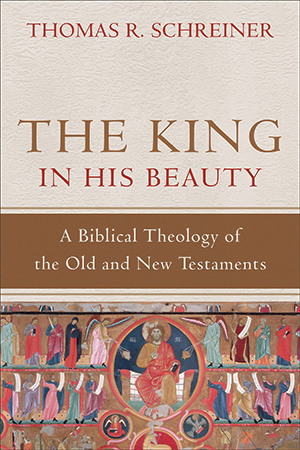
What follows is not an attempt to summarize every section of the book. I am more interested in the things that remained with me after finishing it: the recurrence of covenant, obedience, judgment, perseverance, and eschatological hope; the way Christ’s work and identity gather together earlier biblical patterns; and, especially, Schreiner’s treatment of Hebrews, where Christ as Priest-King after the order of Melchizedek brings sacrifice, covenant, kingship, intercession, obedience, holiness, and endurance into unusually close relation. I also want to note where the book led my own thinking further, particularly on obedience arising from inward transformation and on the distinction between finally seeing the King and participating in the life of Christ already begun in this present age.
Book Review
Thomas Schreiner’s The King in His Beauty is a large book because it is trying to do something large: trace the biblical theology of the Old and New Testaments as one story without pretending that every biblical writer says everything in exactly the same way. Schreiner’s stated emphasis is the kingdom of God, and that certainly carries the book, but I did not finish it thinking only about kingdom. Covenant kept coming back. So did obedience, judgment, perseverance, holiness, sacrifice, priesthood, promise and fulfillment, and of course the person and work of Christ. Some of those themes become clearer only after they have been sitting there for a long time. Hundreds of pages, in some cases. That is part of what makes the book work. Schreiner generally lets the biblical text develop before trying to close the argument too quickly.
The beginning is familiar enough, but Schreiner makes the early material carry forward. God creates, humanity bears His image, and man is placed under His rule with a real vocation before Him (Gen. 1:26–28). The fall is rebellion, not merely a mistake or moral defect (Gen. 3:1–19). With Abraham come land, offspring, blessing, and blessing for the nations (Gen. 12:1–3; 15:1–21; 17:1–8), and with the Exodus comes a people redeemed not into independence but into belonging to God (Exod. 6:6–8; 19:3–6). I think that point matters more than it is sometimes given credit for. Redemption in Scripture does not mean God frees a people and then leaves them to themselves. He brings them to Himself. That is why tabernacle, priesthood, sacrifice, purity, and holiness follow. God intends to dwell among them (Exod. 25:8; 29:45–46), which immediately raises the question Leviticus keeps pressing: how does the Holy One dwell among sinful people? Sacrifice and cleansing are not side issues. Neither is holiness (Lev. 16; 19:1–2).
Israel’s history makes the deeper problem harder to avoid. They receive the land, but the land does not change them. Then kingship comes, David receives the promise of an enduring house and kingdom (2 Sam. 7:8–16), and still the same problem remains. Kings fail. The people fail. Idolatry spreads. Judgment comes. The temple is lost and exile follows. Yet the promises of God are not withdrawn. I thought Schreiner handled that tension especially well because he did not rush past the ugliness of Israel’s failure just to get to fulfillment. The Prophets announce judgment because covenant unfaithfulness is real, but they also begin speaking about something God Himself will have to do: a righteous Davidic ruler, forgiveness, a new covenant, a new heart, the Spirit, restoration, and the nations coming under God’s saving rule (Isa. 9:6–7; 11:1–10; 52:13–53:12; Jer. 31:31–34; Ezek. 36:25–27). By then the answer cannot simply be better circumstances. The person has to change.
That became one of the more important things I took from the book. Obedience does not disappear when grace enters the discussion. Scripture simply will not allow that. But neither does the answer become, try harder. Jeremiah speaks of the law written upon the heart (Jer. 31:33), and Ezekiel of a new heart and Spirit, with God causing His people to walk in His statutes (Ezek. 36:26–27). That is different. Obedience comes from transformation. I would probably put it that simply. Not obedience as another ground of salvation beside grace, but the obedience that begins to appear because God has acted within the person. Once I started noticing that, I saw it almost everywhere in the later parts of the book.
Christ comes into a story already full of unfinished things. That is one of Schreiner’s better achievements. Jesus is not presented merely as the answer to scattered predictions. He is David’s Son (Matt. 1:1; Luke 1:32–33), the Son of Man who receives dominion (Dan. 7:13–14; Mark 14:61–62), the suffering servant (Isa. 52:13–53:12; Mark 10:45), and the obedient Son where Israel had not been obedient (Matt. 2:15; 4:1–11). Kingship, covenant, sacrifice, temple, sonship, the Spirit—all of it starts gathering around Him. There are places where “fulfillment” almost feels too small a word for what is happening. The earlier realities do not merely predict Him. They find their completion in Him.
Schreiner’s treatment of eschatology also stayed with me. The kingdom has come, but not in its final condition. Christ has died, risen, ascended, and poured out the Spirit, so something genuinely new has happened. Believers have already been transferred into the kingdom of the Son (Col. 1:13), yet still pray, “Thy kingdom come” (Matt. 6:10). The Spirit is already given as firstfruits and guarantee, while bodily redemption remains ahead (Rom. 8:23; Eph. 1:13–14). That tension explains a great deal of the New Testament. Salvation is possessed and awaited. Life has begun, but death is still here. Judgment remains. Resurrection remains. And this is where perseverance stops looking like an uncomfortable doctrinal appendix. Of course perseverance matters if the Christian has entered the coming age but has not yet reached its completion.
Paul fits that larger picture well. I appreciated that Schreiner did not leave salvation sitting only in one category. Justification has to retain its forensic force (Rom. 3:21–28; 4:1–8; 5:1; Gal. 2:15–21; Phil. 3:8–9). I would resist any reading that turns it into something else. But Paul also says the believer is crucified with Christ (Gal. 2:20), buried and raised with Him (Rom. 6:3–5), indwelt by the Spirit (Rom. 8:9–11), adopted (Rom. 8:14–17), and being conformed to the image of the Son (Rom. 8:29). So salvation changes standing before God, yes, but not standing only. Romans 8:13 is one of those verses that will not let the Christian life become passive: “if ye through the Spirit do mortify the deeds of the body, ye shall live.” The believer acts, but through the Spirit. There it is again—grace producing action rather than replacing it.
Hebrews was probably my favorite portion of the book, or at least the one I kept returning to afterward. Schreiner is particularly strong here. Covenant, sacrifice, priesthood, kingship, obedience, holiness, perseverance, judgment, access to God, and final rest all come together without feeling forced. Christ is the enthroned Son at the right hand of God (Heb. 1:3, 13), but He is also Priest after the order of Melchizedek (Heb. 5:5–6; 6:19–20; 7:15–17; cf. Gen. 14:18–20; Ps. 110:1, 4). Priest and King. That connection through Psalm 110 is one of the things I do not think I will read casually again. His priesthood is not grounded in Levitical descent but in divine oath (Heb. 7:20–22); His sacrifice is once for all (Heb. 10:10–14); and because He lives forever, He “ever liveth to make intercession” for those who come to God through Him (Heb. 7:25). There is a completeness to Christ’s priesthood in Hebrews that is hard to overstate.
And Hebrews is where obedience from transformation becomes especially concrete. Christ Himself “learned…obedience by the things which he suffered” and became “the author of eternal salvation unto all them that obey him” (Heb. 5:8–9). I do not read that as though the Son had once been disobedient; His obedience was lived out through suffering and brought to its appointed end. Then the new covenant promise appears: God writes His laws upon the mind and heart (Heb. 8:10; 10:16). After that, the commands of Hebrews make sense in their proper place. Draw near. Hold fast. Endure. Pursue holiness. Encourage one another. Do good (Heb. 10:22–25, 35–36; 12:1–2, 14; 13:15–16). None of those things creates access to God. Christ has already opened the way. They are what life begins to look like after He has. The closing benediction almost settles the question for me: God equips His people “in every good work to do his will,” while He Himself is “working in you that which is wellpleasing in his sight, through Jesus Christ” (Heb. 13:20–21). Both are true. I see no reason to soften either one.
The warning passages deserve the same treatment. Schreiner lets them remain warnings, which I appreciated. Israel in the wilderness “could not enter in because of unbelief” (Heb. 3:19), and Hebrews immediately turns that history toward Christians: “Take heed, brethren” (3:12), “Let us therefore fear” (4:1), “Let us labour therefore to enter into that rest” (4:11). Yet those warnings sit right beside the oath and promise of God and the continuing intercession of Christ (Heb. 6:13–20; 7:25). “We are made partakers of Christ, if we hold the beginning of our confidence stedfast unto the end” (Heb. 3:14). I had considered perseverance before, obviously, but reading it here in relation to participation in Christ, covenant, priesthood, and final inheritance gave it a different weight. Less like a doctrinal problem to solve and more like the actual shape of the Christian pilgrimage.
The title itself also changed somewhat for me by the end. Isaiah says, “Thine eyes shall see the king in his beauty” (Isa. 33:17), and Scripture does move toward seeing God: “they shall see God” (Matt. 5:8), “then face to face” (1 Cor. 13:12), “we shall see him as he is” (1 John 3:2), and finally “they shall see his face” (Rev. 22:4). That certainly approaches what later Christian theology calls the Beatific Vision. Still, I hesitate to let vision carry the whole thing. Hebrews says that God disciplines His children so that they may become “partakers of his holiness” (Heb. 12:10), and then says that without holiness no one will “see the Lord” (12:14). Participation and vision are close, but they are not identical. Seeing is receptive; participation is a manner of life and being. Even now the believer abides in Christ, is indwelt by the Spirit, shares in the communion of His body and blood, belongs to His body, serves others in relation to Him, and is being changed into His likeness (John 15:4–5; Rom. 8:9–11; 1 Cor. 10:16–17; 12:27; 2 Cor. 3:18). So no, I do not think the end is simply spectatorship before God.
That is probably where my own emphasis goes a little beyond Schreiner’s kingdom framework, though not against it. Kingdom is biblical. Clearly. But presence and union with Christ help explain what the kingdom is for. Scripture moves from Eden to tabernacle, temple, incarnation, indwelling Spirit, and finally to, “Behold, the tabernacle of God is with men, and he will dwell with them” (Rev. 21:3). The King reigns, but He also brings His people near. They are not only subjects under His rule; they are members of Christ’s body, branches in the vine, partakers of holiness, and finally a glorified people dwelling before God. I am not sure I would have put the pieces together in exactly that way before finishing the book. Maybe that is one of the better things a biblical theology can do—it leaves you following some of its lines beyond the author’s own stated center.
In the end, The King in His Beauty helped me see more clearly how the parts of Scripture belong together. Leviticus corresponds to Hebrews. David and Psalm 110 open up Christ as Priest-King. Exile gives the prophetic promises of restoration their weight. Jeremiah and Ezekiel make clear that the new covenant reaches into the person through forgiveness, a new heart, the Spirit, and obedience that follows from that work of God. The Prophets prepare the ground for the Gospels, and the resurrection of Christ begins what Revelation finally shows in fullness. I do not agree with Schreiner at every point, but that was never what I was looking for from the book. I wanted to see whether his biblical theology would send me back into Scripture with clearer lines of connection, and it did. By the end, I was thinking much more about the full meaning of salvation in Christ: what He accomplished where fallen humanity and Israel failed, the people He gathers to Himself, and the life He forms in them through grace, faith, holiness, obedience, and perseverance. The story reaches its end in the presence of God. His people see the King in His beauty, but they arrive there already having been brought near, made alive in Christ, and conformed to Him.


