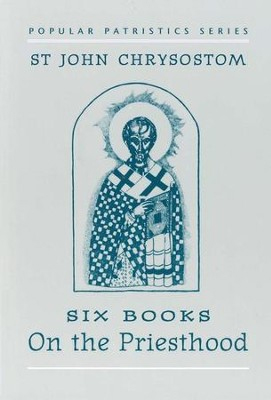
The first book in the Popular Patristics series is entitled “Six Books on the Priesthood.” Today, I finished this book to gain a deeper understanding of Chrysostom’s views on pastoral and priestly ministry and to explore the various books in this series further. The first book I completed within the Popular Patristics Series was “On the Incarnation” by Saint Athanasius.
This translation was rendered by the late Anglican priest Graham Neville (1922-2009). Although the process by which edits and additions were made to incorporate modern sensibilities is unclear, additional translations are available for comparison purposes. However, this reading provides an overall perspective on Chrysostom’s thoughts on the office of the priesthood, incorporating pastoral elements.
Review
John Chrysostom’s “On the Priesthood” stands as one of the most spiritually weighty patristic texts on the pastoral office, written in the fourth century as a defense of his intentional refusal to be ordained. Structured as a series of dialogues between Chrysostom and a fictionalized version of his friend Basil—used as a literary device to frame the treatise—the work lays bare the complexity, burden, and consecrated solemnity of the priestly calling. Rather than presenting a systematic theology of ministry, Chrysostom offers a deeply personal and rhetorical exploration of its moral demands, sacramental gravity, and public accountability. The opening frames the conversation as a justification: Basil is portrayed as indignant that Chrysostom had knowingly pretended to consent to ordination only to deceive and withdraw at the decisive moment, leaving Basil alone to bear the burden. What follows is Chrysostom’s extended and sober exposition on the immense weight of the pastoral office and the reverent fear it stirred in him.
Chrysostom emphasizes the formidable responsibilities of the pastoral office, portraying the priest as a spiritual physician entrusted with the healing of souls. This role demands discernment, vigilance, and profound humility, as the priest must administer correction, comfort, and instruction according to the spiritual needs of each soul (Titus 1:9). The difficulties of pastoral care arise not merely from external challenges but from the priest’s accountability before God, whose judgment is severe upon those who mislead or neglect their flock (James 3:1). This burden, more than any honor or prestige, is what rendered Chrysostom so hesitant to accept ordination. The priest stands in a place of perilous dignity, not because of corruption, but because of the sacred charge to guide others to salvation while contending with his own flaws.
A central theme is the contrast between the priesthood’s outward honor and its inner crucible. Chrysostom warns that many are enticed by the visibility, respect, and ceremonial dignity of the office while failing to grasp the internal vigilance and judgment it entails. He portrays the priest as one who must be as skilled in spiritual healing as the physician is in bodily medicine, knowing when to admonish, when to console, when to rebuke, and when to offer patience (1 Thess. 5:14). Moreover, he is to be a teacher to the wise and a shepherd to the weak. It is no small thing, he says, to be responsible for the spiritual formation of others while contending with one’s own passions and temptations.
Chrysostom devotes considerable attention to the power and danger of rhetoric within the priestly office. Because the priest is often a public speaker and interpreter of Scripture, his words can shape, edify, or destroy. A careless tongue can mislead an entire congregation (Prov. 18:21); a flattering or self-seeking manner can ruin the integrity of the message. The priest, therefore, must strive not only to speak rightly but to embody his message, lest he fall under condemnation as one who preached to others but was himself disqualified (1 Cor. 9:27). This rhetorical emphasis reflects Chrysostom’s own background as an orator and his sensitivity to the power of words.
Equally vivid is Chrysostom’s insistence on the spiritual warfare attendant to the priesthood. He describes the priest as one who stands in the front lines of battle, constantly observed by both angels and demons (1 Pet. 5:8–9). His public failures can scandalize the Church, while his quiet victories often go unnoticed except by God. The devil, he argues, pays particular attention to those in clerical leadership, knowing that their fall can cause the ruin of many. Therefore, the priest must be girded with all virtue, fortified by prayer, and vigilant in humility (Eph. 6:11–18). This sober view reinforces Chrysostom’s initial claim: he did not refuse ordination out of cowardice but out of reverence for its responsibilities.
The dialogue also reflects Chrysostom’s pastoral vision for the Church. Though he defends his initial reluctance to be ordained, he never disparages the priesthood itself. On the contrary, he elevates it as a divine office requiring the utmost spiritual preparation. He praises Basil for his courage in accepting the call and encourages him to fulfill the office with trembling and love (Phil. 2:12). The tone throughout is one of reverence, not rejection; awe, not disdain. Chrysostom’s purpose is to awaken seriousness, not to deter vocation.
In the latter sections, Chrysostom discusses the interplay between human weakness and divine grace. No priest, he acknowledges, is sufficient in himself for so great a task. Yet, it is through weakness that God’s strength is revealed (2 Cor. 12:9). The priest must know his insufficiency and rely wholly upon divine mercy. This reliance does not excuse laxity, but compels diligence (Phil. 3:13–14). The grace given in ordination is not automatic sanctity but a call to deeper sacrifice and sanctification. Chrysostom stresses the necessity of earnest cooperation with grace, counsel, and divine aid, avoiding complacency and urging steadfast effort in all things pertaining to the sacred office.
The final chapter of “On the Priesthood” closes not with lofty celebration but with a sober and restrained hope shaped by vigilance and intercession. Chrysostom urges that the priest must give himself more fully to prayer than to preaching (Acts 6:4), more to being hidden in communion with God than to appearing before others (Matt. 6:6). The sacred charge is not a pursuit of honor but a mission to bring souls safely to eternal life (1 Tim. 4:16). For this cause, the Church must not only revere the priestly office, but continually support her clergy through prayer, spiritual solidarity, and humble fidelity to the gravity of the vocation entrusted to them.
In sum, John Chrysostom’s “On the Priesthood” is both a theological meditation and a stirring spiritual exhortation, spoken from the heart of a man who feared the weight of divine responsibility more than he sought human recognition. It is not a manual for advancement within the Church, but rather a searching examination of the solemn burdens borne by those entrusted with spiritual oversight.
Section Synopses
1. Feigning for Fear
John recounts his calculated evasion of ordination by pretending agreement only to withdraw at the critical moment. The narrative introduces the dramatic premise for the entire treatise, presenting John’s refusal not as dishonor but as reverence for the office’s solemn weight.
2. Wounded Friendship
Basil expresses grief and indignation at John’s apparent betrayal. His reproofs are tender yet sharp, marking a tension between two spiritual brothers who now see the priesthood through different lenses of readiness.
3. The Weight of Office
John responds with humility and fear, explaining that his reluctance is not due to disdain but due to a deep conviction that the pastoral office requires greater sanctity and preparation than he possessed.
4. The Physician of Souls
John expands on the immense discernment required to shepherd souls. The priest must rightly divide correction from comfort and bear the burden of judgment upon himself for the sake of others.
5. The Heart of Ministry
Pastoral care, John argues, must be rooted in genuine love. Without love, all effort becomes dangerous, even destructive, as the shepherd’s motive corrupts his spiritual influence.
6. God’s Judgment and Human Weakness
He confesses his fear of misleading others and emphasizes the terrible accountability borne by those who teach and lead the faithful.
7. Earthly Office, Heavenly Honor
John extols the priesthood as a high and glorious calling that surpasses even angelic tasks, because it mediates divine grace through the sacraments and shepherds the people of God.
8. The Sacred Burden
The awe of the calling is met with sobering reality. Many seek its honor, but few are willing to endure its interior crucibles and public dangers.
9. Visible Life, Invisible Warfare
John outlines the risks faced by bishops: pride, ambition, flattery, and public scrutiny. These temptations make episcopal life more perilous than monastic withdrawal.
10. From Altar to Hearth
Practical dimensions of pastoral life are examined:
- Promotions: Discerning proper advancement and spiritual maturity.
- Widows and the Sick: Compassionate care and administrative oversight.
- Virgins: The protection and instruction of consecrated women.
- Arbitration—Visiting—Excommunication: Managing disputes, pastoral visits, and grave discipline.
11. Answering Before God
The consequences for clerical negligence are spiritual and eternal. Better, says John, to suffer now than to be found wanting at the judgment seat.
12. The Power and Danger of Preaching
The Word of God is both fire and healing balm. John insists that preaching demands both purity and precision lest the preacher mislead.
13. Self-Deception and Vainglory
The teacher’s heart is exposed to pride, hypocrisy, and the subtle temptation to please rather than convict. John warns of the deadly impact of such vanity.
14. The Vessel Must Be Clean
Purity of life, not merely doctrine, qualifies a man to lead others. Without personal holiness, his instruction is hollow and even harmful.
15. Solitude and Shepherding
John compares the quieter, guarded life of the monk with the exposed, public, and demanding life of the bishop. The former hides from sin; the latter stands in its breach.
16. Holy Fear and Hope
John concludes with a prayerful return to his original point: that his evasion was not treachery but trembling. Yet he commends the priesthood as a grace-filled and sacred office, not to be refused lightly, nor accepted without tears.
Saint John Chrysostom
John Chrysostom (349–407 AD) was one of the most revered Church Fathers of the fourth century, known especially for his eloquence in preaching, his ascetical rigor, and his boldness in addressing moral and theological issues of his day. Born in Antioch to a prominent family, he received a classical education under the pagan orator Libanius and later trained in Christian theology under Diodore of Tarsus. Renouncing a promising secular career, Chrysostom embraced the monastic ideal, spending years in ascetical solitude before illness compelled his return to Antioch, where he was ordained a deacon around 381 and a presbyter in 386.
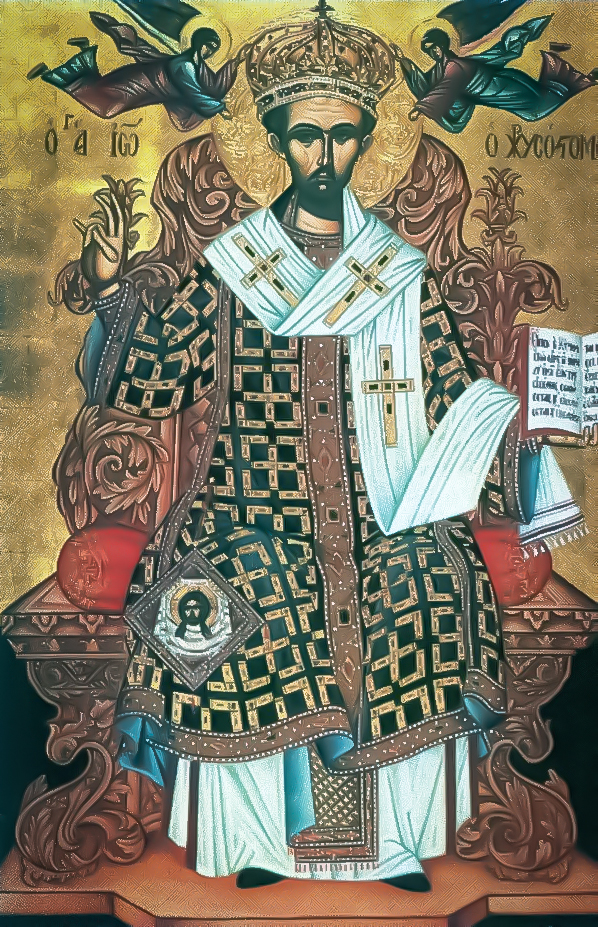
As a priest in Antioch, he gained immense renown for his powerful preaching, which earned him the epithet Chrysostomos, meaning “golden-mouthed.” His sermons—marked by deep scriptural insight, moral urgency, and rhetorical brilliance—drew large audiences and exerted a profound pastoral influence on the city. In 398, he was appointed Archbishop of Constantinople, where his reforming zeal, denunciation of clerical and imperial excesses, and unwavering commitment to spiritual integrity soon aroused both admiration and opposition. His tenure as archbishop was marred by political intrigue and conflicts with Empress Eudoxia and other church leaders, leading to his exile in 403, return shortly after, and final banishment in 404. He died in exile in 407, his last recorded words being, “Glory be to God for all things.”
Chrysostom’s On the Priesthood was written prior to his ordination, likely in the mid-380s, and reflects his early theological convictions and personal struggle with the weight of pastoral calling. His legacy endures not only through this treatise but through his extensive homilies, letters, and liturgical contributions, including the Divine Liturgy of St. John Chrysostom, which remains central to Eastern Orthodox and Byzantine Rite worship to this day. Declared a Doctor of the Church by both East and West, Chrysostom continues to be a model of courageous preaching, ascetical piety, and pastoral seriousness.
The Eastern Orthodox Church claims St. John Chrysostom as one of its own not because of institutional anachronism, but because it sees itself as the organic continuation of the undivided Church of the first millennium, of which Chrysostom was an integral part. Chrysostom lived and ministered during the fourth and early fifth centuries, well before the Great Schism of 1054 divided the Church into Eastern (Orthodox) and Western (Catholic) branches. At that time, the Christian Church was one communion, though regionally diverse, and Chrysostom’s ministry as Archbishop of Constantinople placed him in the very heart of what would later be identified as Eastern Christendom.
His theological orientation, liturgical influence, ascetical emphasis, and ecclesial vision were all embedded in the Eastern Christian tradition that the Orthodox Church later formally inherited. The Divine Liturgy attributed to him is still the normative Eucharistic rite used in the Eastern Orthodox Church to this day. The truths and exhortations within his preaching are shaped by a deep concern for godliness, reverence, and the pursuit of righteousness, reflecting the charge to rightly handle the word of truth (2 Tim. 2:15) and to proclaim the whole counsel of God (Acts 20:27). The themes he develops—especially the transformative power of the sacraments, the ascetical life, and the communion of saints—are not just historically situated but continue to form part of the living tradition of the Orthodox Church. Therefore, the Orthodox do not view Chrysostom as belonging to a “pre-Orthodox” period, but as a father of the same Church they now inhabit in unbroken continuity.


