Today I finished the book The Aeneid (484 pages, ISBN: 978-0143105138). The book was written from 29 to 19 BC. Having completed The Iliad and The Odyssey, I come to Virgil’s The Aeneid as the next great text in the classical epic tradition. Homer gave the war before Troy and the long return from Troy. Virgil begins after Troy has fallen, with Aeneas carrying what remains of his people into exile. The image is plain and memorable: his father on his back, his son beside him, and the household gods in his care.
The reading ahead follows Aeneas from ruined Troy across the sea toward Italy. There will be storms, wandering, Carthage, Dido, Sicily, funeral games, the descent into the underworld, and then war in Latium. The poem gathers much of what has already appeared in Homer: wrath, grief, memory, hospitality, temptation, loss, the gods, the dead, and the cost of honor. Yet the direction is different. Achilles is bound to glory, Odysseus to homecoming, and Aeneas to the burden of carrying a people forward.
That is what makes The Aeneid especially interesting after Homer. It is not merely another ancient adventure, nor Rome’s national epic alone. It receives the world of Troy and turns it toward Rome, with all the sorrow and moral weight that such a trajectory requires. In reading it, I am watching how the classical world remembered war, exile, fathers, sons, cities, gods, and destiny before Christianity judged and transformed that inheritance.
Knox’s Introduction
Bernard Knox’s introduction to The Aeneid is substantial enough to be read almost as a preparatory essay in its own right. It does more than place a few historical facts before the poem. It gives the reader a way to enter Virgil’s world: Rome, civil war, pastoral loss, cultivated order, epic inheritance, Roman memory, and the long afterlife of Virgil in the Western imagination.
This is especially helpful after reading The Iliad and The Odyssey. Homer gives Troy at war and the long struggle to return home after the war. Virgil begins with Troy already gone. The city has fallen, and Aeneas must carry what remains into exile. Knox prepares the reader to understand why this matters and why The Aeneid should not be approached as a lesser Homeric imitation. It is a Roman poem formed out of Greek epic, but turned toward Rome’s own account of order, history, and empire.
Rome and the Augustan World
Knox begins with Rome, and rightly so. The Aeneid cannot be entered first as a detached mythological tale. It belongs to Rome’s memory of itself, and to the age in which Rome passed from Republic to empire.
Virgil was born into a world already strained by conquest, ambition, and civil disorder. Rome had expanded outward with astonishing force, but its own institutions could no longer hold the pressures created by generals, armies, wealth, provincial command, and personal loyalty. The Republic had become too small for the power Rome had acquired.
Julius Caesar stands behind this world. His conquest of Gaul, his crossing of the Rubicon, his victory over Pompey, and his dictatorship brought the crisis into full view. Caesar’s assassination in 44 BC did not restore the Republic. It exposed that the old order had already been broken. The murder of Caesar led not to liberty restored, but to further civil war.
Knox then places Virgil in the aftermath: Antony, Octavian, Cleopatra, Actium, and the emergence of Augustus. The contest between Antony and Octavian was not only a rivalry between two men. It was a struggle over Rome’s future. Antony’s alliance with Cleopatra drew Roman imagination eastward, toward Egypt, monarchy, luxury, and foreign entanglement. Octavian presented himself as the restorer of Rome, the heir of Caesar, and the man through whom order could return.
The victory at Actium in 31 BC gave Octavian the decisive position. In 27 BC, he became Augustus. Rome had peace, but that peace came after civil bloodshed and under the rule of one man.
This is the world Knox places before the reader. Virgil’s contribution to the empire was not military or administrative. He gave Rome a poem large enough to explain Rome to itself. The Aeneid gives Augustus’s Rome a sacred ancestry, a Trojan origin, and a destiny stretching from ruin to rule. Yet Knox does not make Virgil sound like a simple court poet. His Rome is glorious, but wounded. Its order has weight because the disorder before it was real.
That opening section gives the whole introduction its gravity. Before Aeneas appears as the bearer of Troy, Rome has already appeared as the civilization trying to understand what it has become.
The Eclogues: Pastoral Song after Civil War
Knox then turns from Rome to Virgil’s earliest major poetry. Before Virgil becomes the poet of Aeneas, he is the poet of shepherds, fields, songs, love, lament, and dispossession. The Eclogues, also called the Bucolics, are pastoral poems. They belong to a literary world of rural speakers and singing shepherds. On the surface, their scale is small. They do not yet move among armies, founders, gods, and empires. They are poems of the countryside.
But Knox does not let the pastoral world become sentimental. The fields are not untouched by Roman power. Civil war has reached them. Land is confiscated. Veterans are settled. The rural singer is displaced by events decided far away from him. The countryside becomes a place where the consequences of Roman politics are felt in private loss.

This makes the Eclogues more than Virgil’s apprenticeship. They show one of his abiding concerns: the cost of order. Rome may move toward settlement, but some remember what was taken. Peace may return, but not everyone receives it in the same way.
That matters for The Aeneid. In the epic, the scale becomes greater. Troy replaces the field. Aeneas replaces the shepherd. Rome’s destiny replaces the local settlement. But the wound is already present in Virgil’s earlier poetry. He had already learned how to write of order while allowing loss to remain visible.
The Georgics: Land, Labor, and the Recovery of Order
From the Eclogues, Knox moves to the Georgics. The pastoral world gives way to cultivated land. The singer in the field gives way to the laborer who must work the field.
The Georgics are four books of poetry about agriculture: crops, vines, trees, animals, bees, weather, disease, soil, seasons, and the knowledge required to work the earth. They may sound at first like elevated farming verse. Knox presents them as something far more serious.
The land does not yield by sentiment. It must be known, plowed, pruned, watched, guarded, and endured. Nature is fruitful, but resistant. Human beings live by discipline, memory, inherited skill, and submission to realities larger than desire. Cultivation requires patience.
This is where Knox’s sense of Virgil’s development becomes especially helpful. After the civil war, Rome needed more than victory. It needed restoration. The question was no longer only who would rule, but how order could be recovered after disorder. The Georgics answer that question through the image of land and labor.
Civilization appears here in the form of cultivation. A field becomes fruitful only through discipline. A people becomes ordered only through restraint, continuity, labor, and reverence for inherited forms.
This prepares directly for The Aeneid. Aeneas is not simply moving toward a piece of land. He is moving toward the founding of a people. Italy will not receive him without conflict. The future must be suffered, defended, and ordered.
The Eclogues remember dispossession. The Georgics teach labor after disorder. The Aeneid will gather both into epic form.
The Aeneid: Virgil’s Roman Epic
When Knox reaches The Aeneid, the reader has already been prepared. Virgil has moved from pastoral song to cultivated order to epic founding. The poem now appears as the culmination of his poetic life.
This is important because The Aeneid can easily be reduced to “Rome’s national epic.” That description is true, but thin. Knox shows that the poem is more than a patriotic origin story. It is Virgil’s attempt to bring Homeric epic, Roman history, Augustan order, and human suffering into one form.
The relationship to Homer is central. The first half of The Aeneid recalls The Odyssey: sea travel, storm, wandering, strange lands, hospitality, temptation, storytelling, and descent among the dead. The second half recalls The Iliad: war, rage, young men dying, heroic violence, grief, and the struggle for honor.
Yet Virgil reverses Homer’s epic outcome. Homer goes to war, then returns. Virgil gives exile, then war. Aeneas has no home to return to. Troy is gone. His task is not to recover what was lost, but to carry what remains into a future he will not fully see.
That is why Knox’s introduction helps. Aeneas can disappoint if he is measured only against Achilles or Odysseus. Achilles burns. Odysseus dazzles. Aeneas bears. His greatness is bound to a burden.
Narrative: How the Poem Works
Knox’s section on narrative is helpful because The Aeneid does not unfold in a flat line. Virgil does not simply begin with Troy’s fall and then proceed step by step to Italy.
The poem opens with Aeneas already at sea. He is already displaced. The reader meets him in motion, under divine hostility, carrying a past that has not yet been fully narrated.
Troy then returns through memory. Aeneas recounts the city’s fall to Dido in Carthage. This is one of Virgil’s great narrative decisions. The destruction of Troy is not given as detached information. It comes as testimony. Aeneas tells it as one who survived it.
That changes how the reader receives the event. Troy is not merely background. It is wound, memory, and burden. The reader hears of the wooden horse, Priam’s death, Creusa’s loss, Anchises carried from the city, Ascanius led through the ruins, and the household gods preserved in flight.
Knox helps the reader notice how much of the poem moves this way. Past, present, and future are continually layered together. Aeneas acts in the present, remembers Troy, and is shown Rome. The poem is always larger than the scene immediately before the reader.
This gives The Aeneid its solemnity. The story is not only about what happens next. It is what the past demands and what the future requires.
History: Myth Made Roman Memory
The section on history shows why The Aeneid is never merely myth. Virgil takes legendary material and makes it bear the weight of Roman identity.
Aeneas does not found Rome directly. That matters. The poem is not a simple account of a city’s beginning. It works through ancestry, prophecy, divine command, and symbolic anticipation. Aeneas stands at the beginning of a line that will eventually lead to Rome.
Knox shows how Virgil reads Roman history backward into Trojan memory. The later greatness of Rome gives weight to Aeneas’s suffering. The empire known to Virgil’s own age becomes the future toward which the poem moves.
This creates both grandeur and strain. Rome’s destiny is majestic, but the path toward it is filled with loss. Dido dies. Pallas dies. Turnus dies. Priam dies. Creusa vanishes. Aeneas himself is not left untouched. He is commanded, delayed, bereaved, and hardened.
Knox is strong here because he does not make Roman history clean. He allows the reader to feel both the claimed greatness of Rome and the human cost beneath it. That is one reason the poem continues to matter. It praises Rome, but it does not let Rome escape tragedy.
Anchises’ Pageant: The Future among the Dead
The underworld scene in Book 6 becomes one of the centers of the poem. Knox treats Anchises’ pageant with the seriousness it deserves.
Aeneas descends among the dead and meets his father. There, Anchises shows him the future Roman line. The unborn appear in the realm of the dead. Rome’s future is displayed in the underworld.
That setting is essential. Virgil does not show Roman destiny in a scene of public triumph. He shows it beneath the earth, among shades, memory, grief, and ancestral presence. Glory is revealed in the place of mortality.
Anchises’ pageant gives Aeneas a vision of what his suffering serves. He sees the great figures of Rome’s future. The mission becomes historical. His wandering is no longer only survival after Troy. It is the beginning of a people whose destiny will reach far beyond him.
Yet the scene remains grave. Aeneas receives the future from his father among the dead. That gives the pageant its power. Rome’s greatness is real within the poem’s imagination, but it is never separated from death.
Knox’s handling of this section prepares the reader to understand why Book 6 is more than an episode. It is the chamber in which the poem discloses its burden.
The Shield of Aeneas: Rome Carried into Battle
Knox’s section on the shield of Aeneas draws attention to one of Virgil’s clearest acts of Homeric inheritance.
In The Iliad, Achilles receives a shield. It contains a vast image of human life: cities at peace and war, marriage, judgment, harvest, vineyard, cattle, dancing, and the encircling ocean. The shield of Achilles is cosmic and human.
Aeneas also receives a shield. But his shield is different. It contains Rome.
Vulcan engraves scenes from Roman history and Roman destiny upon it. Aeneas carries the future into battle before he fully understands what he carries. The reader understands more than Aeneas does, and that distance gives the scene its force.
The image is remarkable. A man who has lost Troy bears Rome on his arm. The future becomes armor. History is not only foretold to him; it is placed upon him.
Knox is right to give this scene its own attention. The shield gathers Virgil’s art into one object: Homeric imitation, Roman history, divine craftsmanship, Augustan destiny, and the burden of the hero who carries more than he comprehends.
The shield also prepares the reader for the violence of the poem’s final view. Rome’s future is glorious in image, but it must be carried into war. The symbol is beautiful, but the path ahead is bloody.
Virgil’s Afterlife
Knox ends by following Virgil beyond Virgil’s own lifetime. This is the proper ending for the introduction because The Aeneid did not remain only an Augustan poem. It became one of the great texts of the Western literary inheritance.
Virgil became a school author, a moral authority, a master of style, and a guide for later poets. His influence passed through Rome, late antiquity, medieval learning, Renaissance imitation, and modern translation.
For a Christian reader, this afterlife is especially important. Augustine knew Virgil’s power and also its danger. Dante received Virgil with profound reverence, choosing him as a guide through Hell and Purgatory. Yet Dante also understood Virgil’s limit. Virgil can lead far. He cannot lead into the vision of God.
That is the proper place for Virgil in Christian literary memory. He is pagan, profound, morally serious, and limited. He belongs to the inheritance Christianity received, judged, and transformed. He is not a prophet of the gospel, but he is one of the great witnesses to the classical world’s longing for order, meaning, and civilization.
Knox’s final section gives the introduction a long horizon. First, Aeneas carries Troy toward Rome. Then Virgil’s poem itself is carried through the centuries. The bearer becomes borne. The epic of Roman destiny becomes part of the literary memory of the West.
Summary
Knox’s introduction works because it has order. It begins with Rome, then progresses through Virgil’s earlier works, pauses over its great prophetic images, and finally follows Virgil into his afterlife.
Rome gives the historical pressure. The Eclogues give dispossession and wounded pastoral memory. The Georgics give land, labor, and cultivation. The Aeneid gathers these concerns into epic form. Narrative shows how the poem moves. History shows what the poem carries. Anchises’ pageant and the shield of Aeneas disclose Rome’s future inside the poem. Virgil’s afterlife shows why the poem did not end with Rome.
For someone who has just completed The Iliad and The Odyssey, Knox’s introduction is especially valuable. It explains why Virgil belongs next, while also explaining why he must not be read as Homer repeated in Latin. Homer gives the war at Troy and the long return from war. Virgil begins after Troy’s ruin and asks what can be carried forward.
That is the weight of The Aeneid. It is an epic of survival, founding, order, obedience, and cost. Knox gives the reader a frame large enough to enter it.
About Bernard Knox
Knox’s account is more severe than a simple “soldier finds a book” anecdote. The moment came only after a long passage through war.
He had already fought in the Spanish Civil War in 1936 with the International Brigades, where he was hit in the neck and shoulder near Madrid, his carotid artery nicked, and he was left for dead before somehow recovering and walking to aid. By World War II, after Pearl Harbor, he entered the U.S. Army, became an officer, and moved into the OSS. Because of his languages and nerve, he was assigned to Operation Jedburgh, whose teams parachuted behind enemy lines to work with Resistance forces. Knox parachuted into Brittany in July 1944 with Team GILES, worked with French resistance fighters, arranged weapons drops, trained guerrillas, evaded German capture, and later took part in the operations around Brest.
After France, he asked for another European assignment and was sent into northern Italy with an OSS unit working with Italian partisans. This placed him in the last, brutal phase of the Italian campaign, as German forces were withdrawing northward through the mountains. The account preserved by Rutgers says he was operating in the mountainous areas of North Italy and was pinned down in the cellar of a house in Fasano, where he saw, among crumbled brick and broken glass, the corner of a book protruding from the rubble. Another account places the immediate event after the capture of Fanano in the Apennines, with Knox pinned down in an abandoned villa by an enemy machine gun. The common substance is the same: he was under fire, in rubble, in northern Italy, during the closing months of the war.
The book was a 1938 edition of Virgil, edited by J. Albini and H. Funaioli, published by the Accademia Nazionale Virgiliana, with the title-page formula iussu Benedicti Mussolini—“by order of Benito Mussolini.” In other words, Knox found Virgil in Italy, in wartime rubble, in an edition marked by the Fascist regime itself. That detail sharpens the whole scene. The ancient Roman poet had been appropriated by modern imperial ideology, and Knox encountered him while fighting through the destruction such ideology had helped unleash.
The sors Vergiliana
Wondering whether he still had his Cambridge Latin, Knox performed the sors Vergiliana, the ancient practice of opening Virgil at random and taking the passage under one’s finger as an omen or disclosure. Knox opened the Virgil volume at random and found himself at Georgics 1.500–11, where Virgil speaks of “a world in ruins,” of right and wrong changing places, wars everywhere, the plow dishonored, fields left untended, and impious War raging throughout the world.
That is why the passage struck him. It named the world he was physically in: “shell-pocked, mine-infested fields,” shattered cities, starving people, and the misery of global war. He was reading lines written before Christ, but they seemed to speak more directly than modern statements about the very Italy around him.
The book was too large to carry. As his unit moved on—one account says as they “ran and crawled through the rubble”—he left it behind and made the oath that changed his life:
“If I ever get out of this alive, I’m going back to the classics and Virgil especially.”
He kept the oath. He was demobilized in September 1945, entered graduate study in Classics on the G.I. Bill, and eventually became one of the major classicists of the twentieth century. The line from that cellar or villa to his later work on Virgil is direct: he did not return to the classics as an antiquarian escape, but as one who had seen war, ruin, courage, ideology, and civilization under judgment. That is why Virgil has weight.
Book Review
Having completed both The Iliad and The Odyssey, one naturally turns to The Aeneid as the third great epic of the ancient world. While Homer tells the story of the Trojan War and Odysseus’s long journey home, Virgil begins where those stories end. Troy has fallen. Aeneas, one of the few survivors, escapes the burning city carrying his aged father upon his shoulders and leading his young son by the hand. What follows is the account of a people without a homeland, wandering across the Mediterranean in search of the land promised by the gods. The first half of the epic follows these years of exile, from the shores of Carthage and the tragic story of Queen Dido, through many ports of call, to Aeneas’ descent into the underworld, where he is shown the future of the Roman people. The second half shifts from wandering to war as the Trojans arrive in Italy, gather allies, endure siege, and fight a series of costly battles that ultimately decide the future of Latium. The poem closes with a single combat between Aeneas and Turnus, bringing the long struggle to its end while leaving the founding of Rome to the generations that follow.
My first attempt at reading The Aeneid was through Robert Fitzgerald’s translation. Although highly regarded, I found myself setting it aside after only a short time. The language often felt distant, and I struggled to maintain narrative continuity. Rather than drawing me into the story, I found myself working through the text sentence by sentence without the sense of continuity that had made Homer so rewarding. Eventually, I placed it back on the shelf, deciding I would return when I found a translation that better matched how I read. I’ll need more time and experience before trying Fitzgerald’s translation again.
That opportunity came through the translation by Robert Fagles. Before beginning the epic itself, I read Bernard Knox’s forty-five-page introduction, which proved to be one of the finest introductions I have encountered in classical literature. Knox sets Virgil within the history of Rome, traces the development of the Eclogues and Georgics, explains the structure of The Aeneid, and concludes with his unforgettable account of discovering Virgil while serving in Italy during the Second World War. Reading Knox before turning to the poem transformed the experience. Combined with Fagles’ clear and vigorous prose, The Aeneid became far more than the story of one man’s journey. It became the account of a civilization emerging from the ruins of another, linking the world of Homer to the history of Rome in one of the enduring masterpieces of classical literature.
Book I — The Shores of Carthage
Virgil opens The Aeneid not with the fall of Troy, but years afterward. Aeneas and the surviving Trojans are already at sea, still searching for the land promised to them. Their long journey has been delayed by storms, wandering, and the continuing hatred of Juno, who cannot forget the judgment of Paris, the future greatness of Rome, or the destiny that will one day overthrow her beloved Carthage.
As the Trojan fleet sails toward Italy, Juno persuades Aeolus, keeper of the winds, to unleash a violent storm upon them. The sea erupts in chaos. Ships are scattered, men are thrown overboard, and Aeneas fears that those who died defending Troy were more fortunate than those now struggling to survive at sea. Before the storm can destroy them completely, Neptune rises from the depths, rebukes the unruly winds for crossing into his domain, calms the sea, and sends the battered fleet safely toward the coast of North Africa.
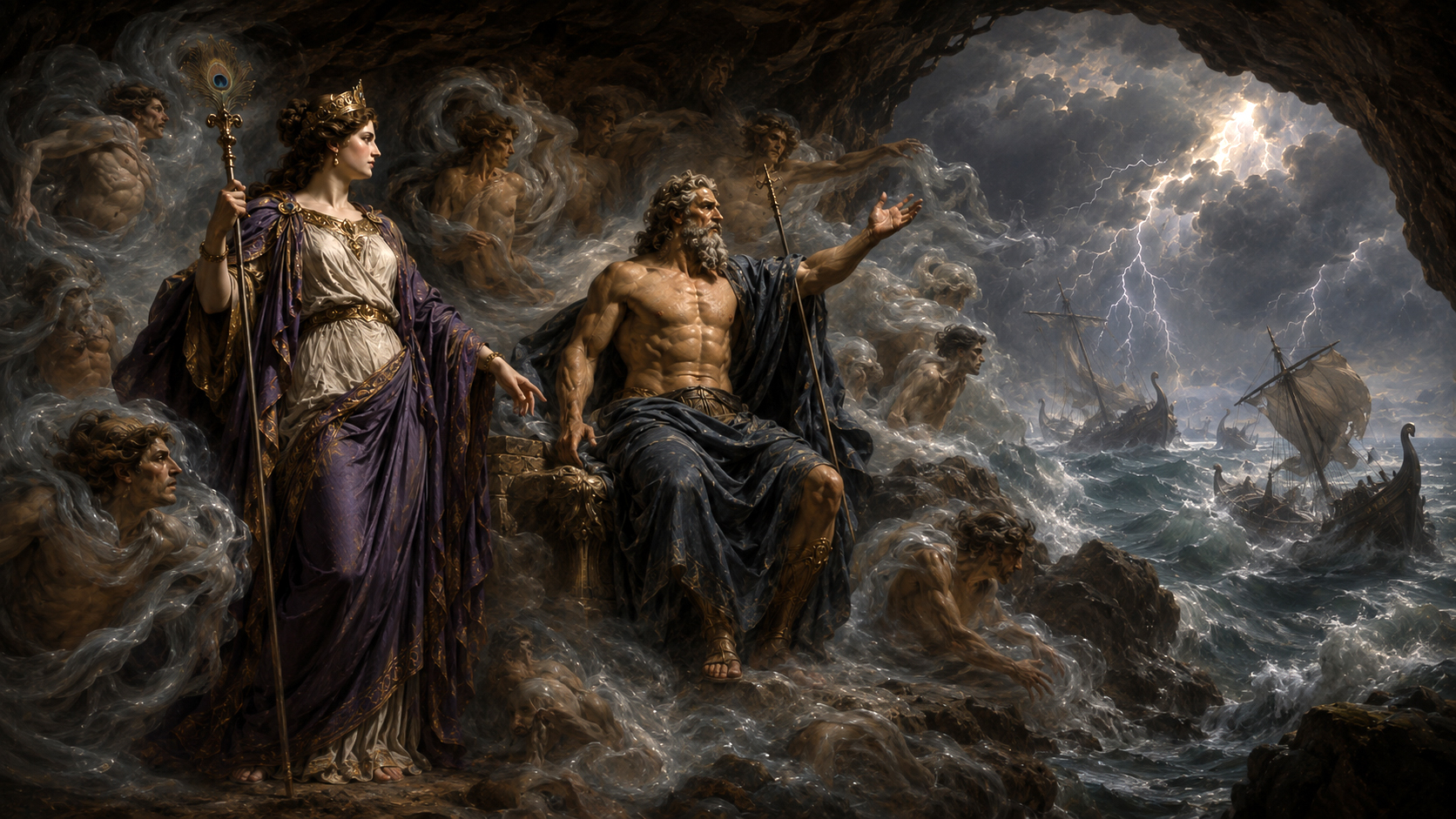
Only seven ships reach land. The weary Trojans come ashore, gather food, repair their ships, and take a brief rest from the hardships of their voyage. Aeneas encourages his companions with words of hope, though he quietly carries his own grief. While they recover, he climbs a nearby hill in search of the missing ships and prays that the rest of his people have survived.
Meanwhile, Venus, Aeneas’ mother, appeals to Jupiter, asking why the promised destiny of her son continues to be delayed. Jupiter reassures her that the future remains unchanged. Aeneas will reach Italy, his descendants will establish a mighty people, and from that line Rome will one day rule the nations. Jupiter also reveals that the time will come when wars will cease, the gates of War will be shut, and an age of peace will be established under Roman rule.
Venus then meets Aeneas disguised as a young huntress. Without revealing her identity, she directs him toward the nearby city of Carthage and tells him about its queen, Dido. Fleeing danger in her homeland of Tyre, Dido had crossed the sea and founded a new city upon the North African coast. Her wisdom, leadership, and determination have already begun to make Carthage prosperous.
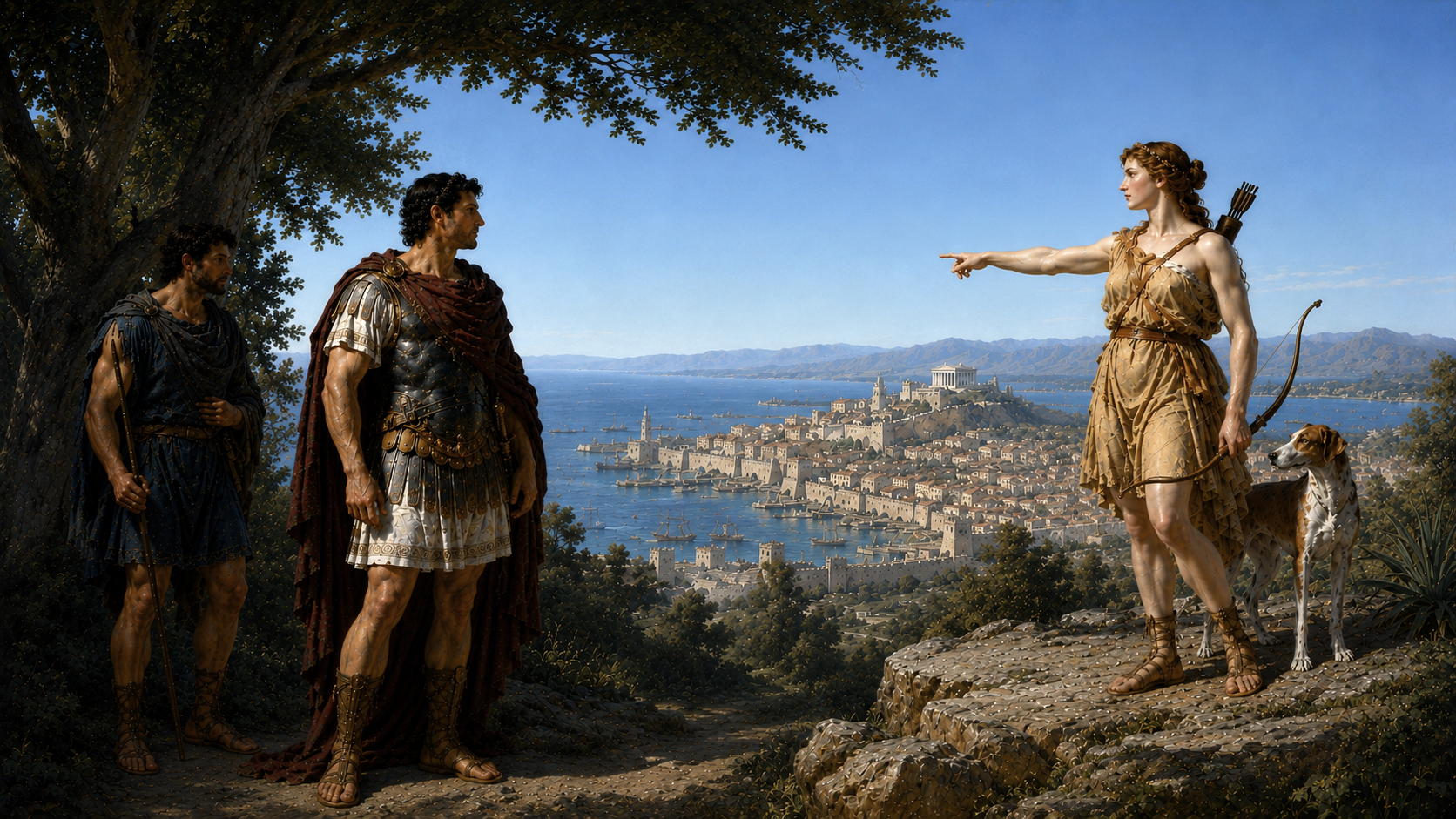
Concerned for her son’s safety, Venus asks Cupid to take the appearance of Aeneas’ young son, Ascanius. Her purpose is to awaken Dido’s affection for Aeneas and the Trojans so they will receive a generous welcome rather than suspicion.
Hidden within a cloud sent by Venus, Aeneas and his faithful companion Achates enter Carthage unseen. They marvel at the city’s walls, temples, markets, and busy workers raising a great civilization from the ground. Inside the temple of Juno, Aeneas unexpectedly discovers paintings of the Trojan War. Seeing familiar scenes of Troy’s destruction so far from home reminds him that the memory of Troy has spread throughout the world.
The cloud surrounding Aeneas finally disappears, revealing him before Queen Dido and her court. She receives him with kindness, welcomes the surviving Trojans into her city, and promises protection and hospitality. At that moment, Ascanius—though in truth Cupid disguised as the boy—is brought into the banquet. As Dido embraces the child, her heart begins to turn toward Aeneas, unaware of the divine influence already at work.
The evening concludes with feasting and conversation. Wanting to know how the Trojans came to her shores, Dido asks Aeneas to recount everything that happened from the final days of Troy until their arrival in Carthage. Her request prepares the way for Aeneas’ own account of Troy’s destruction in the next book.
Book II — The Passing of Troy
At Queen Dido’s request, Aeneas begins telling the story of Troy’s final night. Though painful to remember, he recounts how the city that had withstood ten years of war was finally destroyed through deception rather than open battle.
The Greeks appeared to abandon the war, sailing away and leaving behind an enormous wooden horse outside the walls of Troy. Believing the siege had ended, the Trojans came out to examine the strange gift. Some urged caution, while others wanted to bring it into the city as a sacred offering. The priest Laocoön warned his people not to trust the Greeks, declaring that he feared the Greeks even when they brought gifts. He hurled his spear into the side of the horse, but his warning went unheeded.
Soon afterward, the Trojans discovered a Greek named Sinon, who claimed he had been left behind by his countrymen. Through a carefully crafted story, Sinon convinced the Trojans that the horse had been built as an offering to the goddess Minerva and that bringing it inside the city would secure Troy’s future. As the people listened, two great sea serpents emerged from the sea and killed Laocoön and his two sons. The Trojans believed this terrifying event was punishment for Laocoön’s attack upon the horse, strengthening their decision to bring it within the city walls.
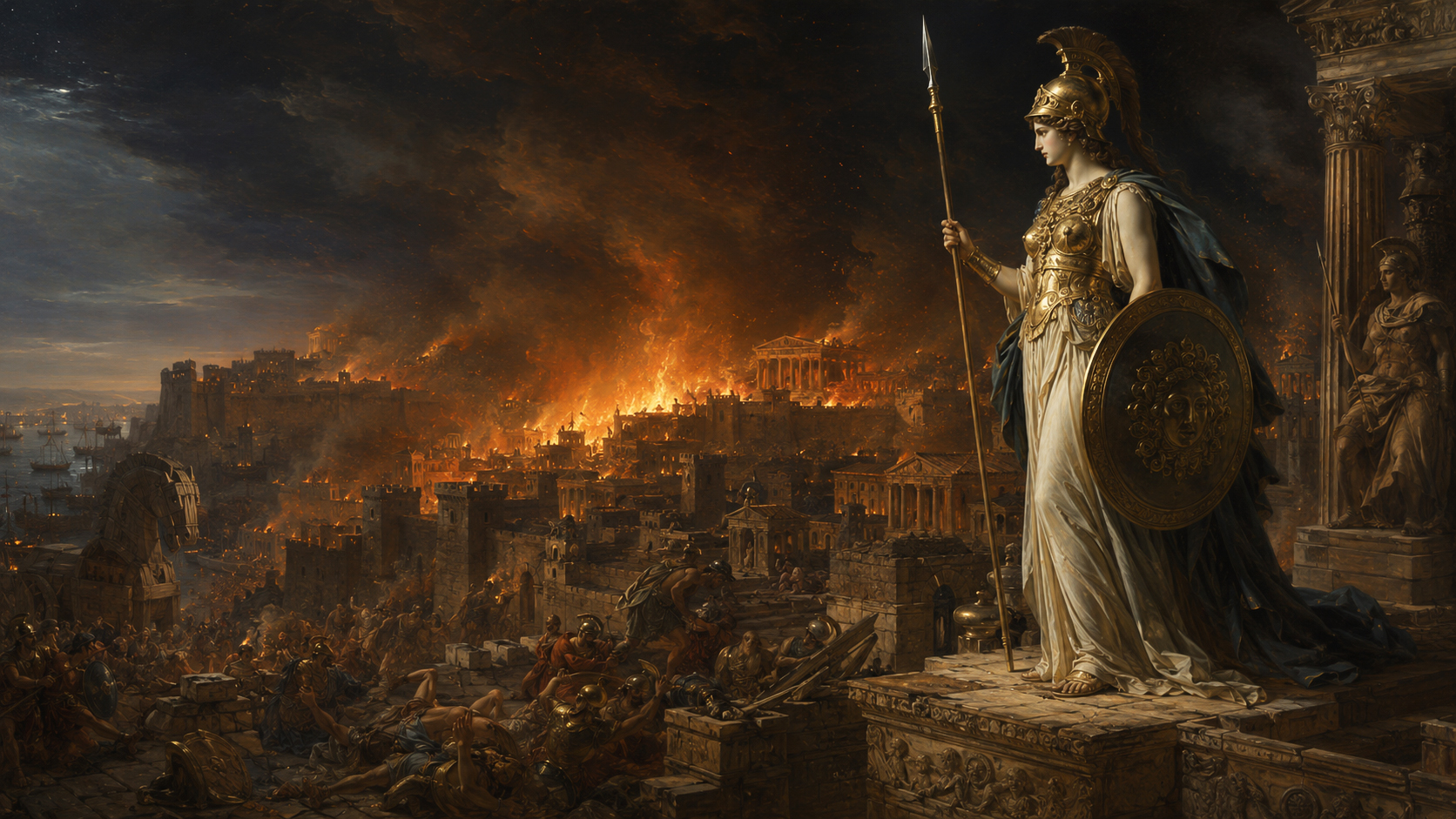
As night fell, the exhausted Trojans celebrated and slept. Under cover of darkness, Sinon opened the hidden door within the horse, releasing the Greek warriors concealed inside. At the same time, the Greek fleet quietly returned from nearby hiding places. The city gates were opened, and the Greek army poured into Troy. Fires spread through the streets as the long-awaited victory of the Greeks became complete.
Aeneas was awakened by the noise of battle and climbed to the roof of his house. Looking across the city, he saw Troy burning. Though greatly outnumbered, he gathered a small band of companions and fought through the streets in a final attempt to defend their homeland. For a brief time, they gained success by disguising themselves in Greek armor, but the confusion of battle soon turned against them. One by one, his companions fell as the city collapsed around them.
During the fighting, Aeneas witnessed the death of King Priam inside his own palace. The aged king, who had once ruled mighty Troy, was struck down before the altar of his household gods by Neoptolemus, the son of Achilles. With Priam’s death, the royal house of Troy came to an end.
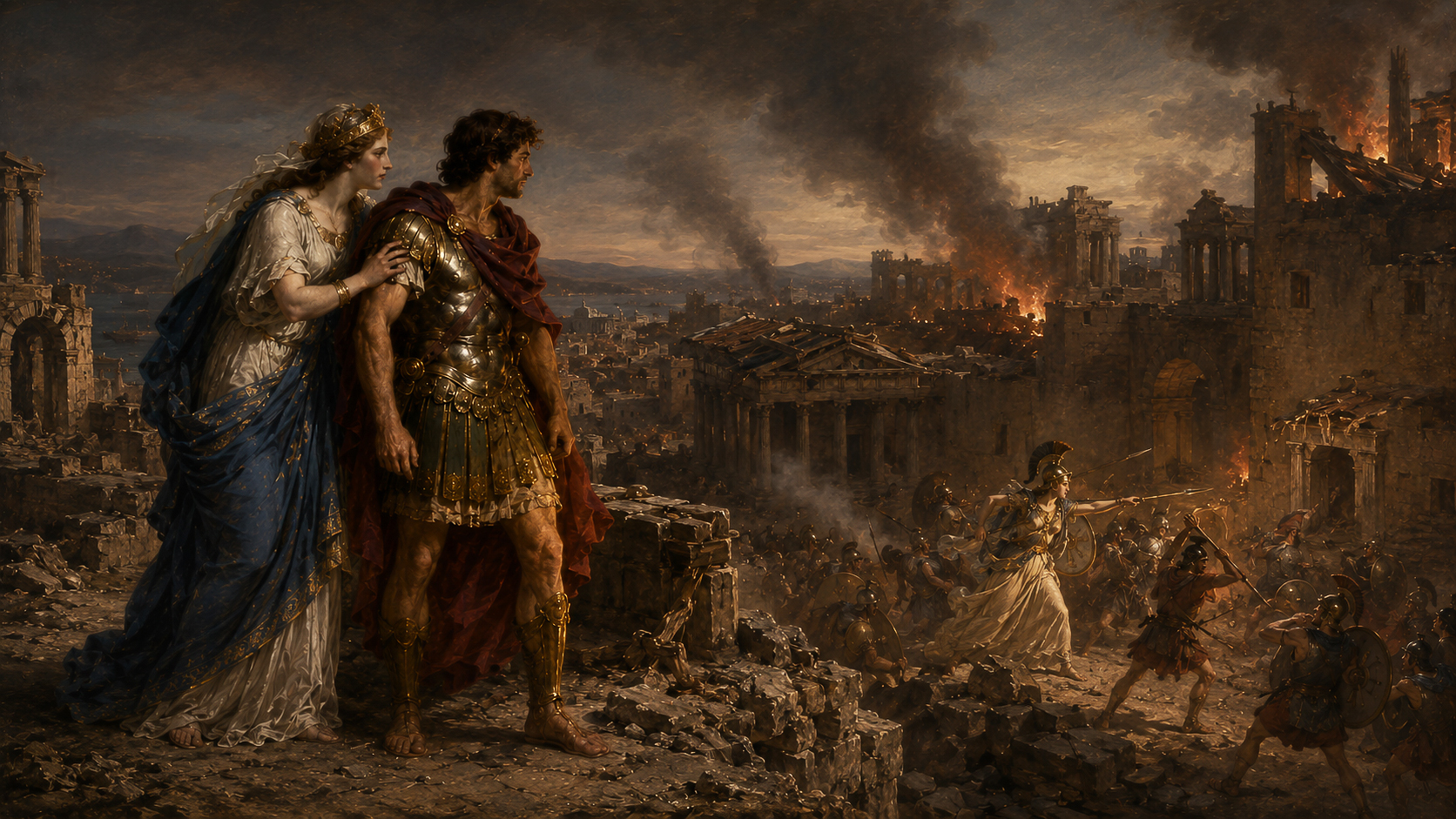
Overcome with grief and anger, Aeneas desired to remain and fight until death. At that moment, his mother, Venus, appeared to him and revealed that the destruction of Troy was not simply the work of the Greeks. The gods themselves were bringing the city to its appointed end. She urged him to leave the battle and save what remained of his family.
Returning home, Aeneas found his aged father Anchises unwilling to abandon the city. Only after signs from heaven—a harmless flame appearing upon the head of Ascanius, followed by a brilliant star crossing the sky—did Anchises recognize that the gods were calling them to depart.
Carrying his father upon his shoulders, leading his young son Ascanius by the hand, and followed by his wife Creusa, Aeneas left the burning city. They agreed to meet outside the walls if they became separated. In the confusion of flight, however, Creusa disappeared. Aeneas searched desperately through the ruined streets, calling her name, but she was nowhere to be found.
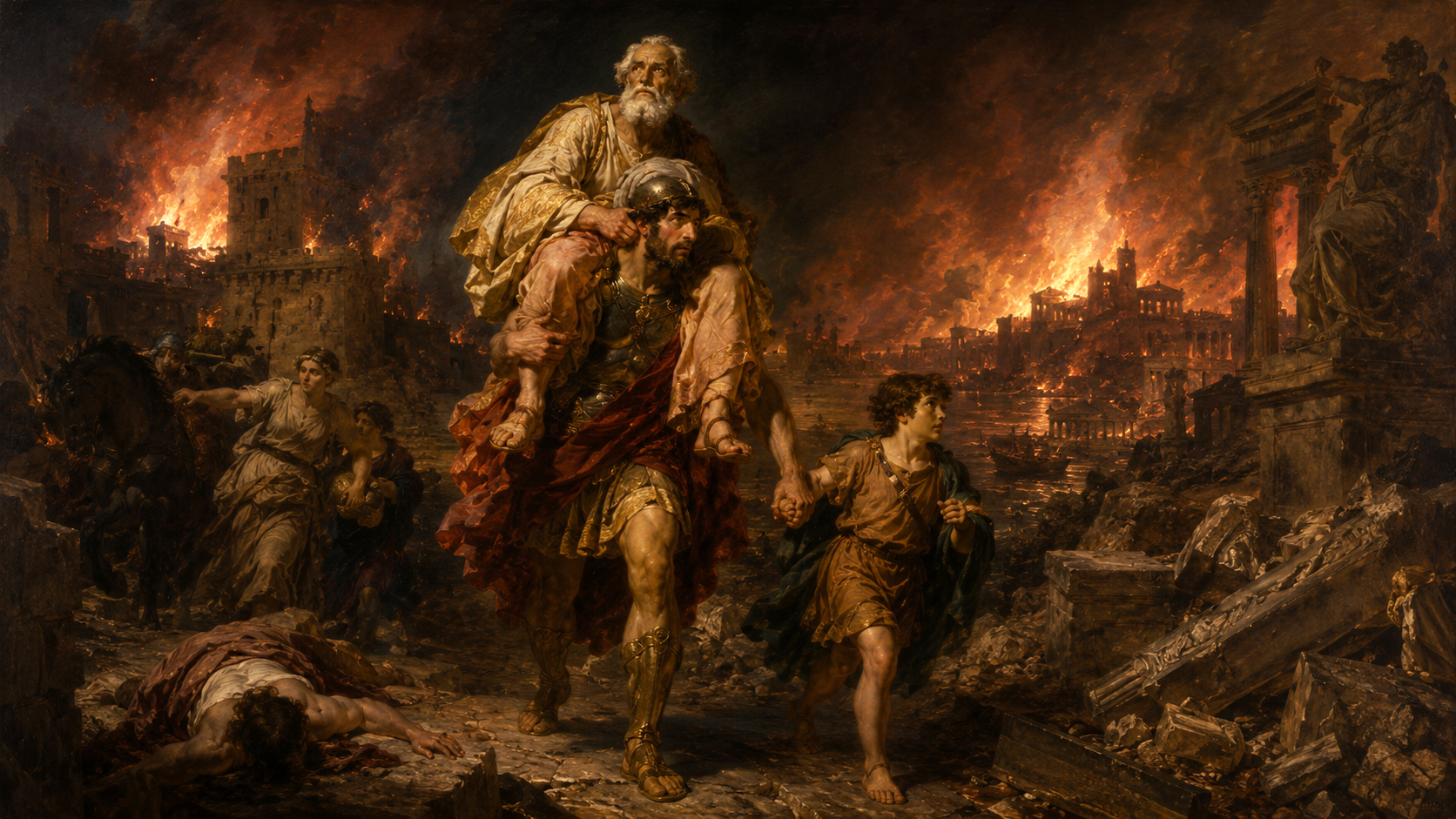
At last, the spirit of Creusa appeared before him. She told Aeneas not to grieve for her, explaining that it was not the will of the gods for her to continue the journey. She foretold that he would one day reach a distant land, where a new kingdom and a new marriage awaited him. Comforted by her final words, Aeneas tried three times to embrace her, but each time her spirit vanished like smoke into the air.
Before dawn, Aeneas returned to the meeting place outside the city, where many other survivors had gathered around him. Looking back upon Troy one final time, he saw only smoke, fire, and ruin. The city had fallen, but its people had not been entirely destroyed. Gathering the survivors, Aeneas accepted the burden of leading them into exile in search of the land the gods had promised.
Book III — The Search for a Homeland
Continuing his story before Queen Dido, Aeneas describes the long years that followed the fall of Troy. With their city destroyed, the surviving Trojans gathered what remained of their people, built a fleet of ships, and set out across the sea in search of the homeland the gods had promised. Their journey would lead them from one shore to another, often bringing hope, only to discover that each place was not yet their final destination.
Their first settlement was in Thrace, where Aeneas began preparing a new city. While gathering branches for an altar, he discovered that the plants bled when pulled from the ground. The spirit of Polydorus, a son of King Priam, spoke from beneath the earth, revealing that he had been murdered there after Troy’s fall. Horrified by the crime, the Trojans buried him with honor and immediately departed, refusing to build their future upon a place stained by betrayal.
From there, they sailed to the island of Delos, where the god Apollo instructed them to seek the ancient homeland of their ancestors. Believing this referred to Crete, Anchises led the Trojans there, and they began building another settlement. Before long, however, disease spread through the people and their crops failed. During the night, the household gods of Troy appeared to Aeneas in a dream and revealed that Crete was not the land they sought. Their true destination lay farther west in Italy, the homeland connected with their earliest forefather, Dardanus.
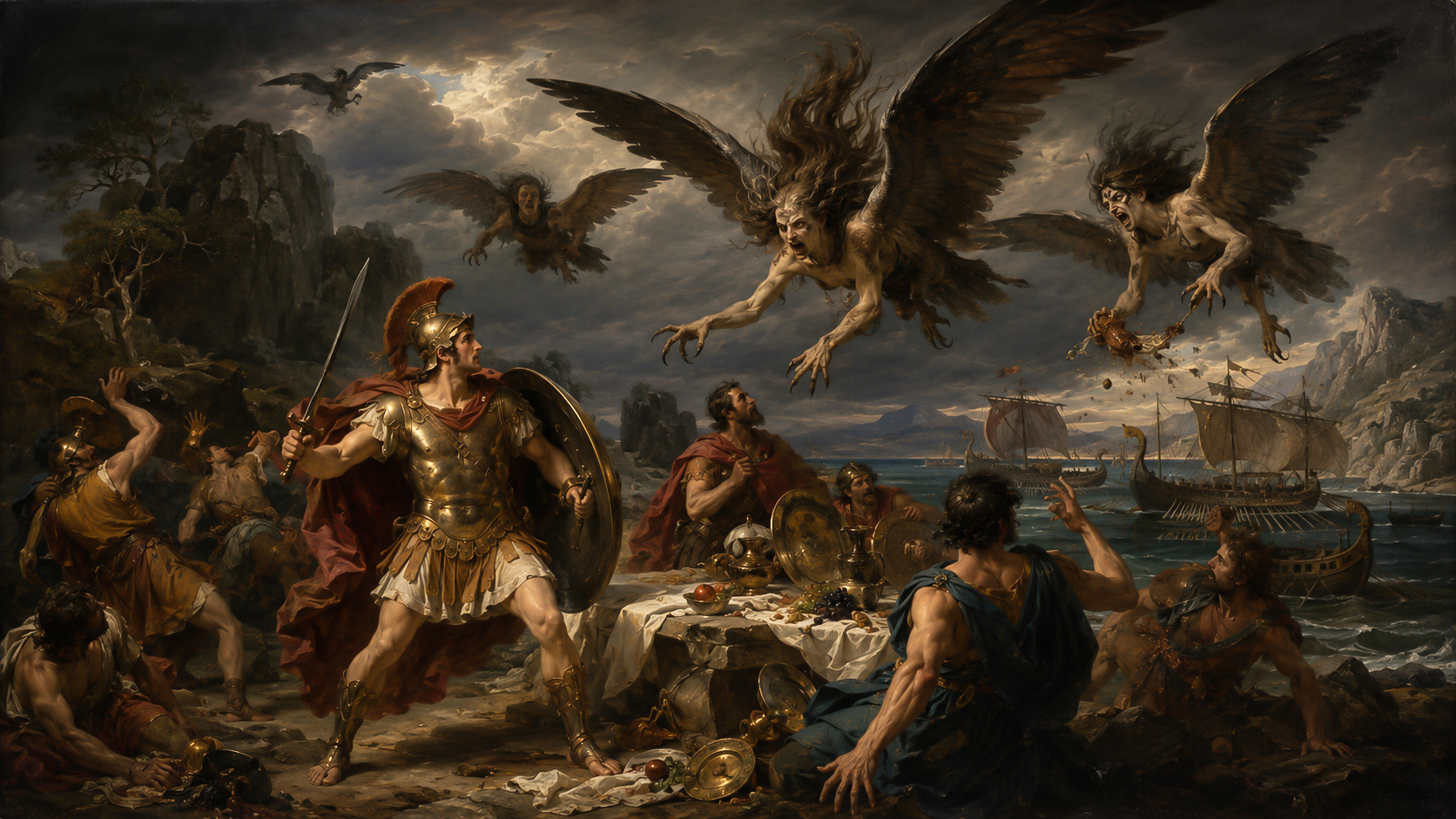
Once again, the Trojans set sail. Fierce storms drove them across the sea until they reached the Strophades Islands, home of the Harpies. After the hungry travelers prepared a feast from the cattle they found there, the Harpies attacked, snatching away the food and leaving behind filth and destruction. Their leader, Celaeno, pronounced a grim prophecy: before the Trojans would finally establish their new home, hunger would become so great that they would consume their very tables.
The journey continued through many islands and coastlines. At Actium, they paused to offer sacrifices and hold athletic games in thanksgiving for their safety. From there, they sailed past lands already familiar from the Greek world, avoiding dangerous waters whenever possible.
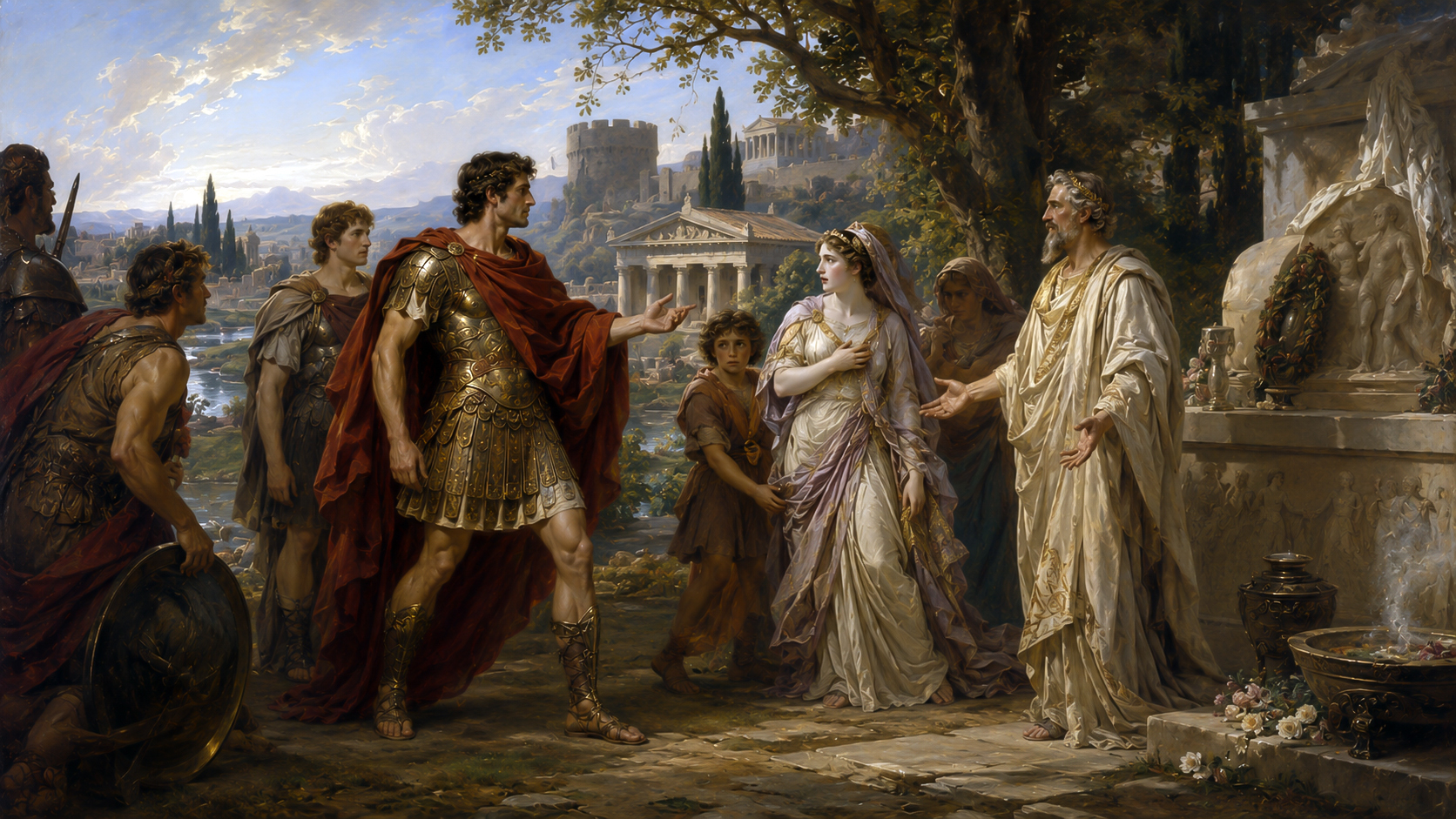
Eventually they reached Buthrotum in Epirus, where they made an unexpected discovery. Helenus, one of Priam’s sons who had survived the war, now ruled there together with Andromache, the widow of Hector. The two had created a small city patterned after the Troy they had lost. Their meeting was filled with sorrow as old friends remembered those who had perished.
Helenus, gifted with prophetic knowledge, gave Aeneas detailed instructions for the voyage ahead. He warned him about the dangers that still lay before them, described the route that would lead safely toward Italy, and advised him to seek the Sibyl at Cumae after arriving there. He also revealed the sign by which Aeneas would recognize the land destined for his people: a white sow nursing thirty young piglets.
Leaving their friends behind, the Trojans sailed onward, passing the mountains of Ceraunia before crossing the Adriatic Sea. At last, they caught their first distant glimpse of Italy. Landing briefly upon its shores, they offered sacrifices of thanksgiving before continuing their voyage southward.
Their journey soon brought them near the narrow strait between Scylla and Charybdis, the same dangers once faced by Odysseus. Remembering Helenus’ warning, Aeneas wisely chose the longer and safer route around Sicily rather than risk losing the fleet in the deadly passage.
While sailing along the coast of Sicily, the Trojans encountered a frightened Greek named Achaemenides. Left behind years earlier by Odysseus, he had survived alone among the Cyclopes. He begged Aeneas for rescue, and the Trojans welcomed him aboard despite his being one of the Greeks who had once fought against Troy. As they hurried away, the giant Cyclops Polyphemus emerged from his cave, blinded but still searching for those who had escaped him.
The Trojans continued around Sicily until they reached the city of Drepanum. There, after so many trials at sea, Anchises, the father of Aeneas, died. His death brought deep sorrow to the entire company, for he had guided them with wisdom throughout their wandering. With that final grief, Aeneas concluded the story of their travels, bringing his account to the point where the storm had carried them at last to the shores of Carthage.
Book IV — The Queen of Carthage
After hearing Aeneas recount the fall of Troy and the long years of wandering that followed, Queen Dido found herself unable to put him out of her mind. Though she had once vowed to remain faithful to the memory of her late husband, her growing affection for the Trojan leader steadily overcame her resolve. Encouraged by her sister Anna, Dido began to believe that a union with Aeneas would strengthen both her kingdom and her people.
As the days passed, Dido and Aeneas spent more time together. While hunting in the countryside, a sudden storm scattered their companions and drove the two into the shelter of a cave. There, their relationship was sealed, and Dido regarded the moment as a marriage. From that time forward, she devoted herself entirely to Aeneas, while much of the work of building Carthage slowed as the queen’s attention turned elsewhere.
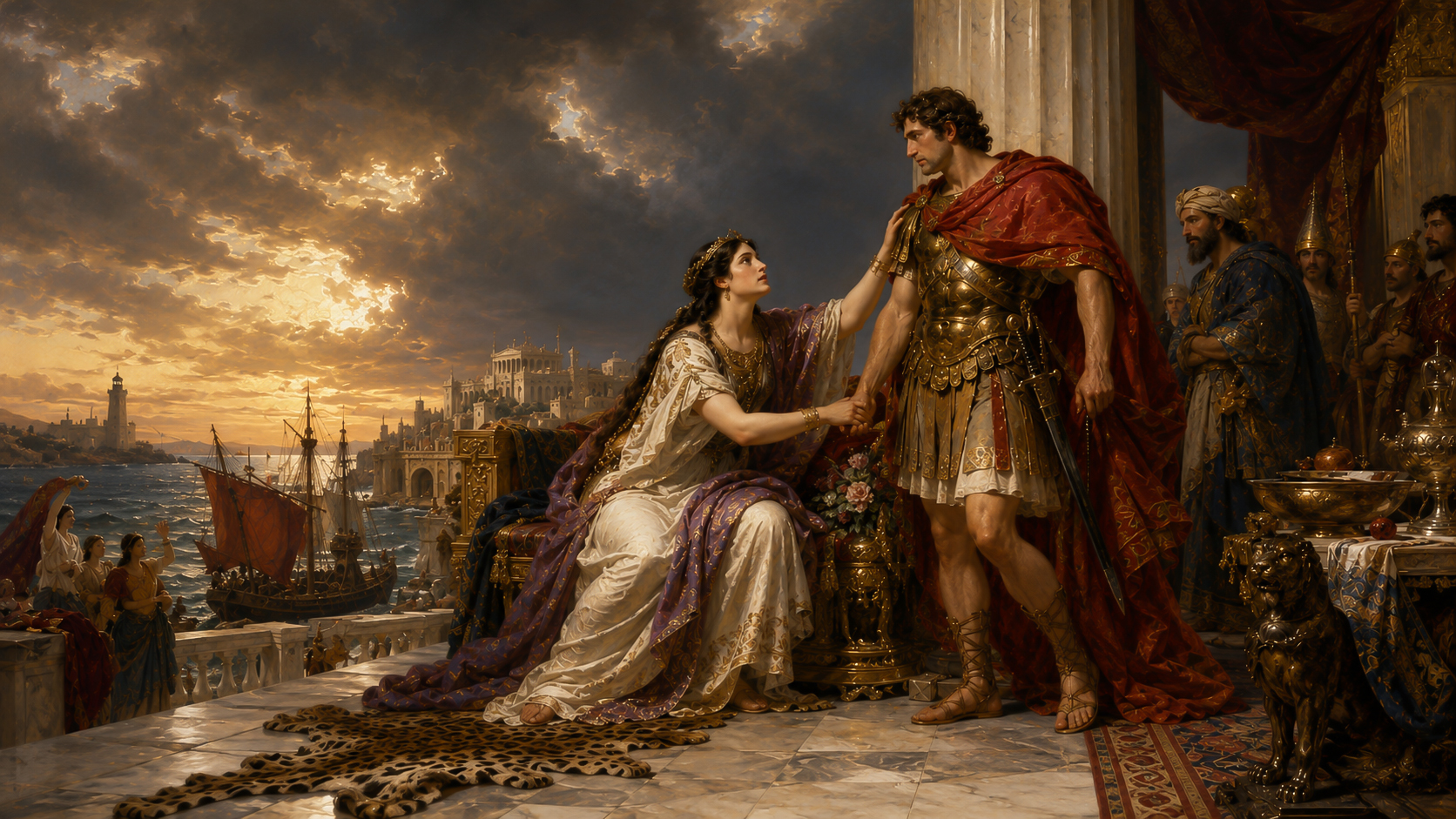
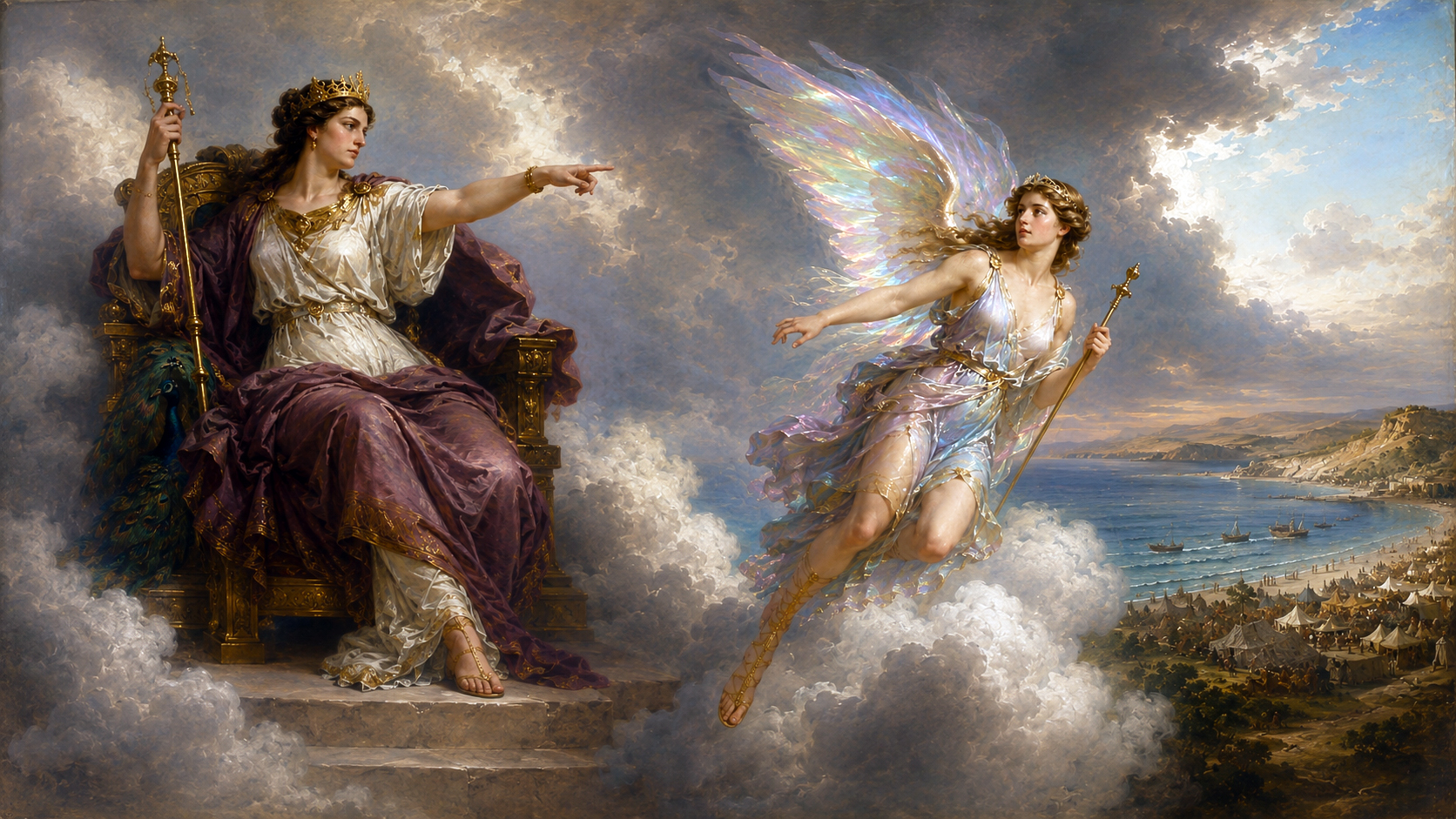
News of their relationship spread quickly throughout the surrounding lands. The king of a neighboring people, who had hoped to marry Dido himself, complained to Jupiter that Aeneas had abandoned the mission appointed to him and had settled comfortably in Carthage. In response, Jupiter sent Mercury to remind Aeneas that his destiny did not lie in North Africa but in Italy, where a future kingdom awaited him.
The message troubled Aeneas deeply. Though grateful for Dido’s kindness and aware of her affection, he recognized that he could not remain in Carthage. Quietly, he ordered his men to prepare the fleet for departure. When Dido learned of his plans, she confronted him with sorrow and anger, asking why he would leave without even speaking to her.
Aeneas answered that he had never promised to remain forever, nor had he sought to deceive her. He explained that he was bound to obey the will of the gods and continue the journey that had been entrusted to him. His words brought little comfort. Dido pleaded with him to stay, but Aeneas remained firm, believing he had no choice except to continue toward Italy.
Seeing that Aeneas would not be persuaded, Dido withdrew in despair. She ordered a great funeral pyre to be built, claiming that it would be used to destroy the belongings Aeneas had left behind. In secret, however, she intended something far different. As the Trojans completed their preparations and sailed away under cover of darkness, Dido climbed onto the pyre carrying Aeneas’ sword.
Watching the ships disappear over the horizon, Dido called down a curse upon Aeneas and upon the future descendants of Troy. She prayed that lasting conflict would arise between her people and his, and that no friendship would ever exist between the two nations. With those final words, she took her own life upon the pyre.
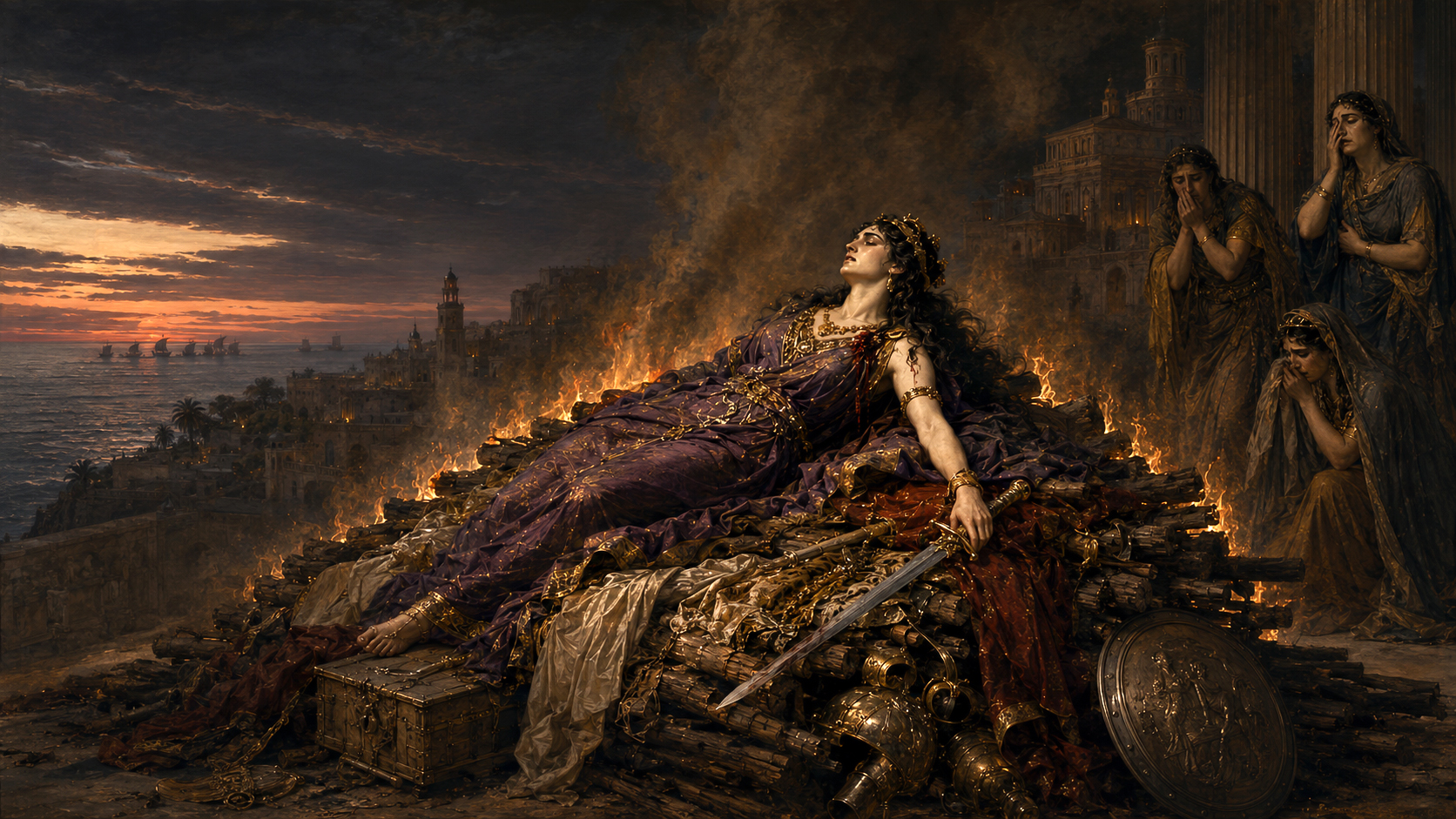
The news of Dido’s death spread quickly through Carthage. Her people mourned the loss of the queen who had founded their city and guided its early years. Unaware of what had happened until he had already reached the sea, Aeneas looked back and saw only the smoke rising from the shore. Though he did not yet know its cause, he understood that great sorrow had been left behind.
The Trojans continued their voyage toward Italy, while Carthage was left grieving the death of its queen. The farewell between Aeneas and Dido marked the end of one chapter in the journey and prepared the way for the trials that still lay ahead.
Book V — In Memory of Anchises
Leaving Carthage behind, Aeneas and the Trojans sailed once again across the sea. A sudden storm forced them away from their course, bringing them back to Sicily, where they had buried Anchises one year earlier. King Acestes, a friend of the Trojans, welcomed them with kindness and offered them a place to rest. Seeing that the anniversary of his father’s death had arrived, Aeneas gathered his people to honor Anchises with sacrifices, feasting, and athletic games.
The ceremonies began at Anchises’ tomb. As Aeneas poured offerings upon the grave, a great serpent emerged from the earth, peacefully moved among the altars, and disappeared again. Taking this as a favorable sign, Aeneas continued the sacrifices before calling the people together for the games.
The first contest was a ship race between four Trojan captains. The race was close, with each crew struggling for the lead around the turning point at sea. One ship struck the rocks, another gained ground through skillful rowing, and the final stretch ended in a hard-fought victory. Aeneas awarded generous prizes to every crew, honoring not only the winners but all who had competed.
Next came the foot race. The runners sped across the course until Nisus slipped in the blood of sacrificed animals near the finish. As he fell, he intentionally blocked another runner, allowing his close friend Euryalus to cross the line first. Though the outcome caused laughter and protest, Aeneas rewarded each competitor with fairness and generosity.
The boxing match followed. The experienced boxer Entellus reluctantly accepted the challenge of the younger Dares. At first, Dares fought well, but Entellus soon demonstrated his greater strength and skill. After Dares had suffered enough, Aeneas stepped in to end the contest before serious harm was done. Entellus then struck down a great bull with a single blow, dedicating the victory to the memory of Anchises.
The final athletic contest was an archery competition. Each archer took aim at a target suspended from the mast of a ship. The first arrows found their marks, but the final shot, loosed by Acestes, blazed through the sky with fire before disappearing. The unexpected sign amazed everyone present, and Aeneas awarded Acestes a special prize in honor of the wonder they had witnessed.
The games concluded with the Riding of Troy, a display performed by the young boys of the Trojan families under the leadership of Ascanius. Dividing into companies, they rode their horses through carefully practiced formations, weaving together and apart as though preparing for future battles. Their display delighted the gathered crowd and brought the day’s celebration to a fitting close.
While the games were taking place, Juno continued her efforts to prevent the Trojans from reaching Italy. She sent Iris to stir discouragement among the Trojan women, many of whom had grown weary of years of wandering. Persuaded that they would never find a permanent home, the women set fire to the Trojan ships. The flames spread quickly, threatening to destroy the entire fleet.
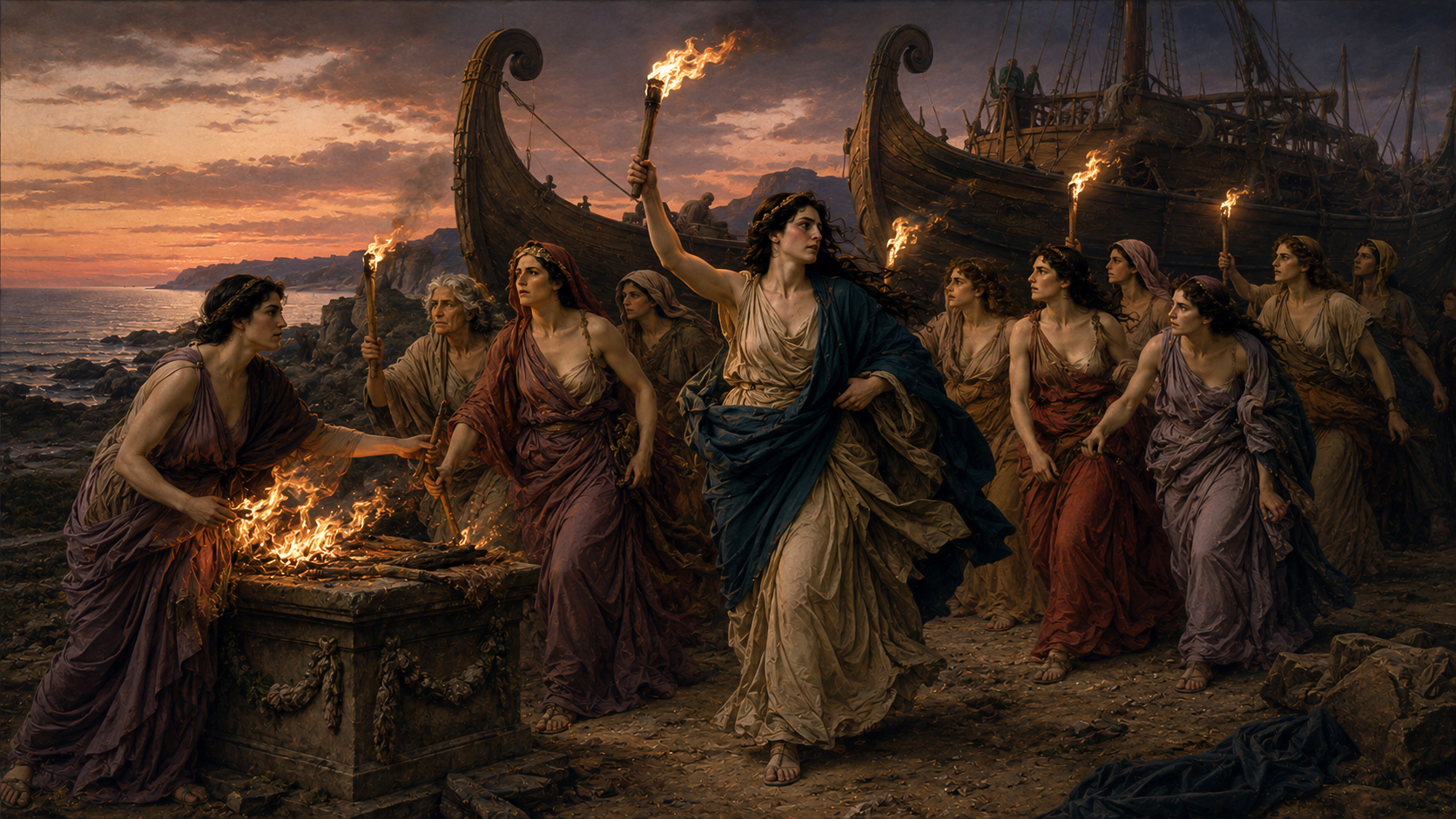
Seeing the disaster, Aeneas prayed earnestly for help. In answer, Jupiter sent a heavy rainstorm that extinguished nearly all the fires, though several ships were lost. That night, the spirit of Anchises appeared to Aeneas in a dream. He instructed his son to leave behind those who were too old, too weary, or unwilling to continue the journey. They would remain in Sicily under the care of King Acestes, while the stronger members of the company would sail onward to Italy.
Following his father’s counsel, Aeneas established a settlement for those remaining behind and entrusted them to Acestes. After making the necessary preparations, the Trojans launched their repaired fleet once more.
As the ships departed, Neptune promised Venus that the fleet would reach Italy safely, though one life would be required before the voyage ended. During the night, Palinurus, the faithful helmsman of Aeneas’ ship, struggled to remain awake at the helm. The god of Sleep overcame him, and he fell into the sea. Though the fleet continued safely toward Italy, Aeneas entered the final stage of the journey, grieving the loss of his trusted companion.
Book VI — Into the Underworld
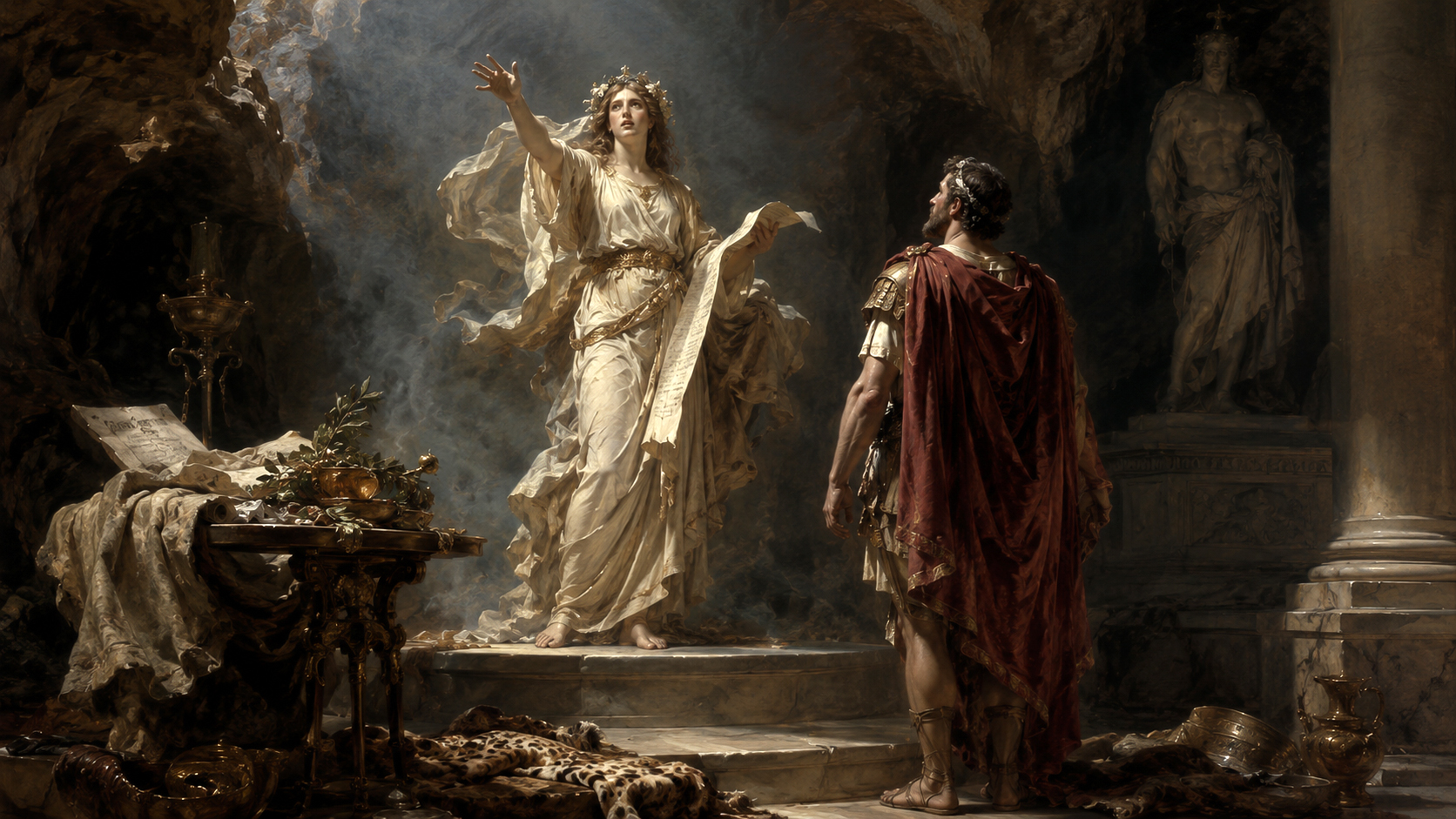
At last, the Trojans reached the western coast of Italy, landing near Cumae. There, Aeneas sought the famous Sibyl, the priestess of Apollo, just as Helenus had instructed him. Entering the sacred cave, he asked for guidance concerning the land that had finally come into view and requested permission to descend into the world of the dead so he might speak once more with his father, Anchises.
The Sibyl declared that difficult days still lay ahead before the Trojans could settle in Italy. She told Aeneas that if he wished to enter the underworld, he must first find the Golden Bough hidden within the forest and bury the body of a companion whose death had brought ritual uncleanness upon the company. Returning to the shore, Aeneas discovered that Misenus, one of his faithful companions, had died. After honoring him with a proper funeral, two doves sent by Venus led Aeneas to the Golden Bough. He plucked it from the tree and carried it to the Sibyl.
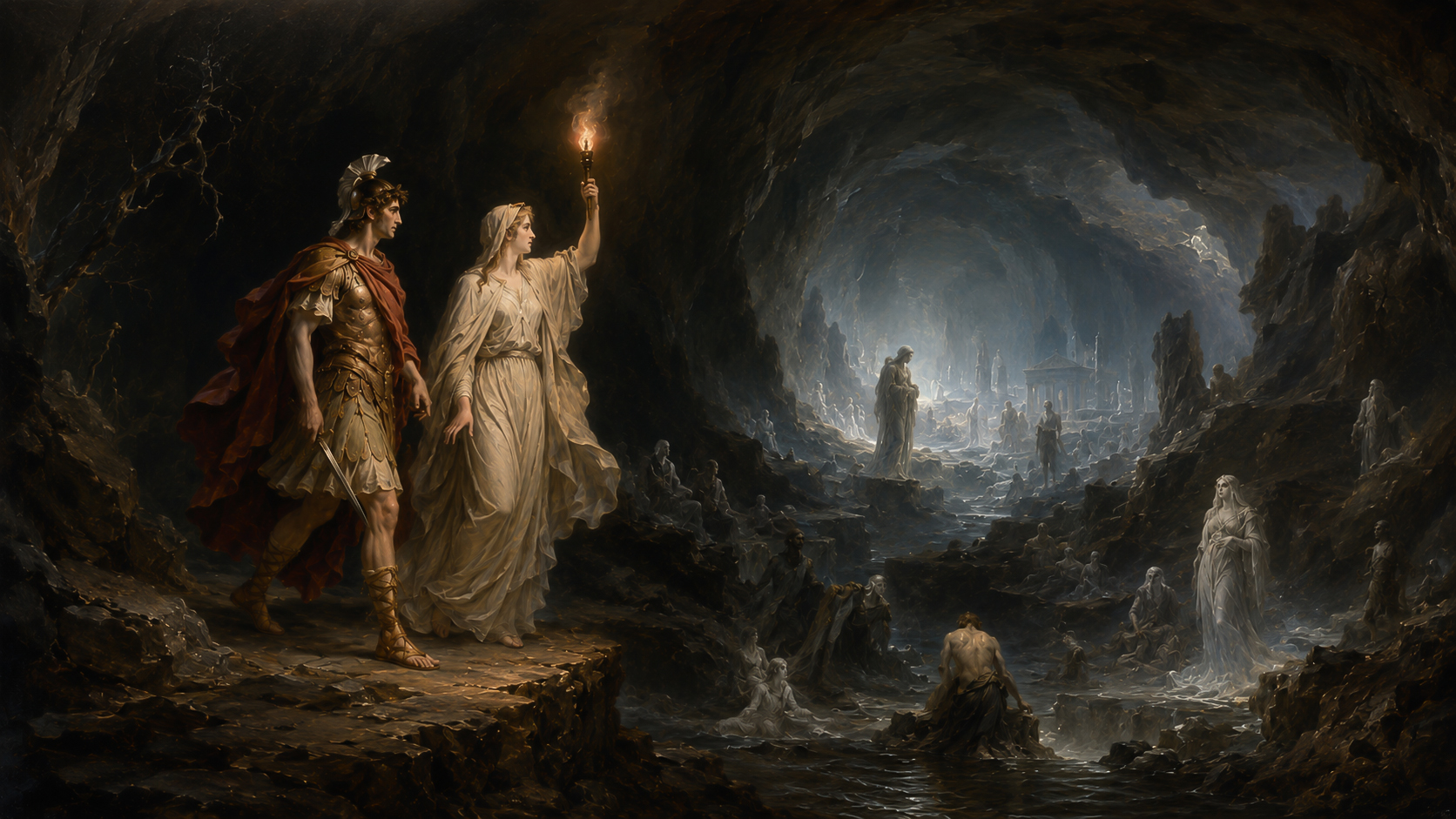
Together, they entered the dark passages leading into the kingdom of the dead. Along the way, Aeneas saw many strange figures, including the spirits of Sorrow, Fear, Disease, Old Age, and Death. Reaching the river Styx, they found Charon, the ferryman who carried the souls of the dead across the water. At first, he refused passage, but when the Sibyl displayed the Golden Bough, Charon allowed them aboard his boat.
After crossing the river, they passed the great guardian Cerberus, whose three heads watched over the entrance to the underworld. The Sibyl quieted the beast with a drugged cake, allowing them to continue safely. As they journeyed farther, Aeneas saw many different groups of departed souls. He met the spirit of Palinurus, who asked for a proper burial. He also saw the souls of infants, those wrongly condemned, and many others who had completed the course of earthly life.
In the Fields of Mourning, Aeneas encountered Dido. He spoke gently to her, explaining that he had not wished to leave her and that the gods had compelled him to continue his journey. Dido answered nothing. She turned away from Aeneas and walked silently back to the spirit of her former husband, Sychaeus. Filled with sorrow, Aeneas watched her depart before continuing onward.
Further along, Aeneas met many of the heroes who had fought in the Trojan War. Some greeted him kindly, while others withdrew at the sight of the Trojan leader. Beyond them stood the mighty walls of Tartarus, where the wicked received punishment for the evil they had done during their lives. Though the Sibyl described the place, Aeneas did not enter its gates.
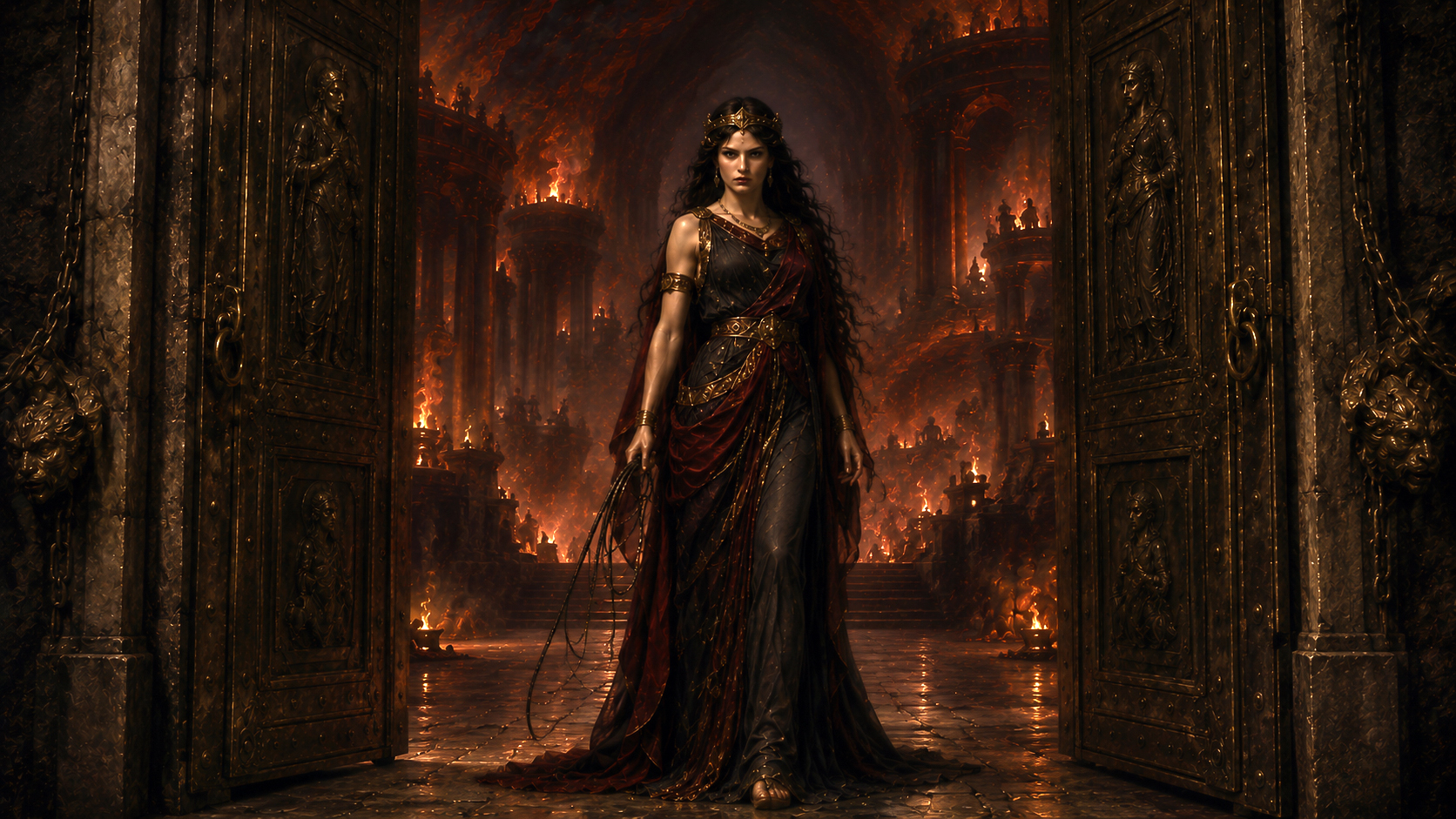
At last, they reached the peaceful fields where the blessed dead dwelt. There, Aeneas found Anchises among the spirits. Father and son embraced with joy, though Aeneas discovered he could not fully hold the spirit of the man he loved. Anchises welcomed him warmly and began explaining the mysteries of the souls waiting to be born again into the world.
Leading Aeneas through the peaceful fields, Anchises revealed the long line of descendants who would one day arise from the Trojan people. One by one, he pointed to future kings, leaders, and heroes who would shape Rome’s history. He showed Aeneas Romulus, who would found the city itself, and many others who would follow. Finally, he revealed Augustus Caesar, whose future reign would bring peace and extend Roman rule across the known world.
Among the many spirits waiting to be born, Anchises also pointed out the young Marcellus, a promising Roman whose life would end before its full greatness could be realized. The sight filled Anchises with sorrow, reminding Aeneas that even the brightest hopes are sometimes cut short.
When their conversation had ended, Anchises encouraged his son to fulfill the task appointed to him. He reminded Aeneas that his future lay not among the dead but in the world above, where his descendants would establish the nation whose history he had just witnessed.
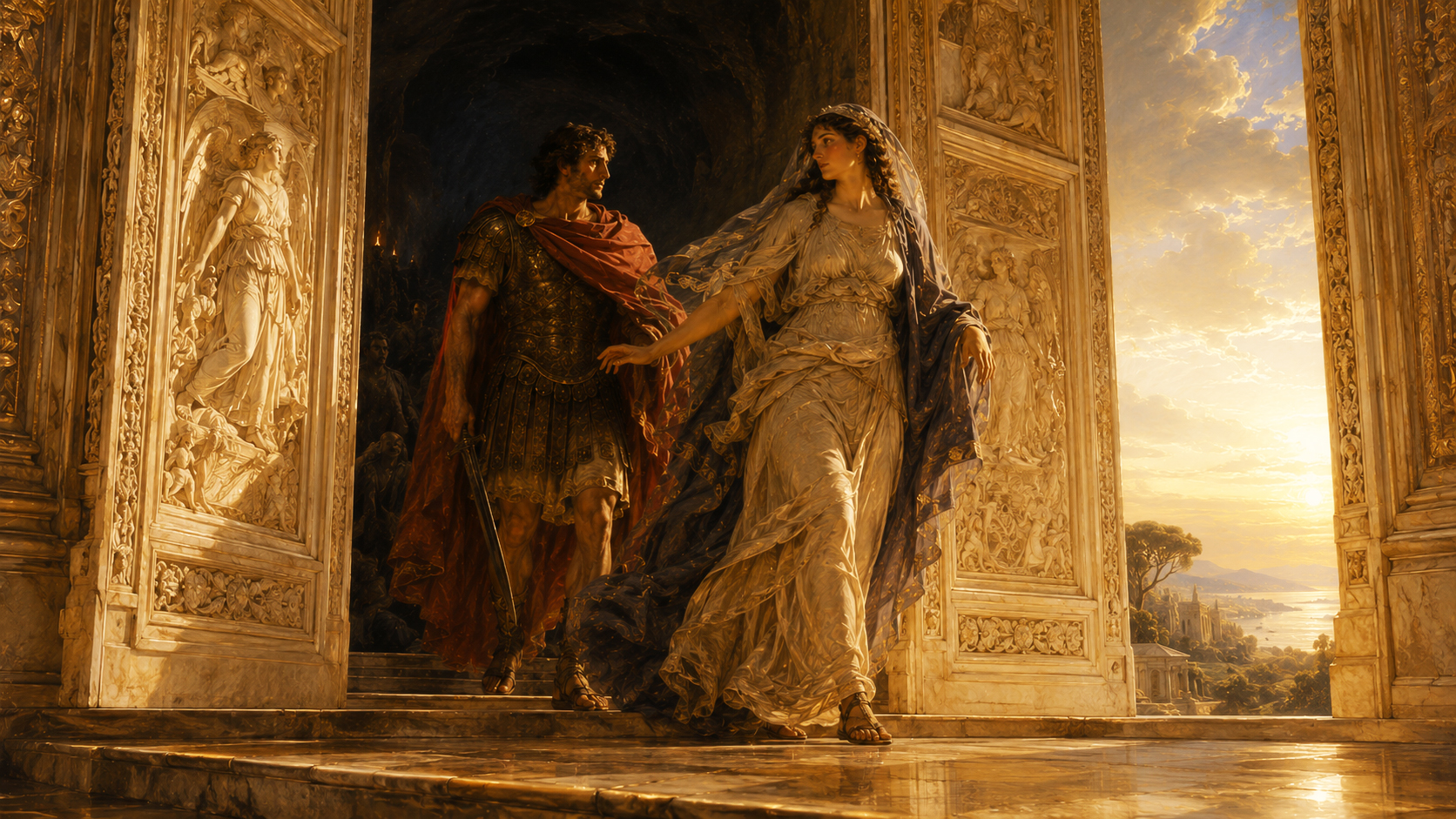
At the close of their meeting, Anchises led Aeneas and the Sibyl to the two gates through which dreams pass into the world. Passing through the Gate of Ivory, they returned to the land of the living. Aeneas rejoined his companions, and together the Trojans prepared to continue their journey into Italy, carrying with them a renewed understanding of the future that awaited them.
Book VII — The Gates of War
After leaving Cumae, Aeneas and the Trojans sailed north along the western coast of Italy until they reached the mouth of the Tiber River. At last, they landed in the land that had been promised to them for so many years. As they prepared a simple meal, they placed their food upon round flat loaves of bread. When the meal was finished, they ate the bread as well. Smiling, Ascanius remarked that they had even eaten their tables. Aeneas immediately remembered the prophecy of the Harpies and realized that the long journey had finally brought them to their destined homeland.
The land was ruled by King Latinus, an aged and respected ruler who had received signs from the gods concerning the future of his kingdom. Oracles had warned him that his daughter Lavinia was not to marry one of the local princes. Instead, a foreign husband would arrive whose descendants would bring greatness to the land.
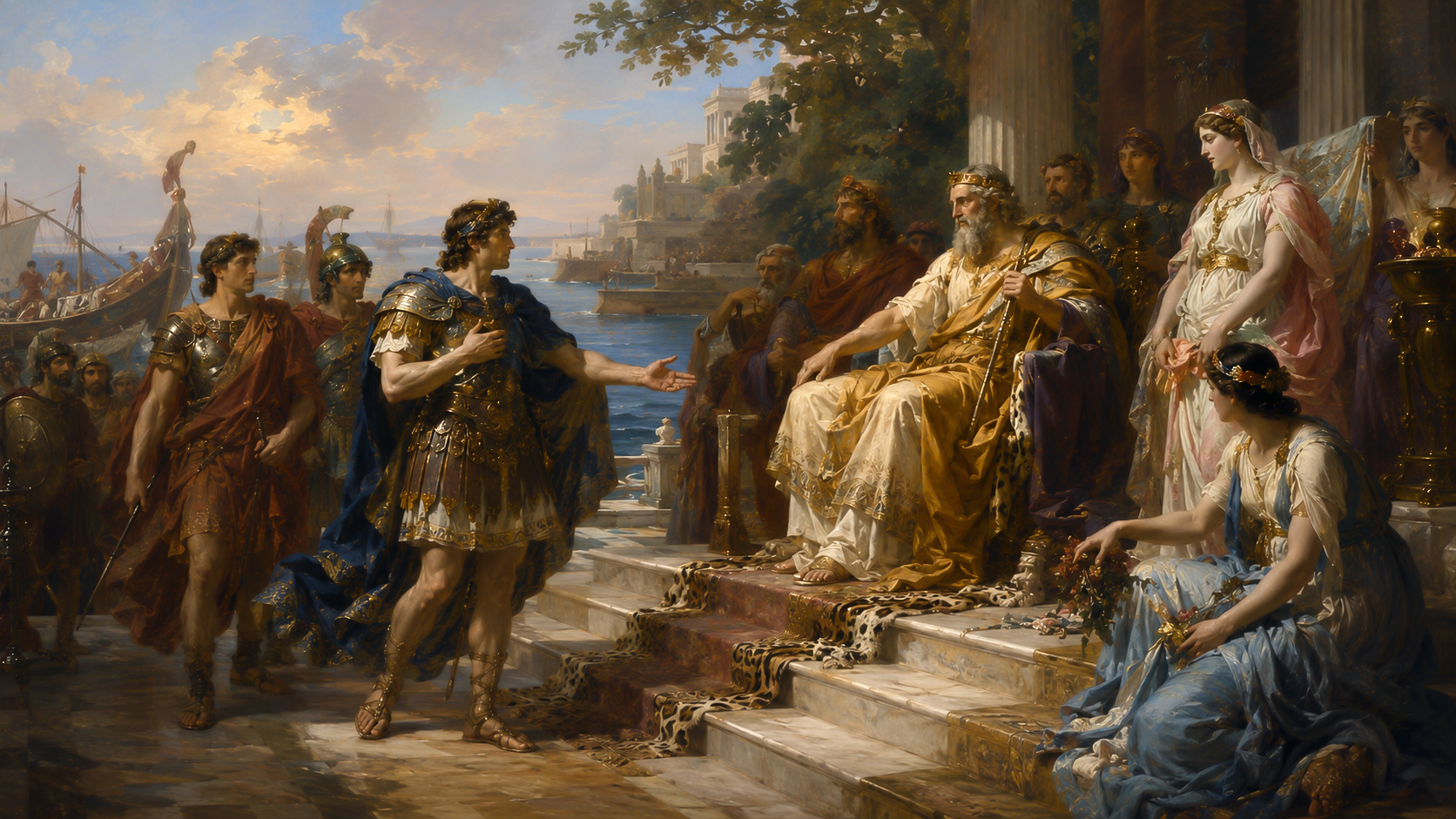
Aeneas sent ambassadors bearing gifts to King Latinus, asking only for a place where the Trojans might settle peacefully. Latinus welcomed them with kindness and recognized that the prophecies were being fulfilled. He offered friendship to the Trojans and proposed that Aeneas should marry Lavinia, joining the two peoples together.
Not everyone welcomed this decision. Queen Amata strongly opposed the marriage, believing that Lavinia should marry Turnus, the brave leader of the Rutulians, who had long expected to become her husband. Turnus himself regarded the arrival of the Trojans as a threat to his honor and his future.
Juno, still determined to prevent the Trojans from establishing their new home, called upon the Fury Allecto to stir hatred and conflict among the people. Allecto first entered the heart of Queen Amata, filling her with fierce anger against the proposed marriage. The queen gathered many of the women of Latium and withdrew into the forests, urging them to resist the union between Lavinia and Aeneas.
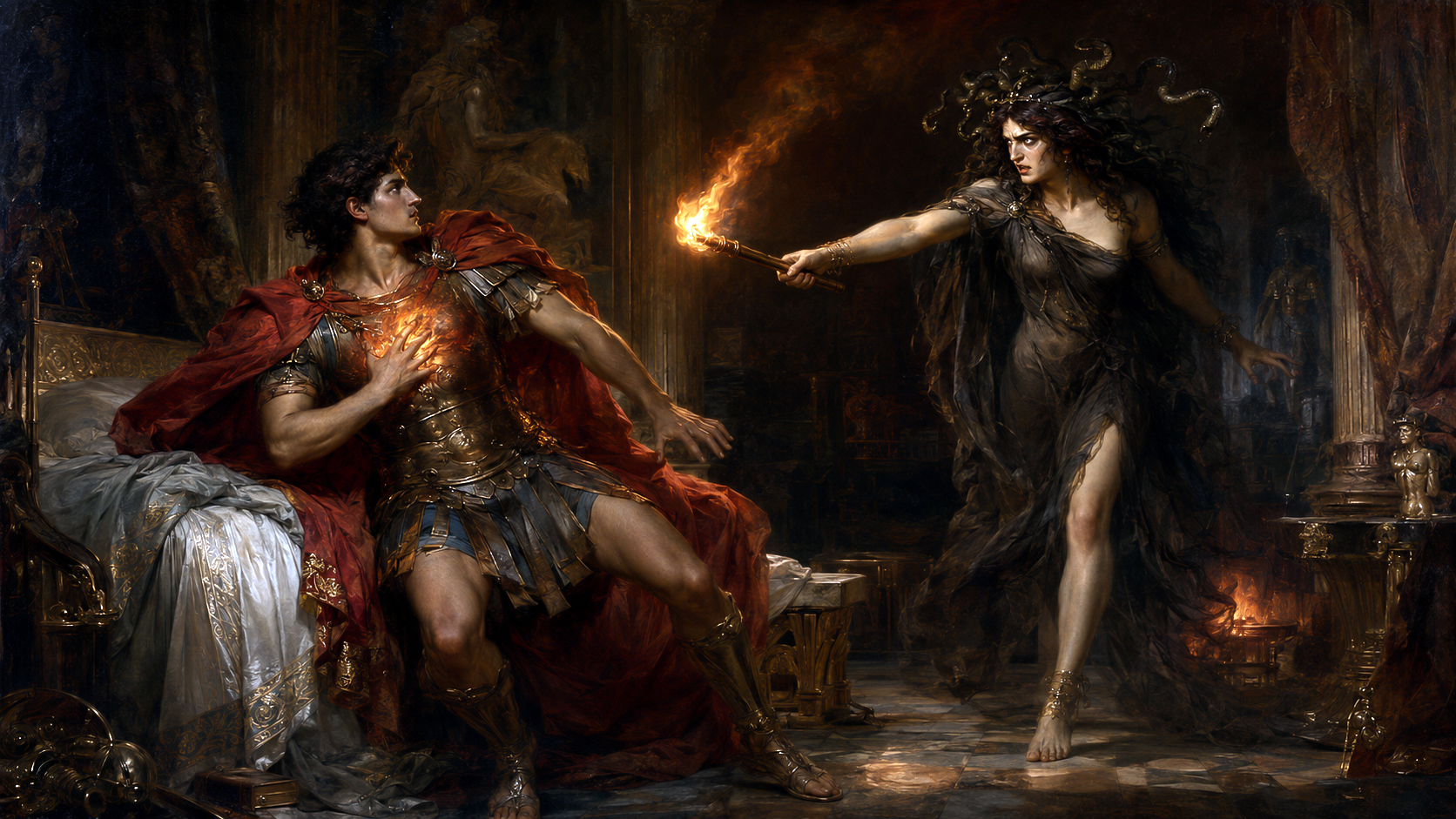
Allecto then visited Turnus as he slept. Appearing at first in the form of an aged priestess, she urged him to take up arms against the Trojans. When Turnus dismissed the warning, Allecto revealed her terrible appearance and filled him with a burning desire for war. Turnus immediately called his people together and prepared for battle.
The Fury next turned her attention to the countryside. There she caused a quarrel between the Trojan hunters and local shepherds. Ascanius accidentally killed a magnificent stag that had been raised almost as a household pet by a nearby family. Grief quickly turned to anger, and the dispute spread into open fighting. Before long, both Trojans and Latins had suffered their first losses.
The deaths convinced many that peace was no longer possible. Though King Latinus desired to avoid war, he found himself unable to restrain the growing demands of his people. Refusing to lead them into conflict, he withdrew from public affairs while others prepared for battle.
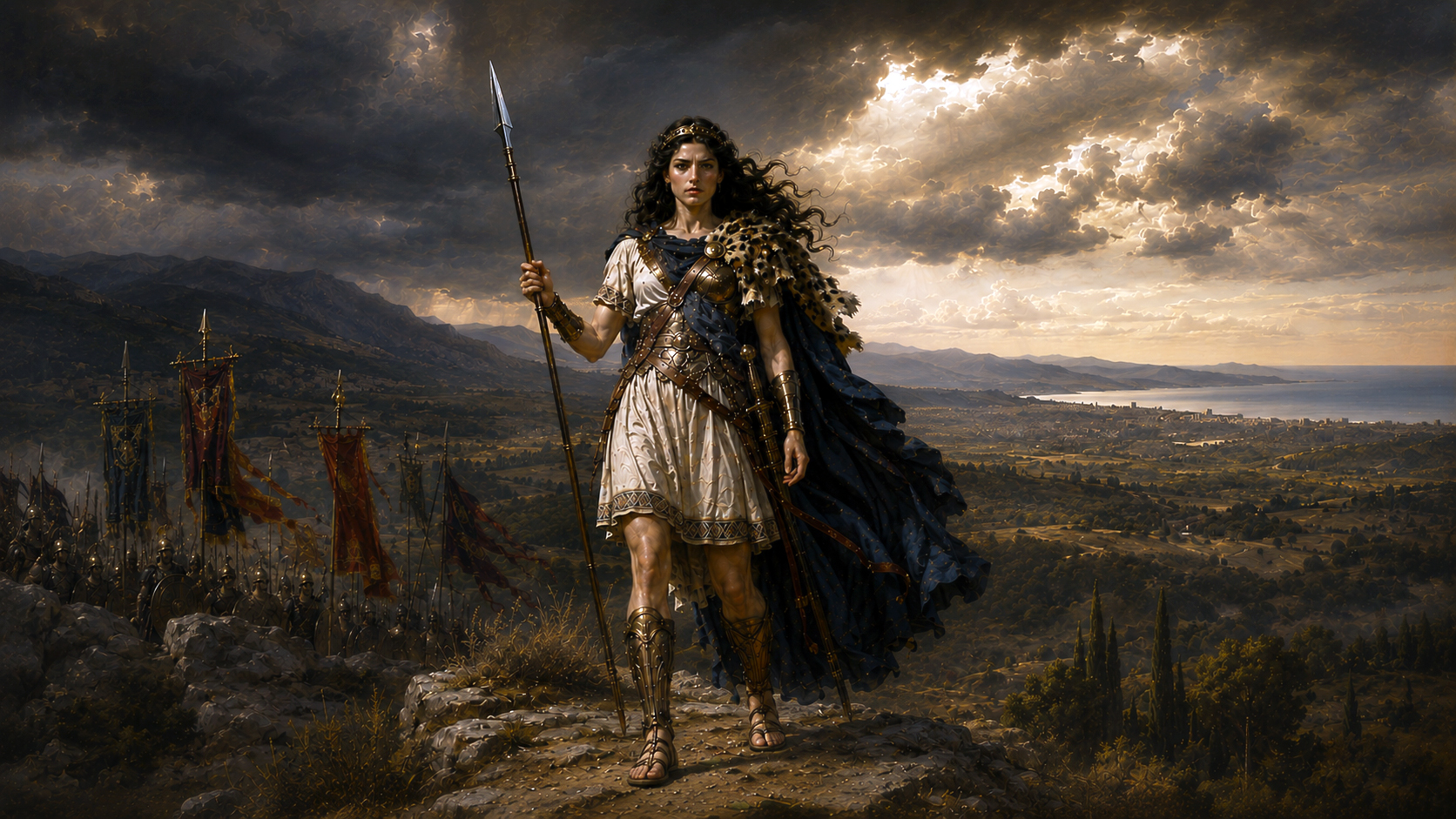
At Juno’s urging, the gates of the Temple of War were opened, signaling that the time for peace had ended. Throughout Latium, warriors gathered from many tribes and cities. Chiefs assembled their armies, weapons were forged, horses were prepared, and banners were raised. Among those who answered the call were Turnus, the fierce warrior maiden Camilla, the powerful Mezentius, and many other leaders from across Italy.
As the armies formed on both sides, the Trojans realized that their arrival in the promised land had not brought an end to their trials. The years of wandering were over, but a new struggle had begun. The book closes with the many nations of Italy assembling for the conflict that would decide the future of the land.
Book VIII — Forged for Battle
As war spread across Latium, Aeneas found himself facing many enemies with only a small band of Trojans at his side. During the night, while he rested beside the Tiber River, the river god Tiberinus appeared to him in a dream. He encouraged Aeneas not to fear, assuring him that he had finally reached the land promised by the gods. The river god also reminded him of the sign foretold long ago—a white sow nursing thirty young piglets—which Aeneas soon discovered exactly as it had been described. Tiberinus then advised him to seek an alliance with King Evander, who ruled a small settlement farther up the river.
The next morning, Aeneas and a small group of companions traveled by boat along the peaceful waters of the Tiber until they reached Evander’s city, a simple settlement built upon the hills that would one day become the site of Rome. The people were celebrating a festival in honor of Hercules when the strangers arrived.
King Evander welcomed Aeneas warmly after learning that both men traced their ancestry to the same ancient family. Aeneas explained the hardships his people had endured and asked for assistance in the coming war. Though Evander’s own strength was limited, he gladly agreed to help. He promised to send warriors under the command of his son Pallas and urged Aeneas to seek additional support from the powerful Etruscans, who had recently turned against their cruel ruler, Mezentius.
Before sending Aeneas on his way, Evander led him through the surrounding countryside, pointing out many places that would one day become famous throughout Roman history. Though little more than hills, forests, and scattered villages in Aeneas’ day, Evander described the ancient traditions connected with the land and welcomed his guest into his humble home for the night.
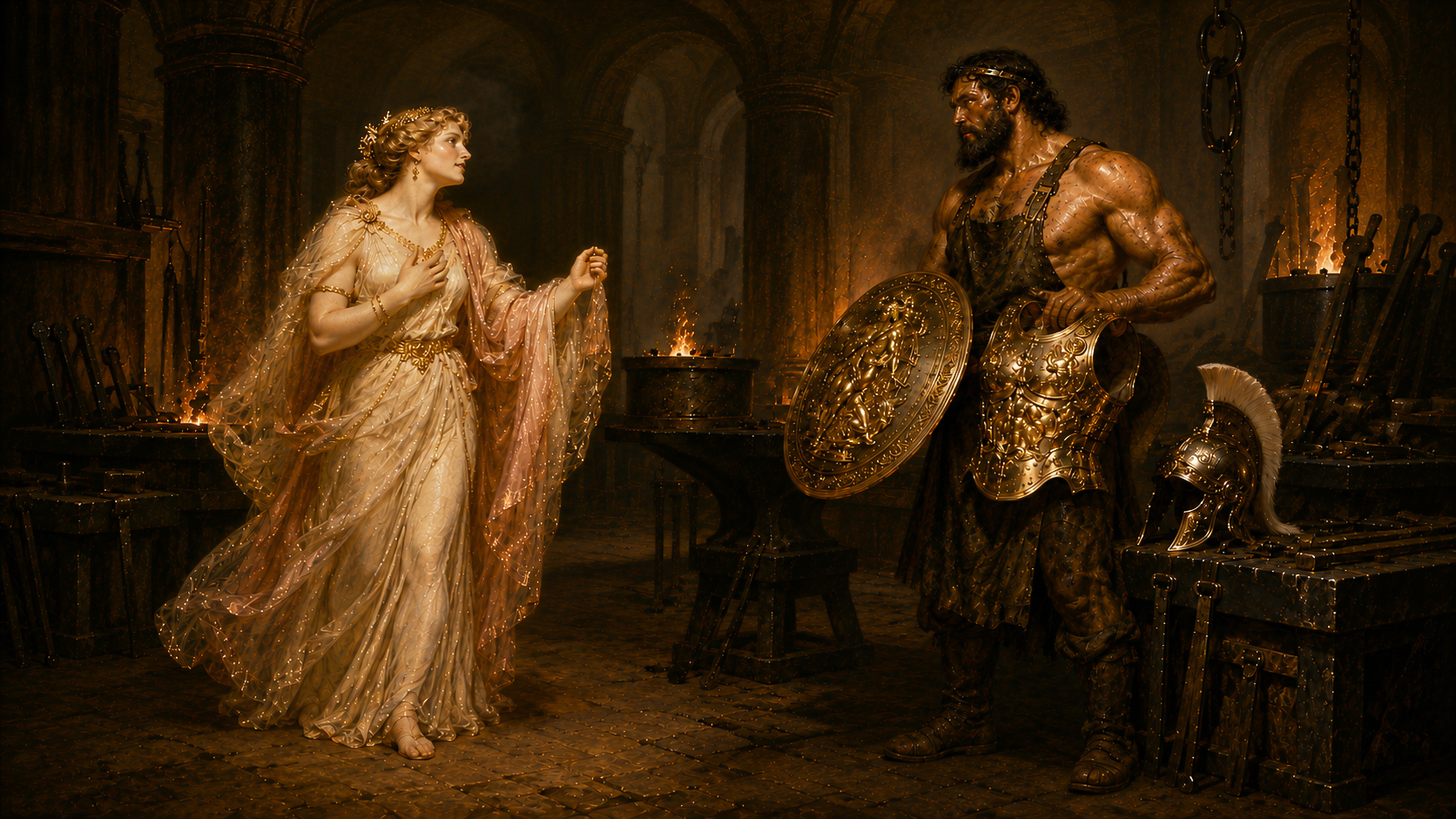
Meanwhile, Venus became concerned for her son’s safety as the armies of Italy continued to gather. She appealed to her husband, Vulcan, asking him to fashion new armor for Aeneas. Moved by her request, Vulcan entered his great forge, where the Cyclopes labored beneath the earth. Together, they forged a magnificent set of weapons unlike any seen among men.
Among these gifts was a splendid shield. Upon its surface, Vulcan crafted scenes that reached far beyond Aeneas’ own lifetime. The shield displayed many events that would shape the future history of Rome. It showed Romulus and Remus as infants cared for by the she-wolf, the early kings of Rome, famous battles, and many other moments from generations yet to come. At its center stood the great naval Battle of Actium, where Augustus Caesar defeated the combined forces of Antony and Cleopatra. The shield concluded with scenes of triumph and peace as Rome celebrated its victories.
When morning came, Evander entrusted his beloved son Pallas to Aeneas’ care. Together, they departed to seek the Etruscan army. There, Aeneas was welcomed as the leader long expected by prophecy, and the Etruscans willingly joined his cause. Their combined forces prepared to march toward the battlefield.
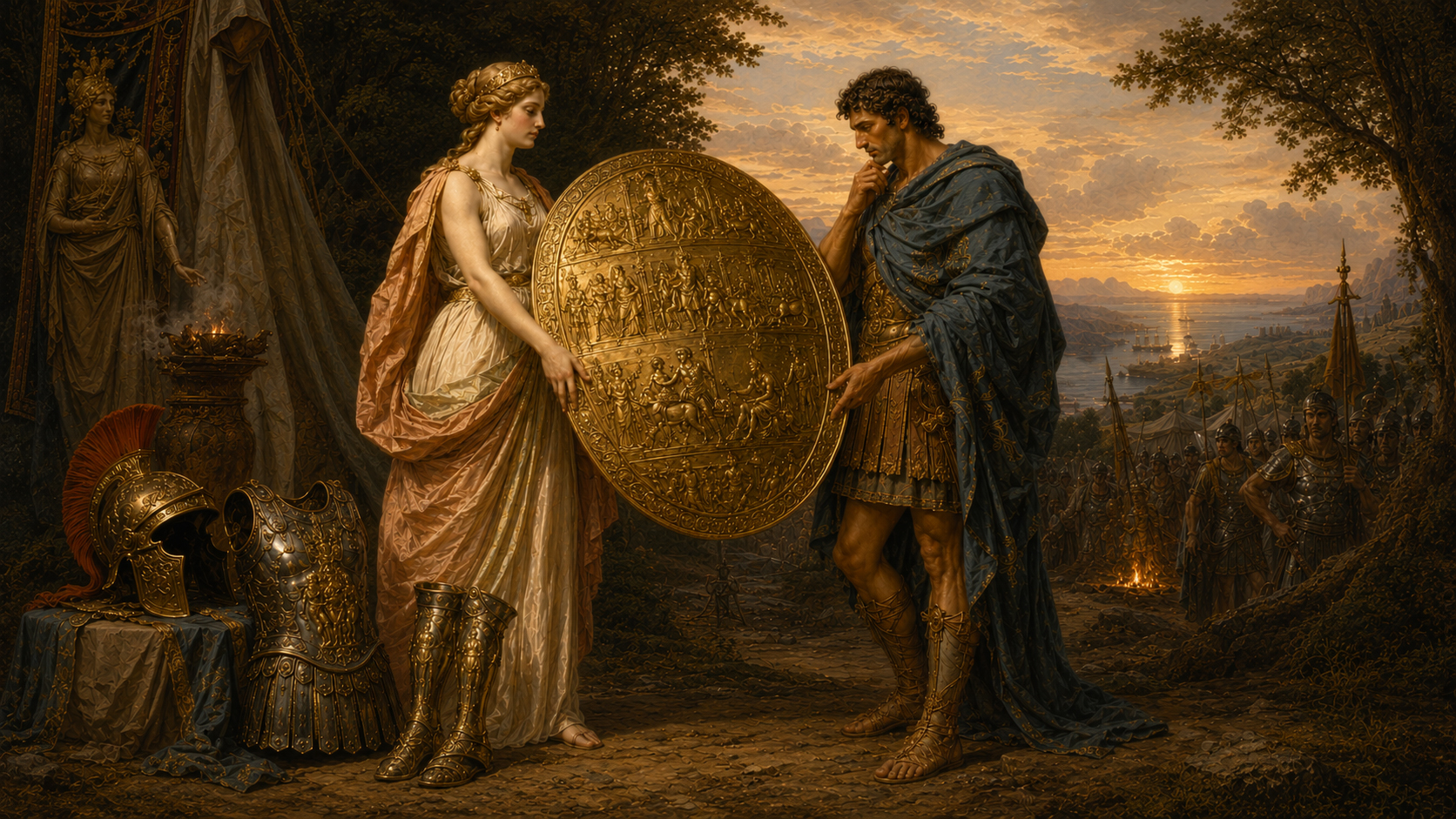
At that same time, Venus appeared and delivered the armor forged by Vulcan. Aeneas marveled at the beauty of the weapons, especially the great shield whose images foretold events still hidden in the future. Though he could not yet understand everything it revealed, he gladly lifted the shield upon his shoulder and accepted the burden of the destiny it represented.
With new allies gathered and new armor in hand, Aeneas set out to rejoin the Trojans. The long years of wandering were behind him. The struggle for the future of his people was about to begin in earnest.
Book IX — The Siege of the Trojans
While Aeneas was away gathering allies, Turnus seized the opportunity to attack the Trojan camp. Confident that the Trojans were leaderless, he marched his army against their fortified position beside the Tiber River. Remembering Aeneas’ instructions, the Trojans remained behind their walls rather than meeting the enemy in open battle.
Turnus first attempted to destroy the Trojan ships by setting them on fire. As the flames spread, the sea goddess Cybele remembered that the ships had been built from the sacred trees of her mountain. At Jupiter’s command, the ships were transformed into sea nymphs before they could be consumed by the fire. Breaking free from their moorings, they slipped into the water and swam safely away, leaving both armies astonished.
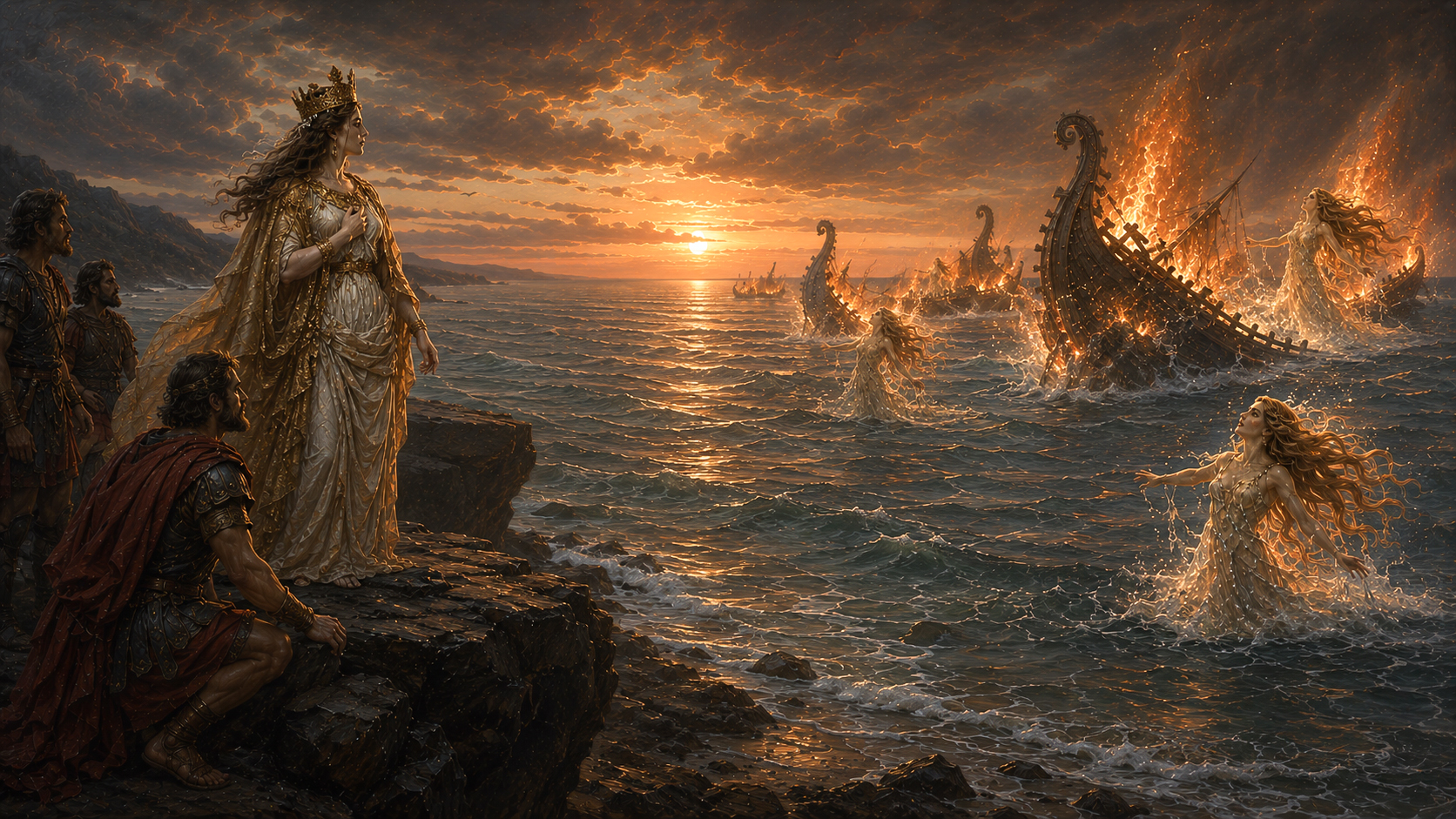
Unable to burn the fleet, Turnus surrounded the Trojan camp and laid siege to its walls. Day after day, the defenders held their positions while waiting for Aeneas to return. Among the young warriors inside the camp were Nisus and his close companion Euryalus, whose friendship was well known throughout the Trojan company.
Believing that Aeneas must be informed of the danger, Nisus proposed a daring mission. Under cover of darkness, the two friends slipped through the enemy lines to carry word to their absent leader. Before leaving, they received the blessings of their companions and promised to return if the gods granted them success.
Moving silently through the sleeping enemy camp, Nisus and Euryalus defeated many of the warriors they encountered. As they prepared to escape, Euryalus paused to collect several pieces of richly decorated armor from the fallen. The delay proved costly. As dawn approached, a group of Latin horsemen spotted the gleaming helmet Euryalus had taken, revealing the two Trojans as they tried to pass unnoticed through the forest.
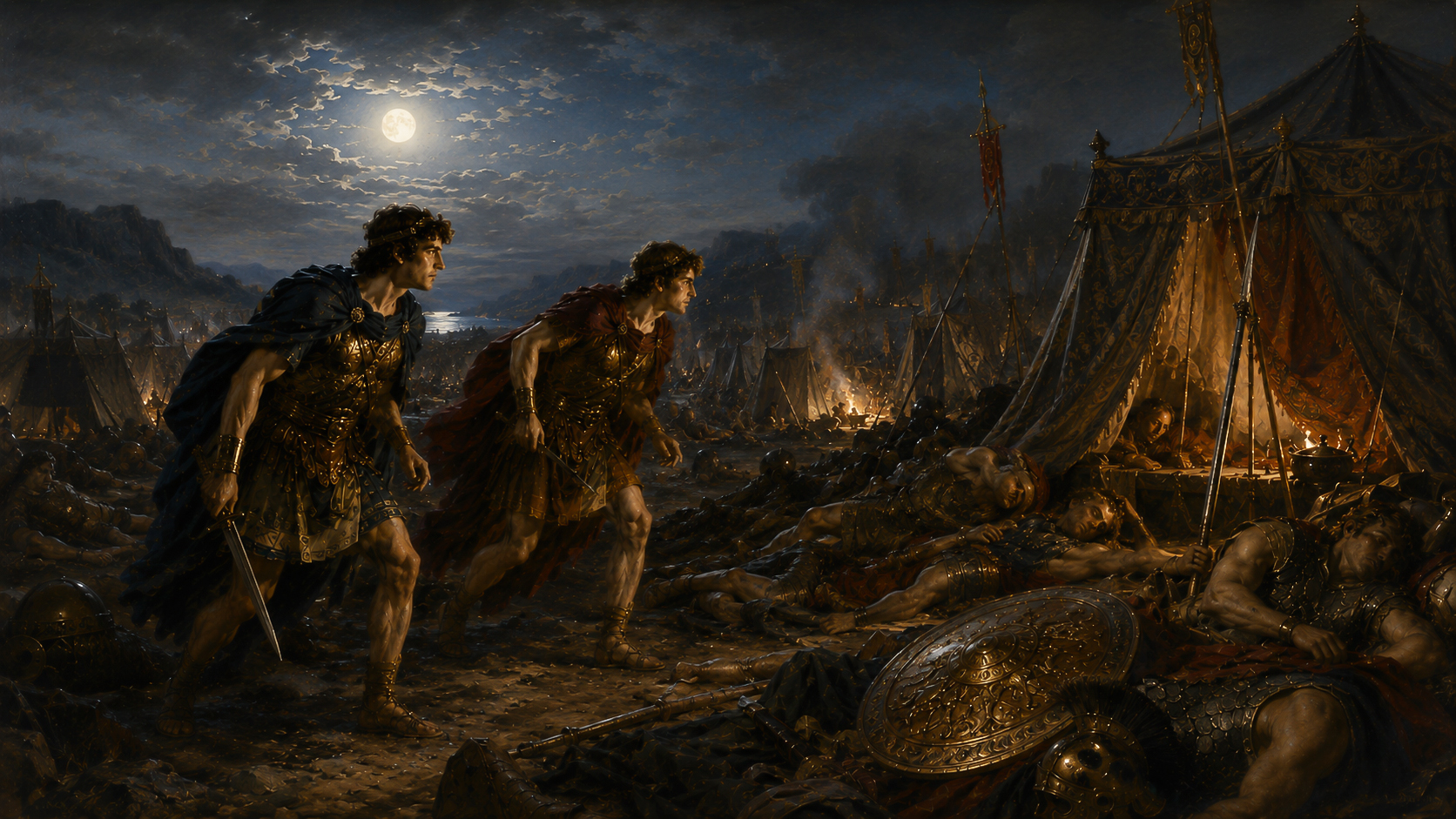
The friends became separated during the pursuit. Nisus escaped into the woods but soon realized that Euryalus had been captured. Refusing to abandon his companion, Nisus returned alone and attacked the enemy with desperate courage. Though he struck down several warriors, he could not save Euryalus. The two friends fell together, faithful to one another until the end.
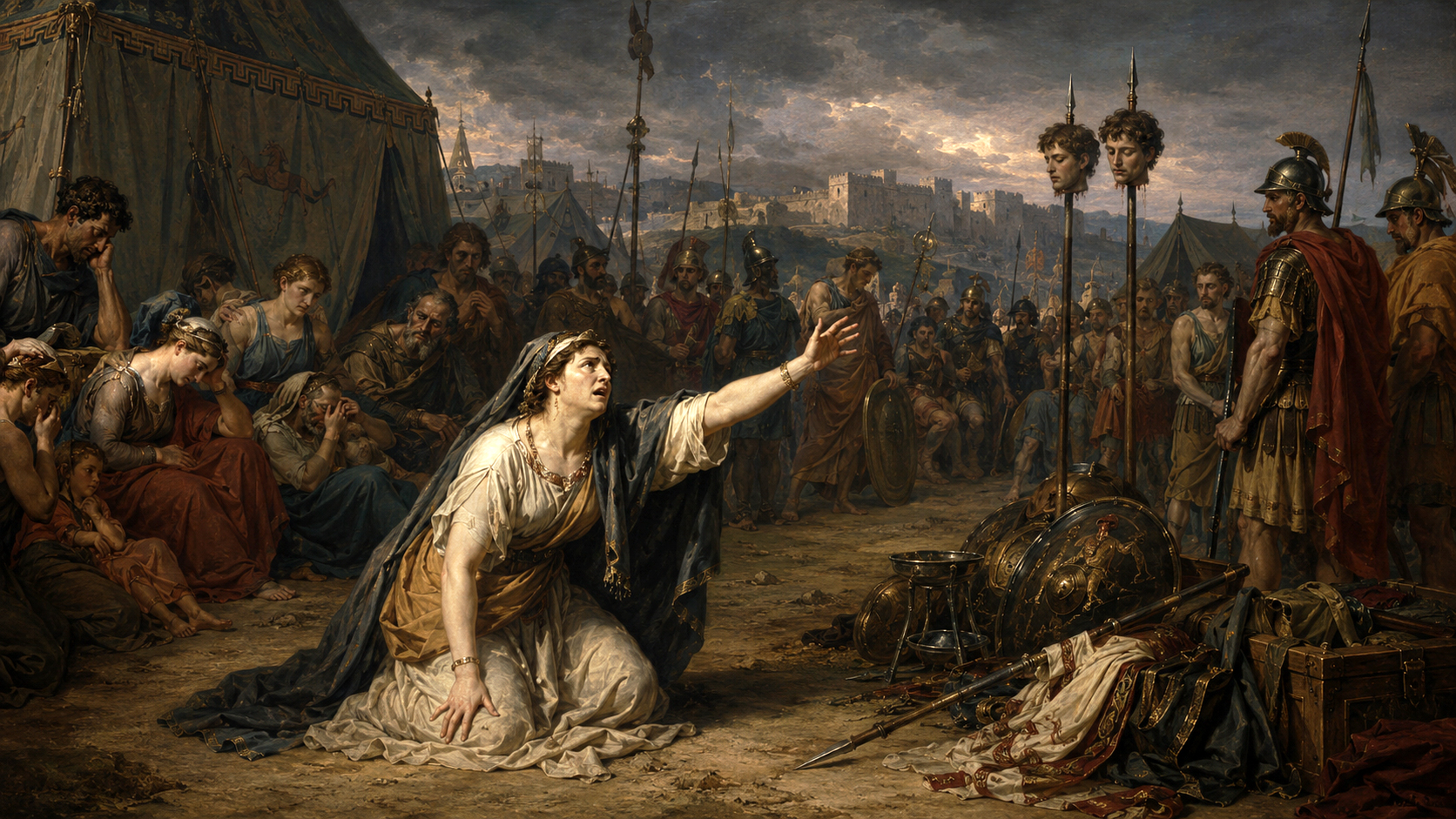
The Latins placed the heads of Nisus and Euryalus upon spears and displayed them before the Trojan camp. The sight filled the defenders with grief, while Euryalus’ mother wept bitterly for her only son. Her cries echoed throughout the camp as the Trojans prepared themselves for another assault.
The fighting soon grew more intense. The Latins brought ladders against the walls while the Trojans defended the gates with arrows, stones, and spears. Young Ascanius entered the battle for the first time, striking down an enemy warrior with a well-aimed arrow. His courage won praise from the older soldiers, though he was urged to remember that greater responsibilities still awaited him.
As the struggle continued, Turnus forced his way through one of the gates and entered the Trojan camp alone. With remarkable strength and skill, he drove the defenders before him and defeated many in single combat. For a time, it seemed that the camp itself might fall into his hands.
Gradually, however, the Trojans recovered from their surprise and surrounded Turnus from every side. Finding himself trapped, Turnus fought fiercely until he reached the river. There he leaped into the water with his armor still upon him and was safely carried back to his own people by the current.
The battle ended without either side gaining a decisive victory. The Trojans had defended their camp, but they had suffered painful losses. As night returned, they continued to wait for Aeneas, hoping that he would soon come back with the allies needed to meet the growing strength of the armies gathered against them.
Book X — The Turning of the War
As the war in Italy continued, the gods gathered in council before Jupiter. The leaders of heaven argued over the fate of the Trojans and the people of Latium, but Jupiter declared that each side must meet the outcome appointed for them without further divine interference. The battle would now be decided by the courage and actions of men.
Meanwhile, Aeneas sailed back toward the Trojan camp with the Etruscan allies he had gathered. Along the way, he was joined by the sea nymphs who had once been the Trojan ships. They warned him that Turnus had surrounded the camp and urged him to return as quickly as possible. Before dawn, Aeneas reached the shore with his fleet, and the battle began at once.
The arrival of Aeneas gave new strength to the Trojans. Fighting beside the young Pallas, the son of King Evander, Aeneas drove back the enemy and broke through the lines surrounding the camp. Across the battlefield, warriors from both armies fought fiercely as the struggle spread over the plains of Latium.
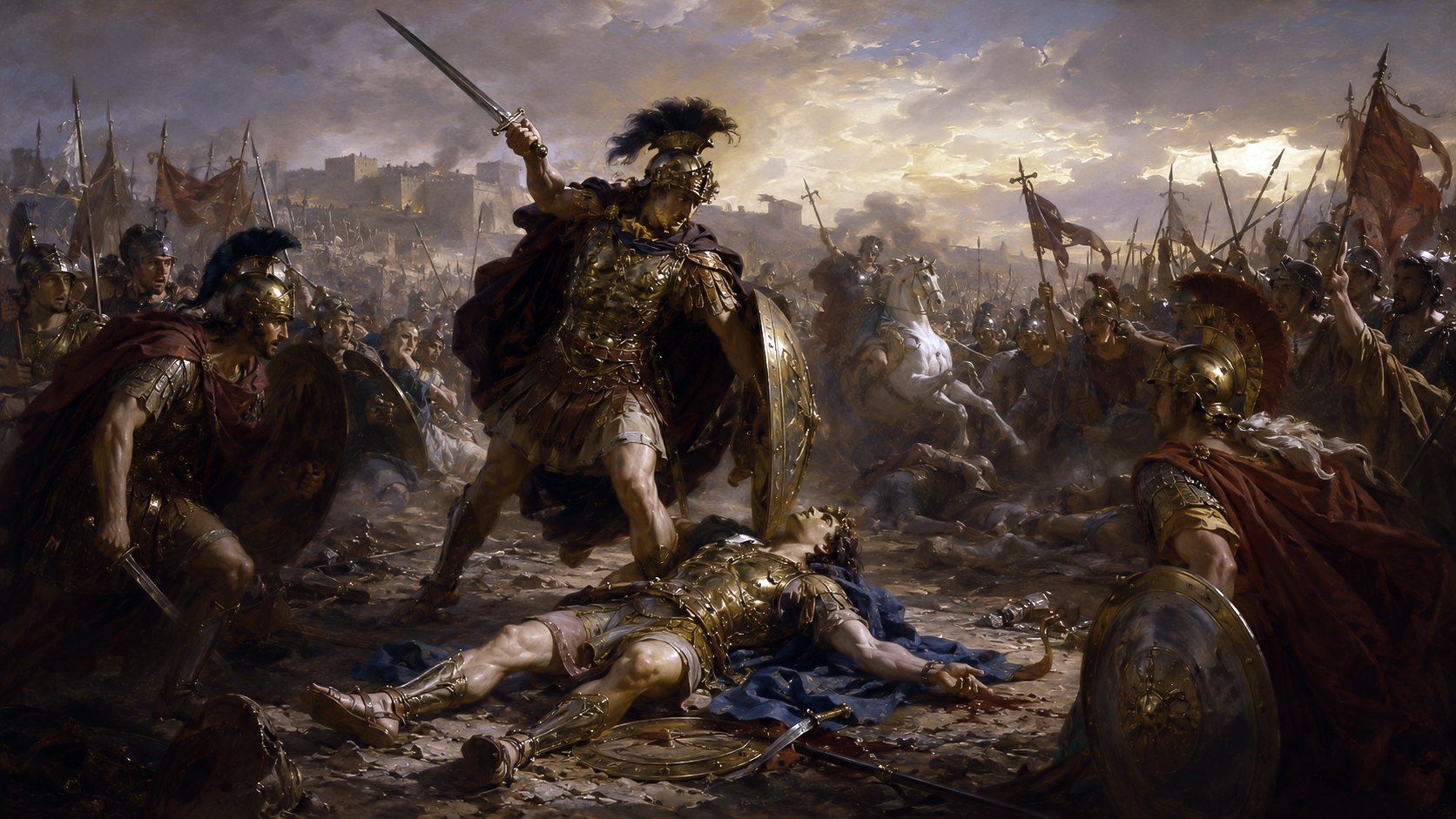
Pallas soon found himself facing Turnus in single combat. Though younger and less experienced, he fought with great courage and nearly gained the advantage. In the end, however, Turnus struck him down with a powerful blow. Standing over the fallen warrior, Turnus removed the richly decorated belt that Pallas wore and kept it as a trophy of victory.
News of Pallas’ death quickly reached Aeneas. Filled with grief and anger, he swept through the battlefield with tremendous force, defeating many of the enemy warriors before him. None could slow his advance as he searched for Turnus, determined to avenge the death of Evander’s son.
While Aeneas pursued Turnus, the fighting spread to other parts of the field. The Etruscans attacked the forces of Mezentius, the cruel former king they had once driven from their land. Mezentius’ son, Lausus, fought bravely beside his father and attempted to protect him when Aeneas closed in.
During the struggle, Aeneas struck down Lausus. As he looked upon the fallen young man, he recognized his courage and was deeply moved by the loss. He honored Lausus by returning his body to his companions so that he could receive a proper burial.
When Mezentius learned that his son had died defending him, he was overcome with sorrow. Though wounded and knowing that death was near, he mounted his horse one final time and rode out to face Aeneas alone. The two warriors met in fierce combat, but Aeneas proved the stronger. Mezentius fell beside his faithful horse, ending the life of the proud warrior who had once ruled the Etruscans.
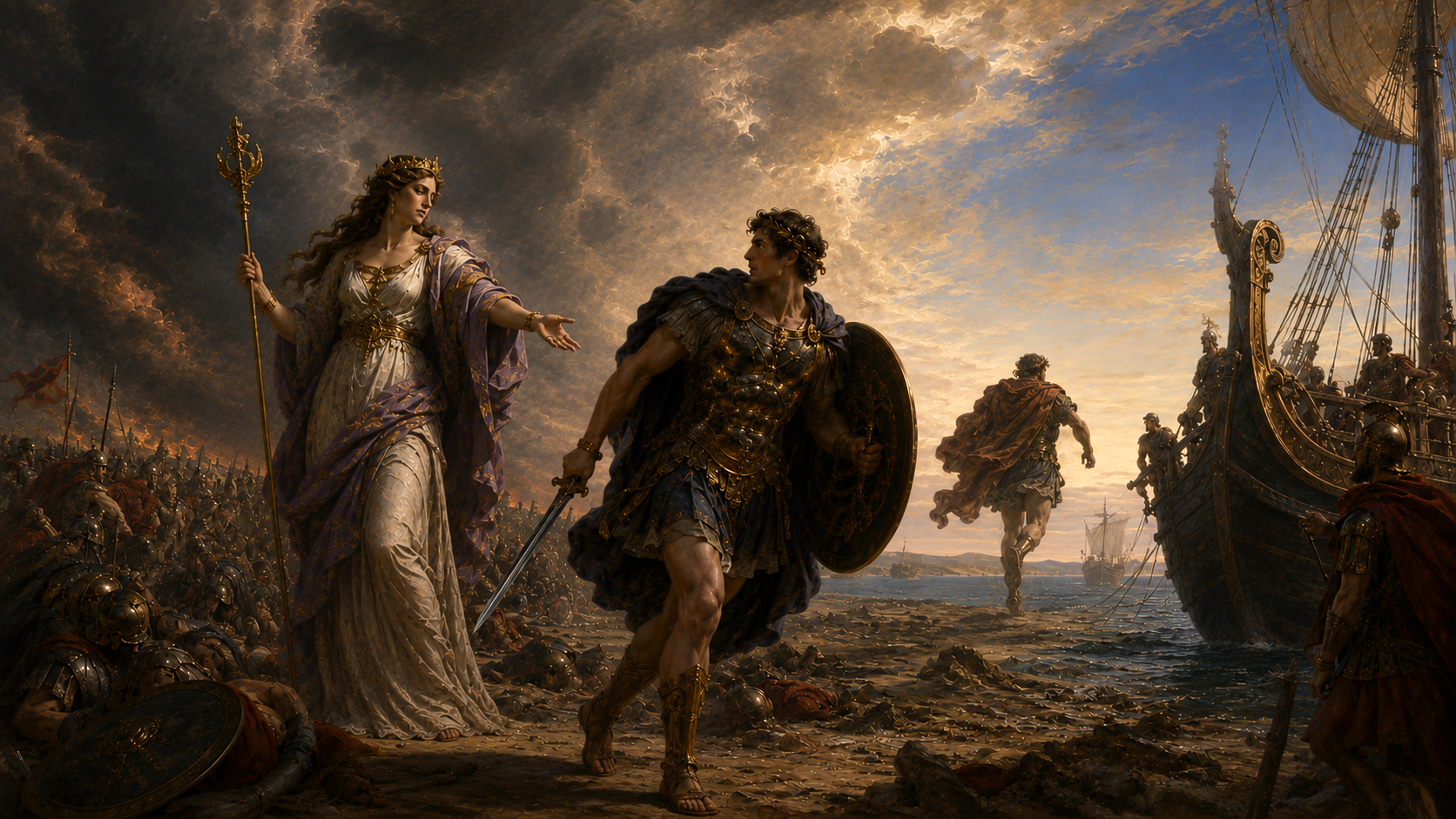
Elsewhere on the battlefield, Juno briefly rescued Turnus from Aeneas by drawing him away from the fighting, allowing the Rutulian leader to escape the encounter. Though Aeneas searched for him throughout the battle, the two champions did not meet that day.
As evening approached, the fighting finally came to an end. Many leaders on both sides had fallen, and the fields were covered with the dead. The death of Pallas brought deep sorrow to the Trojan camp, while the deaths of Lausus and Mezentius added to the growing cost of the war.
When the battle was over, Aeneas stood victorious, but his triumph was tempered by grief. The war had entered a new stage. Friendships had been tested, great leaders had fallen, and the losses suffered by both armies made it clear that the struggle for Italy would demand an even greater price before it reached its conclusion.
Book XI — The Cost of War
With the fighting ended for a time, Aeneas devoted the next day to honoring those who had fallen in battle. He gave thanks to the gods for the victory that had been won and dedicated the armor of Mezentius as an offering. His thoughts soon turned to Pallas, whose death weighed heavily upon him. Aeneas arranged a great funeral procession, surrounding the body of the young warrior with flowers, weapons, and gifts before sending him back to his father, King Evander.
When the people of Latium asked for a truce so they could bury their own dead, Aeneas gladly agreed. For twelve days, both sides laid aside their weapons while families mourned those who had been lost. Across the countryside, funeral fires burned as friends and enemies alike gave honor to the fallen.
Meanwhile, the leaders of Latium gathered to decide what should be done next. Many believed the war had already cost too much and urged King Latinus to seek peace with the Trojans. Some even suggested that Lavinia should be given to Aeneas, fulfilling the prophecy that had long pointed to a foreign husband. Others, however, continued to support Turnus and called upon him to defend both his honor and the land.
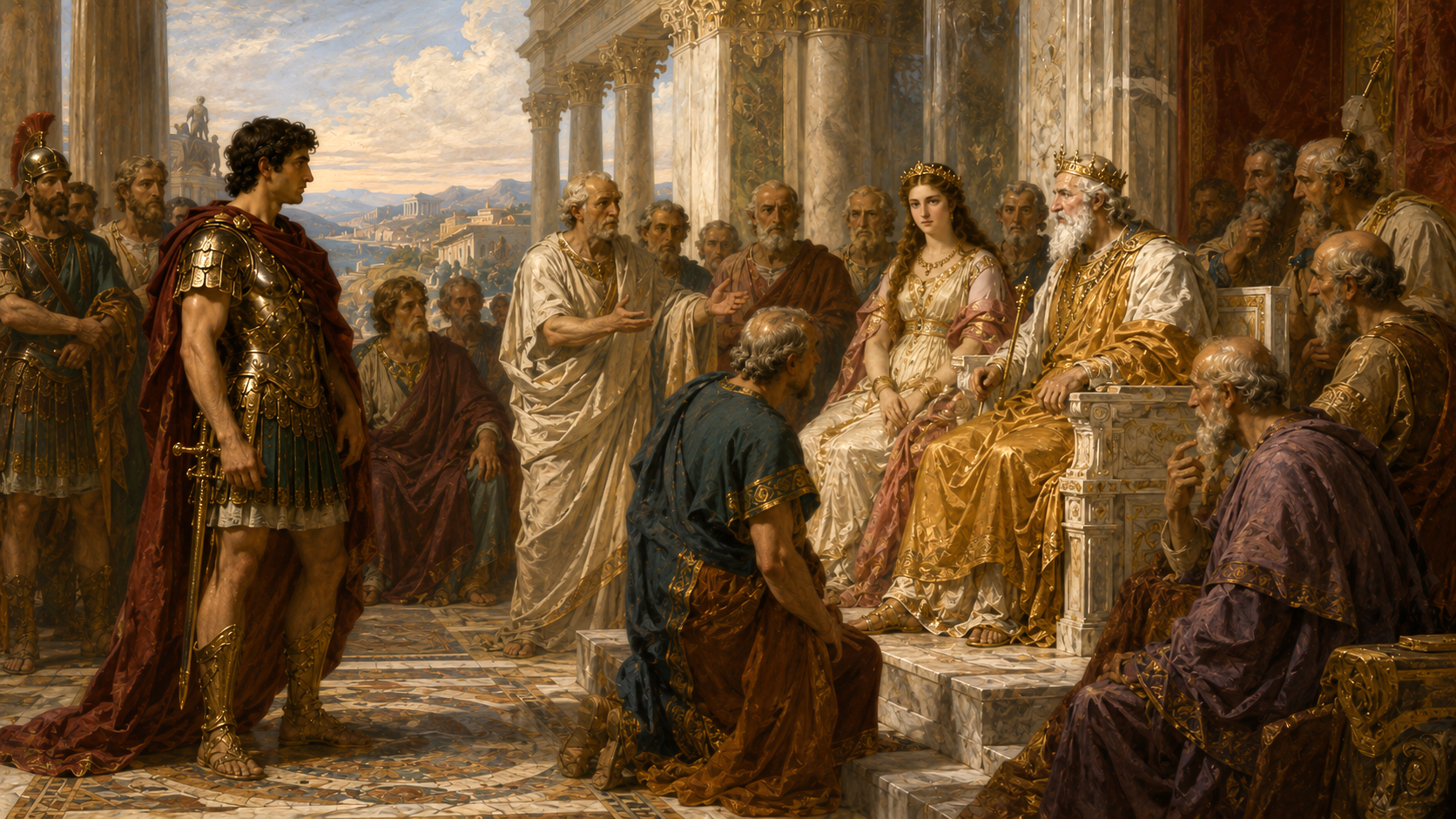
At that same time, the Greek warrior Diomedes received an embassy from the Latins asking him to join the war against the Trojans. Diomedes refused. Having experienced the hardships that followed the fall of Troy, he warned that the Trojans should not be opposed and advised the Latins to make peace instead. His message returned without the help they had hoped to receive.
The debate among the Latins ended without agreement. Turnus rejected every proposal for peace and insisted that the war continue. Seeing that another battle was unavoidable, both sides once again prepared their armies.
Knowing that Aeneas and his allies would soon advance, Turnus developed a plan to defend the approaches to the city. He led part of the army into the hills to prepare an ambush, while another force remained to protect the open plain. Among those chosen to defend the city was Camilla, the queen of the Volscians, whose courage and skill in battle were admired by friend and foe alike.
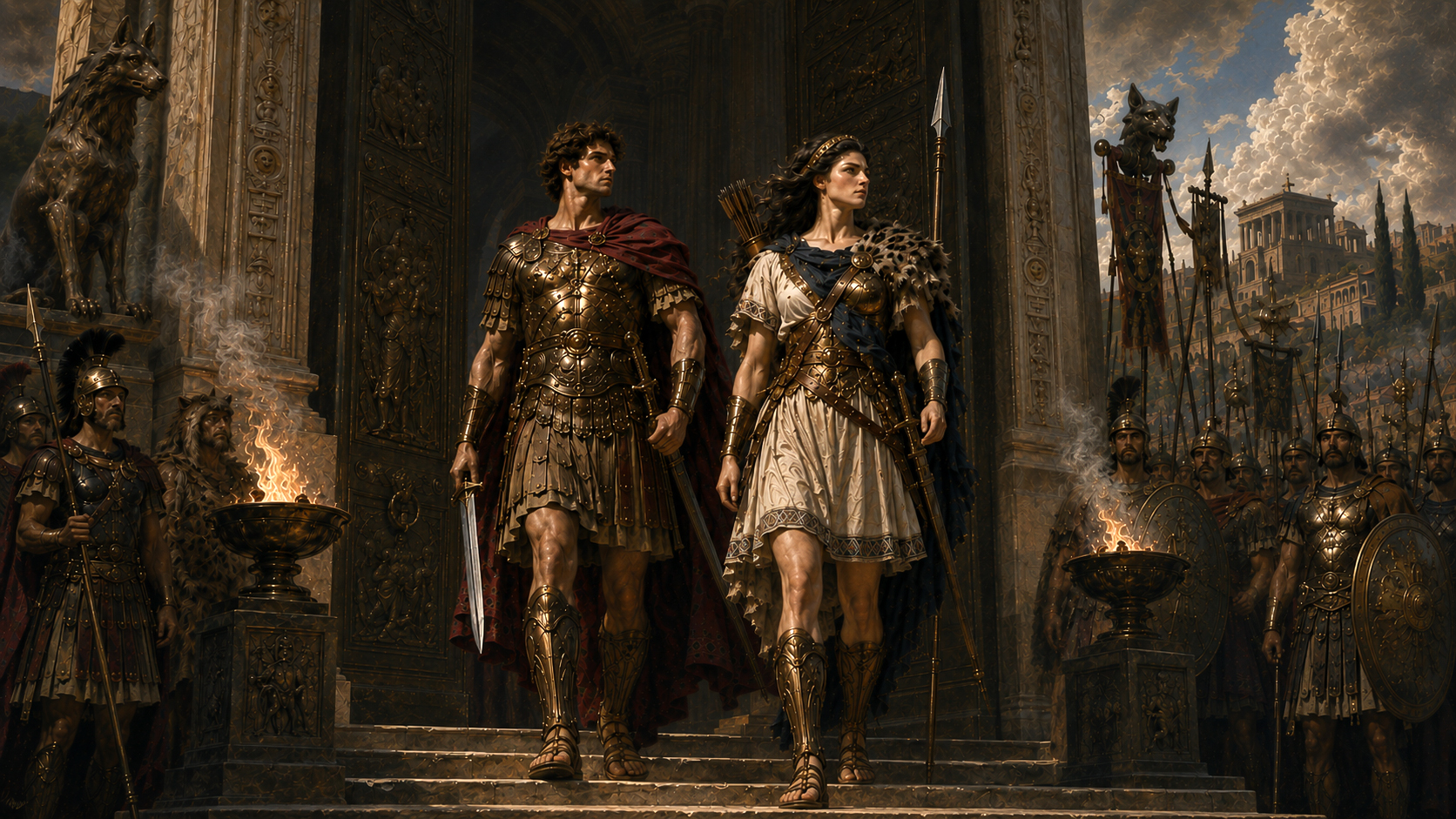
Virgil then recounts the remarkable story of Camilla’s childhood. As an infant, she had been carried to safety by her father during a time of war. Pursued by enemies, he tied the child to a great spear and hurled it across a rushing river while praying that the goddess Diana would protect her. Camilla survived and was raised in the wilderness, growing into a fearless huntress and an unmatched warrior.
When battle resumed, Camilla led her mounted warriors into the fight with remarkable speed and skill. She rode fearlessly across the field, defeating many opponents and inspiring her followers by her example. Wherever the fighting was fiercest, Camilla could be found pressing forward against the enemy.
As the battle continued, Camilla pursued a richly dressed enemy warrior whose fine armor and weapons caught her attention. While concentrating on the chase, she exposed herself to danger. The warrior Arruns, who had been waiting for such an opportunity, secretly hurled his spear. It struck Camilla, mortally wounding her.
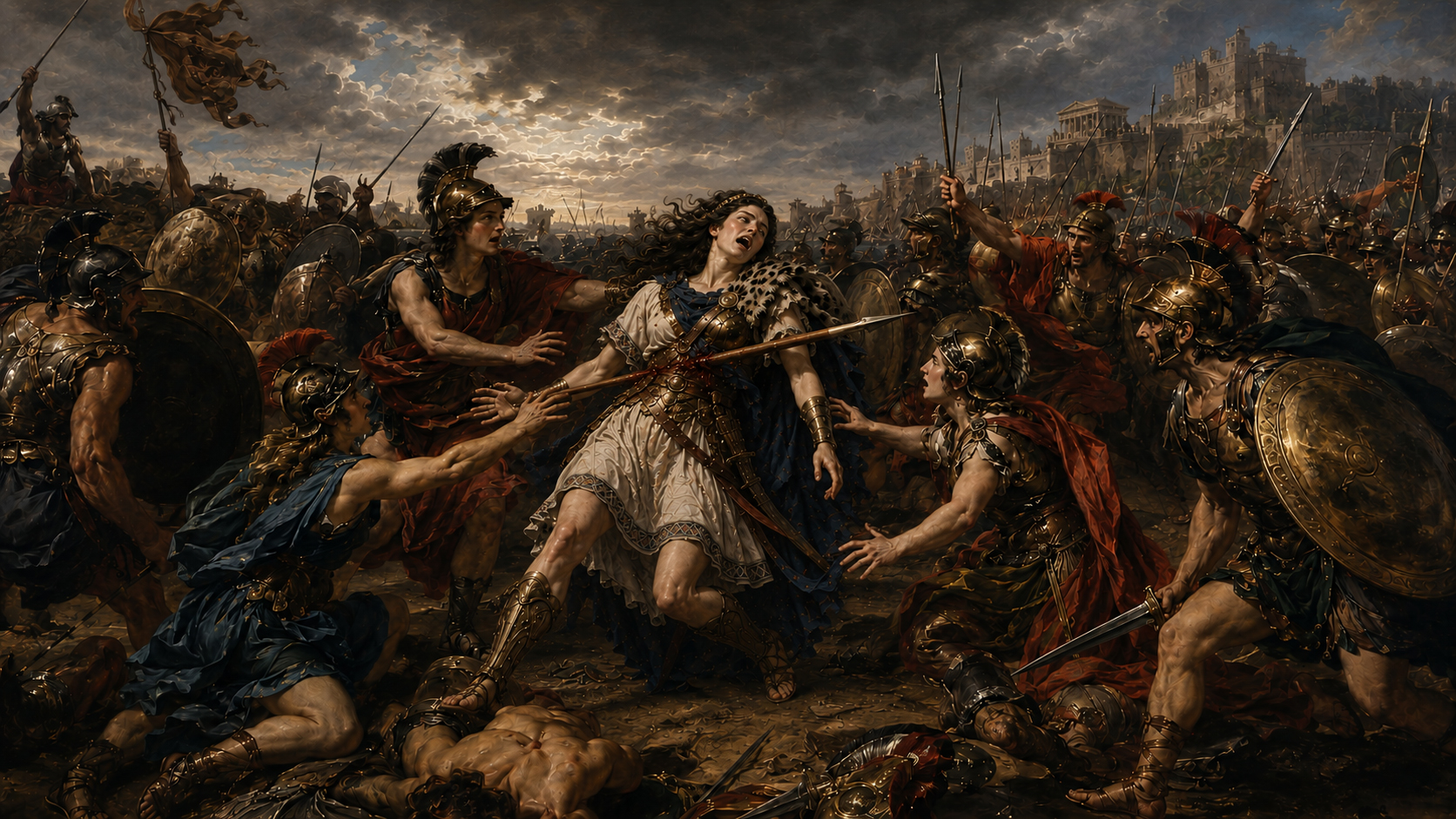
As Camilla fell, she entrusted her final message to one of her companions, asking that Diana be told of her faithful service. Her warriors carried her from the battlefield, but the news of her death quickly spread through the army. Seeing their leader gone, the Volscians lost heart and began to retreat. Their flight soon spread to the rest of the defenders, and the battle turned in favor of the Trojans.
When Turnus learned that Camilla had fallen and that the defenses had collapsed, he abandoned his position in the hills and withdrew toward the city. Night brought an end to the fighting before Aeneas and Turnus could meet in battle. Both armies returned to their camps knowing that the long conflict had nearly reached its conclusion. The next encounter would decide the future of Latium and the destiny of the Trojan people.
Book XII — The End of the War
After the death of Camilla, both armies understood that the war could not continue much longer. Turnus finally agreed to settle the conflict by meeting Aeneas in single combat. If Turnus won, the Trojans would leave Italy. If Aeneas prevailed, the Trojans would be allowed to settle peacefully in the land. King Latinus accepted the agreement, and both sides gathered to witness the duel that would decide the future.
Before the fighting began, sacrifices were offered, and solemn promises were made to keep the outcome of the contest. Yet Juno still opposed the destiny of the Trojans. She persuaded Juturna, the divine sister of Turnus, to save her brother from danger if possible. Taking the form of one of the Latin leaders, Juturna stirred doubt among the warriors and encouraged them to break the agreement.
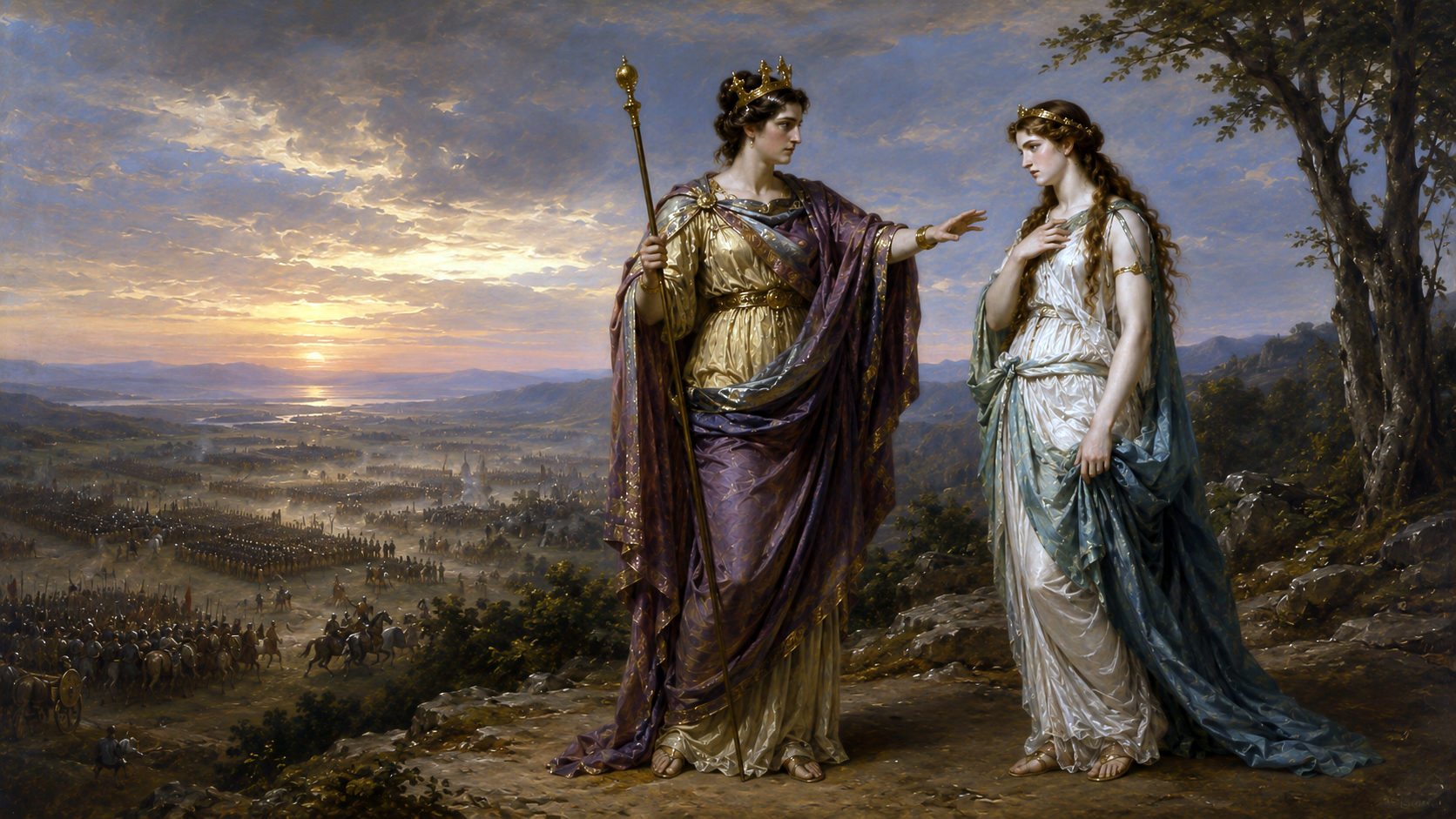
Soon, an arrow was fired, and the peace between the two armies collapsed. The battle spread once again across the plain as soldiers from both sides rushed into combat. In the confusion, Aeneas was struck by an arrow and forced to withdraw from the fighting while his companions searched for a way to remove the wound.
Venus came to her son’s aid by providing a healing herb that allowed the physicians to draw out the arrow. Strength quickly returned to Aeneas, and he armed himself once more. Rather than continue fighting ordinary soldiers, he set out across the battlefield looking only for Turnus, determined to end the war by defeating his rival.
Juturna repeatedly prevented the meeting by carrying Turnus away in his chariot whenever Aeneas drew near. As the pursuit continued, neither champion could bring the struggle to its conclusion. Seeing that the battle had become hopelessly confused, Aeneas changed his plan and marched directly toward the city itself. The sudden threat forced the defenders to abandon their positions, and panic spread through the streets.
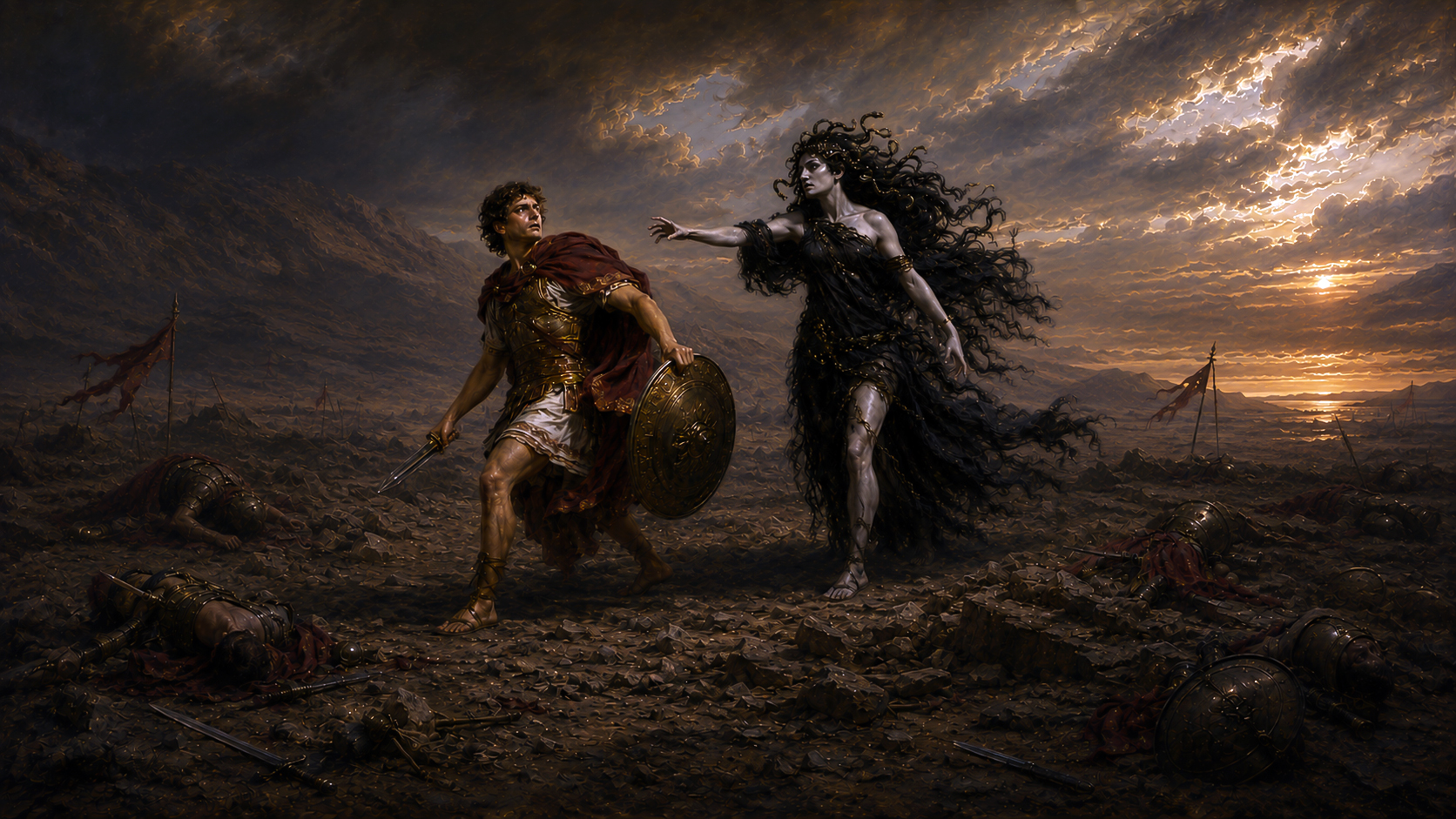
From the city walls, Queen Amata watched the fighting unfold. Believing that Turnus had already been killed, she lost all hope and took her own life. When Turnus learned of the queen’s death and saw that the city itself was in danger, he finally abandoned every attempt to avoid Aeneas. He returned to face his opponent in the duel both armies had awaited.
The two champions met alone upon the battlefield while warriors from both sides watched in silence. They exchanged brutal blows with spear and sword, each having great courage and determination. During the struggle, Turnus’ sword unexpectedly broke because he had taken the wrong weapon in the confusion of battle. He fled across the field while Aeneas pursued him, searching for another opportunity to fight.
At last, Turnus recovered his proper sword, and the duel resumed. Aeneas hurled his great spear with tremendous force, striking Turnus and bringing him to the ground. Wounded and unable to continue, Turnus admitted defeat. He pleaded for mercy, asking Aeneas to spare his life and allow his body to be returned to his father.
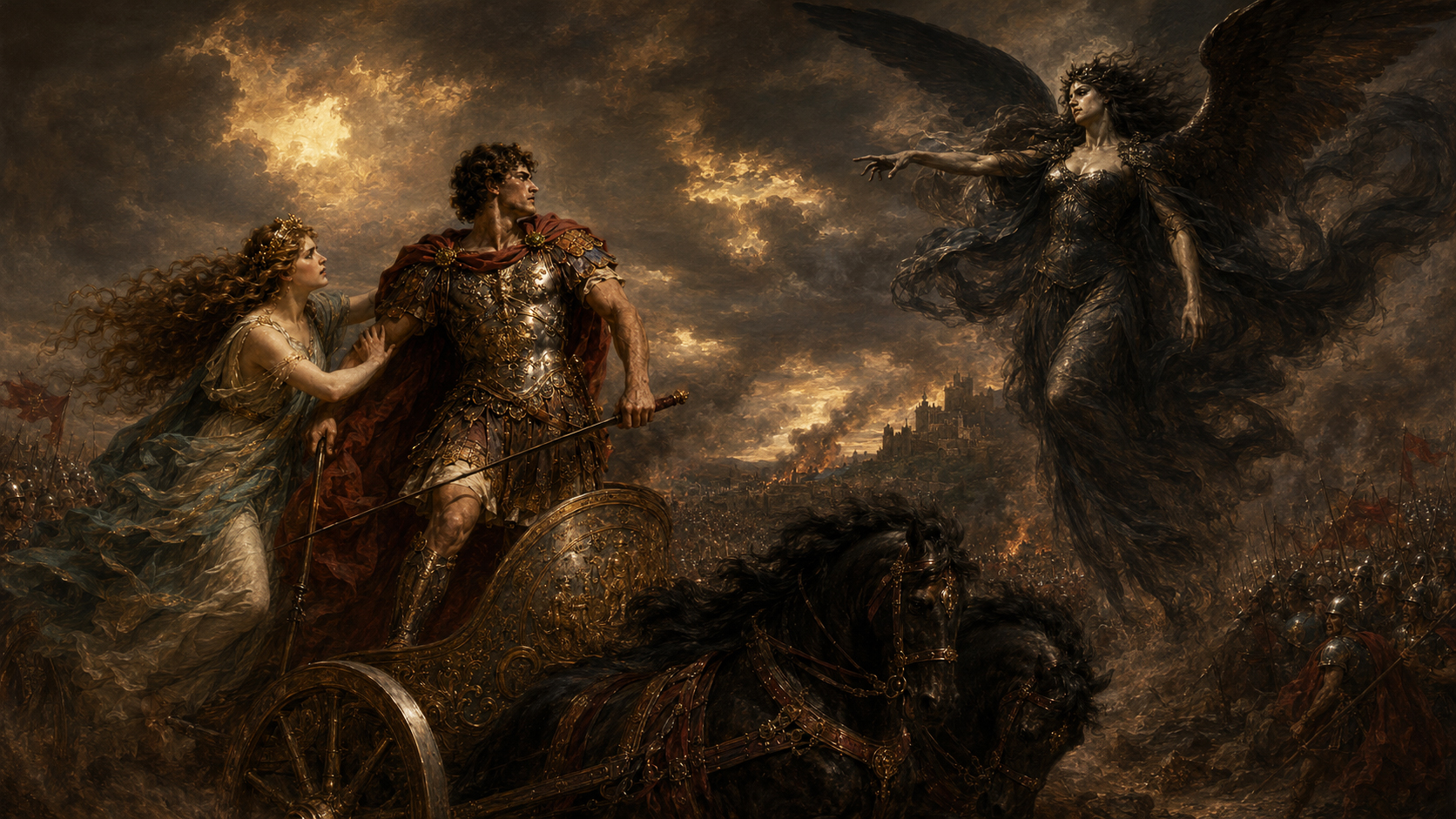
For a brief moment, Aeneas hesitated. Then he noticed the richly decorated belt of Pallas fastened around Turnus’ shoulder—the very belt Turnus had taken after killing the young prince. The sight reminded Aeneas of his promise to honor Pallas and the grief of King Evander. Filled with renewed determination, Aeneas struck the final blow, bringing the life of Turnus to an end.
With the death of Turnus, the long war came to its conclusion. The struggle that had begun when the Trojans first arrived in Latium was finally over. Aeneas had secured the future of his people and fulfilled the mission that had guided him from the day Troy fell. The epic closes at that moment, leaving the founding of the new nation to the generations that would follow.
Final Thoughts
Reading The Aeneid after The Iliad and The Odyssey gave the poem its proper place in the sequence. Homer presents Troy at war and the long return after the war. Virgil begins after Troy is gone. Aeneas is not returning home like Odysseus, and he is not seeking glory like Achilles. He is carrying a ruined world forward. The poem begins in loss, continues through exile, and turns toward the founding of a people.
My earlier attempt with the Fitzgerald translation did not take hold. I could recognize its literary quality, but the reading itself felt distant and difficult to sustain. The Robert Fagles translation, together with Bernard Knox’s introduction, opened the poem in a different way. Knox’s introduction gave the necessary historical frame: Rome, Virgil’s earlier works, the civil wars, Augustus, the structure of the epic, and the long afterlife of Virgil. His account of finding Virgil in the ruins of World War II Italy was especially striking. It made clear that Virgil was not merely a poet of the ancient past, but a voice that could still speak into a world in ruins.
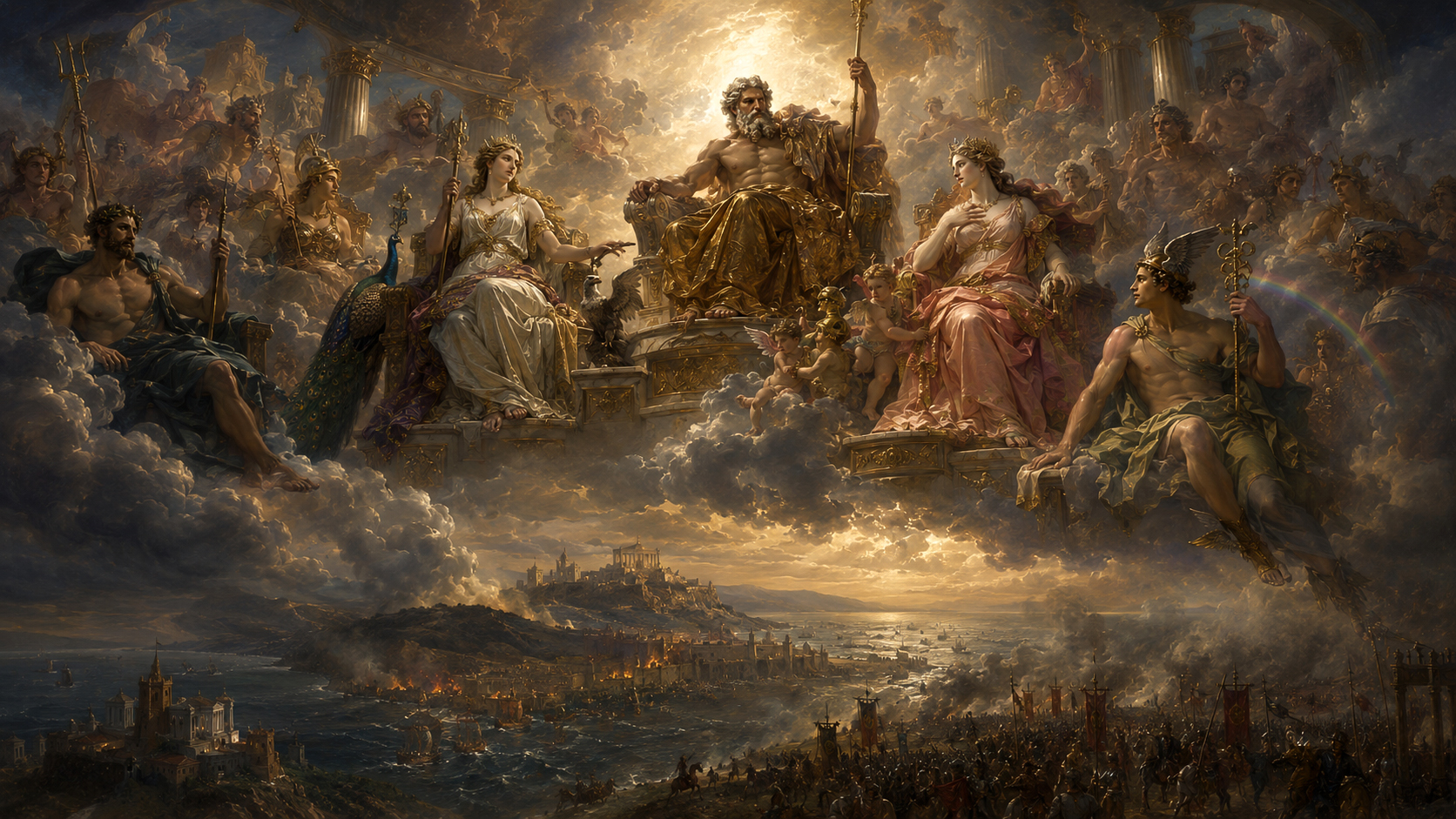
The first half of The Aeneid follows Aeneas through storm, memory, wandering, love, remembrance, and descent into the underworld. The second half turns toward Italy and war. That structure helped me read the poem as a whole rather than as disconnected episodes. Carthage, Troy, Sicily, Cumae, Latium, Evander, Pallas, Turnus, and the final duel all belong to one converging point: the passage from destruction to settlement.
The poem is not simple. It honors Rome, but it does not make Rome clean. The founding comes through grief, conflict, and loss. Dido is left behind. Pallas dies. Camilla dies. Turnus dies. Even Aeneas, who carries the burden of destiny, is not left untouched by rage and sorrow. Virgil allows the cost of founding Rome to remain visible.
As a reader devoted to Christ, I cannot receive Virgil’s world as true in its religious imagination. The gods of the poem are unstable, partial, and often destructive. Yet that is part of what makes the reading instructive. The poem displays the human longing for order, destiny, civilization, and providence in a world that does not yet know the true King. Virgil can see ruin, duty, sacrifice, and the longing for peace, but his horizon remains Rome.
That is why The Aeneid is so important to understanding Western thought. It stands between Homer and the later Christian literary world. Augustine would remember Virgil with sorrow and suspicion. Dante would honor him as a guide while also revealing his limit. Reading Virgil helped me better understand the classical inheritance that Christianity received, judged, and transformed.
By the end, I did not read The Aeneid merely as Rome’s national epic. I read it as a very long epic poem about what remains after destruction, what must be carried, what must be left behind, and what it costs to found anything that endures. It is a work of exile, memory, burden, war, and destiny. It belongs after Homer, and it prepares the way for the Christ-centered reckoning with the classical world.


