Any discussion of divine judgment must begin by recognizing that Scripture does not speak of it in a single, uniform way. For those who do not belong to God—those whom the Gospel describes as already under condemnation apart from Christ (John 3:18)—judgment is not covenant discipline meant to correct or restore, but the rightful outcome of a life spent resisting God’s truth and authority. It is not a sudden reversal, but the confirmation of a settled direction, the sealing of a separation already chosen. Scripture treats this reality with gravity, not to provoke fear or spectacle, but to clarify what is at stake when light is persistently refused and darkness is preferred instead.
Introduction
When Scripture speaks of judgment, it rarely appears as a sudden disaster. Most often, it begins quietly, when a person keeps pushing God away, and His steadying presence finally withdraws. When that happens, clarity fades. Right and wrong lose their sharpness, and the heart starts leaning toward things it once knew were false. Life grows confused and disordered, and inner peace slips away. Over time, the guiding light that once helped a person see the path ahead grows dim, and God allows the person to follow the way he has chosen. The consequences eventually expose what that path really is. In principle, judgment looks like this: a slow unraveling that takes place when the soul insists on walking without the God who gives light, truth, and strength.
We need this review because the biblical pattern of judgment isn’t theoretical—it describes things we can see happening right now. Scripture shows that judgment comes only after long stretches of patience and mercy, when God makes Himself known and gives repeated opportunities to listen and turn back. Over time, resistance settles in quietly. The heart drifts, usually while convincing itself that nothing is wrong. As God’s voice is ignored, moral clarity fades, and people lose the ability to tell what is good from what is harmful. What once seemed obviously destructive becomes acceptable, then attractive. That shift leads to inner confusion and fragmentation, which now feel normal rather than alarming.
As this continues, peace disappears, and anxiety takes its place. Restlessness becomes the baseline. Clear truth starts to feel heavy, intrusive, or even unbearable. Eventually, God allows people to continue down the path they have chosen, and the consequences arrive without needing to be forced. Life itself exposes what those choices have produced. This exposure isn’t meant to crush, but to show what was previously hidden. And the pattern doesn’t end in hopelessness. In Scripture, judgment is always meant to lead back to repentance, renewal, and restored fellowship with Christ. Read together, these patterns help us understand our moment honestly, without panic, and remind us that mercy is still present, still calling, and still offering a way home.
Because this pattern shows up throughout the whole of Scripture—from Israel’s wandering in the wilderness, to the warnings of the prophets, to the teaching of Christ and the letters of the apostles—it can be seen as a repeated progression. Each stage deepens the weight of judgment, marking further breakdown in the soul as it resists truth and turns inward on itself. Yet even here, Scripture shows not only discipline but mercy. God allows these consequences so that what is hidden becomes visible and the wayward can come to their senses and return to Him. The following sections trace this biblical pattern, showing how judgment unfolds, what it brings into the open, and how it ultimately clears the way for restoration.
These patterns are consistent from Genesis to Revelation and form a unified theology of judgment.
I. Judgment Begins as Withdrawal
In Scripture, judgment usually does not begin with God striking or intervening forcefully, but with God withdrawing His protective presence and restraint. This pattern appears repeatedly: God “goes and returns to His place” (Hosea 5:15), leaving a people to feel the weight of having turned away; He pronounces woe because they have strayed from Him (Hosea 7:13); He declares that His Spirit will not contend with humanity indefinitely (Genesis 6:3); and He commands that those bound to idols be left to themselves (Hosea 4:17). Taken together, these passages show that the earliest—and often most severe—form of divine judgment is not immediate punishment, but God allowing chosen paths to unfold and their consequences to take full effect.
II. Darkened Understanding
Spiritual confusion follows as the mind itself grows clouded. As Paul writes, “they became futile in their thinking, and their foolish hearts were darkened” (Romans 1:21), describing not an act of active destruction but the withdrawal of clarity and sound judgment. When this happens, wisdom begins to appear foolish, truth is treated as an offense, sin is praised, and moral inversion becomes ordinary rather than shocking. With discernment gone, Isaiah’s warning comes into view: “Woe to those who call evil good and good evil” (Isaiah 5:20). This declaration is more than simple denunciation; it marks the point at which God gives a people over to moral corruption, allowing their loss of judgment to fully expose itself.
III. Moral Inversion & Social Unraveling
After discernment collapses, individuals, communities, and entire societies begin to settle into sin rather than struggle against it. What God calls shame is not merely tolerated but openly celebrated, just as Paul describes when he says that “God gave them up to dishonorable passions” (Romans 1:26–27). The language is judicial rather than impulsive: God steps back, allowing corruption to take the lead. As this continues, the God-given structures meant to support human life begin to break down. Through Jeremiah, the Lord asks how pardon is possible when His people have forsaken Him, broken covenant, and abused the very gifts He provided, concluding, “Shall I not punish them for these things?” (Jeremiah 5:7–9). When the created order is rejected, the foundations of human flourishing—marriage, family, authority, sexual boundaries, the meaning of gender, worship, and social order—begin to decay. The collapse of sexual order and covenant faithfulness is not accidental or random; it is part of God’s judicial response to persistent rebellion, exposing what happens when His design is refused.
IV. Ecclesial Corruption
Scripture is clear that judgment begins with the people of God themselves: “it is time for judgment to begin at the house of God” (1 Peter 4:17). When the church departs from God’s created order and truth, the usual pattern is not immediate external persecution but internal collapse. False shepherds and teachers multiply, just as Paul warns that people who will not endure sound doctrine gather teachers who say what they want to hear and turn instead to myths (2 Timothy 4:3–4). This happens when God withdraws restraining grace and allows desires to dictate leadership. At the same time, leaders themselves become blind. Isaiah’s indictment of watchmen who cannot see and shepherds without understanding (Isaiah 56:10–11) describes not an unfortunate mistake but a covenant judgment. The result is what Christ warns of in Revelation: the removal of the lampstand (Revelation 2:5). This does not mean the destruction of the universal Church, but the loss of a particular church’s witness. Its credibility erodes, its spiritual life weakens, and its voice no longer carries weight. Scripture treats this as a severe, yet fitting, consequence of rebellion within the church.
V. Divine “Handing Over” to Consequences
This pattern reaches its clearest expression in the New Testament. Paul states repeatedly in Romans 1 that “God handed them over” (vv. 24, 26, 28), making clear that this is not a momentary phrase but a deliberate judicial act. God releases people to the desires they insist on pursuing, and those very desires become the instruments of their undoing. What appears, on the surface, to be divine inactivity is not indifference at all. It is a measured form of judgment, purposeful and exact, in which restraint is withdrawn so that consequences may speak.
As this judgment spreads, its effects move beyond the individual and into the life of society itself. Scripture observes that “when the wicked rule, the people groan” (Proverbs 29:2), capturing the outward result of inward corruption. Personal ruin widens into social decay; order gives way to instability; clarity dissolves into confusion; and conflict steadily increases. These are not random outcomes, but the natural fruit of a people whom God has handed over to the path they have chosen.
VI. Internal Division & Conflict
Scripture consistently shows that as judgment deepens, God permits people to turn against one another. Isaiah describes this kind of internal collapse when the Lord says He will stir Egyptians against Egyptians, setting city against city and kingdom against kingdom (Isaiah 19:2). Such breakdowns in unity are not accidents of history but part of a judicial pattern in which social bonds unravel. The same principle appears in the psalmist’s account of God granting Israel what they demanded while sending a wasting emptiness into their souls (Psalm 106:13–15). The divisions, hostilities, and fractures that surface among a people are not random or merely political; they are outward expressions of an inner emptiness and spiritual barrenness allowed to run their course.
VII. Loss of Protection and Prosperity
When sin reaches a certain point, Scripture shows that God removes the blessings tied to covenant faithfulness. Peace is withdrawn, and fear takes its place, so that even small or imagined threats cause panic, as described in the warning that “the sound of a driven leaf shall put them to flight” (Leviticus 26:36). Provision is also affected. The prophet Haggai speaks of labor that never satisfies—people eat but are never full, earn wages only to watch them disappear—showing how economic frustration often accompanies divine withdrawal (Haggai 1:6). Stability, too, is taken away, as Moses warns that foreign nations will consume the fruit of the land (Deuteronomy 28:33). Throughout Scripture, external pressure and loss are not treated as random misfortune, but as the outward result of deeper internal corruption that has been left unaddressed.
VIII. Judicial Hardening
After repeated warnings are ignored, Scripture shows that the heart can reach a point where repentance becomes impossible apart from extraordinary mercy. God’s judgment is sometimes expressed through hardness itself. Isaiah is commanded to proclaim a word that will make the heart of the people dull and their ears heavy (Isaiah 6:9–10), not as a separate punishment, but as the judgment itself. Paul echoes this reality when he writes that God sends a strong delusion so that those who reject the truth come to believe what is false (2 Thessalonians 2:10–11). When truth is persistently refused, error no longer feels deceptive but compelling. This is the most frightening form of judgment: to continue in sin while losing the capacity to recognize it as sin at all.
IX. Famine of the Word
Scripture warns that judgment can reach a point where God no longer speaks. Through Amos, the Lord declares that He will send a famine of hearing the words of the LORD, leaving people searching but unable to find a true word from Him (Amos 8:11–12). Outward forms may remain—sermons are preached, books are written, churches stay open—but they carry no weight. There is no conviction, no repentance, no life. The absence of God’s voice is not subtle; it is overwhelming, and the silence itself becomes a judgment.
X. Exposure
In the final stage, judgment becomes public and unmistakable, as the shame of sin and error is brought into the open. God declares through Ezekiel that He will gather those people whom they trusted and expose their nakedness before them, revealing what was once hidden (Ezekiel 16:37). When God exposes sin, it is as though light is suddenly thrown into a darkened room, ending the pretense of privacy and stripping away illusion. This exposure is not arbitrary; it serves as a witness. Scripture presents Israel’s collapse as a sign to the surrounding nations, a visible warning that their ruin has meaning and purpose (Jeremiah 19:7–9). Their fall becomes a living testimony of what follows when a people abandon the Lord who once upheld them.
XI. Remnant Preserved
Even in judgment, Scripture makes clear that God preserves those who remain faithful to Him. A remnant who fears the LORD is remembered, spared, and treated as God’s treasured possession, as Malachi describes (Malachi 3:16–18). For these faithful ones, judgment does not mean abandonment but refinement. Zechariah speaks of God refining His people as silver is refined, purifying them through trial so that what is false is burned away and what is true remains (Zechariah 13:9). In this way, judgment serves to cleanse the remnant and ready them for renewal and restoration.
Summary
In character and pattern, biblical judgment unfolds in these patterns:
God withdraws restraining grace.
Understanding darkens.
Moral inversion sets in.
The church’s lampstand loses brightness.
Society cannibalizes itself.
Divine protection and prosperity fade.
Hearts become hardened.
God’s Word ceases to convict.
Sin is exposed publicly.
A remnant is preserved and purified.
This is the consistent pattern from Genesis to Revelation. This is what judgment “looks like” in character—not instantaneous destruction, but the solemn, ordered unravelling of a people who have walked away from the God who formed them.
Supporting Work
I. Biblical Theologies
John Murray — Redemption: Accomplished and Applied (Clear pastoral theology of union, conviction, and repentance.)
Walter C. Kaiser — The Messiah in the Old Testament (Tracks divine presence, judgment, and restoration through redemptive history.)
G. K. Beale — We Become What We Worship (Biblical psychology of idolatry leading to moral and perceptual deformation.)
Christopher J. H. Wright — The Mission of God (Biblical motifs of divine judgment, exile, and return.)
Stephen Dempster — Dominion and Dynasty (Narrative structure of covenant faithfulness, decline, and restoration.)
II. Reformed and Puritan
John Owen — The Mortification of Sin (Classic interior account of how sin darkens, disorders, and deceives.)
John Owen — Communion with God (The relational dynamics of divine nearness and withdrawal.)
Richard Baxter — The Saints’ Everlasting Rest (The effects of sin on the soul and the restorative presence of God.)
Thomas Goodwin — The Heart of Christ (Christ’s relational posture toward repentant believers after judgment.)
Jonathan Edwards — Religious Affections (Discerning true spiritual direction from wrong, including seasons of desertion.)
III. Classic Theologies
Augustine — Confessions (Interior account of sin’s darkening, God’s withdrawal, the collapse of peace.)
Augustine — The City of God (Macro-patterns of societal decline, judgment, and restoration.)
Athanasius — On the Incarnation (The descent of the soul and the divine rescue through the Word.)
Martin Luther — The Bondage of the Will (Theological clarity on the mind’s captivity, blindness, and need for divine initiative.)
John Calvin — Institutes of the Christian Religion (Book III treats divine judgment, repentance, and sanctification with precision.)
IV. Monographs
Sinclair Ferguson — The Christian Life (Clear biblical mapping of conviction, repentance, adoption, and renewal.)
J. I. Packer — Knowing God (The difference between knowledge of God and estrangement from His presence.)
D. A. Carson — A Call to Spiritual Reformation (Biblical prayers that address divine nearness, discipline, and renewal.)
Iain H. Murray — Revival and Revivalism (Historical patterns of genuine Spirit-given conviction and restoration.)
Michael Horton — A Puritan Theology (with Beeke) (broad combined monograph-length systematic treatment) (Comprehensive theological mapping of sin, judgment, illumination, and communion.)
After the Puritan period of Christian faith and practice, few figures drew as much reverence as Jonathan Edwards. Born on October 5, 1703, in East Windsor, Connecticut, Edwards emerged as a figure who significantly influenced a Christ-centered revival that swept through the British American colonies in the mid-18th century. His contributions as a pastor and theologian have left an unforgettable mark on Christianity in America and global theological discourse.
Introduction
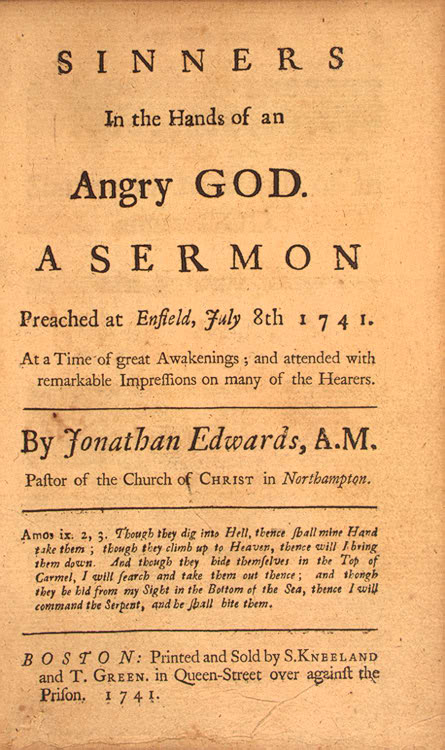
In the corpus of religious literature, few sermons have garnered as much attention and debate as Jonathan Edwards’ “Sinners in the Hands of an Angry God.” Delivered in 1741, this sermon is a gem of Christendom history and a profound exploration of Puritan theology and the human condition. It epitomizes the era’s spirit and offers a window into the historical mindset of 18th-century colonial America. The message was delivered during great Christ-centered devotion in the American colonies. Characterized by a renewed and passionate emphasis on personal and corporate fellowship, faith, and discipleship, Jonathan Edwards, a significant figure in this movement, sought to awaken his audience to the realities of sin, divine judgment, and the urgency of redemption.
A key to understanding this message lies in grasping Edwards’ theological framework. Aligned to Reformed doctrines of grace, Edwards emphasized God’s sovereignty, man’s depravity, and the necessity of salvation through Christ.
Message
While often remembered for its imagery of hell and divine wrath, the message is more than just a historical gem of Puritan imperatives. It encapsulates critical elements of Edwards’ theology and his timeless warnings and plea to people who are on their way to hell. Its enduring influence is seen in its continued study in theological seminaries, its enduring bearing on Christian American thought, and its place alongside the abiding by the biblical narrative.
SINNERS IN THE HANDS OF AN ANGRY GOD
by Jonathan Edwards
Preached at Enfield, July 8th, 1741, at a time of great awakenings, and attended with remarkable impressions on many of the hearers.
Deut. 32:35 –Their foot shall slide in due time–
“In this verse is threatened the vengeance of God on the wicked unbelieving Israelites, who were God’s visible people, and who lived under the means of grace; but who, notwithstanding all God’s wonderful works towards them, remained (as ver. 28.) void of counsel, having no understanding in them. Under all the cultivations of Heaven, they brought forth bitter and poisonous fruit; as in the two verses next preceding the text.—The expression I have chosen for my text, Their foot shall slide in due time, seems to imply the following things, relating to the punishment and destruction to which these wicked Israelites were exposed.
That they were always exposed to destruction; as one that stands or walks in slippery places is always exposed to fall. This is implied in the manner of their destruction coming upon them, being represented by their foot sliding. The same is expressed, Psalm 73:18. “Surely thou didst set them in slippery places; thou castedst them down into destruction.”
It implies, that they were always exposed to sudden unexpected destruction. As he that walks in slippery places is every moment liable to fall, he cannot foresee one moment whether he shall stand or fall the next; and when he does fall, he falls at once without warning: which is also expressed in Psalm 73:18, 19. “Surely thou didst set them in slippery places; thou castedst them down into destruction: how are they brought into desolation as in a moment?”
Another thing implied is, that they are liable to fall of themselves, without being thrown down by the hand of another; as he that stands or walks on slippery ground needs nothing but his own weight to throw him down.
That the reason why they are not fallen already, and do not fall now, is only that God’s appointed time is not come. For it is said that when that due time, or appointed time, comes, their foot shall slide. Then they shall be left to fall, as they are inclined by their own weight. God will not hold them up in these slippery places any longer, but will let them go; and then, at that very instant, they shall fall into destruction; as he that stands in such slippery declining ground, on the edge of a pit, he cannot stand alone, when he is let go he immediately falls and is lost.
The observation from the words that I would now insist upon is this.—“There is nothing that keeps wicked men at any one moment out of hell, but the mere pleasure of God.”—By the mere pleasure of God, I mean his sovereign pleasure, his arbitrary will, restrained by no obligation, hindered by no manner of difficulty, any more than if nothing else but God’s mere will had in the least degree, or in any respect whatsoever, any hand in the preservation of wicked men one moment.—The truth of this observation may appear by the following considerations.
There is no want of power in God to cast wicked men into hell at any moment. Men’s hands cannot be strong when God rises up: the strongest have no power to resist him, nor can any deliver out of his hands.—He is not only able to cast wicked men into hell, but he can most easily do it. Sometimes an earthly prince meets with a great deal of difficulty to subdue a rebel, who has found means to fortify himself, and has made himself strong by the numbers of his followers. But it is not so with God. There is no fortress that is any defence from the power of God. Though hand join in hand, and vast multitudes of God’s enemies combine and associate themselves, they are easily broken in pieces. They are as great heaps of light chaff before the whirlwind; or large quantities of dry stubble before devouring flames. We find it easy to tread on and crush a worm that we see crawling on the earth; so it is easy for us to cut or singe a slender thread that any thing hangs by: thus easy is it for God, when he pleases, to cast his enemies down to hell. What are we, that we should think to stand before him, at whose rebuke the earth trembles, and before whom the rocks are thrown down?
They deserve to be cast into hell; so that divine justice never stands in the way, it makes no objection against God’s using his power at any moment to destroy them. Yea, on the contrary, justice calls aloud for an infinite punishment of their sins. Divine justice says of the tree that brings forth such grapes of Sodom, “Cut it down, why cumbereth it the ground?” Luke 13:7. The sword of divine justice is every moment brandished over their heads, and it is nothing but the hand of arbitrary mercy, and God’s mere will, that holds it back.
They are already under a sentence of condemnation to hell. They do not only justly deserve to be cast down thither, but the sentence of the law of God, that eternal and immutable rule of righteousness that God has fixed between him and mankind, is gone out against them, and stands against them; so that they are bound over already to hell. John 3:18. “He that believeth not is condemned already.” So that every unconverted man properly belongs to hell: that is his place; from thence he is, John 8:23. “Ye are from beneath,” and thither he is bound; it is the place that justice, and God’s word, and the sentence of his unchangeable law, assign to him.
They are now the objects of that very same anger and wrath of God, that is expressed in the torments of hell. And the reason why they do not go down to hell at each moment, is not because God, in whose power they are, is not then very angry with them; as he is with many miserable creatures now tormented in hell, and there feel and bear the fierceness of his wrath. Yea, God is a great deal more angry with great numbers that are now on earth; yea, doubtless with many that are now in this congregation, who it may be are at ease, than he is with many of those who are now in the flames of hell.—So that it is not because God is unmindful of their wickedness, and does not resent it, that he does not let loose his hand and cut them off. God is not altogether such a one as themselves, though they imagine him to be so. The wrath of God burns against them, their damnation does not slumber; the pit is prepared, the fire is made ready, the furnace is now hot, ready to receive them; the flames do now rage and glow. The glittering sword is whet, and held over them, and the pit hath opened its mouth under them.
The devil stands ready to fall upon them, and seize them as his own, at what moment God shall permit him. They belong to him; he has their souls in his possession, and under his dominion. The Scripture represents them as his goods, Luke 11:21. The devils watch them; they are ever by them, at their right hand; they stand waiting for them, like greedy hungry lions that see their prey, and expect to have it, but are for the present kept back. If God should withdraw his hand, by which they are restrained, they would in one moment fly upon their poor souls. The old serpent is gaping for them; hell opens its mouth wide to receive them; and if God should permit it, they would be hastily swallowed up and lost.
There are in the souls of wicked men those hellish principles reigning, that would presently kindle and flame out into hell-fire, if it were not for God’s restraints. There is laid in the very nature of carnal men, a foundation for the torments of hell. There are those corrupt principles, in reigning power in them, and in full possession of them, that are seeds of hell-fire. These principles are active and powerful, exceeding violent in their nature, and if it were not for the restraining hand of God upon them, they would soon break out, they would flame out after the same manner as the same corruptions, the same enmity, does in the hearts of damned souls, and would beget the same torments as they do in them. The souls of the wicked are in Scripture compared to the troubled sea, Isaiah 57:20. For the present, God restrains their wickedness by his mighty power, as he does the raging waves of the troubled sea, saying, “Hitherto shalt thou come, and no further;” but if God should withdraw that restraining power, it would soon carry all before it. Sin is the ruin and misery of the soul; it is destructive in its nature; and if God should leave it without restraint, there would need nothing else to make the soul perfectly miserable. The corruption of the heart of man is immoderate and boundless in its fury; and while wicked men live here, it is like fire pent up by God’s restraints, whereas if it were let loose, it would set on fire the course of nature; and as the heart is now a sink of sin, so, if sin was not restrained, it would immediately turn the soul into a fiery oven, or a furnace of fire and brimstone.
It is no security to wicked men for one moment, that there are no visible means of death at hand. It is no security to a natural man, that he is now in health, and that he does not see which way he should now immediately go out of the world by any accident, and that there is no visible danger in any respect in his circumstances. The manifold and continual experience of the world in all ages, shows this is no evidence, that a man is not on the very brink of eternity, and that the next step will not be into another world. The unseen, unthought of ways and means of persons going suddenly out of the world are innumerable and inconceivable. Unconverted men walk over the pit of hell on a rotten covering, and there are innumerable places in this covering so weak that they will not bear their weight, and these places are not seen. The arrows of death fly unseen at noon-day; the sharpest sight cannot discern them. God has so many different unsearchable ways of taking wicked men out of the world and sending them to hell, that there is nothing to make it appear, that God had need to be at the expense of a miracle, or go out of the ordinary course of his providence, to destroy any wicked man, at any moment. All the means that there are of sinners going out of the world, are so in God’s hands, and so universally and absolutely subject to his power and determination, that it does not depend at all the less on the mere will of God, whether sinners shall at any moment go to hell, than if means were never made use of, or at all concerned in the case.
Natural men’s prudence and care to preserve their own lives, or the care of others to preserve them, do not secure them a moment. To this, divine providence and universal experience does also bear testimony. There is this clear evidence that mens’ own wisdom is no security to them from death; that if it were otherwise we should see some difference between the wise and politic men of the world, and others, with regard to their liableness to early and unexpected death: but how is it in fact? Eccl. 2:16. “How dieth the wise man? even as the fool.”
All wicked men’s pains and contrivance which they use to escape hell, while they continue to reject Christ, and so remain wicked men, do not secure them from hell one moment. Almost every natural man that hears of hell, flatters himself that he shall escape it; he depends upon himself for his own security; he flatters himself in what he has done, in what he is now doing, or what he intends to do. Every one lays out matters in his own mind how he shall avoid damnation, and flatters himself that he contrives well for himself, and that his schemes will not fail. They hear indeed that there are but few saved, and that the greater part of men that have died heretofore are gone to hell; but each one imagines that he lays out matters better for his own escape than others have done. He does not intend to come to that place of torment; he says within himself, that he intends to take effectual care, and to order matters so for himself as not to fail.
But the foolish children of men miserably delude themselves in their own schemes, and in confidence in their own strength and wisdom; they trust to nothing but a shadow. The greater part of those who heretofore have lived under the same means of grace, and are now dead, are undoubtedly gone to hell; and it was not because they were not as wise as those who are now alive; it was not because they did not lay out matters as well for themselves to secure their own escape. If we could speak with them, and inquire of them, one by one, whether they expected, when alive, and when they used to hear about hell, ever to be the subjects of that misery, we, doubtless, should hear one and another reply, “No, I never intended to come here: I had laid out matters otherwise in my mind; I thought I should contrive well for myself: I thought my scheme good. I intended to take effectual care; but it came upon me unexpected: I did not look for it at that time, and in that manner; it came as a thief: Death outwitted me: God’s wrath was too quick for me. O my cursed foolishness! I was flattering myself, and pleasing myself with vain dreams of what I would do hereafter; and when I was saying, peace and safety, then sudden destruction came upon me.”
God has laid himself under no obligation, by any promise, to keep any natural man out of hell one moment. God certainly has made no promises either of eternal life, or of any deliverance or preservation from eternal death, but what are contained in the covenant of grace, the promises that are given in Christ, in whom all the promises are yea and amen. But surely they have no interest in the promises of the covenant of grace who are not the children of the covenant, who do not believe in any of the promises, and have no interest in the Mediator of the covenant.
So that, whatever some have imagined and pretended about promises made to natural men’s earnest seeking and knocking, it is plain and manifest, that whatever pains a natural man takes in religion, whatever prayers he makes, till he believes in Christ, God is under no manner of obligation to keep him a moment from eternal destruction.
So that thus it is that natural men are held in the hand of God over the pit of hell; they have deserved the fiery pit, and are already sentenced to it; and God is dreadfully provoked, his anger is as great towards them as to those that are actually suffering the executions of the fierceness of his wrath in hell, and they have done nothing in the least to appease or abate that anger, neither is God in the least bound by any promise to hold them up one moment: the devil is waiting for them, hell is gaping for them, the flames gather and flash about them, and would fain lay hold on them, and swallow them up; the fire pent up in their own hearts is struggling to break out; and they have no interest in any Mediator, there are no means within reach that can be any security to them. In short, they have no refuge, nothing to take hold of; all that preserves them every moment is the mere arbitrary will, and un-covenanted, unobliged forbearance, of an incensed God.
Application
The use of this awful subject may be for awakening unconverted persons in this congregation. This that you have heard is the case of every one of you that are out of Christ.—That world of misery, that lake of burning brimstone, is extended abroad under you. There is the dreadful pit of the glowing flames of the wrath of God; there is hell’s wide gaping mouth open; and you have nothing to stand upon, nor any thing to take hold of; there is nothing between you and hell but the air; it is only the power and mere pleasure of God that holds you up.
You probably are not sensible of this; you find you are kept out of hell, but do not see the hand of God in it; but look at other things, as the good state of your bodily constitution, your care of your own life, and the means you use for your own preservation. But indeed these things are nothing; if God should withdraw his hand, they would avail no more to keep you from falling, than the thin air to hold up a person that is suspended in it.
Your wickedness makes you as it were heavy as lead, and to tend downwards with great weight and pressure towards hell; and if God should let you go, you would immediately sink and swiftly descend and plunge into the bottomless gulf; and your healthy constitution, and your own care and prudence, and best contrivance, and all your righteousness, would have no more influence to uphold you and keep you out of hell, than a spider’s web would have to stop a falling rock. Were it not for the sovereign pleasure of God, the earth would not bear you one moment; for you are a burden to it: the creation groans with you; the creature is made subject to the bondage of your corruption, not willingly; the sun does not willingly shine upon you to give you light to serve sin and Satan; the earth does not willingly yield her increase to satisfy your lusts; nor is it willingly a stage for your wickedness to be acted upon; the air does not willingly serve you for breath to maintain the flame of life in your vitals, while you spend your life in the service of God’s enemies. God’s creatures are good, and were made for men to serve God with, and do not willingly subserve to any other purpose, and groan when they are abused to purposes so directly contrary to their nature and end. And the world would spew you out, were it not for the sovereign hand of him who hath subjected it in hope. There are the black clouds of God’s wrath now hanging directly over your heads, full of the dreadful storm, and big with thunder; and were it not for the restraining hand of God, it would immediately burst forth upon you. The sovereign pleasure of God, for the present, stays his rough wind; otherwise it would come with fury, and your destruction would come like a whirlwind, and you would be like the chaff of the summer threshing-floor.
The wrath of God is like great waters that are dammed for the present; they increase more and more, and rise higher and higher, till an outlet is given; and the longer the stream is stopped, the more rapid and mighty is its course, when once it is let loose. It is true, that judgment against your evil works has not been executed hitherto; the floods of God’s vengeance have been withheld; but your guilt in the mean time is constantly increasing, and you are every day treasuring up more wrath; the waters are constantly rising, and waxing more and more mighty; and there is nothing but the mere pleasure of God, that holds the waters back, that are unwilling to be stopped, and press hard to go forward. If God should only withdraw his hand from the flood-gate, it would immediately fly open, and the fiery floods of the fierceness and wrath of God would rush forth with inconceivable fury, and would come upon you with omnipotent power; and if your strength were ten thousand times greater than it is, yea, ten thousand times greater than the strength of the stoutest, sturdiest devil in hell, it would be nothing to withstand or endure it.
The bow of God’s wrath is bent, and the arrow made ready on the string, and justice bends the arrow at your heart, and strains the bow, and it is nothing but the mere pleasure of God, and that of an angry God, without any promise or obligation at all, that keeps the arrow one moment from being made drunk with your blood. Thus all you that never passed under a great change of heart, by the mighty power of the Spirit of God upon your souls; all you that were never born again, and made new creatures, and raised from being dead in sin, to a state of new, and before altogether unexperienced, light and life, are in the hands of an angry God. However you may have reformed your life in many things, and may have had religious affections, and may keep up a form of religion in your families and closets, and in the house of God, it is nothing but his mere pleasure that keeps you from being this moment swallowed up in everlasting destruction. However unconvinced you may now be of the truth of what you hear, by and by you will be fully convinced of it. Those that are gone from being in the like circumstances with you, see that it was so with them; for destruction came suddenly upon most of them; when they expected nothing of it, and while they were saying, Peace and safety: now they see, that those things on which they depended for peace and safety, were nothing but thin air and empty shadows.
The God that holds you over the pit of hell, much as one holds a spider, or some loathsome insect, over the fire, abhors you, and is dreadfully provoked: his wrath towards you burns like fire; he looks upon you as worthy of nothing else, but to be cast into the fire; he is of purer eyes than to bear to have you in his sight; you are ten thousand times more abominable in his eyes, than the most hateful venomous serpent is in ours. You have offended him infinitely more than ever a stubborn rebel did his prince: and yet, it is nothing but his hand that holds you from falling into the fire every moment. It is to be ascribed to nothing else, that you did not go to hell the last night; that you was suffered to awake again in this world, after you closed your eyes to sleep. And there is no other reason to be given, why you have not dropped into hell since you arose in the morning, but that God’s hand has held you up. There is no other reason to be given why you have not gone to hell, since you have sat here in the house of God, provoking his pure eyes by your sinful wicked manner of attending his solemn worship. Yea, there is nothing else that is to be given as a reason why you do not this very moment drop down into hell.
O sinner! consider the fearful danger you are in: it is a great furnace of wrath, a wide and bottomless pit, full of the fire of wrath, that you are held over in the hand of that God, whose wrath is provoked and incensed as much against you, as against many of the damned in hell. You hang by a slender thread, with the flames of divine wrath flashing about it, and ready every moment to singe it, and burn it asunder; and you have no interest in any Mediator, and nothing to lay hold of to save yourself, nothing to keep off the flames of wrath, nothing of your own, nothing that you ever have done, nothing that you can do, to induce God to spare you one moment.
—And consider here more particularly,
Whose wrath it is: it is the wrath of the infinite God. If it were only the wrath of man, though it were of the most potent prince, it would be comparatively little to be regarded. The wrath of kings is very much dreaded, especially of absolute monarchs, who have the possessions and lives of their subjects wholly in their power, to be disposed of at their mere will. Prov. 20:2 – “The fear of a king is as the roaring of a lion: whoso provoketh him to anger, sinneth against his own soul.” The subject that very much enrages an arbitrary prince, is liable to suffer the most extreme torments that human art can invent, or human power can inflict. But the greatest earthly potentates, in their greatest majesty and strength, and when clothed in their greatest terrors, are but feeble, despicable worms of the dust, in comparison of the great and almighty Creator and King of heaven and earth. It is but little that they can do, when most enraged, and when they have exerted the utmost of their fury. All the kings of the earth, before God, are as grasshoppers; they are nothing, and less than nothing; both their love and their hatred is to be despised. The wrath of the great King of kings, is as much more terrible than theirs, as his majesty is greater. Luke 12:4, 5. “And I say unto you, my friends, Be not afraid of them that kill the body, and after that have no more that they can do. But I will forewarn you whom ye shall fear: Fear him, which after he hath killed, hath power to cast into hell; yea, I say unto you, Fear him.”
It is the fierceness of his wrath that you are exposed to. We often read of the fury of God; as in Isa. 59:18. “According to their deeds, accordingly he will repay fury to his adversaries.” So Isa. 66:15 – “For behold, the Lord will come with fire, and with his chariots like a whirlwind, to render his anger with fury, and his rebuke with flames of fire.” And in many other places. So, in Rev. 19:15 we read of “the wine-press of the fierceness and wrath of Almighty God.” The words are exceeding terrible. If it had only been said, “the wrath of God,” the words would have implied that which is infinitely dreadful: but it is “the fierceness and wrath of God.” The fury of God! the fierceness of Jehovah! O how dreadful must that be! Who can utter or conceive what such expressions carry in them? But it is also “the fierceness and wrath of Almighty God.” As though there would be a very great manifestation of his almighty power in what the fierceness of his wrath should inflict; as though omnipotence should be as it were enraged, and exerted, as men are wont to exert their strength in the fierceness of their wrath. Oh! then, what will be the consequence! What will become of the poor worm that shall suffer it! Whose hands can be strong? and whose heart can endure? To what a dreadful, inexpressible, inconceivable depth of misery must the poor creature be sunk who shall be the subject of this!
Consider this, you that are here present, that yet remain in an unregenerate state. That God will execute the fierceness of his anger, implies, that he will inflict wrath without any pity. When God beholds the ineffable extremity of your case, and sees your torment to be so vastly disproportioned to your strength, and sees how your poor soul is crushed, and sinks down, as it were, into an infinite gloom; he will have no compassion upon you, he will not forbear the executions of his wrath, or in the least lighten his hand; there shall be no moderation or mercy, nor will God then at all stay his rough wind; he will have no regard to your welfare, nor be at all careful lest you should suffer too much in any other sense, than only that you shall not suffer beyond what strict justice requires. Nothing shall be withheld, because it is so hard for you to bear – Ezek. 8:18. “Therefore will I also deal in fury; mine eye shall not spare, neither will I have pity; and though they cry in mine ears with a loud voice, yet I will not hear them.” Now God stands ready to pity you; this is a day of mercy; you may cry now with some encouragement of obtaining mercy. But when once the day of mercy is past, your most lamentable and dolorous cries and shrieks will be in vain; you will be wholly lost and thrown away of God, as to any regard to your welfare. God will have no other use to put you to, but to suffer misery; you shall be continued in being to no other end; for you will be a vessel of wrath fitted to destruction; and there will be no other use of this vessel, but to be filled full of wrath. God will be so far from pitying you when you cry to him, that it is said he will only “laugh and mock,” Prov. 1:25, 26, &c.
How awful are those words, Isa. 63:3 which are the words of the great God, “I will tread them in mine anger, and will trample them in my fury, and their blood shall be sprinkled upon my garments, and I will stain all my raiment.” It is perhaps impossible to conceive of words that carry in them greater manifestations of these three things, viz. contempt, and hatred, and fierceness of indignation. If you cry to God to pity you, he will be so far from pitying you in your doleful case, or showing you the least regard or favour, that, instead of that, he will only tread you under foot. And though he will know that you cannot bear the weight of omnipotence treading upon you, yet he will not regard that, but he will crush you under his feet without mercy; he will crush out your blood, and make it fly, and it shall be sprinkled on his garments, so as to stain all his raiment. He will not only hate you, but he will have you in the utmost contempt; no place shall be thought fit for you, but under his feet, to be trodden down as the mire of the streets.
The misery you are exposed to is that which God will inflict to that end, that he might show what that wrath of Jehovah is. God hath had it on his heart to show to angels and men, both how excellent his love is, and also how terrible his wrath is. Sometimes earthly kings have a mind to show how terrible their wrath is, by the extreme punishments they would execute on those that would provoke them. Nebuchadnezzar, that mighty and haughty monarch of the Chaldean empire, was willing to show his wrath when enraged with Shadrach, Meshech, and Abednego; and accordingly gave order that the burning fiery furnace should be heated seven times hotter than it was before: doubtless, it was raised to the utmost degree of fierceness that human art could raise it. But the great God is also willing to show his wrath, and magnify his awful majesty and mighty power, in the extreme sufferings of his enemies – Rom. 9:22. “What if God, willing to show his wrath, and to make his power known, endured with much long-suffering the vessels of wrath fitted to destruction?” And seeing this is his design, and what he has determined, even to show how terrible the unrestrained wrath, the fury and fierceness, of Jehovah is, he will do it to effect. There will be something accomplished and brought to pass that will be dreadful with a witness. When the great and angry God hath risen up and executed his awful vengeance on the poor sinner, and the wretch is actually suffering the infinite weight and power of his indignation, then will God call upon the whole universe to behold that awful majesty and mighty power that is to be seen in it – Isaiah 33:12–14. “And the people shall be as the burnings of lime, as thorns cut up shall they be burnt in the fire. Hear, ye that are afar off, what I have done; and ye that are near, acknowledge my might. The sinners in Zion are afraid; fearfulness hath surprised the hypocrites,” &c.
Thus it will be with you that are in an unconverted state, if you continue in it; the infinite might, and majesty, and terribleness of the omnipotent God shall be magnified upon you, in the ineffable strength of your torments. You shall be tormented in the presence of the holy angels, and in the presence of the Lamb; and when you shall be in this state of suffering, the glorious inhabitants of heaven shall go forth and look on the awful spectacle, that they may see what the wrath and fierceness of the Almighty is; and when they have seen it, they will fall down and adore that great power and majesty. Isaiah 66:23, 24. “And it shall come to pass, that from one new moon to another, and from one sabbath to another, shall all flesh come to worship before me, saith the Lord. And they shall go forth and look upon the carcasses of the men that have transgressed against me; for their worm shall not die, neither shall their fire be quenched, and they shall be an abhorring unto all flesh.”
It is everlasting wrath. It would be dreadful to suffer this fierceness and wrath of Almighty God one moment; but you must suffer it to all eternity. There will be no end to this exquisite horrible misery. When you look forward, you shall see a long forever, a boundless duration before you, which will swallow up your thoughts, and amaze your soul; and you will absolutely despair of ever having any deliverance, any end, any mitigation, any rest at all. You will know certainly that you must wear out long ages, millions of millions of ages, in wrestling and conflicting with this almighty merciless vengeance; and then when you have so done, when so many ages have actually been spent by you in this manner, you will know that all is but a point to what remains. So that your punishment will indeed be infinite. Oh who can express what the state of a soul in such circumstances is! All that we can possibly say about it, gives but a very feeble, faint representation of it; it is inexpressible and inconceivable: for “who knows the power of God’s anger?”
How dreadful is the state of those that are daily and hourly in danger of this great wrath and infinite misery! But this is the dismal case of every soul in this congregation that has not been born again, however moral and strict, sober and religious, they may otherwise be. Oh that you would consider it, whether you be young or old! There is reason to think, that there are many in this congregation now hearing this discourse, that will actually be the subjects of this very misery to all eternity. We know not who they are, or in what seats they sit, or what thoughts they now have. It may be they are now at ease, and hear all these things without much disturbance, and are now flattering themselves that they are not the persons, promising themselves that they shall escape. If we knew that there was one person, and but one, in the whole congregation, that was to be the subject of this misery, what an awful thing would it be to think of! If we knew who it was, what an awful sight would it be to see such a person! How might all the rest of the congregation lift up a lamentable and bitter cry over him! But, alas! instead of one, how many is it likely will remember this discourse in hell! And it would be a wonder, if some that are now present should not be in hell in a very short time, even before this year is out. And it would be no wonder if some persons, that now sit here, in some seats of this meeting-house, in health, quiet and secure, should be there before tomorrow morning. Those of you that finally continue in a natural condition, that shall keep out of hell longest, will be there in a little time! Your damnation does not slumber; it will come swiftly, and, in all probability, very suddenly, upon many of you. You have reason to wonder that you are not already in hell. It is doubtless the case of some whom you have seen and known, that never deserved hell more than you, and that heretofore appeared as likely to have been now alive as you. Their case is past all hope; they are crying in extreme misery and perfect despair; but here you are in the land of the living, and in the house of God, and have an opportunity to obtain salvation. What would not those poor damned, hopeless souls give for one day’s opportunity such as you now enjoy!
And now you have an extraordinary opportunity, a day wherein Christ has thrown the door of mercy wide open, and stands in calling, and crying with a loud voice to poor sinners; a day wherein many are flocking to him, and pressing into the kingdom of God. Many are daily coming from the East, West, North, and South; many that were very lately in the same miserable condition that you are in, are now in a happy state, with their hearts filled with love to him who has loved them, and washed them from their sins in his own blood, and rejoicing in hope of the glory of God. How awful it is to be left behind at such a day! To see so many others feasting, while you are pining and perishing! To see so many rejoicing and singing for joy of heart, while you have cause to mourn for sorrow of heart, and howl for vexation of spirit! How can you rest one moment in such a condition? Are not your souls as precious as the souls of the people at Suffield (the next neighbor town), where they are flocking from day to day to Christ?
Are there not many here who have lived long in the world, and are not to this day born again? And so are aliens from the commonwealth of Israel, and have done nothing ever since they have lived, but treasure up wrath against the day of wrath? Oh, Sirs, your case, in an especial manner, is extremely dangerous. Your guilt and hardness of heart is extremely great. Do not you see how generally persons of your years are passed over and left, in the present remarkable and wonderful dispensation of God’s mercy? You had need to consider yourselves, and awake thoroughly out of sleep. You cannot bear the fierceness and wrath of the infinite God.—And you, young men and young women, will you neglect this precious season which you now enjoy, when so many others of your age are renouncing all youthful vanities, and flocking to Christ? You especially have now an extraordinary opportunity; but if you neglect it, it will soon be with you as with those persons who spent all the precious days of youth in sin, and are now come to such a dreadful pass in blindness and hardness.—And you, children, who are unconverted, do not you know that you are going down to hell, to bear the dreadful wrath of that God, who is now angry with you every day and every night? Will you be content to be the children of the devil, when so many other children in the land are converted, and are become the holy and happy children of the King of kings?
And let every one that is yet out of Christ, and hanging over the pit of hell, whether they be old men and women, or middle aged, or young people, or little children, now hearken to the loud calls of God’s word and providence. This acceptable year of the Lord, a day of such great favour to some, will doubtless be a day of as remarkable vengeance to others. Men’s hearts harden, and their guilt increases apace, at such a day as this, if they neglect their souls; and never was there so great danger of such persons being given up to hardness of heart and blindness of mind. God seems now to be hastily gathering in his elect in all parts of the land; and probably the greater part of adult persons that ever shall be saved, will be brought in now in a little time, and that it will be as it was on the great outpouring of the Spirit upon the Jews in the apostles’ days, the election will obtain, and the rest will be blinded. If this should be the case with you, you will eternally curse this day, and will curse the day that ever you was born, to see such a season of the pouring out of God’s Spirit, and will wish that you had died and gone to hell before you had seen it. Now undoubtedly it is, as it was in the days of John the Baptist, the axe is in an extraordinary manner laid at the root of the trees, that every tree which brings not forth good fruit, may be hewn down, and cast into the fire.
Therefore, let every one that is out of Christ, now awake and fly from the wrath to come. The wrath of Almighty God is now undoubtedly hanging over a great part of this congregation. Let every one fly out of Sodom: “Haste and escape for your lives, look not behind you, escape to the mountain, lest you be consumed.”
But as for these enemies of mine, who did not want me to reign over them, bring them here and slaughter them before me.
Luke 19:27
To echo the words of Jesus, He said, “Fear Him who can destroy both soul and body in Hell (Mt 10:28).” This is eternal punishment for sin and unbelief. More than anyone throughout the entire Bible, Jesus spoke of this place of torment. He referred to it as a fiery furnace and outer darkness, depending upon a given point of reference. It is an eternal fire.
Where this place is not a natural outcome or consequence of bad choices or rejecting God, it is not merely self-imposed; it is the penalty of God’s wrath. It is a place of infinite rage imposed by a holy God for legitimate reasons.
If God, who is infinitely worthy, honorable, and desirable, holds infinite authority and value is rejected, that rejection becomes an infinitely outrageous offense. Where is a situation to, therefore, requires appropriate punishment. Moreover, to quote John Piper:
Hell is not an overreaction to small offenses. It is a witness to the infinite worth of God and to the outrageous dishonor of human sin. – John Piper, “What Jesus Demands of the World” Pg 98.
The urgency of Jesus’ words is, therefore, great mercy. It is a warning that God, our Father’s wrath, is infinite toward those who distrust the one who loved us and gave His Son to die in our place.
This warning to live in a holy fear is an abundant gift and great mercy.