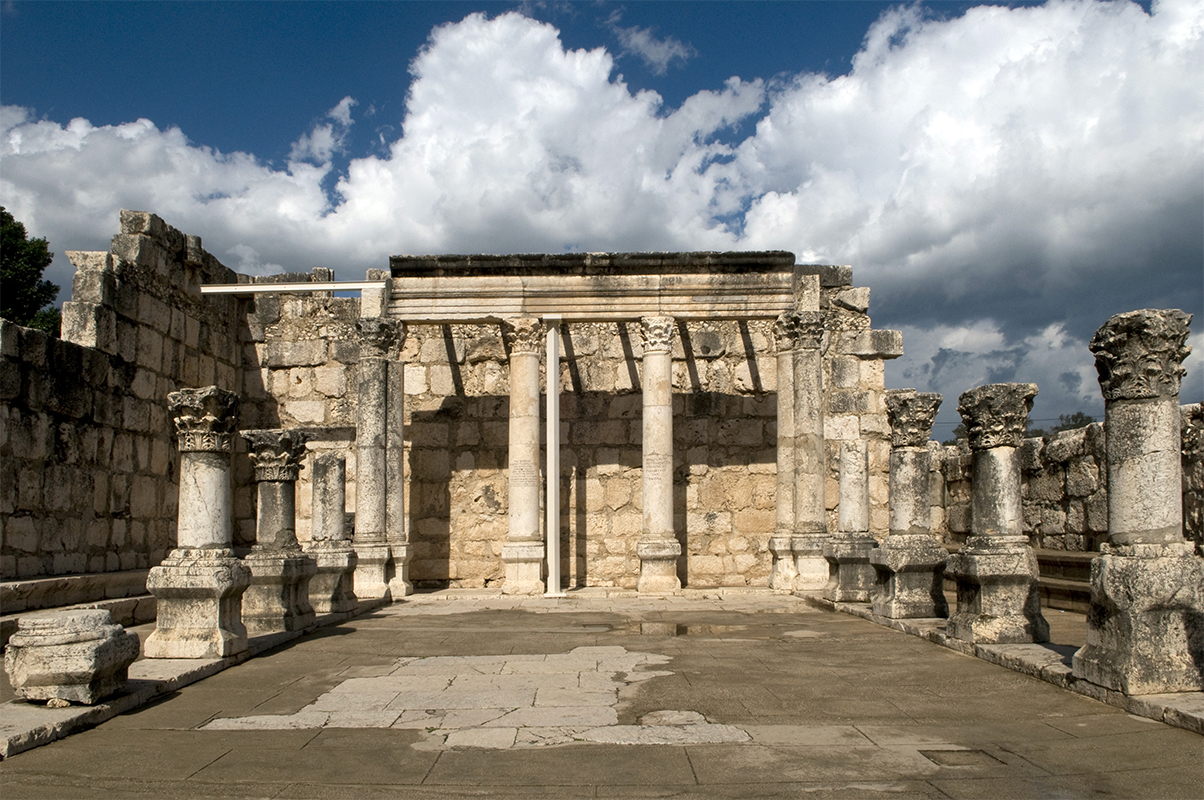
When following the apostle Paul in the book of Acts during his journeys to Asia Minor, it became apparent there were numerous synagogues he visited. Well before that, extending back into the intertestamental period and through the life of Christ, the synagogues of second-temple Israel were among Jewish populations throughout Mediterranean territories. They were gathering locations formed to provide various functions in the delivery of community services rooted in Judaism. The structure and organization of the synagogue were roughly common regardless of its geographical position as its purpose and similarities were centered on relationships among Jewish and God-fearing people. Moreover, the relationship of the Jewish members of a local synagogue appears to be deeply grounded in devotion to Yahweh according to tradition and covenant responsibilities as given by the Torah, the prophets, the writings, wisdom literature, and historical predecessors of influence within Judaism.
Functions
Activities surrounding the functional purpose of a synagogue were numerous. A synagogue operates as a Judaic community center that provides religious instruction with two areas of primary activity. Scripture reading and prayer together constituted the communicative activity between Yahweh and His people. Whether through Scripture by scrolls kept at a synagogue or from prayers, benedictions, and maledictions that were offered together before Yahweh, the Jewish people were socially together in congregations of fellowship and common belief.
Depending upon respective areas of concentration, a synagogue served as a site that operated as a Judaic community center. From the intertestamental period to first-century Judea and beyond, it was of significant influence as it continued to operate in service of Jewish communities. It served as an institution for religious instruction, it operated as a facility for meetings, and it functioned as a court for judgment and discipline. The local synagogue hosted students for academic work and school life.
Synagogue Recitals of Blessings & Woe
The Eighteen Tefillah of Shemoneh Esre (Amidah)
Blessed art Thou, O Lord, Our God and God of our fathers, God of Abraham, God of Isaac, and God of Jacob, the great, mighty, and revered God, God Most High, who art the Creator of heaven and earth, our Shield and the Shield of our fathers, our confidence from generation to generation. Blessed art Thou, O Lord, the Shield of Abraham!
Thou art mighty, who bringest low the proud, strong, and He that judgeth the ruthless, that liveth forever, that raiseth the dead, that maketh the wind to blow, that sendeth down the dew; that sustaineth the living, that quickeneth the dead; in the twinkling of an eye Thou makest salvation to spring forth for us. Blessed art Thou, O Lord, who quickenest the dead!
Holy art Thou and Thy Name is to be feared, and there is no God beside Thee. Blessed art Thou, O Lord, the holy God!
O favor us, our Father, with knowledge from Thyself and understanding and discernment from Thy Torah. Blessed art Thou, O Lord, who vouchsafest knowledge!
Cause us to return, O Lord, unto Thee, and let us return anew [in repentance] in our days as in the former time. Blessed art Thou, O Lord, who delightest in repentance.
Forgive us, our Father, for we have sinned against Thee; blot out and cause our transgressions to pass from before Thine eyes, for great is Thy mercy. Blessed art Thou, O Lord, who dost abundantly forgive!
Look upon our affliction and plead our cause, and redeem us for the sake of Thy Name. Blessed art Thou, O Lord, the Redeemer of Israel!
Heal us, O Lord our God, from the pain of our heart; and weariness and sighing do Thou cause to pass away from us; and cause Thou to rise up healing for our wounds. Blessed art Thou, O Lord, who healest the sick of Thy people Israel!
Bless for us, O Lord our God, this year for our welfare, with every kind of the produce thereof, and bring near speedily the year of the end of our redemption; and give dew and rain upon the face of the earth and satisfy the world from the treasuries of Thy goodness, and do Thou give a blessing upon the work of our hands. Blessed art Thou, O Lord, who blessest the years!
Blow the great horn for our liberation, and lift a banner to gather our exiles. Blessed art Thou, O Lord, who gatherest the dispersed of Thy people Israel!
Restore our judges as at the first, and our counselors as at the beginning; and reign Thou over us, Thou alone. Blessed art Thou, O Lord, who lovest judgment!
For apostates let there be no hope, and the dominion of arrogance [Rome] do Thou speedily root out in our days; and let the Nazarenes [Christians] and the heretics perish as in a moment, let them be blotted out of the book of the living and let them not be written with the righteous. Blessed art Thou, O Lord, who humblest the arrogant!
Towards the righteous proselytes may Thy tender mercies be stirred; and bestow a good reward upon us together with those that do Thy will. Blessed art Thou, O Lord, the trust of the righteous!
Be merciful, O Lord our God, in Thy great mercy towards Israel Thy people, and towards Jerusalem Thy City, and towards Zion the abiding place of Thy glory, and towards Thy glory, and towards Thy temple and Thy habitation, and towards the kingdom of the house of David, Thy righteous anointed one. Blessed art Thou, O God, God of David, the Builder of Jerusalem!
Hear, O Lord our God, the sound of our prayer and have mercy upon us, for a God gracious and merciful art Thou. Blessed art Thou, O Lord, who hearest prayer!
Accept us, O Lord our God, and dwell in Zion; and may Thy servants serve Thee in Jerusalem. Blessed art Thou, O Lord, whom in reverent fear we serve!
We give thanks to Thee, who art the Lord our God and the God of our fathers, for all the good things, the lovingkindness, and the mercy which Thou hast wrought and done with us and with our fathers before us: and if we said, Our feet slip, Thy lovingkindness, O Lord, upheld us. Blessed art Thou, O Lord, unto whom it is good to give thanks!
Bestow Thy peace upon Israel Thy people and upon Thy city and upon Thine inheritance and bless us, all of us together. Blessed art Thou, O Lord, who makest peace!
Services
The influence a local synagogue had on Jewish life was most pronounced through its formation, activity, and how it was organized. Members of the synagogue were members of the community who also had social and market influence. Their attendance and participation had a bearing on trade, work, and daily life within the community. Their interpersonal and social obligations originated from principles taught and heard through the reading of Scripture within the local synagogue, and certainly more contemporary at the time through instruction whether oral or written. The study of Scripture and its audible intake made a lasting impression to inform beliefs and daily conduct. The absorption of God’s instructions through the Torah and other books of the Old Testament also shaped member’s views, adorations, and petitions as uttered by their prayers to Yahweh.
____________
Everett Ferguson, Backgrounds of Early Christianity, Third Edition. (Grand Rapids, MI; Cambridge, U.K.: William B. Eerdmans Publishing Company, 2003), 578–579.
While doing the research to understand the differences between the Jewish beliefs and practices of the Old Testament and those of the second temple period, I arrived at an area of interest that bears further exploration. As a matter of comparison between old and new covenant interpretation of Scripture, this is a useful reference between Judaism and Christianity. It so happens that from an earlier post, I also posted about the methods of interpretation from within the NT.
The Middot of Hillel
Middot in Hebrew means “measure” or “norms.” These are the seven principles, or methods used to interpret biblical meaning (OT) from Rabbi Hillel in the 1st century BC. An early form of Jewish hermeneutics around the study of Judaism that grew in number to 13 under Rabbi Ismael ben Elisha (100 A.D.) then to the 32 from Galilean Rabbi Eliezer ben Yose (150 A.D.). Beginning from the Greek influence of Hellenism upon Judaic thought, these principles remain in place for many centuries.1
The beginning seven principles by name were as follows to have a bearing upon second temple Judaism.2
Qal wahomer Inference from the less important to a more important case (lit., light to heavy), and vice versa.
Gezerah shawah Inference by verbal analogy from one verse to another; where the same words are applied to two separate laws it follows that the same regulations and applications pertain to both.
Binyan ’ab mikathub ’ehad Building up a family from a single text; when the same phrase is found in a number of passages, then a regulation found in one of them applies to all of them.
Binyan ’ab mikathub ’ehad Building up a family from two texts; a principle is deduced by relating two texts together, and the principle can then be applied to other passages.
Kelal upherat The general and the particular; a general principle may be restricted by a particularization of it in another verse, or conversely, a particular rule may be extended into a general principle.
Kayoze bo bemaqom ʾaher Something similar in another passage; a difficulty in one text may be solved by comparing it with another that has points of general (though not necessarily verbal) similarity.
Dabar halamed meʾinyano A meaning established by its context.
Mitigating Jewish Beliefs & Practices
Old Testament to second temple Judaism differences and conditions at the time of Christ. Several factors had a bearing on how OT biblical interpretation and NT authorship originated.
There was a greater adherence and devotion to the law during the second temple period as compared to the prior Old Testament era.3
During the Old Testament, and second temple periods, Jews of Judaism placed primacy of scripture upon the Torah. Jews of Christianity, during the second temple period, placed an emphasis on the Nevi’im and Ketuvim.4
From the second temple period, there was significant weight placed upon the oral law to accompany the written law as a way to govern everyday Jewish life.5 Whether for ceremonial, traditional, or “fencing” purposes, the oral law set up a type of Judaism that extended well beyond covenant intent.
During the apostolic period, there were various sects that had a bearing on the Jewish way of life and beliefs. The Essenes of Qumran, the Sadducees who controlled the Jerusalem Temple, the Pharisees with their Hasidim background, and additional sects were new or distinct in Judaism as compared to the earlier figures and groups in the Old Testament.
Since the prophets fell silent during the intertestamental period, they were replaced by the Scribes of the second temple period concerning matters of authority around the scriptures.6 Torah observance was of prominent interest to the Jews of Judaism during the second temple period which gave rise to the class of “professional scribes”. 7
_________________________
1 Everett Ferguson, Backgrounds of Early Christianity, Third Edition. (Grand Rapids, MI; Cambridge, U.K.: William B. Eerdmans Publishing Company, 2003), 545. 2 Tosefta. Sanhedrin 7.11; Aboth de R. Nathan 37; Sifra 3a 3 Ferguson, Backgrounds of Early Christianity, 3rdEdition. (Grand Rapids, MI; Cambridge, U.K.: William B. Eerdmans Publishing, 2003), 539. 4 Ibid., 543. 5 Ibid., 542. 6 Valdizan, “Historical Background of the New Testament Course Notes,” Unpublished course notes, 2018, 133. 7 Valdizan, “Historical Background of the New Testament Module 6 Lectures,” Jewish Beliefs and Practices, Part 1.
Thesis: The OT in the book of Revelation and John’s use of corresponding apocalyptic work in the book of Revelation. The following are presentation notes concerning the literary nature of the book of Revelation, not its eschatological intent.
The Old Testament in the Book of Revelation
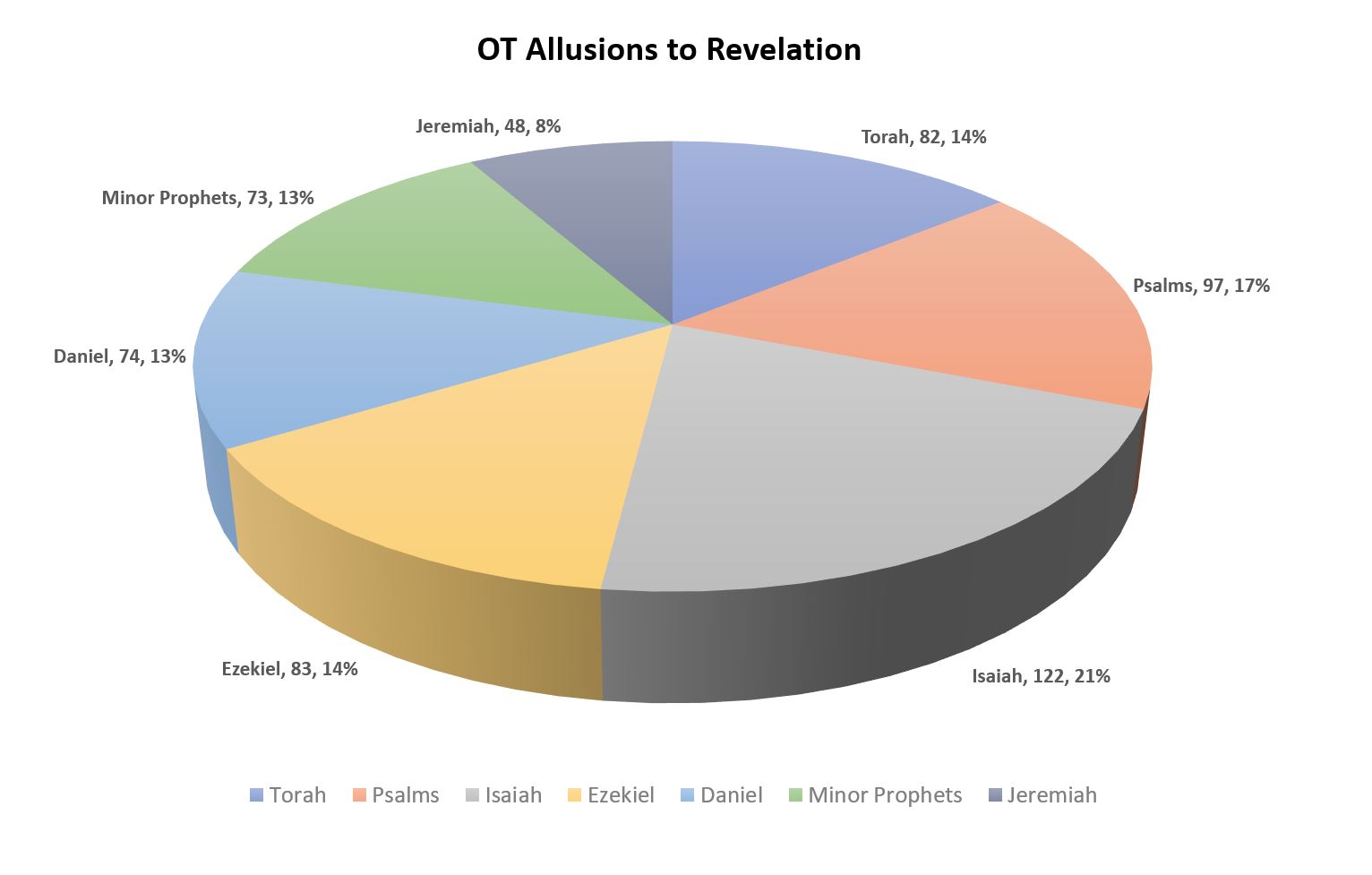
The following is a look at second temple Jewish literature and OT material from the intertestamental period. The source material is the Hebrew Bible (the OT), Jews studying the OT of the same period, world, and cultural setting all current with John of Revelation. The Book of Revelation never uses an introductory formula to introduce OT references. John uses words and phrases from the OT into Revelation’s composition. John draws upon these words and phrases, not as quotes but as material to produce his content. The index of allusions and quotations in the Greek NT reveals that the book of Revelation contains more OT allusions than any other NT book. Yet, there is not a single quotation in the NT that references back to the OT.
John used bits and pieces to create his composition. His voice plus the phrases of meaning from the OT. It is, therefore, useful to understand what sources and OT passages that John was using. Was John using the MT or the LXX? Or both? What was the source text he used? Can the MT or LXX support or sustain what the author concludes? Was the author faithful to what the MT or the LXX says?
In the hindsight of Revelation, does John’s use of the OT articulate Jesus-influenced theology messianic interpretation that could have been obtained by using the MT or LXX prior to the first advent of Christ? Can John (or the reader of Revelation) still discern possible messianic interpretations obtained from the OT even before the Messiah arrived? If he can, then his use of the OT to produce the content of his apocalyptic work is legitimate.
John interprets the Old Testament in light of his experience with Jesus.
Ancient first-century approaches to the Bible should be included in hermeneutical methodologies. Old Testament content is repurposed and is legitimate.
John’s preference for literature was the prophets and poetic works (worship literature).
The Use of Daniel in Jewish Apocalyptic Literature and the Revelation of St. John
Three decades after DSS discoveries. Beale writes of John’s use of the Old Testament by categorizing his use of ancient scripture.
Categories & Methods of Interpretation
Segmentation: Segments of the OT are used as literary prototypes. John models his material after patterns he sees in the OT. He follows sequence or structure to build his content. Or “clusters” of allusions in the OT to use them in sections of Revelation. Reference Daniel 2 and 7 as examples from Revelation 13 and 17.
Thematic: The thematic use of the OT. The divine warrior, earthly cataclysm, eclipses, etc., are directed to apocalyptic messaging in the Revelation to produce content.
Analogical: The analogical use of the OT is used to repurpose well-known persons, places, and events to produce or illustrate imagery by analogy. Such as the Exodus plagues (Rev 8:6-12; the seven trumpets, Rev 16:2-13; the seven bowls) to illustrate the analogical use of the OT.
Universal: The universalization of OT application of what occurred to Israel to the rest of the world. The “Kingdom of Priests” principle concerning the Hebrews became applied to the Church (e.g., Rev 5:9-10). Material meant for Israel becomes universally applied to the Gentiles.
Informality: Informal direct prophetic fulfillment where John, the author of Revelation, sees the fulfillment of OT passages in Jesus or His return by implication and inference. For example, the allusion of Zechariah 12:10 concerns Rev 1:7, where “those whom they have pierced” is not a word-for-word reference but by palpable and undeniable inference around messianic fulfillment.
Typological: A non-verbal prophecy or foreshadowing of something to come. Present within the literature are synonyms that bear the concept of resemblance and similarity. A general definition identifies a biblical event, person, or institution that serves as an example or pattern for other events, persons, or institutions (Baker). Typological relationships exist between events, persons, or institutions that, through divine inspiration, foreshadow later patterns or specific events and conditions that happen later within salvation history. New Testament writers use typologies. —Compare Isaiah 22:22 with Rev 3:7b concerning the key of David as a foreshadow to the keys of Death and Hades (Rev 1:18). These two are linked together; the inference is that Jesus holds power over salvation and judgment since it comes through the line of David. David foreshadowed another king to come: Jesus. As a typology, John uses David as a foreshadow of Jesus in his messianic kingship, who has control over a kingdom.
Inversion: Some allusions are contradictory to the OT contextual meaning, but it’s a surface observation. Upon closer inspection, this category does not work. To see John is doing something subtle and unique. For example, some passages in Isaiah show Gentiles bowing down before Israel to recognize their elect status before YHWH (Isaiah 45:14, Isaiah 49:23, compared to Revelation 3:9). Revelation 3:9 inverts the imagery to concern the Church as to the Jews of Israel.
Style: The perceived imprecise use of the Greek language involved solecisms (grammatical mistakes) throughout the Revelation. John intentionally used Greek “errors” in the language to express his Semitic mind more precisely. They were deliberate efforts to intentionally say something specific in the way it is expressed in Hebrew. Solecisms are littered throughout the Revelation to make the reader look and understand what is occurring from the OT.
______________________
Michael Heiser, “Introducing The Old Testament in the Book of Revelation” (podcast), December 1st, 2020, accessed April 23rd, 2021, https://nakedbiblepodcast.com/podcast/naked-bible-352-introducing-the-old-testament-in-the-book-of-revelation/
G.K. Beale, “The Use of Daniel in Jewish Apocalyptic Literature and in the Revelation of St. John” (Eugene, OR: Wipf and Stock Publishers, 2010)
Steve Moyise, “The Old Testament in the Book of Revelation”, The Library of New Testament Studies, (London, UK: T&T Clark Publishing, 2014)
In an effort to trace the history of animosity between the Jews and Samaritans, I acknowledge the various alternatives that exist throughout primary and secondary sources. The Jews of ancient Israel did not view the Samaritans as Jewish. Due to their historical lineage and origination from Assyria during and after Israel’s captivity from 722BC and thereafter, Assyrian males intermarried with Jewish women to produce half-gentile and half-jew people. The seed and offspring of the Samaritan people became inhabitants of the Northern region of Israel known as Samaria. They became occupants of the area known by the people of Judea as the Samaritans.
Intuitively, because of genealogical baggage, it appears to me that there was never a complete unity between the people of Judea and Samaria (i.e., the Samaritans) to begin a split. They were distinct people by both bloodline and heritage separate through Old Testament and New Testament history. In addition to a commonly inherited yet partial set of tribal genetics, there were shared histories about the identity of God, the patriarchs, and various other beliefs. While there were numerous distinctions about Samaritan ideas and beliefs, they all contributed to their state of separation from the Jewish people of Judea.
The views of the Samaritans about scripture, the prophets, worship, geographical inheritance, the temple, sacrifices to God, the priesthood, and others all contributed to their separation from the Jewish people. Regional conflicts that occurred between the Seleucids and the Ptolemy dynasties of Egypt also set the conditions by which their chosen alliances came into opposition or contradiction to the interests of Judea. There weren’t just growing differences in opinion about the facts and nature of God’s relationship with His people. The was growing isolation between Judea and Samaria that formed into animosity during the New Testament period.
It appears that the Samaritans took up residence in the land of Canaan after the exile and became more than ethnic rivals. They brought with them from the North an ideology that accompanied their covenant convictions. It would appear that the separation of thought from Scripture begins at the time of Jacob and extends through David, the prophets, and so forth. I suspect their objections somewhat correlate to the claims between Esau and Jacob since they only recognize or accept the Pentateuch from their Abrahamic ancestry.
Notice also that Jesus used the phrase “a certain Samaritan” in His parable of the Good Samaritan. The “certain” is an indefinite pronoun that could also mean “just any Samaritan who was someone.” This term appears within the root Masoretic text and gets translated to KJV and NKJV, but not NASB or ESV. NLT renders “despised” Samaritan, which is nowhere from the root manuscript. My point is that Jesus spoke His parable to illustrate the necessary love of this Samaritan, who was the neighbor of the Scribe of the law who asked, “who is my neighbor?” The inference was, between Jew and Samaritan, to do likewise and that it was commanded in the law to love YHWH as the Shema proclaims. Yet also of neighbors between the North and South whether nearby, remote, or distant.
I also think it was entirely significant that Jesus revealed that He is the Messiah through a Samaritan woman. This one is probably among my favorite encounters with Jesus. He made known to the public that He is the Messiah, our Christ, through a Samaritan woman. And that is such a beautiful and telling perspective. At least in terms of why He made that choice and what it meant concerning His intentions.
“For I am not ashamed of the gospel, for it is the power of God for salvation to everyone who believes, to the Jew first and also to the Greek” / Hellenic (Rom 1:16). The sequence of Jesus’s instructions was also significant in spreading the gospel to the Gentile world in stages. The region of Samaria and its occupants was a bridge between the Jewish and Gentile worlds where the new covenant would become known, accepted, and loved.
If one were to zero in on what the Samaritans objected to, there’s a period entitled, “The Era of Disfavor.” Where they claim the beginning of animosity was from the transfer of worship from Shechem to Shiloh. The dispute began from that point, in their view, which gave rise to growing division and opposition. The fact they believed Yahweh should be worshiped in Shechem and not Jerusalem comports with their view about the legitimacy of David and the whole narrative about the selection of the ancient city of Jebus to include the place and purpose of Mt Zion. The theology of the Samaritans to include the Memar Marqah and others, I would imagine originates from tradition prior to the 4th century. It significantly diverges from the course of Hebrew history, theology, and canon.
It intuitively seems that the Samaritans were a people of opposition while the Sadducees were themselves alienated from the common people of Judea also. Not out of resentment for wrong choices, but simply by a difference of conviction about who they were as people before Yahweh. From that flowed their perspectives about heritage, geography, the temple, and worship that inevitably and often fell into contradiction without long-lasting or meaningful reconciliation until many converted through the gospel. Numerous others migrated to Islam in the middle ages.
This week’s reading through 1st and 2nd Maccabees often had me step back to think about what I just read. Throughout the week, I shared some of the details about events that transpired in both books. The overall pattern of conflict resolution and individual behavior among leadership figures was especially repugnant compared to Western society today. Governments, political strife, and military encounters were historically and utterly corrupt and profane in the worst sense of meaning or semantic range. The fullest reach of depravity in a very short concentration of time leaves the reader to ask how conditions and the extent of evil could have been any worse so far distant from the comparative events of Genesis six.
As compared to the Old Testament and New Testament, the density of cross-national slaughter appears hyper-elevated around the events within this time recounted in the Apocrypha. The constant and at times accelerated rate of destruction and death leaves one to wonder how various regions’ birth rates could keep up. Especially at the rate by which soldiers and mercenaries were subdued in conflict after conflict. Both in Josephus and Maccabees’ written accounts of killed were ten thousand here, then 60,000 there, again and again, 20,000, 80,000, 120,000, and lather, rinse, repeat on a cycle. On and on and on, the regions were at war against each other and the people of YHWH.
These were not just stories we read. These were stories about real people who lived daily lives between the Old and New Testaments. At a time when the prophets fell silent, there was no prophetic voice other than Scripture and the arrival of Christ as prophesied in Old Testament literary work. Each culture and society under trauma by siege, physical and spiritual oppression, persistent violence, starvation, enslavement, torture, and perpetual subjugation.
While the books of 1st and 2nd Maccabees together provide historical details about events during the intertestamental period, there are a number of similar motifs, terms, and conditions that appear in the writings at that time. Common OT and NT use of terms such as “Covenant,” “Sackcloth,” “Sinner,” “Sacrifice,” “Offering,” and “Plunder,” appears both across both covenants and each one is unique to each side of the intertestamental period. Israel and Jerusalem were ever surrounded by hostile nations or temporary allies that really never experienced an extended period of stability. Whether from the Assyrians to the North, Egyptians to the South, Rome, Greece, Sparta, Idumea, Persia, and other surrounding adversaries, the underlying strain of hostilities stemmed from the four generals who spawned after the death of Alexander the Great during his campaign of imperial endeavor.
The prophecies of Daniel have an explanatory power to fully grasp what was to occur in the distant future during the time of the Maccabees. Specifically, the depth and range of havoc and devastation the Ptolemy and Seleucid dynasties placed upon the intertestamental world. Right before the birth of Christ, these events and conditions characterized by the presence of priests, kings, traditions, paganism, religious observances, festivals, betrayal, treaties, and so much strife were to inevitably converge to a time unlike any before it.
As a sort of anchor, it seemed necessary for me to think back about what had occurred to the table of nations from Genesis 10 all the way to the arrival of the Kingdom of God through Christ’s crowning achievement at the cross. I had to revert to my overall biblical worldview.
Another example was back during the Canaan conquest, as Moses and Joshua’s people were led to their appointed land. The loss of life as a percentage (though necessary) was enormous. The later ongoing enmity between ancient surrounding nations, such as Edom, Moab, Egypt, Assyria, and Persia, was self-inherent while an evil spiritual bearing was present and in full force. Remember in Daniel when the archangel Michael was in conflict with the princes of Persia and Greece? The message correlated to this prophesied time recounted 2 Maccabees.
“Then he said, “Do you know why I have come to you? Now I must return to fight against the prince of Persia, and when I am through with him, the prince of Greece will come. 21 But I am to tell you what is inscribed in the book of truth. There is no one with me who contends against these princes except Michael, your prince (Dan 10:20-21).The prince, in this sense, from the root text, references a supernatural being. And I strongly suspect applies to other nations, too.
Who was Michael, the archangel? Who were the “princes” he fought? What were they doing and why? Why was Michael the prince of Israel to defend them? It without question appears to me that the underlying causality was of darkness upon humanity. With humanity’s participation, the evil governance and presence of the fallen angels were given to the disinherited nations scattered in Genesis 11. To me, it is a plausible theological explanation of why and how so much evil and destruction permeated the region across generations BECAUSE THEY WERE AND ARE STILL ACTIVE. More specifically, either by direct or indirect judgment as prophesied by Daniel or through their presence and struggle for control and power to serve their interests in opposition to the “Kingdom of Priests” then and the Kingdom of God now.
Recall in 2 Maccabees the presence of angelic figures that fought for the people of YHWH? It’s the same principle, where the adversaries were not just opposing human forces, but what was behind them. Through them, among them, and upon them to perpetuate the sovereign will of the Most-High.
There were numerous outcomes to the transition from the Old Covenant to the New Covenant. All largely magnified during the intertestamental period. A series of overlapping and concurrent losses represented both pronounced and fundamental changes in the relationship between God and His chosen people.
Five Major Losses of the Jews after the fall of Jerusalem
1.) Loss of Land 2.) Loss of the Monarchy 3.) Loss of the Temple and God’s Presence 4.) Loss of the Mother Tongue 5.) Loss of Prophetic Revelation
Political, Social, and Geographic
The Jews’ loss of their treasured land of possession to the Hellenists, Romans, Syrians, and Egyptians over their struggles to maintain religious autonomy and regain national sovereignty came with significant and long-term turmoil. With the ongoing occupation and hostilities from foreign nations, there was internal strife between the ruling classes of ancient Israel. The animosity between Aristobulus and Hyrcanus to attain a lasting monarchy translated to alliances among the Pharisees and Sadducees with the backing of social classes. Pharisees were of authority among the common people, whereas Sadducees were upper the aristocratic and priestly class. The struggle between the Hasmonean and the Sadducean parties led to the formation of relationships with foreign nations and leaders to advance internal political causes to obtain power and government control over the priesthood, the land, and religious interests of the Jewish people.
The presence of God never really returned after Solomon’s temple, as made evident by the vision of Ezekiel on the bank of the Chebar River. While the prophet witnessed the spiritual departure of God’s glory from the first temple, he was in captivity in Babylon. Not only were the people of Judah placed into exile, but YHWH had left the temple without any hope of a return to the way things were within the old covenant. Both prophets Jeremiah and Ezekiel recorded YHWH’s intent to bring a new covenant (Ezek 11:19, Ezek 36:26, Jer 31:33, Heb 8:10). Until then, the people of Israel were to settle in Babylon for 70 years until their release to Jerusalem and beyond numerous Mediterranean territories. The building of the second temple restored a central location of worship and service, while synagogues served the need of Jewish peoples scattered abroad.
The Jewish solution to all of the strife, oppression, and hardship was a foretold Messiah who would deliver the people to a kind of freedom and prosperity assumed from Scripture. During their time of difficulty, there was an expectation of politically and socially restorative action where the Messiah would be their King and Prophet to bring them to a kingdom of Israel that served their interests.
Religious, Literary, and Cultural
The changes imposed upon the intertestamental Jewish people were comprehensive. The momentum of changes began earlier in Israel’s history around its succession of corrupt kings and its captivity to Assyria and Babylonia centuries before the second temple period. The scattering of the Jewish peoples brought further hardships upon religious and cultural practices that negatively impacted its language, lifestyle, and worship. Whether by security reasons, economic necessity, or enslavement, Jews settled across Mediterranean coastal territories such as Asia Minor, Antioch, Alexandria, Carthage, Cypress, and Rome. They dispersed West to form communities to keep hold of their homogenous identity. Outside Israel and Jerusalem, leadership centered around local synagogues and oral traditions complimentary to the writings of the law and the prophets.
By occupying foreign territories, intertestamental Jews faced significant changes around their indigent verbal and written language. As the people of Israel returned from Babylon, they essentially adopted the Aramaic language. Only to be faced with the dominant Greek language of imperial Greek Hellenization, Israel faced further dilution of social use of their language. Greek, Latin, Aramaic, and Hebrew were disparately in use among the various pagan territories, so preserving the Hebrew language was often a product of religious and elementary education within the home.1 Further loss of Jewish interest around literary work was mitigated by translation efforts, such as the Old Testament into Greek, by the 70 (LXX) commission of Ptolemy. Along with the absence of prophetic guidance during the intertestamental period, apocalyptic or apocryphal writings were produced for historical and religious value.
Scribes and priests were the wise men who came to replace the prophets. Scholars in the sacred writings were considered among the scribes who carried authority and interpretive weight.2 Oral law and the apocalyptic literature provided divine guidance and interpretation of Scripture during the time of prophetic silence.3
____________________________
1. Everett Ferguson, Backgrounds of Early Christianity, Third Edition. (Grand Rapids, MI; Cambridge, U.K.: William B. Eerdmans Publishing Company, 2003), 112. 2. Ibid, 401. 3. J. Julius Scott Jr., Jewish Backgrounds of the New Testament (Grand Rapids, MI: Baker Academic, 2000), 112.
With the Hellenization of numerous territories throughout the Mediterranean world, ancient Judea, Samaria, Galilee, and Northern Regions of Israel were immersed in Greek culture and philosophical thought. Widespread was Greek philosophy’s influence in places such as Decapolis, Antioch, and beyond Asia Minor. Even to the extent of Alexandria, Egypt, where Judeaus Philo originated, one could say that what Hellenization was to Judaism is what Gnosticism became to Christianity.1 The influence of Greek philosophical thought upon Judaism was largely speculative, and it touched on every area of Jewish life. More specifically, lifestyle, worldview, religion, ethics, social and interpersonal settings, a focus on individualism became a way to “help” humanity2 from a humanistic standpoint.
Introduction
An overall comparison to the revealed truth of Scripture suggests opposing intentionality. The sharp contrast between Hellenistic philosophical schools and centuries of covenantal life among Jews introduced harmful speculations (2 Tim 2:23). Naturalistic observations and presuppositions brought about “reasoned” conclusions, which also guided conduct, thought, and communication. Philo himself formed an allegorical and symbolic hermeneutic to selectively harmonize the Mosaic covenant with Greek philosophy.
As Philo was a Hellenized Jew, he embraced some facets of Greek culture and its worldview that sought to “teach people how to live.” 2 From foundations of lifestyle to soul-care, Greek philosophy emerged as a religion that produced beliefs and practices as a hollow counterfeit to what Yahweh instructed of the Jews. Caesar Augustus intended to bring Greek philosophy and culture to the “barbarian people” of Israel.3 An early form of imperialism was a leavening of religious and social life within Jewish society.
With Greek philosophy and culture exported to Eastern Mediterranean areas, new and different ideas were lived out and advocated by individuals and communities to affect religious, political, social, and civic life. Together they were a portable method of exported assimilation. It was a self-contradictory people-centered way of reason about the nature of existence, creation, and humanity’s purpose. Hellenization and Greek philosophy had a corrosive and corruptive influence on the Judaic way of life. It held itself out as a symbiosis, yet it was a dilution against Jewish covenantal obligations.
The further in time one goes in the examination of surrounding Hellenization and Greek culture, the emergence of Gnosticism first appear among Christian and Jewish sects. As a form of heretical influence upon the Church and early believers in Christ, it has its roots from within Greek philosophy and religion.
The Nag Hammadi Library
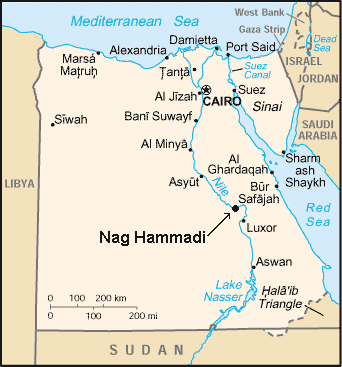
According to Wikipedia, Nag Hammadi (/ˌnɑːɡ həˈmɑːdi/ NAHG hə-MAH-dee; Arabic: نجع حمادى Najʿ Ḥammādī) is a city in Egypt. It is located on the west bank of the Nile river in the Qena Governorate, about 50 miles north-west of Luxor. It had a population of close to 43,000 as of 2007. The Nag Hammadi Library is a collection of writings that were discovered and gave further insights into early Christianity and Gnosticism.
Valentinian Exposition (including On Anointing, On Baptism, and On the Eucharist)
Catechism?
Valentinian
XI,3 45,1–69,20
Allogenes
Apocalypse
Sethian—Non-Christian
XI,4 69,21–72,33
Hypsiphrone
Apocalypse?
XII,1 15,1–34,28
Sentences of Sextus
Wisdom Sayings
Non-Gnostic
XII,2 53,19–60,30
Gospel of Truth
(See I,3)
XIII,3
Fragments
XIII,1 35,1–50,24
Trimorphic Protennoia
Revelation Discourse
Sethian
XIII,2 50,25–34
On the Origin of the World
(See II,5)
NAG HAMMADI LIBRARY
The Berlin Gnostic Codex is closely related and contains the following:
Number of Codex, Tractate, Page, and Lines
Name of Tractate
Literary Form
Affiliations
BG 8502,1 7,1–19,5
Gospel of Mary
Resurrection Gospel/Dialogue and Revelation Discourse
BG 8502,2 19,6–77,7
Apocryphon of John
(See II,1)
BG 8502,3 77,8–127,12
Sophia of Jesus Christ
(See III,4)
BG 8502,4 128,1–141,7
Acts of Peter
Acts
NAG HAMMADI LIBRARY
“The charts above list all of the tractates in the Nag Hammadi Library, with some indication of literary and doctrinal affinities. The Nag Hammadi documents are cited by codex number (in Roman numeral), tractate number in the codex (Arabic numeral), page, and line numbers of the manuscript.
The Gospel of Thomas is a collection of 112 to 118 (according to different editions) sayings attributed to Jesus, some of which were already known in Greek from a collection in the Oxyrhynchus Papyri. The Gospel of Thomas is perhaps the earliest of the new texts in the collection and demonstrates the existence of collections of sayings of Jesus (a sayings gospel) in the early church. It has a strong encratite or ascetic tone but otherwise is not so pronouncedly Gnostic, although clearly consistent with Gnostic understandings. Although scholarly opinion seems to incline toward emphasizing the extent of the independence of the Gospel of Thomas from the Synoptic Gospels, the age and originality of its individual sayings in relation to the canonical Gospels are much debated.
The Gospel of Truth may be identified with a work of that name that Irenaeus attributes to the followers of Valentinus (Against Heresies 3.11.9). It is not properly a “Gospel,” but a meditation on the truth of redemption. Its theme is that the human state is ignorance, and salvation is by the knowledge imparted by Jesus.
The Gospel of Philip is another sayings or discourse gospel, also from Valentinian circles. It offers information on liturgical practices.
The Apocryphon of John appears to have been one of the most popular of the Gnostic works, for three copies of it were found at Nag Hammadi and one other was previously known. It provides a close parallel to the Gnostic system described in Irenaeus, Against Heresies 1.29.
The Epistle to Rheginus, On the Resurrection, sets forth a position close to that of the orthodox in terminology but emphasizes a resurrection of the soul.
The Apocryphon of James, like many documents in the collection, is a post-resurrection revelation of Jesus. He gives blessings and woes through Peter and James. It is argued that the work derives from a sayings collection independent of the New Testament.
The Hypostasis of the Archons describes the efforts of the world rulers to deceive humankind in Genesis 1–6. The myth is close to that of the Ophites or Sethians in Irenaeus, Against Heresies 1.30.
The Tripartite Tractate is the most ambitious and comprehensive theological undertaking in the Nag Hammadi corpus. It has points of contact with the Valentinian teacher Heracleon and attempts to present Gnostic teaching, in response to orthodox criticism, in a way more acceptable to the great church.
Eugnostos the Blessed and The Sophia of Jesus Christ are two versions of the same document, the former a letter by a teacher to his disciples and the latter a revelation discourse of Jesus to his followers. The former is important as a non-Christian form of Gnosticism whereas the latter is a Christianized version of the same.
These writings give us more of the inner religious spirit of Gnosticism, whereas the heresiologists concentrated on the bizarre and on the outer structure of the Gnostic systems. Otherwise, the new finds correspond to the picture given by the Christian authors in its main outlines. The non-Christian nature of many tenets of Gnosticism is evident, although it attached itself to the Christian revelation. The concern with the Old Testament points to an area of proximity to Judaism if not to a specifically Jewish origin.” 4
Citations
1 Everett Ferguson, Backgrounds of Early Christianity, Third Edition. (Grand Rapids, MI; Cambridge, U.K.: William B. Eerdmans Publishing Company, 2003), 308. 2 Ibid, 323. 3 Aaron Valdizan, Historical Background of the New Testament Course Notes, (Unpublished Course Notes, The Master’s University, 2018), 69 4 Everett Ferguson, Backgrounds of Early Christianity, Third Edition. (Grand Rapids, MI; Cambridge, U.K.: William B. Eerdmans Publishing Company, 2003), 305–306.
The Old Testament informs us about how events unfold by what occurs in the New Testament. More specifically, around the canonical gospels, we see echoes of Jewish life and religious tradition that reach back to ancient norms, customs, mannerisms, practices, and developments. Within this research project, the field of view narrows to how Jewish royal accession serves as a backdrop to the legitimacy of Christ’s kingship. With specific examples, we will walk through what occurred along the timeline of monarchies to validate rulership and governance. Each King’s encounters to station them on their respective thrones were unique yet as part of a consistent pattern that developed an expectation for following kings. More relevantly, concerning Christ as the King of the Jews and ultimately as Christ the King of the Kingdom of God.
Introduction
With scriptural support, the astute bible student can detect overlapping conditions by which the Kings of ancient Israel attained their status through lineage, achievement, and appointment. To perform functions as king to which the ancient nation of Israel navigated through conflict is of paramount interest as it concerns the messianic prophecies and covenant promises that were made by YHWH to a people, unlike any other nation. Down through the centuries to the time of Jesus as the Messiah, we see fulfilled expectations in His intentional activity to demonstrate who He is while supported by a genealogical reality that attests to His legitimacy.
The organization of this paper is segmented into several sections that together demonstrate who Jesus was by what He did and by what occurred in His life. The significance of Jesus’ life as ascendant human divinity who, in His humanity, attains elevated stature is by necessity a required outcome as prescribed throughout Old Testament prophecy. The interrelated functions of kingship and messiah operate together. In one sense, for purposes of rule and administration of justice, while on the other for compassion, deliverance, and mercy as the “Mashiach,” or the anointed one.1
The three-part requirement of the kingship of Christ involved stages of accession that were both spiritual and physical realities. With Old Testament examples of these stages, expectations formed over time across kings that ascended to the thrones of Israel. However, the kings of the Old Testament were not messianic in nature as they were of Christ in the New Testament. While the nation of Israel and its people insisted upon having a king like other nations (1 Sam 8:20), those who rose to power were not of the divine caliber and origin who would also usher the Kingdom of God to Earth. Jesus was King of the Jews and the King of Kings in supreme reign over the Kingdom of God.
Necessity & Significance
It was necessary for Jesus to die to accomplish His mission and fulfill His ministry. Moreover, He had to die to ascend as both the King of the Jews and the King of the Kingdom of God. There were additional reasons why Jesus chose to give His life. Still, the prevailing significance of His accession was preceded by intervals of kingly rule among Old Testament royalty who commonly share attributes. The New Testament gospel writers intentionally reached back to patterns of accession repeated in the Old Testament to demonstrate in narrative form Christ’s life and ministry to satisfy requirements much the same. Numerous kings throughout Israel’s history foreshadowed Jesus’ eventual rise that meticulously previews a coming King who would be Messiah and God.
All the way back during the prophet Samuel’s time, the Lord spoke about Israel’s rejection as King over them (1 Sam 8:7). It was then that the Jews were to undergo a long series of failed or limited excursions into human governance whereby Christ the King and Messiah would in the distant future arise as the rightful and effective King of the people. It was of significance then because YHWH was once again relegated to the inferior preferences of the people. Even along the way of failed covenantal history, they rejected Him as God and then King whereas eventually, their Messiah would emerge to fulfill prophetic utterances. Jesus’ ascension through the Davidic genealogy was to set up the path in which His office as King would be validated.2 Even more, substantiated by the pattern of accession that the biblical writers, in both the Old and New Testaments, articulate as true to Christ.
The announcements of Jesus as King began at the time of John the Baptist as they were both aware of His descendants from King David. While John the Baptist would exclaim, “the Kingdom of Heaven is at hand” (Matt 3:2) to usher in Jesus the Messiah, he made sure that His presence was upon the people.3 Moreover, Jesus Himself would proclaim the same message, “The time is fulfilled, and the kingdom of God is at hand; repent and believe in the gospel” (Mark 1:17). Together they were reminiscent of a royal procession as earlier intimated by Rome’s coming to Judea when Caesar traveled through Palestine.4 Where before him, the way was cleared of logs and debris, and his path was made straight for his visit to Judea. The coming emperor’s recognition was made clear by what was prepared before him and would, after that, translate in John the Baptist’s proclamations about Jesus as the coming King and God-man. It all comes together about 500 years before the arrival of Jesus, Zechariah, the prophet foretold of Him as the king who would be endowed with salvation while riding into Jerusalem.
“Rejoice greatly, O daughter of Zion! Shout in triumph, O daughter of Jerusalem! Behold, your king is coming to you; He is just and endowed with salvation, Humble, and mounted on a donkey, Even on a colt, the foal of a donkey.” – Zechariah 9:9
There it was in the New Testament, where he arrived in humble yet royal procession into the Kingdom of His own as publicly pronounced dramatically by John the Baptist.
Tripartite Requirement of Kingship
Ever since the time of the prophet Samuel, we see throughout Scripture the progression of three conditions by which individuals became King of Israel. Every time an ancient Israeli individual became king, there wasn’t a precisely familiar ritual to accession, but a general pattern by which a king was anointed who then overcame a foe as a test and after that underwent a ceremony of some type. To follow are various examples in the Old Testament outlined in detail where they together demonstrate a pattern that beckons toward what Jesus lived through as necessary to rise as the legitimate king over the people of Israel and all nations.
The stages of accession were not formal or structured as some ongoing methodology down through the centuries. However, they were part of a pattern to set expectations among Israel’s people to recognize the legitimacy and qualities of an existing or forthcoming monarchy.5 The leaders who took the office of king in ancient Israel arrived at that status by which one condition preceded another by necessity. The first stage of accession (anointing) always followed the second stage (defeat of a foe), which in turn was followed by a third stage (coronation). All stages were accompanied by various circumstances that correspond to the work of YHWH within Israel with respect to its surrounding nations.
Stages of Accession
Consistent with the gospel narratives, the kingly accession pattern follows an Old Testament course of historical events. This pattern of stages is consistent with research and terms concerning their definitions and meaning within an ancient Jewish context.6
Divine Selection and Anointing (Designation) More generally, of a prophet beginning with Samuel and to King Saul, then to David, Solomon, Jeroboam and others, YHWH selects and appoints individuals as rulers over the nation of Israel for a sovereign purpose.
Defeat of a Foe (Demonstration) Before coronation can occur, a designated king-elect must undergo a trial to overcome a foe and set of difficult circumstances. YHWH forms and uses circumstances to validate selected royal accession to achieve redemptive outcomes toward His purposes.
Exaltation (Coronation) Once YHWH’s designation is given to an appointee, and there follows a demonstration of worthy accession, an exaltation occurs to indicate permanence (i.e., “Long Live the King!”) to forever seal the newly arrived power to reign, administer justice, and rule.
All three stages are coherent with one another across time as each is mutually inclusive.
Old Testament Stages of Accession
King Saul
We find in 1 Samuel 10:19 a prayer of the Israelites in which they petition YHWH for a King.7 As YHWH hears their prayer and answers them, He gathers all tribes together to direct the people to their anointed King. The Lord has chosen Saul to reign as King over them (1 Sam 10:24), where his designation was settled and recognized by the population. He was anointed to be the prince of the people of Israel (1 Sam 10:1) by Samuel with oil as a mark of certitude prior to the people’s recognition of their given King.
After his designation, Saul bears the challenge of defeating an enemy. YHWH instructed him through Samuel to attack and destroy the Philistines (10:7), but instead, he attacks and destroys the Ammonites in a feat of victory and triumph. A satisfactory outcome in the view of the people of Israel, but not before YHWH. Nevertheless, Samuel accepts the victory and the second stage of Saul’s accession advances. The people gather in Gilgal and make peace offerings before the Lord, where they also rejoice greatly for their new king. Yet another rejection of their God over them.
King David
The story of the prophet Samuel’s anointing of David is clear evidence of designation by YHWH (1 Sam 16:13). Thereafter, David would face the giant Goliath (1 Sam 17:50) and kill him to defend God’s honor as a set up to deliver a feat of victory in view of Israel to again point to a valid stage of accession after the prophet Samuel anointed young David as King-elect. The following coronation in Scripture is self-evident (1 Chronicles 12:38) to make clear the final stage of David’s permanent reign.
King Solomon
Solomon’s anointing was done by both a priest and a prophet this time. Both Zadok the priest and Nathan the prophet anoint Solomon (1 Kings 1:34) to double-down on the accession’s legitimacy by tradition and divine appointment. King David knew the stages required, and YHWH set the circumstances by which Solomon would become challenged, victorious, and given a coronation to elevate him to reign as king. Adonijah challenges the King-elect by requesting through Bathsheba the concubine Abishag a Shunammite as his wife. This woman, who was previously a type of concubine of David before his death, was a pawn to capture the kingdom even while Adonijah recognized Solomon’s place as king as appointed by YHWH (1 Kings 2:15). Adonijah already had Abiathar, the priest, and Joab, the military commander, as allies and to take David’s concubine was to take a piece of his harem. Adonijah was not done and did not relinquish the kingdom to YHWH and Solomon as king. Adonijah, the older brother of Solomon, had challenged him as a foe with formidable support from the people and the authorities surrounding him. Solomon recognized the challenge as defiance where the next stage of his accession would commence.
Solomon had both Adonijah, and Joab killed, with Abiathar exiled by decree. Solomon’s first and final stages of accession by coronation are recorded in Scripture (1 Chronicles 29:20-25).
King Jeroboam
King Jeroboam’s designation does not come by anointing but by another means that indicate a succession of Solomon from YHWH (1 Kings 11:29-37). Ahijah, the prophet, finds Jeroboam on the road, takes his garment, and rips it into 12-pieces. There were ten pieces of which represent ten tribes of Israel, handed over to Jeroboam. This activity is a prophetic act of designation that sets Jeroboam to the king of these tribes. As Jeroboam was not of a Davidic lineage and the transfer of power originated as a judgment from YHWH against Solomon, the requirement to validate Jeroboam’s kingship was implicitly waived. To therefore recognize him as a king who was simply illegitimate in terms of accession and by comparison.
New Testament Stages of Accession
Old Testament patterns of accession are valuable indicators for recognizing and understanding what prophetic events led to the kingship of Christ. We realize through the biblical text what markers to look for from among legitimate kingly accessions. Namely, from the Davidic line of royalty to validate the office of King toward Jesus, we are to look for the stages of His ascent and ask what is more substantive to gain maximum confidence around the accuracy of prophetic fulfillment. More importantly, what these stages mean with respect to the reign of Christ over the Kingdom of God.
In careful consideration of New Testament events, we observe the anointing of Jesus through His baptism, His demonstration and defeat of a foe, and His coronation at the crucifixion.8 These were the stages He underwent with spiritual meaning at a much greater depth and significance than merely as the King of the Jews (which He was). Old Testament stages anchored the legitimacy of His elevated status that various kings cleared. Still, the translation to events in the life of Jesus was of a spiritual realm compared to a kingdom of a chosen people fraught with politics and religious self-interest.
The difference between the anointing of Jesus and the legitimate Davidic kings that preceded Him was that John the Baptist baptized Him, and God the Father audibly appeared to express His approval. His anointing was unique in this sense because He was designated rightful king both as human and God to become God-king. The prophet’s anointing was a double portion, so to speak, as both John the Baptist and Elijah were there to designate Jesus as King (Matt 11:14). King of both the Kingdom of God and the Jews. Immediately after the anointing of Christ, He was led to the wilderness by the Holy Spirit to face His foe, Satan. The second stage of accession was ushered upon Jesus to prove He is worthy and to set the tone for His ministry and forthcoming work through His apostles. While He was tempted to commit sins against the Father and betray His mission, the hardship He underwent was of enormous spiritual significance. Far greater than conflicts that were upon Him from religious adversaries, or Rome, and the social pressures throughout the Galilee area. Jesus was especially victorious in the face of temptations common to humanity where He would become elevated as the King over the Kingdom of God. Exalted and worthy of all honor and glory befitting Him as King of the greatest stature, His coronation thereafter became inevitable. He proved Himself worthy while holy and blameless as a man to serve as a model for humanity to admire, love, and pursue in righteousness.
Before the final stage of Jesus’ accession, it was necessary to establish expectations toward His forthcoming status. Both Old and New Testament biblical writers knew these patterns of accession, whether they were a matter of tradition or historically customary norms. Jesus likely knew of the tripartite stages of accession as He was entirely adept at Old Testament Scripture since they spoke of Him (John 5:39). His successful completion of one stage after the other had to be public to satisfy the expectations concerning legitimacy compared to the Davidic lineage before Him. Witnesses to His anointing, or designation, and demonstration of kingly stature and position were necessary as a validated correlation to assure maximum confidence in Jewish literature that He was and is, in fact, a King. Both the King of the Jews and the King of the Kingdom of God due to how Jesus advanced along the stages of accession.
It was not until the end of Christ’s life that the Roman Procurator Pilate began to recognize Jesus’ assertion that He is a king. At the time of Jesus’ trial, from among numerous Jewish leaders, Herod, Roman officials, and others, He was referred to as a King several times. While recorded in Scripture as a mockery, His status was recognized if not dismissed as a joke for the privileged class and onlookers to witness. To cast shame upon Him, He suffered as a King not for Himself, but for others to accomplish what the King of a spiritual kingdom would do.
Jesus was placed on trial because He claimed to sit at the right hand of power. Before the Jewish religious authorities, this put Him in a heap of big trouble. Jesus used this intentional phrase to cast certainty upon what the Sanhedrin would do to assure Jesus would die. For Jesus to advance to the final stage of accession, He had to die. As King, for there to be a resurrection and ascension, He first had to die. And die as a messianic king to accomplish His eternal status and reign over the Kingdom of God inhabited by people who would follow Him through salvation by grace through faith made possible. He would return His people to the Father, and they were to become citizens of a Kingdom that He brought in fulfillment of covenant promises centuries before.
The question Pilate posed to Jesus, “are you the King of the Jews?” (Lk 23:3, Jn 18:33), revealed that he did not recognize the Jewish rules of accession. After all, in his words, “Am I a Jew?” (Jn 18:35) reinforces the value of Jesus’ clarity when He acknowledges His reign of another Kingdom. A kingdom above all kingdoms to include both Israel and Rome. Pilate pressed Jesus about His claim of royalty; the words of Jesus resonate in the hearts of millions. He, in fact, was and is a King who bears witness to the truth, and His followers know Him and abide in Him. By His testimony before Pilate, “You say that I am a king. For this purpose, I have come into the world,” Jesus seals His claim and what was to follow by necessity was His coronation. There was nothing Pilate could do to release Him as His redemptive purpose must be fulfilled.
Jews, the political class, the social elite, and religious leaders were oblivious to what Jesus was to accomplish. Even His apostles were not fully aware of what was to occur and why. Only as revealed through Christ’s post-resurrection appearances and the Holy Spirit were they later able to piece together the implications of what was to come. Through the gospel and discipleship, the Kingdom of God was to develop and grow just as YHWH intended from the beginning. Challenges to the Kingdom from the Jews or Pilate were ineffective and absented any coherent understanding of what was forming before them and those for generations to follow.
The crucifixion was the final stage of accession. The crucifixion was the official coronation ceremony of Jesus’ ascent to the throne. His seat of power was given to Him by His death on the cross and by it, He was awarded eternal glory and honor due to such magnificence. As He was held at trial before Pilate and then to Herod and back to Pilate again, the vestments of royal position and notoriety were placed upon Him.9 He was given a crown of thorns (Jn 19:2) to serve as a visual cue that He was a king yet not by derision only. Even while Jewish people as a nation rejected Jesus, they still crowned Him King, and in a spiritual sense, the way they did it was of far greater significance and eternal meaning.
With the three stages of accession now complete, Jesus was irreversibly endowed as King. In accordance with the Scriptures, His intended purpose (Jn 18:37), and by the Jewish tradition of ascent to monarchy, there is no denying that He was marked as King both then and now. Then He was made King of the Jews and now as the ruler over the Kingdom of God both in heaven and on Earth. Objections to Jesus’ status from a historical perspective were made implausible because of what He had accomplished.
The Royal Heritage of Jesus
To further reinforce the historical accession of Christ as He passed through the three stages, His genealogy must be considered. If He did not begin from the correct bloodline, then at the outset, His contemporaries and everyone today must recognize His ascent as invalid. The root of His claim to the throne comes through the Davidic line of kingly advancement. Crucial to the Jews is the genealogy of a family line to trace back generations of heritage. The distinction between the genealogical account in the gospel of Matthew as compared to Luke was centered around His Jewish ancestry.10 The fascination about the lineages from Adam to Jesus rests with the divergence of genealogies after King David. Both Solomon and Nathan were the ancestors of Jesus’ parents, both Joseph and Mary, respectively. While Jesus needed to pass through the kingly accession, foundational to that effort and those outcomes was the royal descent between male and female to originate him through His birth. To this end, the backdrop of Jesus’ lineage was of paramount importance to Jewish populations during first-century Judaism.
The Royal Retinue of Jesus
The emergence of Jesus as King is found throughout Scripture to indicate His royal place among His people. The markers are placed throughout the biblical text to illustrate the means of His kingly office between His role as prophet, priest, and judge. The functional depth and breadth of Jesus’ place among His people and throughout history are unmistakable through various gospel accounts that speak of Him as a teacher, healer, counselor, and further positions of high regard. However, Augustine termed the three chief offices of Christ as the munus triplex: prophet, priest, and king designate Him as the son of David who alone is worthy of the seat of power at the right hand of God. All functions subordinate to the overarching place as the mediator between God and humanity (1 Tim 2:5).
Back toward early Christian thought, the primary facet of Jesus’ kingship was His messianic identity.11 With the royal retinue of the crucified with Him at the cross, there were yet further indications of His station in a literal way. Not in figurative imagery to infer His place, but by actual instances and accounts of royal conduct of the messianic king. When biblical figures referenced Jesus as master, rabbi, Lord, they generally recognized His preeminent status. However, over time, His messianic status became more widely recognized as His ministry grew. As savior, the Christ, His performative function as a rescuer and deliverer was entirely congruent with how He as a God-king serves those of His Kingdom. The Samaritan woman at Jacob’s well recognized His messianic status (Jn 4:29). Peter recognized His messianic status (Matt 16:12-20). In time, all the Apostles, including the early church, recognized His divine nature as Messiah and a King of Kings due to return.
Further evidence of Jesus’ accession is found at the beginning and ending periods of His life. From the time of the Magi in Matthew 2, King Herod becomes distressed about the arrival of the “King of the Jews” (v.3). In fulfillment of Micah 5:2, Herod and all of Jerusalem were alarmed at the birth of Christ as the forthcoming king. As it was written,
“‘And you, Bethlehem, land of Judah, Are by no means least among the leaders of Judah; For out of you shall come forth a Ruler Who will shepherd My people Israel.’”
The phrase, “a ruler over the people of Israel,” has a clear enough meaning to bring out panic within Herod as he would seek to kill the coming king (v.13). There is no mystery here that Jesus was who Micah prophesied about to give an early indication and prediction that he would accede to ruler status and have governance over the people of Israel. There was enough prophetic credibility around the magi’s testimony to end the lives of the firstborn throughout Bethlehem and its vicinity. The valid and plausible threat of a king to impose rulership over Herod’s house of successors was enough for him to recognize its merits and act upon them.
At the end of Jesus’ life, just before the crucifixion, He was referred to as king several times in the space of a day. Between Herod, Pilate, and the Jews, front and center was this notion that Jesus was a king who would become pitted against Caesar as the Jews decried “we have no king but Caesar” (Jn 19:15).
With all the intense upheaval in Jerusalem, in Galilee to the North, and even among Judean territories, so much attention and consternation added enormous weight to the accession of Christ. Not just by the accusations against Him and the claim to power that Jesus said and demonstrated, but by His matter-of-fact status. The gravity of protests against Him added weight to the truth of His kingship.
The Royal Return of Jesus
The return of Jesus as King is not only eschatological. Upon His resurrection, He returned to live among His followers victorious over sin and death. Just as a conquering king does, He defeats yet another foe. Only now to set Him as ultimate Potentate, or Lord of lords and King of kings because of the circumstances around His death and recovery. Having visited the “spirits in prison” to proclaim to them the truth of what He overcame and was now seated at the right hand of God (1 Pet 3:19-22) where angels and authorities were now subjected to Him. The reign of Christ just kept going well after the stages of His accession. His return by resurrection after death by crucifixion was further evidence of His kingship.
Throughout apocalyptic and eschatological work, we read of vivid imagery and symbolic meaning around the return of Christ. Particularly concerning His second coming and of His reign during the millennium era. The “Day of the Lord” suggests a call to authority. The kind of authority that is due to the King who reigns over the Kingdom of God. More explicitly, the Kingdom of God upon the Earth at His arrival is referred to by the Apostle John in his letter to the Churches in Asia Minor. In the biblical text, Revelation 19:16, he writes about the authority and power of the King.
“And on His robe and on His thigh, He has a name written, “King of Kings, and Lord of Lords.”
So as an expression of absolute sovereignty, Jesus appears as having authority over all rulers.12 Yet, while the title “King of kings” is frequently found in early Jewish literature, we find references to the same title in a similar fashion.13 The associations to this ultimate title are referenced by the gospel writers from the Old Testament (Deut. 10:17, Dan. 2:47) and sources available during the intertestamental period (2nd & 3rd Maccabees, 1 Enoch 9:4, among others). For example, to extoll the glories of Christ, “You are Lord of lords and the God of gods and King of the ages. The throne of your glory lasts unto all the generations of the ages, and your name is holy and great and blessed unto all the ages.”14 Throughout scripture and first-century literature is a foundation of references to the significance and meaning around the truth of Jesus’ return and reign in power and glory. As a King would reign over His kingdom, Jesus has a forthcoming mission to settle the Kingdom of God on Earth where renewal of creation and the restoration of His people is made certain.
Conclusion
With exquisite detail, all the way from the birth of Jesus through to the time of His return, there is a mountain of evidence about His kingship. Yet a royalty of a different kind. An ultimate royalty as the messianic God-king who was and is deeply involved in the welfare of His people. In Scripture, He gives the people of His kingdom historic clarity about the stages of accession as His predecessors assume the throne before Him. Sort of precursors to the reign that would follow, we witness human authorities and governments’ failures, whereas, in Christ, we become informed and understand His place as Lord of lords and King of Kings. Throughout His life and ministry, we see the overwhelming certainty of who He is by what He does from His authority.
There is a clear thread of Jesus as King throughout all of Scripture. All of it and then some throughout first-century literature. His prominence and exalted stature throughout creation to include humanity are of utmost astonishing value and meaning. All of creation is in witness of who He is and what He has done. That God the Father is pleased with Him adds to our desire to worship and honor Him as our sovereign King over all the Earth. His life’s events and circumstances in the Old and New Testaments are a comprehensive representation of who He is as King in authority over all rulers. It is without question that Jesus was the King of the Jews. Everyone will bow before Him from then, now, and the future. As Paul wrote to the Romans long ago, “Every knee shall bow, and every tongue shall confess Jesus as Lord” (Is 45:23, Rom 14:11, Phil 2:10), we shall honor Him and worship Him because of who He is and what He has done.
Citations
A portion of the research and material here is inspired and supported by the framework of accession as covered by Heiser’s podcast that outlines Shelton’s paper as cited. His review of other academic papers is referenced here as well. For further details and depth, reference Heiser’s podcast 333 “The Israelite King and Jesus as King” posted July 19, 2020, https://nakedbiblepodcast.com/podcast/naked-bible-333-the-israelite-king-and-jesus-as-king/.
Mark L. Strauss, “Messiah,” ed. John D. Barry et al., The Lexham Bible Dictionary (Bellingham, WA: Lexham Press, 2016).
M. G. Easton, “Kingly Office of Christ,” Easton’s Bible Dictionary (New York: Harper & Brothers, 1893).
David S. Dockery, “King, Christ As,” ed. Chad Brand et al., Holman Illustrated Bible Dictionary (Nashville, TN: Holman Bible Publishers, 2003), 984.
John F Hall, “The Roman Province of Judea: A Historical Overview.” Brigham Young University Studies, vol. 36, no. 3, 1996, pp. 319–336. JSTOR, www.jstor.org/stable/43044136. Accessed 5 Mar. 2021.
Marc Zvi Brettler – God Is King: Understanding an Israelite Metaphor, vol. 76, Journal for the Study of the Old Testament Supplement Series (Sheffield: Sheffield Academic Press, 1989), 51.
W. Brian Shelton, “An Ancient Israelite Pattern of Kingly Accession in the Life of Christ,” Trinity Journal 25, no. 1 (2004): 72.
James Parks, All the Prayers in the Bible, Faithlife Biblical and Theological Lists (Bellingham, WA: Faithlife, 2020), 1 Sa 10:19.
Joel Marcus, “Crucifixion as Parodic Exaltation” Journal of Biblical Literature, vol. 125, no. 1, 2006, pp. 73–87.
John MacArthur, “One Perfect Life: The Complete Story of the Lord Jesus” (Nashville, TN: Thomas Nelson Publishers, 2012), 455.
Robert Duncan Culver, “The Earthly Career of Jesus, the Christ” (Grand Rapids, MI: Baker Book House, 1991), 17.
David Schrock, “Jesus’ Kingly Office,” in Lexham Survey of Theology, ed. Mark Ward et al. (Bellingham, WA: Lexham Press, 2018).
John F. MacArthur Jr., The MacArthur Study Bible: New American Standard Bible. (Nashville, TN: Thomas Nelson Publishers, 2006), Re 17:14.
Craig A. Evans and Craig A. Bubeck, eds., John’s Gospel, Hebrews–Revelation, First Edition., The Bible Knowledge Background Commentary (Colorado Springs, CO; Paris, ON; Eastbourne: David C Cook, 2005), 387.
Rick Brannan et al., eds., The Lexham English Septuagint (Bellingham, WA: Lexham Press, 2012), Enoch 9:4.
Bibliography
al., Rick Brannan et. The Lexham English Septuagint. Bellingham: Lexham Press, 2012. Brettler, Marc Zvi. “God Is King: Understanding an Israelite Metaphor.” Journal for the Study of Old Testament Supplement Series, vol. 76, 1989: 51. Craig A. Evans, Craig A. Bubeck. The Bible Knowledge Background Commentary – John’s Gospel, Hebrews-Revelation. Colorado Springs: David C. Cook, 2005. Culver, Robert Duncan. The Earthly Career of Jesus, the Christ. Grand Rapids: Baker Book House, 1991. Dockery, David S. Christ As King. Nashville: Holman Bible Publishers, 2003. Easton, M.G. Kingly Office of Christ, Easton’s Bible Dictionary. New York: Harper & Brothers, 1893. Hall, John F. “The Roman Province of Judea: A Historical Overview.” Brigham Young University Studies, vol 36, no. 3, 1996: 319-336. Heiser, Michael “The Israelite King and Jesus as King”: Podcast 333 posted July 19, 2020. https://nakedbiblepodcast.com/podcast/naked-bible-333-the-israelite-king-and-jesus-as-king/. Accessed March 08, 2021. MacArthur, John. One Perfect Life: The Complete Story of the Lord Jesus. Nashville: Thomas Nelson Publishers, 2012. —. The MacArthur Study Bible: New American Standard Bible. Nashville: Thomas Nelson Publishers, 2006. Marcus, Joel. “Crucifixion as Parodic Exaltation.” Journal of Biblical Literature, 2006: 73-87. Parks, Jimmy. All the Prayers of the Bible. Bellingham: Faithlife, 2020. Schrock, David. Jesus’ Kingly Office. Bellingham: Lexham Press, 2018. Shelton, W. Brian. “An Ancient Israelite Pattern of Kingly Accession in the Life of Christ.” Trinity Journal, vol. 25, 2004: 72. Strauss, Mark L. “Messiah”, The Lexham Bible Dictionary. Bellingham: Lexham, 2016.
The purpose of this build is to become more familiar with how to develop a free-standing Arduino system using the Arduino Nano. The Nano is a smaller equivalent to the Arduino Uno, but with fewer interface options. It obviously occupies less space since it is…
“One thing thou lackest: go thy way, sell whatsoever thou hast, and give to the poor, and thou shalt have treasure in heaven: and come, take up the cross, and follow me.” – Mark 10:21 KJV This is what it means to be justified before…