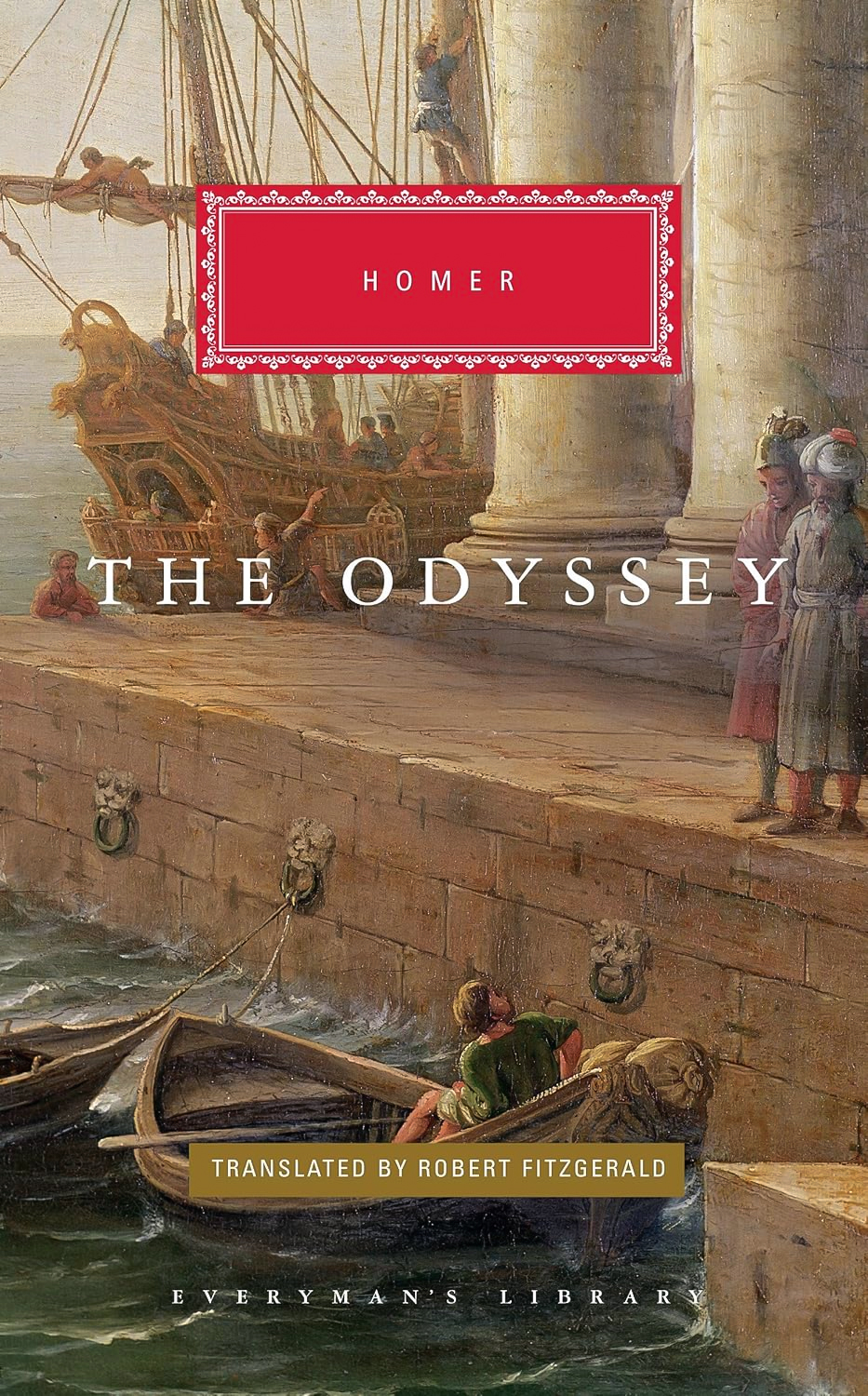
Today I finished the book The Odyssey (504 pages, ISBN: 978-0679410478). It is the second of two books, following The Iliad, that recount the events surrounding the Trojan War and the return of the Achaean leaders to their homelands. The Odyssey follows Odysseus after the fall of Troy as he attempts to return to Ithaca, his wife Penelope, his son Telemachus, and the kingship that belongs to him. The poem does not remain in the Greek camp, on the battlefield, or within the walls of Troy as The Iliad does. It passes through seas, islands, caves, foreign courts, storms, feasts, the realm of the dead, and finally the halls of Odysseus’ own house. While Odysseus is delayed, the suitors consume his property, press Penelope for marriage, and treat his absence as permission to take what is not theirs. The account is brought to a close when Odysseus returns, reveals himself, kills the suitors, and restores his household.
The work is attributed to Homer, whose life is not preserved in detail. The account follows Odysseus through trials that keep him from Ithaca after Troy has fallen. He escapes the Cyclops, receives and loses the winds of Aeolus, survives the Laestrygonians, remains for a time with Circe, goes down to the dead, passes the Sirens, suffers through Scylla and Charybdis, and loses his remaining men after the cattle of Helios are slain. These episodes are not set beside the return as ornaments or digressions. Each one delays the return, tests Odysseus, exposes the weakness of his companions, or narrows the company until Odysseus alone remains.
The poem also follows what has happened in Ithaca during his absence. Athena directs Telemachus, strengthens Odysseus, and brings events forward while still leaving Odysseus to watch, speak, conceal himself, and act when the occasion is given. When he returns, he does not immediately enter his house as king. He first comes to Eumaeus the swineherd, then is reunited with Telemachus, and later proves the loyalty of Philoetius the cowsherd. He sees the suitors in his own hall, hears their words, bears their contempt, and learns who has remained faithful and who has turned corrupt. Penelope remains within the house, delaying remarriage and testing what is brought before her. Laertes remains apart in grief until the return of his son reaches him also. The whole account is therefore not only a voyage home, but the recovery of a household that has been waiting under disorder.
Book Review
The Odyssey begins with Odysseus absent. The war is over, Troy has fallen, and many of the Achaeans who fought there have already returned or been destroyed. Odysseus alone remains delayed from the home to which he is trying to return. His absence is not empty. It has consequences. His house has been entered by men who do not belong there, his property is being consumed, his wife is being pressed, and his son is coming of age under the burden of disorder.
The opening books do not begin with Odysseus’ own voice, but with Telemachus. This is important because the condition of the house is shown before the return of the man who must set it right. Telemachus is the son of Odysseus, but he has not yet become strong enough to govern the house in his father’s absence. The suitors treat him with contempt because they do not fear him. They eat and drink within the hall, they demand Penelope, and they act as though the house of Odysseus has already become theirs.
Athena enters this situation and directs Telemachus. She does not remove the difficulty from him, but sends him out from Ithaca to seek word of his father. He travels first to Nestor and then to Menelaus. Through these visits, the poem reaches back to Troy and gathers the memory of those who returned from the war. The past is not left behind. It still bears upon what is happening in Ithaca. Agamemnon’s death is recalled as a warning. He returned from war and was murdered in his own house by Clytemnestra and Aegisthus. This account hangs over the poem because Odysseus also must return to a house in danger. The question is not only whether he will reach Ithaca, but what he will find when he does.
Odysseus himself is first shown on the island of Calypso. He is alive, but he is held away from home. Calypso offers him ease and immortality, yet he still longs for Ithaca and Penelope. He does not belong where he is. His return cannot proceed until the gods permit it, and when Hermes comes with the command that he be released, Odysseus prepares to leave. Even then, the sea does not receive him gently. Poseidon wrecks him again, and he reaches the land of the Phaeacians only after further suffering.
The Phaeacians receive Odysseus after Nausicaa finds him near the river. He is brought before Alcinous and Arete, and there he is welcomed according to the customs of hospitality. In their court, after hearing the song of Troy and being moved by it, Odysseus begins to tell his own account. This is where the poem turns back over the years of wandering and allows Odysseus himself to recount what happened after he left Troy.
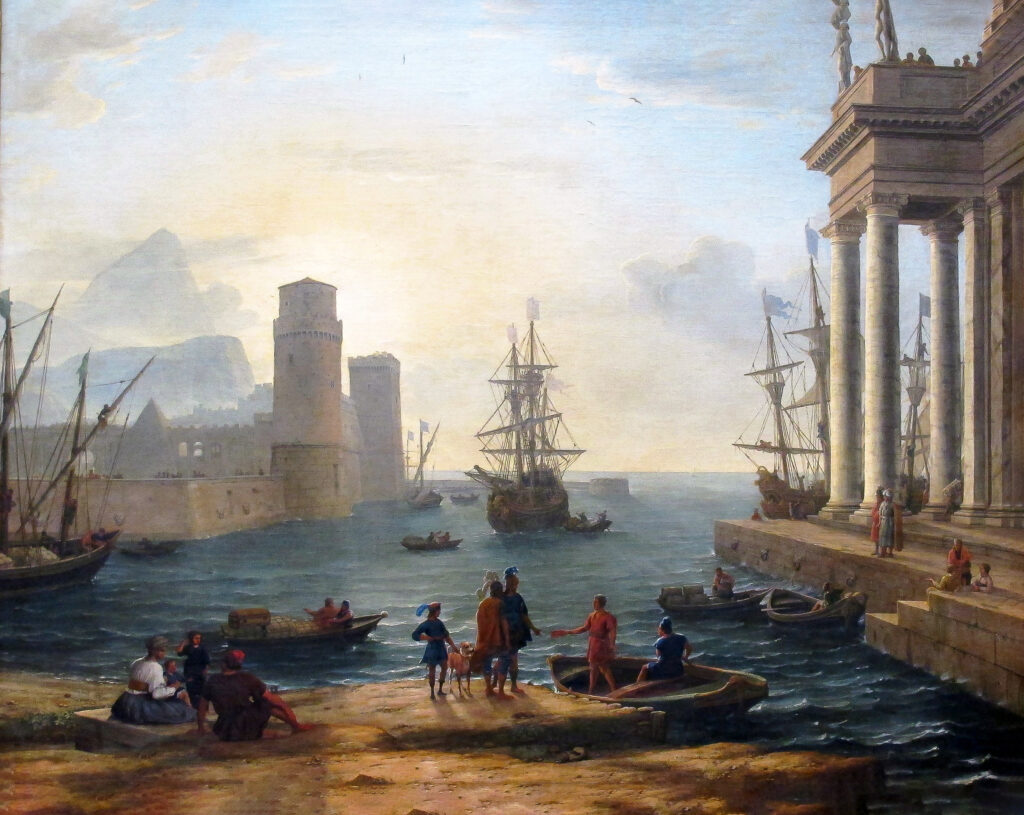
His first account is of the Cicones. There, the men take the city but fail to depart quickly. Their delay costs them. The Cicones gather strength and drive them back, and Odysseus loses men. From the beginning, the return is hindered not only by enemies but by failure to leave when leaving is required. After this comes the land of the Lotus-Eaters. The danger there is different. The men who eat the lotus no longer desire to return home. They do not become violent, but they forget the purpose of the voyage. Odysseus must drag them back to the ships. The episode is brief, but it is serious because it shows that the return can be lost through forgetfulness as much as through battle.
The encounter with Polyphemus is among the most important parts of the poem. Odysseus and his men enter the cave of the Cyclops and are trapped there when Polyphemus returns. The Cyclops violates the order of hospitality and devours the men. Odysseus survives through speech and deception. He names himself “Nobody,” waits until Polyphemus is overcome with wine, blinds him, and escapes with his men beneath the rams. Yet after he has escaped, he calls out his true name. That cry brings the curse of Poseidon upon him. The same mind that saved him becomes joined to a desire to be known, and the suffering that follows is made greater because of it.
After Polyphemus, Odysseus reaches Aeolus, who gives him the winds enclosed in a bag. For a time, the return to Ithaca appears near. The men can even see the land. But while Odysseus sleeps, his companions open the bag, thinking treasure is inside. The winds are released, and the ships are driven back. This is one of the bitter turns in the account because the failure is not caused by an enemy. It comes from suspicion and folly among his own men.
The Laestrygonians bring greater destruction. Their land becomes a place of ruin for almost the whole company. The ships are trapped and smashed, and only Odysseus’ own ship escapes because it had been kept outside the harbor. From that point forward, the company has been greatly reduced. The return continues, but the losses are mounting, and the men who remain are repeatedly shown to be unstable under fear and desire.
Odysseus next comes to the island of Circe. His men are changed into swine, and Odysseus must go to recover them. With help from Hermes, he withstands Circe’s power and compels her to restore his companions. Yet the island becomes another place of delay. They remain there for a time, and Odysseus must again be reminded that the return has not been completed. Circe then tells him that he must go to the realm of the dead and speak with Tiresias before he can proceed.
The descent to the dead is one of the weightiest parts of The Odyssey. It is not an adventure like the Cyclops, nor a temptation like the Lotus-Eaters, nor a delay like Calypso and Circe. Odysseus goes to the border of death and summons the shades. He performs the rites as instructed, and the dead come toward the blood. He must keep them back until Tiresias appears.
Elpenor comes first. He had died on Circe’s island and had not yet been buried. His appearance is a striking beginning because before Odysseus receives prophecy from Tiresias, he is confronted with an obligation he has not yet fulfilled. Elpenor asks for burial and remembrance. Death does not erase what is owed. The living must still do what is proper for the dead. Odysseus promises to return and perform the rites.
Tiresias then comes and tells Odysseus what remains ahead. He speaks of Poseidon’s anger, the danger of the cattle of Helios, the loss that will follow if the cattle are harmed, and the trouble that waits in Odysseus’ house. He also tells him that the return will not end simply when he reaches Ithaca. Odysseus must deal with the suitors and later make an offering to Poseidon in a land where men do not know the sea. The prophecy gives the rest of the poem a fixed direction. Odysseus is not wandering without meaning. The end is known, but he must still pass through what has been appointed.
Odysseus then sees his mother, Anticleia. He had not known she was dead. She tells him that she died from grief over his absence. This brings the cost of the journey into his own family. The war and the wandering have not only endangered him. They have reached into his house and into the life of his mother. When he tries to embrace her, she passes through his arms. He can speak with her, but he cannot hold her. The scene is severe because it shows the boundary between the living and the dead. Memory remains, speech remains for a time, but the life that has been lost cannot be grasped again.
After this, the women of former generations appear. Their presence connects Odysseus’ story to older houses, older unions, and earlier sorrows. The poem places his return within a larger memory of families and generations. He is not only an isolated man trying to survive. He stands within a world where names, houses, marriages, births, and deaths carry forward through time.
Agamemnon then appears, and his account returns the poem again to the danger of homecoming. He tells of his murder and warns Odysseus from the wound of his own betrayal. This matters because Odysseus is also returning from war to a wife and a house under pressure. Yet the contrast between Clytemnestra and Penelope is already present. Agamemnon’s household was destroyed by betrayal. Odysseus’ household is endangered by the suitors, but Penelope remains watchful and guarded.
Achilles also appears, and his speech changes how his earlier greatness is heard. In The Iliad, Achilles stands as the great warrior whose glory is bound to his death. Among the dead, he does not speak as though that glory has satisfied him. He says he would rather be alive as a poor servant than rule among the dead. The statement is not a small one. It places the glory of battle under the shadow of death. Achilles still cares about his son and his father, but his words among the dead are different from the force that surrounded him in the war.
Ajax appears but refuses to speak to Odysseus. The quarrel over the armor of Achilles remains unresolved. Odysseus addresses him, but Ajax withdraws in silence. Even death has not removed the grievance. This is also important because the realm of the dead does not flatten all men into the same condition. They retain memory, honor, sorrow, anger, and judgment.
Odysseus also sees those who suffer punishment, including Tantalus and Sisyphus. These scenes show that the dead are not merely shadows without distinction. Some bear continuing consequences. Some suffer in ways tied to their former deeds. The whole passage is filled with burial, prophecy, family grief, heroic memory, bitterness, punishment, and fear. At last the dead crowd around Odysseus, and he fears that Persephone may send against him the head of the Gorgon. He goes back to the ship and departs.
After returning from the dead, Odysseus goes again to Circe’s island, buries Elpenor, and receives further instruction. He then continues toward the Sirens. Their song is dangerous because it promises knowledge and draws men toward destruction. Odysseus wants to hear it, but he must be bound to the mast while his men stop their ears. He hears, but he cannot follow. The ship passes because the men obey what has been commanded.
Scylla and Charybdis follow. This is another kind of trial because loss cannot be avoided. Odysseus must choose the danger that will not destroy all. Scylla takes men from the ship, and the suffering continues. Later, the company reaches the island of Helios. Here, the warning from Tiresias becomes decisive. Odysseus commands his men not to harm the cattle, but hunger and disobedience overcome them while he sleeps. They slaughter what was forbidden. Destruction follows, and Odysseus alone survives.
After all of this, Odysseus is washed onto Calypso’s island, where the earlier delay had begun in the poem’s present order. The story he tells to the Phaeacians, therefore, completes the account of how he came to be alone and why his companions are gone. The Phaeacians then send him home to Ithaca, bringing him by ship while he sleeps.
When Odysseus reaches Ithaca, he is home, but he is not yet restored. Athena meets him and changes his appearance. He must not enter the house openly before he knows the condition of those within it. His return, therefore, begins not with public honor but with concealment. He goes first to Eumaeus, the swineherd. Eumaeus receives him as a stranger and shows himself faithful to Odysseus even though he does not yet know that Odysseus is before him. His loyalty is shown in ordinary speech, hospitality, grief, and memory.
Telemachus then returns to Ithaca, escaping the suitors’ plot against him. He comes to Eumaeus’ hut, and there Athena makes it possible for Odysseus to reveal himself to his son. The recognition between father and son changes the final part of the poem. Telemachus is no longer only the son searching for word of his father. He becomes his father’s ally in the recovery of the house.
Odysseus enters his own hall in the appearance of a beggar. This is one of the most important arrangements in the poem. He sees the suitors while they do not know him. He hears how they speak. He receives insults and blows. He watches the servants. He sees the difference between those who still honor the absent master and those who have joined themselves to corruption. The house is being judged before the judgment is carried out.
The suitors continue in arrogance. Antinous and Eurymachus stand out among them. They eat, boast, mock, threaten, and behave as men who do not fear consequence. Their offense is not only that they desire Penelope. They have lived upon another man’s house, consumed his goods, dishonored his son, and turned hospitality into theft. Their guilt is shown in public, within the very hall they have violated.
Penelope remains one of the strongest figures in the poem. She delays the suitors and does not give herself easily to what is pressed upon her. She is careful with speech and does not yield quickly to appearances. When she speaks with Odysseus in disguise, she is near him without yet knowing him. She listens, questions, and tests. Her caution belongs to the condition of the house, because she must discern truth in a place filled with deception and pressure.
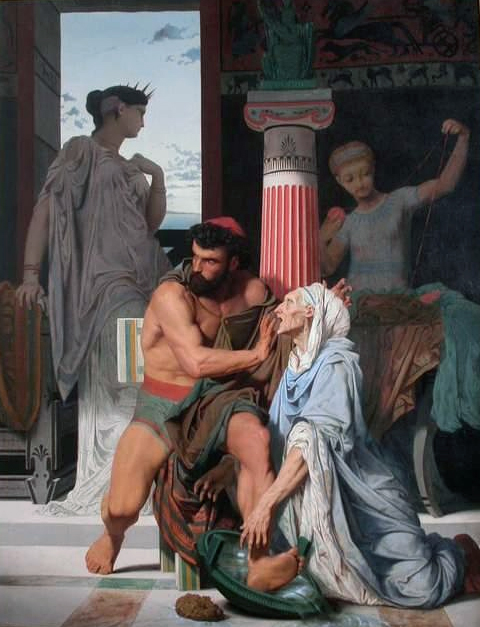
The recognition by Eurycleia comes through the scar. As she washes the stranger’s feet, she recognizes the mark from Odysseus’ youth. This moment brings the hidden identity close to exposure, but Odysseus stops her from speaking. Recognition is not yet to be made public. The time has not yet arrived.
The contest of the bow brings the account to its crisis. Penelope sets the bow before the suitors, and they fail to string it. The weapon belongs to Odysseus, and their inability to master it exposes them. When the bow reaches Odysseus, still in a beggar’s form, he strings it. The sound of the bow changes the hall. The man they mocked is no longer simply the beggar before them. He is the master of the house.
Odysseus then reveals himself and begins the killing of the suitors. This violence is not the same as the field slaughter in The Iliad. It is enclosed within the hall. It is directed against those who have corrupted the house from within. Telemachus, Eumaeus, and Philoetius stand with him. The disloyal servants are also dealt with. What had been tolerated through the years of absence is brought to its end.
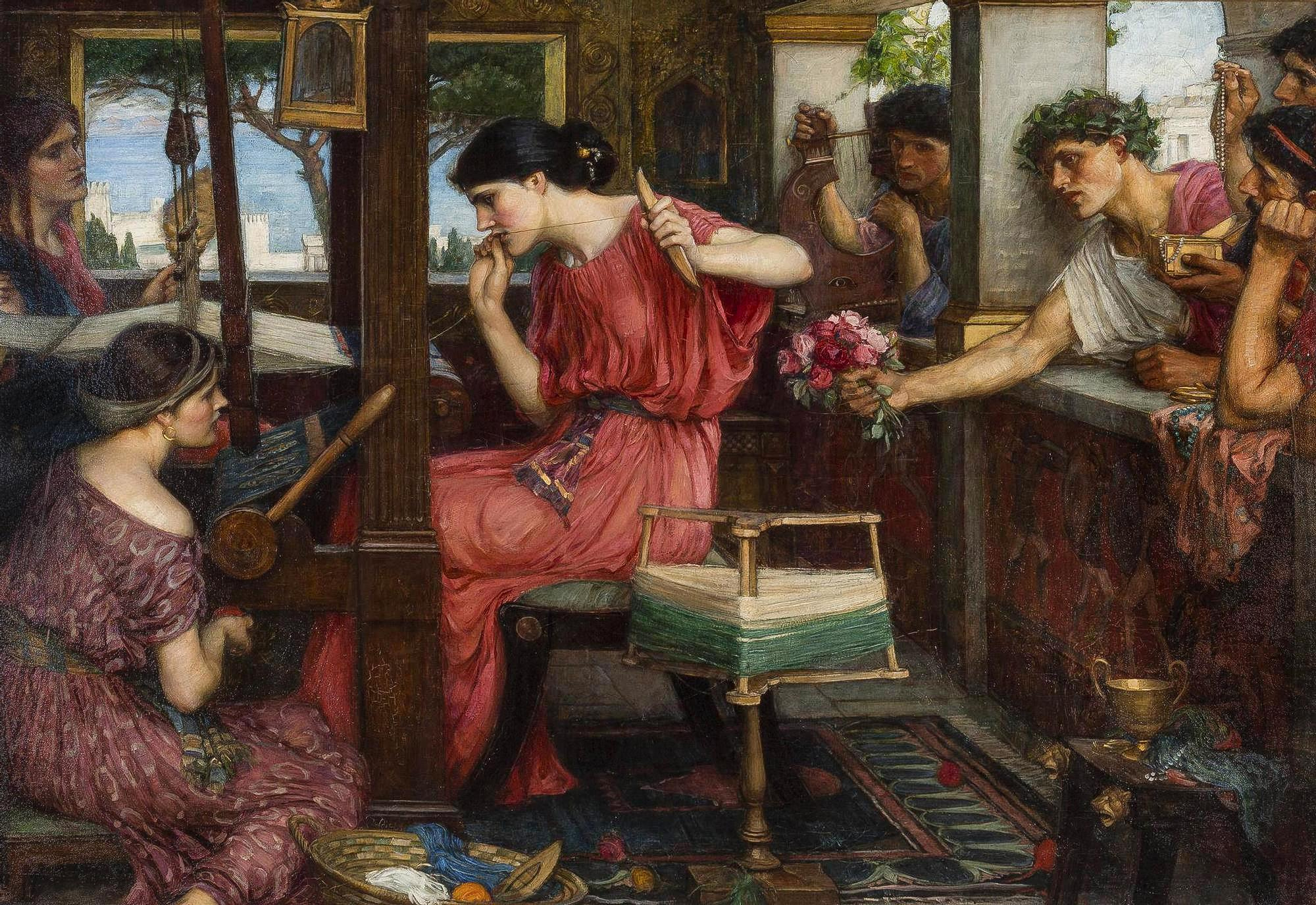
After the suitors are killed, the house must still be restored. Penelope does not immediately receive Odysseus without testing him. This is fitting because the poem has shown repeatedly that appearances may deceive. The sign of the bed confirms him. Odysseus built it around a living olive tree, and only he knows its nature. The marriage is recognized through something fixed within the house itself, something that cannot be moved and cannot be known by a stranger.
Odysseus is then reunited with Laertes. His father has been living apart in grief, aged and diminished by the absence of his son. The reunion brings the return beyond wife and son to father as well. Odysseus is restored across the generations of the house. He returns as husband, father, son, and king.
The families of the suitors then rise in response to the deaths. Their anger threatens to extend the violence beyond the house and into the wider land. Athena intervenes and brings the conflict to an end. The poem, therefore, closes not with the wandering alone finished, but with settlement imposed after judgment has been carried out.
The whole account is held together by Odysseus’ return and the restoration of his house. The sea delays him, the gods act upon his path, monsters threaten him, his companions fail, the dead speak, and Ithaca waits under corruption. The poem begins with absence and ends with recognition, judgment, and settlement. Odysseus reaches home before the poem is finished, but arrival alone is not enough. The return is complete only when the household is known, the faithful are distinguished from the corrupt, Penelope receives the true husband, Laertes receives his son, and the rule of Odysseus is restored.
Reflection
Reading The Odyssey from a scriptural and historical perspective, one is confronted by the constant interference of the so-called “gods,” figures whose authority is entirely manufactured and whose actions are arbitrary, vindictive, and corrupt. Athena manipulates and deceives, Poseidon obstructs and punishes, and all are engaged in petty quarrels that impose suffering on humans. These beings represent the projection of human idolatry rather than any true moral force. Their involvement is not guidance but corruption: a culture’s attempt to make sense of life through imagined powers that both enslave and mislead. The moral responsibility in every episode remains entirely human; the gods’ actions serve only to amplify the consequences of folly or misjudgment among men.
Odysseus’ encounters with the dead reinforce the seriousness of human choice, exposing the emptiness of these deities. The shades of Elpenor, Tiresias, Agamemnon, Achilles, and others reveal that the true weight of consequence lies in the lives and actions of men themselves. While Homer’s gods claim influence, the poem repeatedly demonstrates that virtue—fidelity, prudence, endurance, and discernment—cannot be conferred or removed by their will. Human agency, shaped by circumstances and the natural order, determines survival, justice, and restoration. Any apparent divine “aid” is a disguise for arbitrary interference; the book’s fictitious gods themselves are unreliable, chaotic, and morally deficient.
The disorder within Ithaca illustrates the stakes of human decisions without recourse to these fabricated powers. The suitors exploit the absence of proper authority, consuming goods, corrupting servants, and pressuring Penelope. Odysseus’ return is measured not by divine favor but by the careful observation, judgment, and action of a man who must reclaim his house from human evil. Loyalty is tested, corruption exposed, and order restored through discernment and effort. The gods’ interventions do not relieve men of duty; they often create further opportunities for error and suffering. Obligation rests largely upon humans who must navigate both their companions’ failings and the consequences of their own choices.
Ultimately, the epic portrays a world in which gods are a dangerous fiction, while human action carries enduring consequences. The Odyssey depicts a civilization in turmoil, shaped by error, ambition, and moral test, in which wisdom, courage, and perseverance must come from the individual. From a scriptural standpoint, the gods are false, idolatrous constructs whose interference distorts judgment and amplifies suffering. The journey of Odysseus is not a tribute to them but a tale of the persistence of human error and corruption, and of recovery; the endurance of virtue under trial; and the restoration of order in a world where fictional powers seek to mislead and corrupt.


Comments are closed.