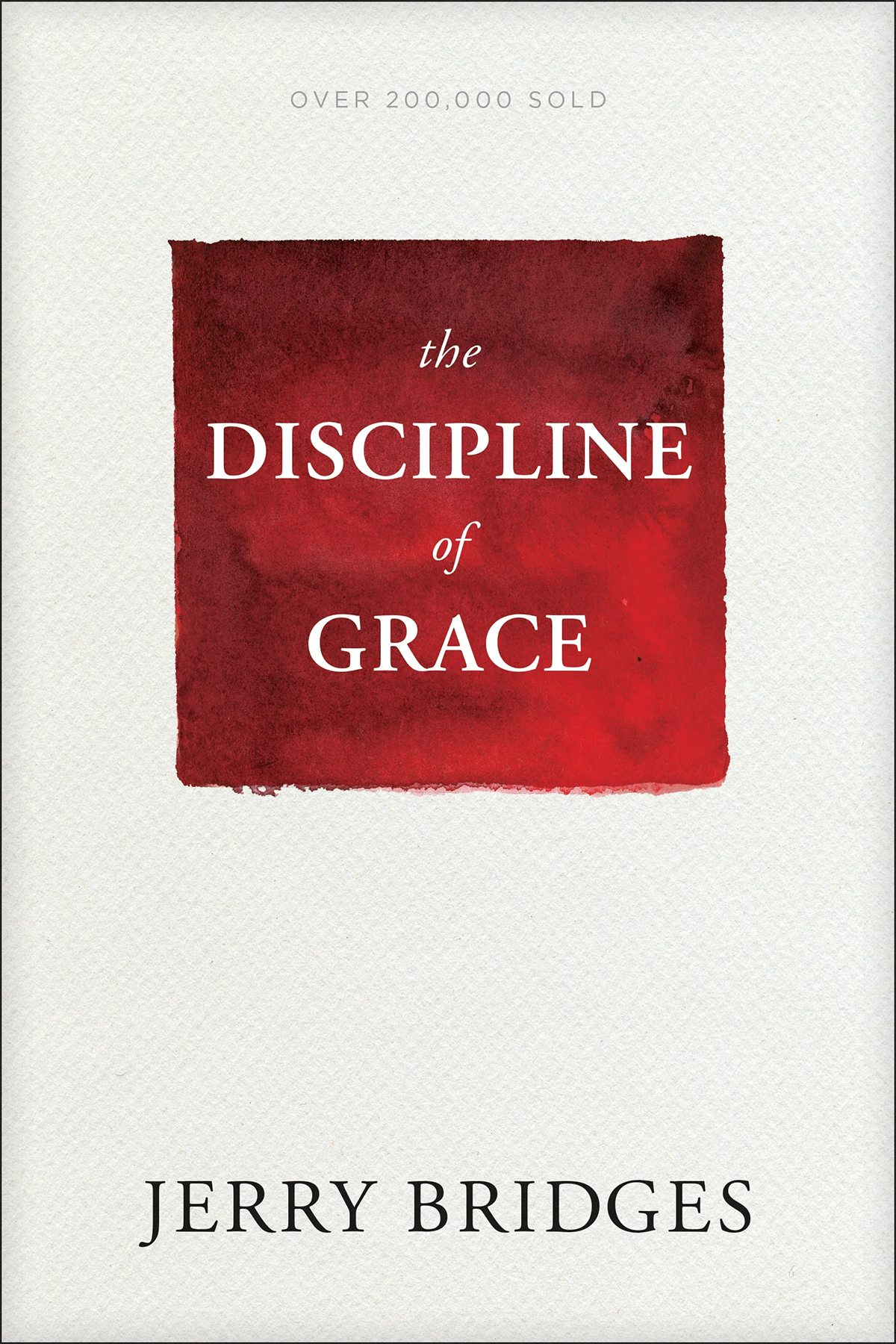
Today I completed the book The Discipline of Grace, and it was a helpful, clear grounding in what it means to live by discipline through grace. Various disciplines were covered, spanning thoughts, words, and actions, both internal and external to a person. The author covered not only the specifics but also why they exist and why they must be practiced as an exercise of grace.
Introduction
The Discipline of Grace stands as one of the most mature and refined works by Jerry Bridges, written in the later arc of his ministry with The Navigators. Whereas The Pursuit of Holiness presses the necessity and seriousness of sanctification with clarity and force, The Discipline of Grace turns inward and downward—seeking to correct the distortions that arise when holiness is pursued without a continual, governing return to the gospel.
Bridges does not retreat from holiness; he deepens its foundation. The book is not a softening of his earlier work, but a stabilization of it, guarding against both legalism and passivity. It is written not for the careless, but for the earnest believer who has already taken holiness seriously and now must learn to do so rightly—under grace, through dependence, and by means of the Spirit working through Scripture.
Book Review
What follows are not general impressions, but the principal burdens the book carries—those areas where Bridges is most intent on correcting, grounding, and directing the believer’s life.
1. Performance-Based Acceptance
Bridges identifies a deeply rooted error among serious Christians: the quiet assumption that one’s standing with God fluctuates with one’s obedience. Even where justification by faith is affirmed doctrinally, it is often denied functionally.
The believer feels:
- Nearer to God after obedience
- More distant after failure
Not merely in experience, but in perceived standing.
Bridges dismantles this by returning relentlessly to the objective ground of acceptance: the righteousness of Christ alone. This is not introductory doctrine—it is the daily ground upon which the Christian must stand.
This is the instinctive but fatal assumption that one’s moral effort can establish acceptability before God. The encounter of the rich young ruler in the Gospel of Mark 10:18 is not treated as an isolated episode, but as a mirror held up to the reader: a man sincere, disciplined, and outwardly obedient, yet fundamentally misaligned in his understanding of goodness. Bridges presses the point that God’s standard is not comparative or incremental, but absolute—rooted in His own character. Thus, even the most refined human obedience fails to meet the required threshold. The effect is not merely to humble, but to dismantle every residual confidence in personal performance as a basis for acceptance. What remains, by necessity rather than preference, is the righteousness of Christ. The chapter, therefore, does not simply critique moralism; it establishes the ground upon which the rest of the book must stand—that justification is entirely external to the believer, and that any attempt to supplement it, however subtle, is a return to the very error the gospel corrects.
2. Preach the Gospel to Oneself Daily
One of the book’s most defining contributions is the insistence that the gospel must be continually reapplied, not assumed.
This is not vague remembrance, but deliberate rehearsal:
- No condemnation in Christ
- Justification apart from works
- Reconciliation already accomplished
Without this, the believer inevitably drifts toward either despair (after sin) or self-reliance (after obedience). The gospel is not left behind; it is the operating center of the Christian life.
3. Subtlety of Legalism
Bridges’ treatment of the Pharisee is not directed outward, but inward. Legalism is not merely external rule-keeping—it is the misplacement of confidence, even in sincere effort.
The danger is especially acute for those who:
- Pursue discipline
- Desire holiness
- Structure their lives carefully
Because discipline itself can become a new ground of confidence, replacing Christ subtly rather than overtly.
This turns from the standard of righteousness to the posture of the heart before God, drawing from the parable in the Gospel of Luke 18:11–12. The Pharisee is not portrayed as outwardly corrupt, but as religiously exact, morally disciplined, and doctrinally correct—yet fundamentally deceived in the ground of his acceptance. His prayer reveals a subtle but decisive shift: he measures himself against others and quietly presents his obedience as evidence of worthiness. The tax collector, by contrast, offers nothing but a plea for mercy, grounded in the recognition of his own sinfulness. Bridges presses the reader to see that the issue is not the presence or absence of discipline, but the basis upon which one approaches God. Even sincere obedience becomes corrupt when it is allowed to function as a credential before Him. Thus, the chapter exposes how easily self-righteousness can inhabit a life that appears devout, and it reasserts that the only acceptable posture is one of continual dependence upon grace. The justified man is not the one who has achieved, but the one who has abandoned all claim to achievement and cast himself entirely upon the mercy of God.

4. Union with Christ by Death to Sin
Moving beyond justification, Bridges grounds sanctification in Romans 6: the believer has died to sin.
This is not experiential language, but positional reality:
- Sin remains present
- But its dominion has been broken
The Christian does not strive to achieve freedom, but fights from an already altered relationship to sin. This guards against both defeatism and false triumphalism.
Bridges anchors the pursuit of holiness in the believer’s union with Christ, drawing directly from Romans 6:1–2. He is careful to distinguish between sin’s continued presence and its broken authority: the believer still contends with sin, yet is no longer under its dominion. This death to sin is not an experiential claim to be measured by present feeling or success, but an objective reality established through participation in Christ’s death. Bridges presses that sanctification must proceed from this ground; otherwise, the believer either fights sin as though still enslaved, leading to discouragement, or assumes a level of victory that denies ongoing conflict. The proper stance is neither denial nor defeat, but a settled recognition that a decisive break has occurred. So, the exhortation is not to become dead to sin, but to live in accordance with what is already true—to reckon oneself as such, and to present one’s members accordingly. In this way, obedience is framed not as an attempt to secure freedom, but as the rightful expression of a life that has already been transferred out of sin’s reign into the sphere of Christ.
5. Grace as Training
This is a necessary correction:
- Against viewing grace as mere pardon
- Against viewing effort as inherently opposed to grace
The distinction is precise:
“Grace is opposed to earning, not to effort.”
Thus, discipline is not negated—it is redefined and redirected.
This chapter clarifies the active and formative nature of grace, drawing from Titus 2:11–12. Grace is not presented merely as pardon for past sin, but as a present power that instructs, trains, and governs the believer’s life. Bridges is careful to dismantle the false opposition between grace and discipline: grace does not replace effort, nor does it excuse indifference; rather, it establishes the only proper context in which disciplined obedience can occur. The believer is not left to generate holiness independently, but neither is he permitted to remain passive. Grace teaches the renunciation of ungodliness and the pursuit of self-controlled, upright, and godly living, not as a means of earning favor, but as the necessary outworking of favor already received. Thus, discipline is redefined—not as self-imposed rigor aimed at securing acceptance, but as responsive obedience shaped and sustained by grace itself. In this way, the chapter preserves both sides: the necessity of effort and the primacy of grace, held together without confusion or separation.
6. Integration of Dependence and Discipline
One of the book’s most careful balances is held here:
- The believer must pursue holiness actively
- Yet never independently of the Holy Spirit
Bridges rejects both:
- Self-reliant effort
- Passive dependence
Instead, he calls for dependent exertion—a lived tension in which the believer acts, but is consciously and continually reliant on the Spirit’s enabling.
Here, the subject matter turns to the nature of sanctification itself, grounding it in the transforming work of the Holy Spirit as described in 2 Corinthians 3:18. The change he describes is neither self-produced nor instantaneous, but progressive and Spirit-wrought, as the believer beholds the glory of the Lord and is thereby conformed to His image. Bridges is careful to locate transformation not in mere external conformity or disciplined behavior alone, but in a deeper reformation of the inner person—affections, desires, and inclinations increasingly aligned with Christ. Yet this transformation does not occur apart from means; it is mediated through sustained engagement with Scripture, where the glory of Christ is revealed and contemplated. As the believer remains under that revelation, the Spirit effects real change over time, moving “from glory to glory.” The emphasis, therefore, is neither on passive waiting nor on self-driven effort, but on intentional exposure to the truth through which the Spirit works, producing a likeness to Christ that is both gradual and genuine.
7. Spirit Through Scripture
This is one of the most weight-bearing elements of the book, and one often underemphasized in summary.
Bridges assumes and teaches that:
“The primary way the Holy Spirit transforms the believer is through Scripture.”
This carries significant implications:
- Transformation is not detached from the Word
- The Spirit does not ordinarily operate apart from it
- The degree of engagement with Scripture affects the degree of transformation
Thus, Scripture is not merely informative—it is instrumental.
Naturally, Bridges draws the pursuit of holiness into its proper center by grounding it in love for God, as set forth in Matthew 22:36–40. Obedience, in his treatment, is not sustained by discipline alone, nor by fear of failure, but by a rightly ordered affection—heart, soul, and mind directed toward God Himself. Bridges is careful to distinguish this love from sentiment or mere intention; it is expressed concretely through obedience to His commands. At the same time, he guards against reducing the Christian life to external rule-keeping by showing that such obedience must arise from a relational posture rather than a mechanical one. The greatest commandment, therefore, functions as both motive and measure: it calls the believer beyond compliance into devotion, while also defining that devotion in terms of what God has actually required. Obedience is not something we create or sustain on our own, but something that flows from a love shaped by Scripture and empowered by grace.
8. Insufficiency of Daily Reading
In one of his more practical and corrective observations, Bridges states plainly that daily reading alone is insufficient.
The issue is not frequency, but depth and continuity.
He appeals implicitly to the biblical pattern (Psalm 1; Psalm 119):
- Meditation “day and night”
- Sustained reflection
- Repeated return
This leads to a necessary conclusion:
“Scripture must be carried into the day, not left behind in the morning.”
Here establishes the necessary union between effort and reliance, drawing from Psalms 127:1—“Unless the LORD builds the house, those who build it labor in vain.” He does not diminish the need for discipline; rather, he exposes the futility of discipline pursued in self-sufficiency. The believer is called to act—to pursue holiness deliberately, to structure life toward obedience—but never as though the outcome rests in personal resolve or method. Bridges is careful to show that dependence is not merely a posture at the beginning of the day, but one that must be maintained throughout action itself. Effort is real, but it is consciously carried out under the awareness that any true progress is the result of God’s working, not human achievement. In this way, discipline is preserved without becoming autonomous, and dependence is preserved without becoming passive. The chapter, therefore, calls the believer to a sustained posture in which every act of obedience is undertaken with effort, yet never apart from reliance upon God, who alone makes that effort effective.
9. Persistent Immersion
From that biblical model, Bridges presses toward a functional pattern:
- Initial engagement with Scripture
- Meditation—lingering, turning, pressing into meaning
- Application—immediate and specific
- Reinforcement—returning to the same truth throughout the day
This is not formalized as a system, but its intent is unmistakable.
The goal is not that one has read Scripture, but that one is living under its continual influence, where the Spirit recalls and applies it in real time.
It’s therefore necessary to turn to a settled and deliberate resolve in the pursuit of holiness, drawing from Psalms 119:106—“I have sworn an oath and confirmed it, to keep Your righteous rules.” He makes clear that growth in godliness does not proceed from vague desire or intermittent effort, but from a definite commitment of the will to obey God’s commands. This commitment is not impulsive or merely emotional; it is thoughtful, grounded in Scripture, and expressed in specific areas of life. Bridges presses that without such resolve, the believer remains governed by circumstance, mood, or momentary inclination. Yet even here, he guards against self-reliance: commitment is necessary, but it is exercised in dependence on grace, not as an independent source of strength. The point is not to generate confidence in one’s own resolve, but to bring the will into alignment with what God has already revealed. In this way, commitment functions as a stabilizing force—anchoring obedience not in fluctuating desire, but in a conscious, sustained decision to follow God’s Word.
Continuum of Influence
Bridges identifies an ongoing reality in the believer’s life: the mind is never neutral, but is continually shaped by competing influences—God’s truth, the world’s patterns, and the inclinations of the flesh. The issue is not whether influence is occurring, but which influence is dominant. Because most of the day is spent under non-biblical inputs, brief exposure to Scripture is insufficient to govern thought and action. The necessary response is not mere daily reading but sustained engagement, in which Scripture is carried, revisited, and applied throughout the day. In this way, the believer increasingly comes under the governing influence of God’s Word, such that its presence outweighs and overrides all competing influences.
Within this continuum, the Holy Spirit works through the Word as His primary means of shaping the believer. His work is not detached from Scripture, but occurs as it is actively engaged, recalled, and applied. As the Word remains present throughout the day, the Spirit brings it to mind, presses it into specific situations, and enables obedience in response to it. In this way, transformation is not produced by exposure alone, but by the Spirit working through sustained engagement with the truth.
10. Discipline through Adversity
The book’s closing situates the believer’s life within the Father’s hand.
Adversity is not incidental—it is formative:
- Confirming sonship
- Shaping holiness
- Training endurance
This extends discipline beyond personal effort into providence itself. The believer is not only disciplining himself; he is being disciplined by God.
This is beneath outward obedience to the level of settled belief, as given by Romans 12:2. Bridges distinguishes between preferences, which move with circumstances, and convictions, which are formed through Scripture and remain fixed. Without convictions, the believer is left vulnerable to pressure, impulse, and the subtle influence of the surrounding culture. He emphasizes the necessity of shaping the mind with truth until it arrives at clear, governing conclusions about what is right before God. These convictions do not arise automatically; they are developed through intentional engagement with Scripture and must be held with intentional firmness. Yet they are not ends in themselves—they exist to guide conduct, ensuring that obedience is not reactive but principled. In this way, convictions become the internal framework that steadies the believer, enabling consistent obedience even when external conditions or internal inclinations would suggest otherwise.
Analysis: Use of the OICA Model
The framework is an inductive analysis method using canonical correlation, often referred to as OICA (Observation, Interpretation, Correlation, and Application). It’s an expanded form of a classic inductive study method, widely taught within discipleship traditions such as The Navigators. At its core, the inductive method follows a simple approach: what does the text say (Observation), what does it mean (Interpretation), and what does it require (Application). The addition of Correlation makes explicit a principle already assumed in sound interpretation: that Scripture must be read in light of Scripture, allowing the whole canon to inform the meaning of any given passage as it was intended. In this way, OICA functions not as a foreign method of understanding, but as a more explicit and guarded form of inductive reason, ensuring that interpretation remains anchored in authorial intent and canonical coherence.
Bridges’ use of Scripture throughout The Discipline of Grace consistently follows this OICA pattern. He begins with the text itself, draws out its meaning, relates it to the broader witness of Scripture, and then presses it into the life of the believer. His argument is not constructed from isolated verses or impressions, but from a disciplined handling of the text that moves in a deliberate sequence.
Observation — Careful Attention to the Text
- Mark 10:18; Luke 18:11–12; Romans 6 & 8; Titus 2:11–12
- What the scripture says, what the language implies; what is revealed about God and man
Interpretation — Determining Authorial Meaning
- Romans 8:1 → no condemnation
- Romans 6:1–2 → death to sin as a change in dominion
- Titus 2:11–12 → grace as active teacher
Correlation — Scripture Interpreting Scripture
- Justification (Romans 8) with sanctification (Romans 6)
- Grace (Titus 2) with discipline
- Doctrinal coherence across passages
Application — Directed Response
- Preach the gospel to yourself daily
- Depend on the Spirit
- Form convictions; practice watchfulness; receive adversity as discipline
The result is a method that gives both clarity and stability to his theology. Meaning is not derived from a single passage, and application is not imposed externally. Each conclusion arises from the text as it is read in light of the whole of Scripture, and each exhortation flows from that established meaning into the believer’s daily life.
Conclusion
This book gathers the believer’s life into a single, governing reality: grace is not only the ground of acceptance, but the ongoing power that stabilizes and propels obedience. The believer is not left to move from justification into a separate mode of self-directed effort. Instead, the same grace that justifies continues to train, direct, and sustain. This requires a continual return to the gospel, a refusal to measure standing before God by performance, and a deliberate dependence upon the Spirit in every act of obedience.
At the same time, grace does not diminish responsibility. Bridges presses for real discipline as a commitment of the will, formation of convictions, watchfulness in conduct, and perseverance under adversity. These are not techniques for self-improvement, but the proper response to grace already given. The believer acts, chooses, and endures in dependence on God, with the understanding that He is at work and that obedience flows from what He has already accomplished.
The result is a life stabilized by a settled understanding of grace. Discipline remains, now carried out from that foundation—steady in direction, consistent in practice, and sustained by the same grace that first established the believer before God.